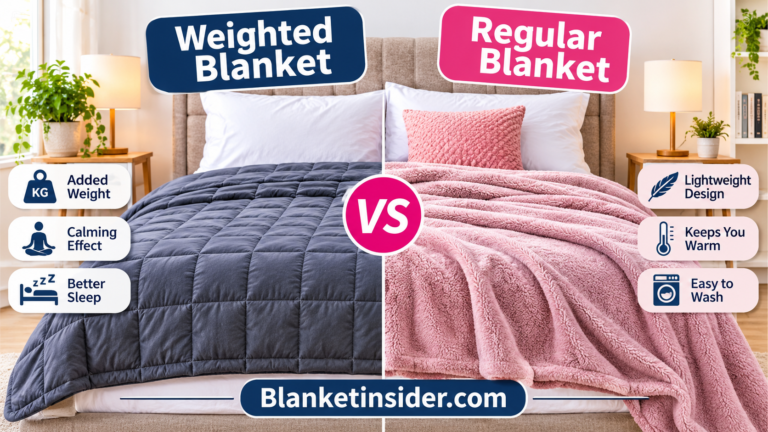
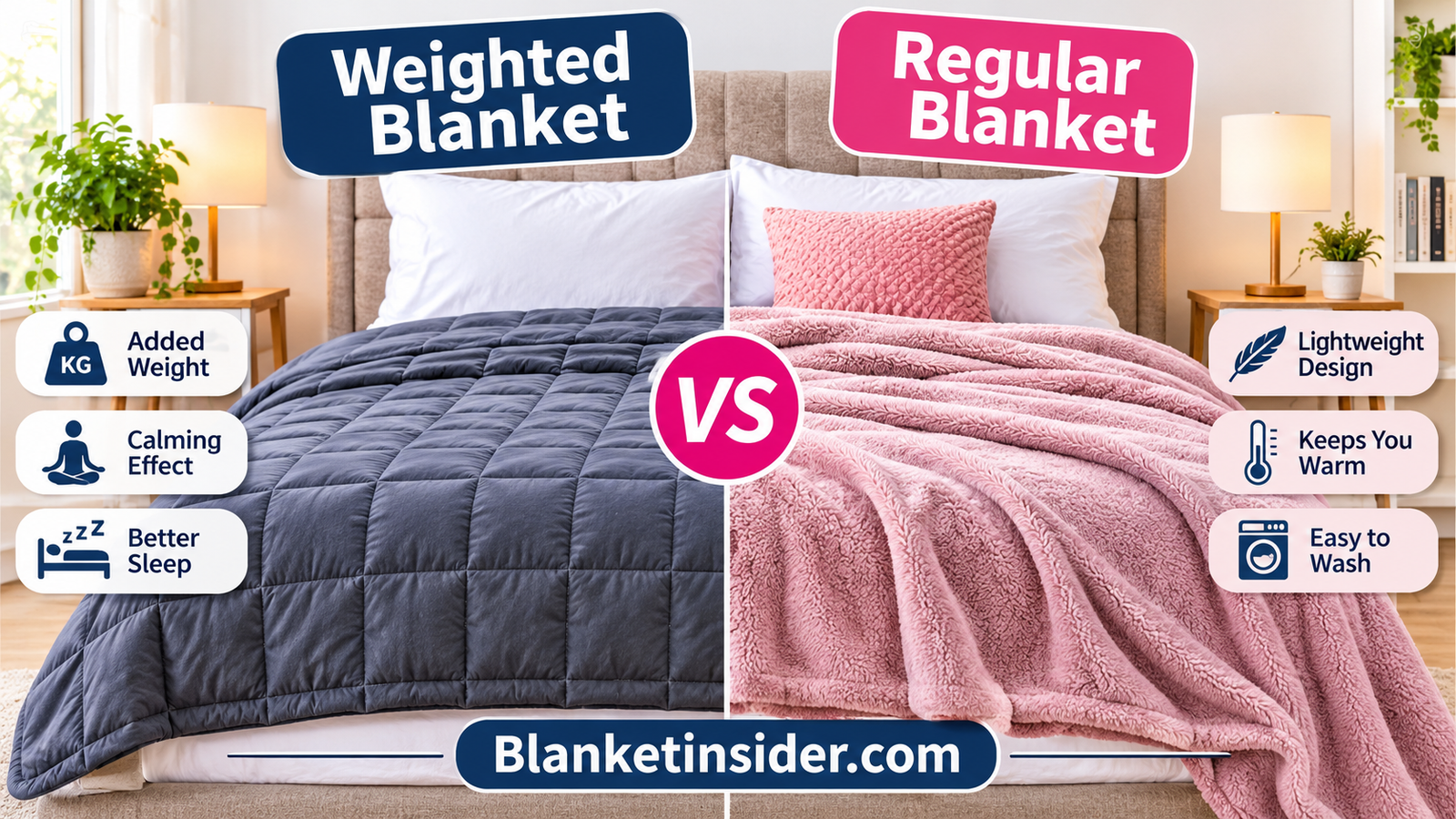
Weighted Blanket vs. Regular Blanket: What’s the Real Difference?
One adds gentle, even pressure across your body. The other keeps you warm and nothing more. Here’s how to tell whether the upgrade is actually worth it for how you sleep.
Here’s the short answer: a weighted blanket adds gentle, even pressure across your body, while a regular blanket provides warmth without any extra weight. If what you want is to feel held, grounded, and settled at bedtime, a weighted blanket does something a normal blanket simply cannot. If what you want is warmth, softness, and easy everyday bedding, a regular blanket already does the job — and does it with far less effort.
It’s a question that comes up more than you’d think. Weighted blankets moved from a niche, therapeutic-sounding product into mainstream bedding, and suddenly everyone’s wondering whether the fleece throw they’ve owned for years is leaving something on the table. The honest answer is: sometimes yes, sometimes absolutely not.
The difference between the two isn’t really about quality or price. It’s about mechanism. A regular blanket insulates. A weighted blanket presses. Those are different sensations doing different jobs, and they suit different people, different bodies, and different kinds of restless nights. This guide breaks down how each one is made, how they feel, how warm they get, who should and shouldn’t use a heavy blanket, what they cost to own, and how to decide between them — including the option of simply using both.
The one-sentence version
Choose a weighted blanket if your nights are restless, your mind is busy, and the feeling of firm pressure helps you settle.
Stick with a regular blanket if your bedding is fine and what you actually want is warmth, softness, and something easy to wash.
Quick Comparison: Weighted Blanket vs. Regular Blanket
| Feature | Weighted Blanket | Regular Blanket | What It Means For You |
|---|---|---|---|
| Weight | Deliberately heavy, usually several times a standard blanket of the same size. | Light to medium; the heaviest styles are still easy to lift and fold. | Weight is the entire point of one of these. |
| Feel | Firm, hug-like pressure that conforms closely to the body. | Light, flexible, floaty drape that moves freely as you do. | Pressure versus freedom of movement. |
| Warmth | Naturally warm from density and fill, but not adjustable and can feel too warm. | Ranges from very light to very warm depending on fabric and fill. | Warmth is easier to tune with a regular blanket. |
| Breathability | Varies widely by fill and cover; dense styles trap heat. | Wide range — open weaves and natural fibers breathe best. | Hot sleepers have more choice with regular bedding. |
| Sleep use | Aimed at restlessness, tension, and winding down. | Everyday warmth, layering, and year-round use. | Different jobs, not different tiers. |
| Care | Heavy to launder; covers and large machines help a lot. | Usually easy to machine wash and dry at home. | Regular blankets win on convenience. |
| Lifespan | Long-lasting; wear usually appears in stitching and fill clumping. | Long-lasting; wear appears as fabric pilling or thinning. | Both are durable when cared for gently. |
| Price range | Generally a step above comparable regular blankets. | Spans everything from inexpensive to premium. | Pay for pressure only if you’ll use it. |
Section 01Weighted Blanket vs. Regular Blanket: The Quick Answer
If you want the decision in plain terms, it comes down to one question: are you looking for warmth, or are you looking for the feeling of being held down? That sounds abstract until you’ve tried both. A regular blanket can be the softest, warmest thing in the world and still leave you feeling unsettled at bedtime. A weighted blanket can feel like exactly what you needed — or it can feel heavy and restrictive within ten minutes.
Who should choose a weighted blanket
A weighted blanket is worth the upgrade when restlessness is the problem. If you toss and turn, if your legs won’t settle, if you spend the first twenty minutes of bed rearranging yourself and your covers, or if you already sleep under two or three blankets because one never feels like enough, then the added pressure is likely to do something useful for you.
It also tends to suit people who find comfort in firm contact — the kind of person who likes a firm hug, sleeps best under a heavy quilt, or instinctively pulls the covers tight around themselves. For those people, a weighted blanket isn’t a luxury item; it’s simply the bedding that matches how they naturally want to sleep.
The trade-offs are the ones you’d expect from something heavy: it takes more effort to make the bed, it’s harder to wash, and it can run warm. If you’re not sure where to start on weight and size, our weighted blanket calculator gives you a sensible range in about a minute.
Who should stick with a regular blanket
Most people, honestly. If your sleep problem isn’t restlessness — if it’s temperature, light, noise, a bad mattress, or a schedule that doesn’t suit you — then a weighted blanket is an expensive way to solve the wrong problem. Regular blankets come in an enormous range of weights, fabrics, and warmth levels, which means it’s usually possible to get exactly what you need without the added mass.
They’re also the better everyday choice for people who move around a lot at night, make the bed frequently, share bedding with a partner who has different preferences, or want one blanket they can wash, dry, and put straight back on the bed. If you want to explore what’s out there, the best blanket materials guide is a good place to see how much variety actually exists.
Can you use both?
Absolutely, and it’s a popular setup. Many people use a weighted blanket as a top layer for the first part of the night or while reading, and a regular blanket or comforter underneath for warmth and easy washing. Layering also solves the heat problem: a breathable regular blanket beneath a weighted blanket keeps things from getting stuffy.
The main thing to watch is total thickness and how the two layers behave when you turn over. We’ll cover layering properly in the final section of this guide.
Decision table by need and sleep style
| Your Need | Better Pick | Why |
|---|---|---|
| Restless sleep, busy mind, trouble settling | Weighted blanket | Pressure is the sensation that helps the body settle. |
| Just want warmth and softness | Regular blanket | Lighter, easier to care for, and easier to tune for warmth. |
| Hot sleeper or warm climate | Regular blanket (breathable) | More airflow, less trapped heat, more fabric choice. |
| Move around a lot at night | Regular blanket | Weight can feel restrictive when you change positions often. |
| Side sleeper who likes to feel tucked in | Either | Both work well; choose by whether you want pressure. |
| Shared bed with a partner | Regular blanket, or weighted sized for two | Weight preferences differ; sizing matters more than usual. |
| Easy laundry day | Regular blanket | Lighter, faster to wash and dry at home. |
| Restless and cold | Both, layered | Regular blanket for warmth, weighted blanket for pressure. |
Feeling restless at bedtime?
A weighted blanket adds the pressure a regular blanket can’t.
Browse Weighted Blankets on AmazonSection 02What Is a Weighted Blanket?
A weighted blanket is a blanket engineered to be heavier than normal — typically several times the weight of a standard blanket in the same size. That mass is spread evenly across the surface so it settles over you like a firm, even layer rather than piling up in one place. There’s nothing electronic about it. It works through gravity and construction alone.
How weighted blankets work (deep pressure)
The sensation is usually described as “deep pressure” — the same kind of firm, distributed contact you get from a tight hug, being tucked in snugly, or wearing a weighted vest. For many people, that contact feels grounding. Shoulders drop. Fidgeting slows. The body gets the message that it’s time to stop bracing and start resting.
That’s the entire theory in one line: steady, even pressure feels calming to a lot of people. Whether it does for you is a personal question, and the only real test is to try one. What you can be confident about is the mechanism — weight distributed across the body is a genuinely different sensation from a light, floating cover.
For the full breakdown of how they’re designed and what to expect, see our weighted blanket guide, or the plain-English version in what does a weighted blanket do.
Fillings and how weight is distributed
What’s inside determines how the blanket feels, how thick it is, and how quietly it moves:
- Glass beads. Small, dense, and quiet. They let the blanket stay slim rather than bulky, and they move with you instead of pooling in one corner.
- Plastic poly pellets. Larger and lighter, which means more bulk for the same weight. They can also make a faint rustling sound when you move.
- Steel shot beads. Very dense and low-profile, sometimes blended with other fills.
- Knitted or fabric constructions. No loose fill at all — the weight comes from dense, chunky yarn. These breathe noticeably better and are a favorite among people who run warm.
Distribution is what separates a good blanket from a frustrating one. Fill is held in place by a grid of small stitched compartments, so it can’t migrate to the corners overnight. If you want to see how the popular knit construction compares to a beaded blanket in daily use, our Bearaby Tree Napper review and Bearaby weighted blanket review cover it honestly.
Covers, layers, and construction
Most weighted blankets are built in layers: an inner weighted core and an outer shell, often with a removable duvet-style cover that ties or buttons on. That cover is more useful than it sounds — it keeps the heavy inner blanket clean, makes laundry manageable, and lets you change the feel from plush to smooth without buying a new blanket.
Stitching quality matters more here than in ordinary bedding. Seams carry real stress every time you drag a heavy blanket off the bed, so reinforced box quilting and durable edge binding pay off over time. It’s also worth knowing how weighted blankets compare to the comforter you already own — see weighted blanket vs. comforter and down vs. weighted blanket.
Common sizes and weights
Weighted blankets come in three broad formats: personal sizes designed to drape over one person, bed sizes matched to twin through king mattresses, and throw sizes for the couch. Weights span a wide range, with lighter options suited to smaller adults and children’s supervised use, mid-range options being the most common for average adults, and heavier options for larger adults who want a firmer sensation.
One thing that surprises people: a weighted blanket is sized for the person, not just the mattress. Too wide and it hangs over the edge and slides off. Too narrow and it doesn’t cover you properly. For a comparison against a branded option people often ask about, see weighted blanket vs. gravity blanket.
Where weighted blankets shine
- Firm, even pressure that many people find calming
- Stays put overnight and drapes close to the body
- No cords, settings, or setup of any kind
- Durable construction built for daily weight
- Removable covers make care easier
Where they fall short
- Heavier to make the bed and harder to wash
- Can feel too warm in hot weather
- Weight must suit the person using it
- Can feel restrictive for active sleepers
- Usually costs more than a comparable regular blanket
Want pressure without the guesswork?
Start with a weight range that suits your body and bed.
Check Price on AmazonSection 03What Counts as a Regular Blanket?
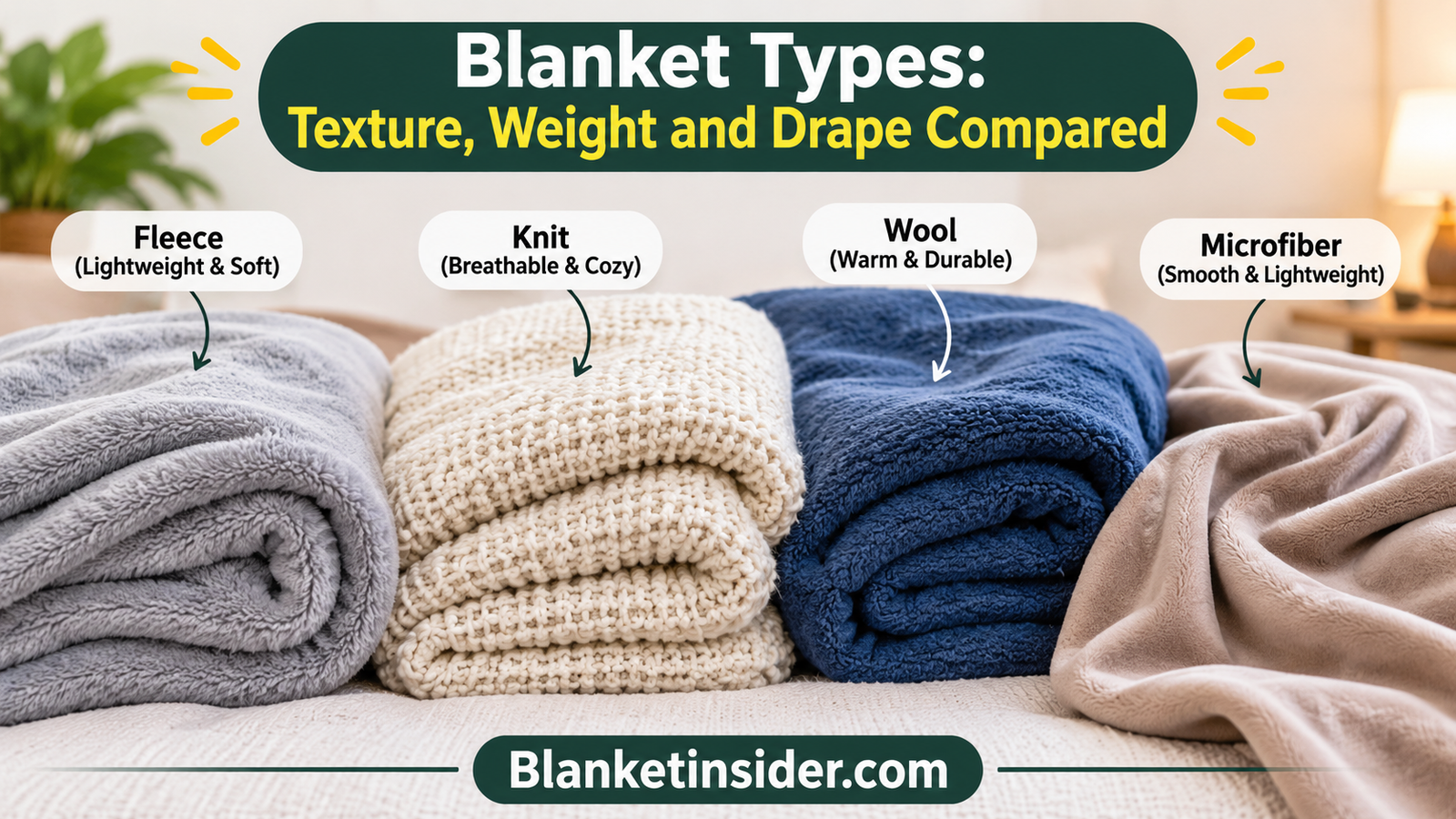
“Regular blanket” is a broad category, and that’s precisely the point. It covers everything from a thin cotton layer to a thick wool throw to a lofty comforter — all unified by one thing: they keep you warm through insulation and softness, and they don’t add intentional weight.
Fleece, cotton, wool, and microfiber blankets
These are the everyday workhorses, and each fabric has a distinct personality. Fleece and microfleece are soft, light, and warm for their weight, which is why they dominate throw blankets and children’s bedding. Cotton is breathable, easy to wash, and comfortable across seasons. Wool is a superb insulator that handles moisture well but needs gentler care. Microfiber is smooth, durable, and often the most affordable.
If you’re choosing between them, texture and warmth are the two variables that matter. See fleece vs. cotton blanket, fleece vs. flannel blanket, and wool vs. fleece blanket. For a deep dive on the plush side, what is a sherpa blanket and fleece vs. sherpa blanket cover the textures people ask about most.
Quilts, throws, and bed blankets
These are defined more by construction and size than by fabric. A quilt is thin, stitched in layers, and often decorative as well as functional. A throw is small enough for one person on a couch or at the foot of a bed. A bed blanket is sized to cover the mattress and drape down the sides.
Size conventions confuse people more than any other part of bedding. Throw vs. full blanket and perfect throw blanket size clear up the everyday questions, while quilt vs. blanket and quilt vs. comforter sort out the construction differences. And if you’ve ever wondered about specific styles, what is an afghan blanket and mink blanket guide explain two classic categories.
Comforters and duvets (and how they differ)
Comforters and duvets are the lofted, filled end of regular bedding. A comforter is a single finished piece — fill stitched inside a decorative shell. A duvet is a plain, filled insert that goes inside a removable cover, which you wash far more often than the insert itself. Quilts sit thinner and flatter than both.
This distinction matters when you’re comparing anything to a weighted blanket, because a lofty comforter and a dense weighted blanket feel radically different even at the same total warmth. The clearest way through it is comforter vs. duvet vs. blanket, supported by duvet vs. blanket, duvet vs. comforter, and coverlet vs. bedspread vs. comforter.
Blanket weight and warmth basics
Warmth in ordinary bedding comes from trapped air — the loft of the fill, the density of the weave, and the number of layers. A thin cotton blanket and a thick wool throw can both keep you warm, but through different amounts of insulation. That’s why “heavier” doesn’t automatically mean “warmer” in regular bedding, and why a fleece throw can outperform a much heavier woven blanket on a cold night.
Once you understand that insulation is the variable, choosing gets much easier. If you want the fastest education in the category, start with best fleece blankets for softness and light warmth, and our best waffle weave blankets picks for breathable, all-season options.
Where regular blankets shine
- Huge range of weights, fabrics, and warmth levels
- Easy to wash, dry, and swap seasonally
- Light and easy to move around at night
- Simple to layer for adjustable warmth
- Available at every price point
Where they fall short
- No pressure or grounding sensation
- Light covers can slide off during the night
- Warmth often requires multiple layers
- Pilling and thinning over time in some fabrics
- Doesn’t address restlessness on its own
Looking for easy, everyday bedding?
Shop regular blankets by fabric, warmth level, and size.
Check Price on AmazonSection 04Feel and Comfort
This is the section that actually decides it for most people. Specs get you to the store; the feeling gets you to keep the blanket. And weighted and regular blankets feel fundamentally different in the hand and in the bed.
The pressure of a weighted blanket
Describe it to someone who’s never tried one and the word that always comes up is “hug.” The blanket settles across your torso and legs and holds you in place with firm, even contact. There’s no floaty, drifting quality — the fabric follows every contour and stays there. People who like it describe their shoulders relaxing almost immediately and their legs going still.
The sensation is strongest where the blanket is densest, usually across the chest and hips. Some sleepers like it pulled up high; others prefer the weight concentrated lower down. Either way, the experience is one of being gently pinned in a way that feels comforting rather than confining.
The light, flexible feel of a regular blanket
A regular blanket does almost the opposite. It drapes loosely, moves when you move, and barely announces itself. That lightness is exactly what a lot of people want — the freedom to shift, stretch, and rearrange without wrestling anything heavy.
Comfort here comes from texture and temperature rather than pressure. A brushed fleece, a crisp cotton weave, a lofty down fill — each feels distinct, and there’s far more variety in the ordinary blanket world than in the weighted one. If texture is your main interest, what is minky fabric and minky vs. fleece blanket are worth a read.
Moving, turning, and getting in and out of bed
This is where the differences get practical. A weighted blanket takes a little more effort to pull back when you get up, and it settles more slowly when you lie back down. Turning over means moving the weight with you, which for some people feels like a feature and for others feels like work.
A regular blanket is effortless by comparison — flick it back, pull it up, done. For anyone who gets up frequently during the night, shares a bed with a light sleeper, or makes the bed every morning, that convenience is genuinely valuable and shouldn’t be underestimated.
Comfort for side, back, and stomach sleepers
- Side sleepers do well with both. Weighted blankets drape naturally over the hip and shoulder curve; regular blankets layer easily and stay flexible.
- Back sleepers often get the most out of weighted blankets, since pressure distributes evenly across the chest and legs when lying flat.
- Stomach sleepers are the group most likely to find a heavy blanket uncomfortable. A lighter weight, a throw covering only the lower body, or simply a regular blanket usually works better.
And if your question is really “how does a weighted blanket compare to the comforter I already have,” weighted blanket vs. comforter and down vs. weighted blanket answer it directly.
Choose the sensation you actually want
Firm pressure or light, flexible drape — that’s the real fork in the road.
Check Price on AmazonSection 05Warmth and Temperature
Here’s something that surprises people: weighted blankets aren’t designed to be warmer than regular ones — but they often feel that way. Density traps heat, and there’s no way to vent it once you’re underneath.
Do weighted blankets sleep hotter?
They can, yes. A dense blanket with a plush cover holds a lot of body heat close to the skin. People who sleep hot often notice it within a few nights, particularly in warmer months or in a bedroom without good airflow.
That doesn’t rule weighted blankets out for warm sleepers — it just means the choice of construction matters more. Open-knit styles without loose fill breathe far better than beaded blankets with plush covers, and lightweight versions exist precisely for this reason. If heat is your worry, start with the cooling blanket guide and see how cooling blankets compare to regular ones.
Warmth levels of common regular blankets
Regular blankets span the entire warmth spectrum, which is their biggest practical advantage. A single cotton layer is barely there in summer. A flannel or fleece adds solid autumn warmth. A wool throw or a lofty comforter handles deep winter. You can dial the warmth up and down by layering, swapping fabrics, or simply owning two weights of the same blanket.
For cold-weather specifics, see best blanket for winter and best thermal blankets. If you’re building a year-round rotation, the seasonal blanket selector takes the guesswork out.
Hot sleepers vs. cold sleepers
Cold sleepers tend to love weighted blankets regardless of construction, because the density that traps heat is exactly what they want. Hot sleepers tend to prefer regular bedding with breathable weaves and moisture-friendly fibers.
If overheating is a persistent problem, you may be shopping in the wrong category altogether. best blankets for night sweats covers this properly, and fabric choice makes a real difference — bamboo vs. cotton blanket and best bamboo blankets are the two places most people land.
Season-by-season use
- Winter. Weighted blankets work beautifully here, especially layered over a regular blanket or comforter.
- Spring and autumn. The sweet spot for weighted blankets in moderate temperatures; regular blankets in mid-weights.
- Summer. Most weighted blankets go into storage unless they’re knit or lightweight; a single breathable layer is usually plenty.
Storage matters across seasons — heavy blankets need somewhere clean and dry to live. See best blanket storage bags and best blanket chests and storage trunks.
Warmth and breathability comparison table
| Scenario | Weighted Blanket | Regular Blanket | Better Fit |
|---|---|---|---|
| Cold bedroom in winter | Warm and insulating | Warm if layered or lofty | Either — layering wins |
| Hot sleeper, warm climate | Can overheat unless knit or light | Breathable fabrics available | Regular blanket |
| Air-conditioned room | Comfortable and cozy | Light layer usually enough | Weighted (lightweight) |
| Night sweats | Risky unless specifically breathable | Moisture-friendly options exist | Regular, breathable |
| Mild room, restless sleep | Ideal conditions | Fine, but no pressure benefit | Weighted blanket |
| Warm sleep, need adjustable warmth | Fixed insulation only | Easy to add or remove layers | Regular blanket |
Running warm at night?
Breathable fabrics and lighter layers make the biggest difference.
Check Price on AmazonSection 06Sleep, Stress, and Relaxation
Weighted blankets are marketed as a sleep and calm aid, and plenty of people swear by them. It’s worth being clear-eyed about what they do, what the research can and can’t tell you, and when a perfectly ordinary blanket is all you actually need.
How people use weighted blankets to feel calmer
The most consistent thing people report isn’t falling asleep faster — it’s feeling settled. Less restlessness in the legs and shoulders. Less tossing. A sense that the body has stopped scanning for something and can finally relax. That’s a meaningful change for anyone whose nights feel wired rather than tired.
People use them in different ways: all night, for the first hour while reading, or on the couch in the evening as part of a wind-down routine. If comfort and calm at bedtime is what you’re after, do weighted blankets help with anxiety, best blankets for anxiety, and do weighted blankets help with ADHD cover the questions people ask most.
What research does and doesn’t show (keep claims general)
Be cautious with bold claims here. Weighted blankets have been examined in small studies and surveys, and results have been mixed — some report improvements in self-reported calm and sleep quality, others find little measurable difference. The fair summary is that many people find them comforting, the mechanism is plausible, and the evidence base is still developing.
What’s clear is that comfort and relaxation at bedtime are worthwhile on their own terms. What’s not clear is that a weighted blanket treats any medical condition. If you want the balanced picture, weighted blanket side effects, can you sleep with a weighted blanket every night, and our general weighted blanket review are honest starting points.
When a regular blanket is enough
Plenty of the time. If you sleep reasonably well and you’re simply curious, a weighted blanket is a nice-to-have rather than a need-to-have. If the thing keeping you awake is a bright room, a noisy street, a lumpy mattress, or a schedule that fights your body clock, no blanket fixes that.
And there’s a whole world of comfort-focused bedding that helps at the margins without any added weight. Weighted-style comfort options exist for specific needs too — best fidget blanket for dementia shows how comfort bedding is adapted for particular situations.
Sleep habits that matter more than the blanket
- A consistent sleep and wake time, including weekends
- A cool, dark, quiet bedroom
- Reducing bright screens in the last stretch before bed
- A wind-down routine your body recognizes
- A mattress and pillow that genuinely suit you
Get those right first and the blanket becomes the finishing touch rather than the load-bearing wall. If you’re curious about other comfort trends in this space, grounding sheet review and do grounding sheets work examine one popular claim directly.
Building a calmer bedtime?
Start with the sensation that helps you settle down fastest.
Check Price on AmazonSection 07Safety and Who Shouldn’t Use a Weighted Blanket
Regular blankets carry essentially no safety considerations beyond ordinary bedding hygiene. Weighted blankets come with a short, sensible list of guidelines — mostly around choosing the right weight and making sure the user can move freely beneath it.
Choosing a safe weight for your body
The guiding principle is straightforward: the blanket should feel firm and comforting, never restricting. Sizing advice usually starts as a percentage of body weight, with lighter options for smaller people and heavier options for larger adults. That’s a starting point rather than a rule — comfort, mobility, and sleeping position matter just as much as the number.
A useful mental test: you should be able to push the blanket off and get out from under it without struggling. If you can’t, it’s too heavy. Our weighted blanket calculator gives a sensible range quickly, and are weighted blankets safe covers the details.
Kids, toddlers, and older adults
Weighted blankets are not intended for babies or very small children. Infant bedding has entirely separate rules, and adding weight to a small child’s sleep space isn’t the place to experiment. If you’re navigating safe sleep for a little one, start with when can baby sleep with a blanket, best baby blankets, and swaddle vs. sleep sack.
For older children, weight selection and supervision matter — see weighted blanket for kids. For older adults, the key considerations are mobility and the ability to remove the blanket independently. For infants specifically, best swaddle blankets and are receiving blankets and swaddles the same thing clarify a confusing area.
Medical and mobility concerns
A few groups should think twice before adding weight over their body at night. Anyone with circulatory or respiratory issues, limited mobility, difficulty moving under covers, certain neurological conditions, or recovery from surgery should approach with care. Pregnancy is another situation where individual guidance is genuinely useful.
The logic is simple: a weighted blanket adds resistance to movement and holds heat and pressure close to the body. For most healthy adults that’s fine. For people whose bodies already face constraints in those areas, it’s worth pausing first.
Why to ask a doctor if you’re unsure
This is one of those cases where a brief professional opinion is worth more than any article. A short conversation with a doctor or physiotherapist can tell you whether added pressure at night is sensible for your situation, and what weight range makes sense. It’s a low-cost step that removes a lot of second-guessing.
Safety comparison table
| Safety Topic | Weighted Blanket | Regular Blanket |
|---|---|---|
| Main consideration | Choosing a weight that allows free movement | Standard bedding hygiene and warmth level |
| Babies and toddlers | Not intended for very small children | Follow safe-sleep guidance for infants |
| Older adults | Ensure the blanket can be removed unaided | Generally straightforward |
| Mobility limitations | May be unsuitable; seek advice first | Usually fine |
| Temperature risk | Holds heat; monitor for overheating | Easy to adjust by layering |
| Medical conditions | Ask a clinician about pressure and circulation | Ask only if specific fabric sensitivities exist |
Choosing a weight that suits you
Lighter options for smaller bodies, firmer weight for larger adults.
Check Price on AmazonSection 08Size, Weight, and Fit
Fit is where weighted blankets behave differently from everything else in the bedding world, and it’s the source of most disappointment. A regular blanket can be slightly too big or too small and still work. A weighted blanket needs to be right.
Weighted blanket sizing (body size vs. bed size)
Two variables are in play: who’s sleeping under it and what mattress it goes on. A blanket sized for the person but too narrow for the bed will leave one side uncovered. A blanket sized for the bed but too wide for one person will hang over the edge and slowly slide off overnight.
The practical solution is to size for the sleeper first, then check it against the mattress width. For shared beds, that usually means a blanket sized for two rather than two smaller ones. For bed dimension reference, blanket size chart by bed size and the blanket size guide calculator are quick references, and best king size blanket covers larger mattresses specifically.
Choosing the right weight
Start with the general percentage-of-body-weight guidance, then adjust for preference and sleeping position. Back sleepers tolerate more weight; side and stomach sleepers usually prefer less. If you like firm pressure in daily life, you’ll likely want the upper end of your range. If you’re sensitive to feeling confined, go lighter.
It’s also worth thinking about how quickly the weight will feel familiar. Most people adjust within a few nights, and a small number decide it isn’t for them. That’s normal and fine — the sensation is a genuine preference, not a universal good. Use the weighted blanket calculator as a starting point and adjust from there.
Regular blanket sizing
Regular blankets are far more forgiving. The standard advice is to size so the blanket covers the mattress and drapes down the sides without dragging on the floor, and to go up a size if you share the bed. Throws have their own logic — a throw is sized for one person on a couch or chair rather than for a mattress.
For the couch-versus-bed distinction, throw vs. full blanket and perfect throw blanket size are the two guides that resolve most confusion. Small specialty sizes follow different rules entirely — how big is a 40 x 30 blanket explains one common small format.
Sharing a bed with a partner
This is the trickiest scenario for weighted blankets and the simplest one for regular blankets. Two people rarely want the same weight, and a single heavy blanket can feel like too much for one partner and not enough for the other.
Options include a shared blanket sized for two, two individual blankets under a shared top layer, or a regular blanket for the bed plus a weighted throw for whoever wants it. For sizing and product-shape ideas, best weighted blanket for couples works through the trade-offs.
Sizing for a shared bed?
Look for blankets designed for two, or layer individual options.
Check Price on AmazonSection 09Materials and Construction
Materials determine how a blanket feels against your skin, how warm it gets, how it washes, and how long it lasts. In weighted blankets, the construction choices are relatively few. In regular blankets, the variety is enormous — and that variety is one of the best reasons to stick with ordinary bedding.
Weighted blanket covers and fillings
Most weighted blankets pair a dense inner core with a soft outer shell. Common shell fabrics include cotton (breathable and durable), plush microfiber or minky (soft and warm), and bamboo-derived blends (lighter and more cooling). Fill is typically glass beads, plastic pellets, or a knit construction without loose fill.
The cover matters more than people expect. It’s the surface you actually feel, it’s the part that touches skin, and it’s the piece you’ll wash most. A removable, washable cover is close to essential. For a refresher on how the core works, see weighted blanket guide.
Regular blanket fabrics
Ordinary bedding gives you far more choice:
- Cotton. Breathable, durable, easy care, comfortable across seasons.
- Fleece and microfiber. Soft, light, warm for their weight, quick to dry.
- Wool. Excellent insulation and moisture handling; needs gentler care.
- Linen. Cool, breathable, and gets softer with washing.
- Bamboo-derived fabrics. Light and cooling with a smooth hand.
- Synthetics and blends. Affordable, durable, and available in every finish.
The comparisons worth reading before you buy: cotton vs. polyester blanket, microfiber vs. cotton blanket, linen vs. cotton blanket, wool vs. cotton blanket, and cashmere vs. wool blanket.
Breathable and cooling options
Breathability comes from weave and fiber. Open weaves like waffle and gauze let air move; tightly brushed synthetics trap it. Natural fibers generally handle moisture better than synthetics, though modern performance fabrics have closed the gap considerably.
For hot weather, look at best bamboo blankets, best waffle weave blankets, and the broader cooling blanket guide. Sheet material plays a role too — bamboo vs. cotton sheets for cooling covers that side of the bed. And if you’re weighing up luxury fibers, merino wool benefits, cashmere wool vs. merino wool, and acrylic vs. wool throw are the useful reads.
Allergy and sensitivity considerations
Skin sensitivity is a real factor in blanket choice. Rough textures, certain dyes, and synthetic finishes can irritate sensitive skin, and heavy blankets can feel uncomfortable against irritated areas. If eczema or skin sensitivity is in play, see best blankets for eczema.
Babies and young children need extra care here as well — minky vs. fleece for baby blankets and muslin vs. cotton blanket cover fabric choice for the youngest sleepers. For premium cotton claims, is Egyptian cotton good is a clear-eyed look.
Materials comparison table
| Aspect | Weighted Blanket | Regular Blanket |
|---|---|---|
| Core materials | Glass beads, plastic pellets, steel shot, or knit yarn | Cotton, wool, fleece, linen, down, or synthetic fill |
| Outer fabric | Cotton, plush, minky, bamboo blends | Full range of fabrics and weaves |
| Removable cover | Common and strongly recommended | Usually not needed |
| Breathability | Moderate; knit styles breathe best | Wide range, from very airy to very insulating |
| Construction detail | Box quilting to hold fill in place | Woven, knitted, quilted, or filled |
| Sensitive skin | Choose soft covers and lighter pressure | Broad choice of gentle, natural fabrics |
Texture changes everything
Compare fabrics and finishes before you commit to a blanket.
Check Price on AmazonSection 10Cleaning and Care
This is where regular blankets win on points, and it’s not close. That said, weighted blankets are far easier to live with than their weight suggests — as long as you set up a care system from day one.
Washing weighted blankets
The challenge is simply mass. A heavy blanket can strain a household washing machine, especially a top-loader with an agitator. Many people use a large front-loading machine, take it to a laundromat, or — most commonly — use a removable cover and wash the cover frequently while laundering the inner blanket rarely.
Fill type determines technique. Glass beads are washable but heavy; knitted blankets often handle a gentle cycle easily; natural fills may need gentler handling. Cool water, a gentle cycle, and a low-heat or flat dry are the safe defaults. Full instructions are in how to wash a weighted blanket and how to wash a weighted blanket without ruining the fill.
Washing regular blankets
Most regular blankets go in a home machine and come out fine. Cotton, fleece, and microfiber handle routine washing well; wool and specialty fabrics need cooler water and gentler cycles. Always check the label — it’s the single most useful habit in blanket care.
Fabric-specific guidance is worth following rather than guessing: how to wash a wool blanket, how to wash a minky blanket, and can you wash cooling blankets.
Duvet covers and removable covers
A removable cover is the single best upgrade for either type. It keeps the main blanket clean, cuts washing frequency dramatically, and lets you change the look and feel of the bed without buying new bedding. For duvets, the insert-and-cover system is the whole reason people choose them.
If you’re weighing up cover systems, duvet cover vs. comforter cover clarifies the differences, and our care-focused guides show how much easier maintenance becomes once a cover is in play.
How care affects lifespan
Weighted blankets tend to wear through stitching fatigue and fill clumping; regular blankets tend to wear through pilling, thinning, and fiber breakdown. In both cases, gentle handling extends life noticeably: wash less often than you think, use cool water, avoid high-heat drying, and store loosely.
Storage deserves more attention than it gets. Blankets that live on a bed rarely need it; seasonal blankets do. See best blanket storage bags, best blanket baskets, and best blanket ladders for practical storage options.
Care comparison table
| Care Task | Weighted Blanket | Regular Blanket |
|---|---|---|
| Machine washing | Possible, but heavy — large machine recommended | Routine at home for most fabrics |
| Drying | Low heat or air dry; redistribute fill afterward | Low to medium heat, depending on fabric |
| Spot cleaning | Works well between full washes | Works well |
| Best habit | Use a removable cover | Check the label and wash cool |
| Storage | Loose fold in a breathable bag | Loose fold or roll; avoid compression |
Make laundry day easier
A removable cover or a breathable storage bag protects your blanket.
Check Price on AmazonSection 11Cost and Value
Weighted blankets generally cost more than comparable regular blankets. Whether that premium is worth it depends entirely on whether you’ll use the pressure — and how long you expect to keep the blanket.
Typical price ranges (descriptive only)
Regular blankets span an enormous range, from inexpensive synthetic throws to premium natural-fiber bedding. Weighted blankets sit higher on average, with throws and smaller sizes more accessible and larger sizes, premium covers, and specialty fills at the top end.
There are also add-on costs to consider. Weighted blankets benefit from a separate cover, and if you size wrong, replacing one is more expensive than swapping an ordinary blanket. Worth factoring into the decision.
How long each type lasts
Both categories are durable when treated well. Weighted blankets rarely fail at the fabric — the failure points are seams and fill clumping, both of which slow down with gentle washing and a good cover. Regular blankets tend to pill, thin, or lose loft over time, especially synthetic ones washed hot and dried hard.
The honest expectation for either is years of nightly use. That’s a useful frame when comparing prices, because a small premium spread over a long life is a very different proposition than the same premium on something disposable.
Cost-per-use thinking
Blankets are among the best-value items in a home because they’re used nightly for years. Even a premium blanket works out to a tiny cost per night. That’s the framing worth keeping when you’re tempted by either the cheapest option or the most expensive one.
It also clarifies the weighted-versus-regular question: if you’ll actually use the pressure most nights, the premium is easy to justify. If you’ll use it a handful of times and then fold it into a closet, a good regular blanket is the smarter buy. For a sense of what different weighted options feel like day to day, see YnM weighted blanket review, Luna weighted blanket review, Baloo weighted blanket review, Layla weighted blanket review, and Degrees of Comfort weighted blanket review.
When the extra cost is worth it
- You’ve tried firm pressure before and it genuinely helps you settle
- You already sleep under multiple blankets for the sensation
- You’ve ruled out other causes of restless sleep
- You’ll use it most nights, not occasionally
- You’ve chosen a weight and size that suit your body
Otherwise, spending the same budget on better-quality regular bedding — a good mid-weight blanket and a quality cover — usually returns more comfort per dollar.
Compare before you commit
Look at weight, cover quality, and construction — not just the label.
Check Price on AmazonSection 12How to Choose Between Them (and Using Both)
Everything up to here has been context. This is the part where you make the call — and the option most people end up happiest with isn’t strictly one or the other.
Match to your main goal
Answer one question honestly: what do I want this blanket to do? If the answer is “help me feel calmer and less restless,” buy a weighted blanket. If the answer is “keep me warm and comfortable,” buy a regular blanket. If the answer is “a bit of both,” buy the one that addresses the bigger problem first and add the second later.
Most regret in this category comes from buying a weighted blanket to fix a warmth problem, or a regular blanket when the real need was the feeling of pressure. Neither product was going to work for the other’s job.
Match to your climate and bedroom
- Cold climate, drafty room: regular blanket in a heavier weight, or both layered.
- Moderate climate, well-insulated room: weighted blanket in a standard weight.
- Warm or humid climate, hot sleeper: breathable regular blanket; weighted only if it’s knit or light.
- Highly variable climate: own both and rotate seasonally.
Room factors matter more than people expect — a cold bedroom is a bedroom problem before it’s a bedding problem. If temperature is the whole issue, best blanket for winter and the seasonal blanket selector are good next stops.
Layering a weighted blanket under or over a regular blanket
Layering is the best of both worlds, and there are two ways to do it. Weighted on top gives you the pressure directly and keeps the warmth underneath. Regular on top softens the sensation and can keep a weighted blanket cleaner.
Watch total thickness and how the stack behaves when you turn over. A thick layer under a heavy one can trap more heat than expected, so start lighter than you think you need. And if you’re comparing against other layering setups entirely, weighted blanket vs. comforter is a useful reference.
Alternatives: heated blankets, weighted throws, cooling blankets
If neither quite fits, there are other routes. Heated blankets solve a pure warmth problem with adjustable heat — see how they compare in weighted blanket vs. heated blanket, plus best electric blankets, electric blanket safety, and the format comparison in heated blanket vs. heated mattress pad.
Weighted throws give you the sensation at a smaller, lighter scale — great for the couch. Cooling blankets address the overheating problem head-on. And wearable options add warmth without weight at all: wearable blankets with sleeves. For layering ideas around the home, best cozy blankets for living room is a good browse.
Want warmth with adjustable heat?
Heated blankets are the other upgrade worth considering.
Check Price on AmazonQuestionsFrequently Asked Questions
What is the difference between a weighted blanket and a regular blanket?
A weighted blanket is deliberately heavy, using dense fill or thick knit construction to spread firm, even pressure across your body. A regular blanket keeps you warm through insulation and softness without adding intentional weight. One is about the sensation of being held down; the other is about warmth and everyday comfort.
Are weighted blankets better than regular blankets?
Not better — different. A weighted blanket is better for restlessness and the desire for pressure. A regular blanket is better for adjustable warmth, easy care, and freedom of movement. For most people who sleep fine and just want comfortable bedding, a regular blanket is the right call.
Do weighted blankets help you sleep?
Many people find they settle more easily and feel calmer at bedtime. Evidence from small studies is mixed, and individual experiences vary widely. Treat a weighted blanket as a comfort aid rather than a guaranteed fix, and rule out other causes of poor sleep first.
Are weighted blankets hotter than regular blankets?
They often feel warmer because density traps body heat and there’s no easy way to vent it. Hot sleepers should look at knit constructions, lighter weights, and breathable covers. Regular blankets offer far more choice for warm-weather use.
Can you use a weighted blanket and a regular blanket together?
Yes — it’s a popular combination. A regular blanket or comforter underneath provides warmth and easy washing, while the weighted blanket on top adds pressure. Watch the total thickness so you don’t overheat, and start with less weight than you think you need.
How heavy should a weighted blanket be?
Most sizing guidance starts with a percentage of body weight and adjusts for preference and sleeping position. The goal is firm and comforting, never restricting — you should always be able to push it off easily. The weighted blanket calculator gives a sensible starting range.
Are weighted blankets safe for everyone?
Not quite. They’re not intended for babies or very small children, and they may not suit anyone who can’t easily move under or remove the blanket. People with circulatory, respiratory, or mobility concerns should seek advice first. See are weighted blankets safe for detail.
Can a weighted blanket replace a comforter?
For some people, yes — especially in moderate climates where the weight alone provides enough warmth. For others it’s a top layer used alongside a comforter. It depends on how warm you sleep and how cold the room is. Weighted blanket vs. comforter covers the trade-offs.
How do you wash a weighted blanket?
Check the care label first. Most can be machine washed in a large front-loading machine on a gentle cycle with cool water, then dried on low heat or air-dried with the fill redistributed. A removable cover makes the whole process far easier. Full steps are in how to wash a weighted blanket.
Do weighted blankets lose their weight over time?
The fill itself doesn’t evaporate, but it can clump or shift if stitching fails, which makes the blanket feel uneven rather than lighter. Quality box quilting and gentle washing prevent most of this. If a blanket starts feeling lumpy, it’s usually a construction or care issue rather than lost weight.
Is a weighted blanket worth the money?
Worth it if you’ll use the pressure regularly and you’ve chosen the right weight and size. Less worth it if you’re buying out of curiosity or to solve a warmth problem. Cost-per-use thinking helps: a blanket used nightly for years is inexpensive per night, whatever the sticker price.
Can children use weighted blankets?
Weighted blankets are not intended for babies or very small children. For older children, weight selection and adult supervision matter, and it’s worth discussing with a pediatrician first. Safe infant bedding has separate rules — start with when can baby sleep with a blanket and weighted blanket for kids.
ConclusionSo, Which One Should You Buy?
Choose a weighted blanket if restlessness is the problem. If your mind is busy, your body won’t settle, and the feeling of firm, even pressure is what helps you switch off, the added weight does something a normal blanket simply can’t. Get the weight right for your body, use a removable cover, and pick a breathable construction if you run warm.
Stick with a regular blanket if what you want is warmth, softness, and easy everyday bedding. Regular blankets come in every weight and fabric imaginable, they’re simple to wash and swap seasonally, and they give you complete freedom to move. For most people and most nights, they’re the right choice.
Use both if you deal with restlessness and need warmth too. A regular blanket or comforter underneath with a weighted blanket on top is a genuinely excellent setup — just watch the total thickness and start with less weight than you expect to need.
Your first action: decide whether you want pressure and calm, or just warmth. That single answer tells you which blanket to look at, and everything else in this guide is refinement.
Keep ReadingYou May Also Like
The Complete Weighted Blanket Guide
Weights, fills, covers, and how to choose one that suits how you actually sleep.
Read guide → MaterialsBest Blanket Materials
Cotton, wool, fleece, linen, and more — compared by feel, warmth, and care.
Read guide → ComparisonWeighted Blanket vs. Heated Blanket
Pressure or warmth? The other big blanket decision, answered side by side.
Compare → SizingBlanket Size Chart by Bed Size
Match your blanket to twin, full, queen, or king without guesswork.
See the chart → ToolsWeighted Blanket Calculator
Get a sensible starting weight based on body size, bed, and sleep position.
Try the tool → CareHow to Wash a Weighted Blanket
Machine settings, drying, and how to keep the fill even and intact.
Read guide → Hot SleepersBest Blankets for Night Sweats
Breathable, moisture-friendly options for anyone who overheats in bed.
Read guide → Bedding BasicsComforter vs. Duvet vs. Blanket
Three everyday bedding types, explained so you never mix them up again.
Compare → CoolingCooling Blanket Guide
What “cooling” really means in bedding, and which fabrics actually breathe.
Read guide → RoundupBest Weighted Blankets
Weights, sizes, and constructions worth considering before you buy.
See picks → ToolsFind Your Perfect Blanket
A guided route through the options based on how you sleep and where you live.
Try the tool → LibraryBlanket Reviews & Cozy Living Guides
Every guide, comparison, and review in one place.
Explore →Explore MoreMore Guides & Comparisons
Browse the rest of the library by topic.
Weighted Blanket Reviews
Heated Bedding & Reviews
Heated Blanket Care & Energy
Fabric & Texture Guides
More Fabric Comparisons
Bedding Structure & Layers
Baby, Kids & Family
Outdoor, Travel & Seasonal
Wellness & Alternatives
Cozy Home & Dorm Living
Dorm Setup & Storage
Quick Comparisons
Comparisons, buying guides, and care advice for every kind of blanket.
Explore All Blanket Guides