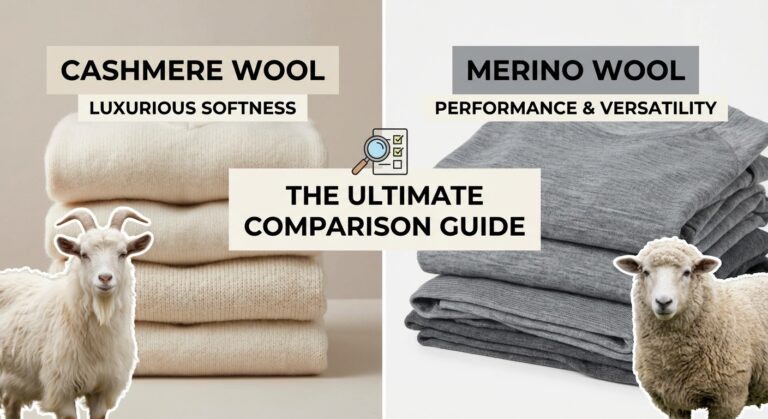
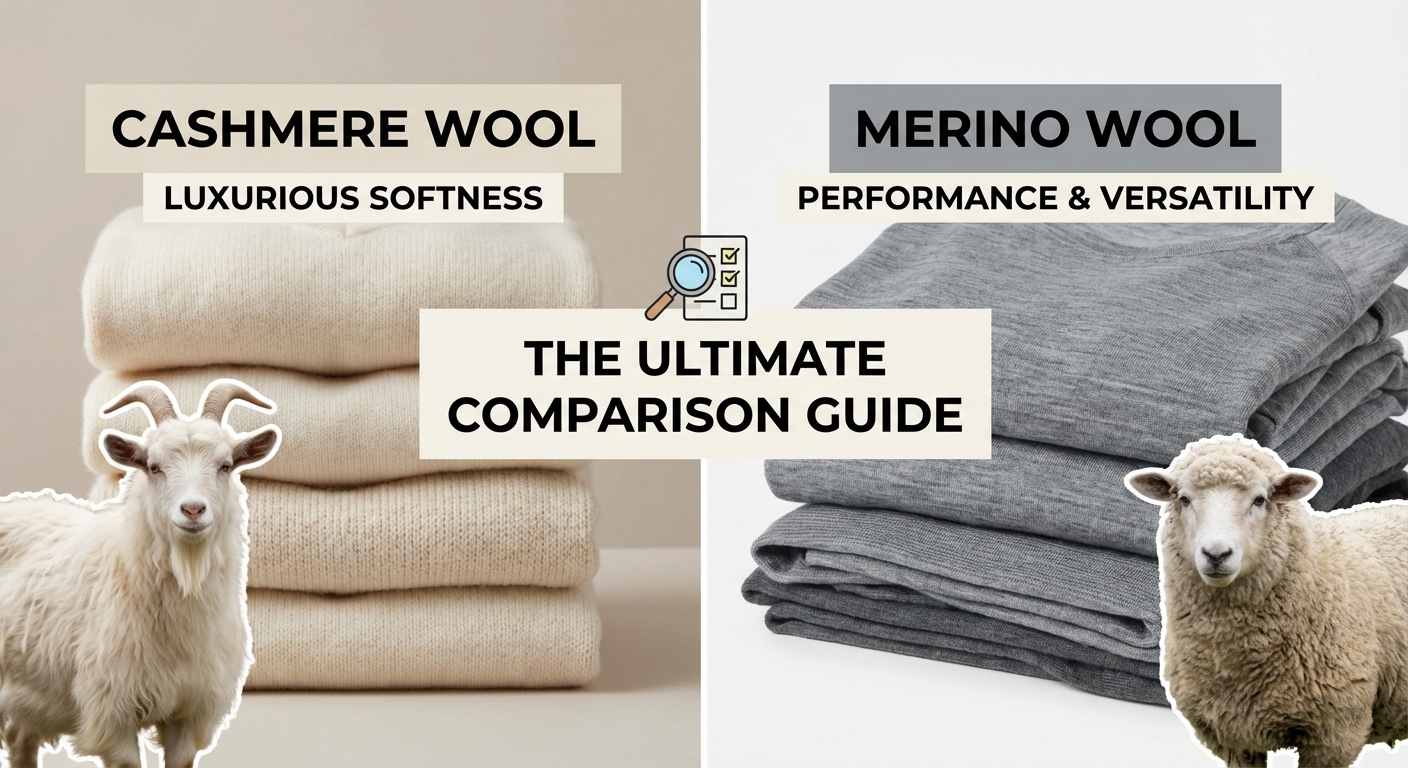
Cashmere Wool vs Merino Wool: The Ultimate Comparison Guide
When the temperature drops, nothing beats the comfort of natural wool. However, standing in front of the sweater aisle or browsing online often leads to a common dilemma: Cashmere wool vs Merino wool. Both are celebrated as premium fabrics, but they cater to very different needs, budgets, and lifestyles.
Is the luxurious softness of cashmere worth the high price tag and delicate care routine? Or does the durability and performance of merino wool make it the superior choice for your wardrobe? In this guide, we dive deep into the fibers to help you decide which material deserves a spot in your closet (and on your skin).
Whether you are looking for cozy home essentials or high-performance travel gear, understanding the nuance between these two wool giants is key. Below, we’ll walk through everything from the farms and animals these fibers come from, to how each one behaves in the wash, on your skin, on the trail, and in your wallet, so that by the end of this guide you’ll be able to shop with total confidence.
Table of Contents
- At a Glance: Cashmere vs. Merino
- Where Each Fiber Comes From
- Warmth & Insulation
- Softness & Comfort
- Durability & Pilling
- Understanding Micron Counts & Grading
- Breathability, Moisture & Odor Control
- Care & Maintenance
- Price & Value
- Sustainability & Ethical Sourcing
- Cashmere-Merino Blends: Best of Both Worlds?
- Best Use Cases by Lifestyle
- Merino and Cashmere for Travel
- Is Either Fabric Safe for Babies and Kids?
- Allergies, Sensitive Skin & Wool Allergy Myths
- How to Spot Quality (and Avoid Fakes)
- Styling Tips for Both Fabrics
- Seasonal Wardrobe Guide
- Other Wool & Fiber Alternatives to Consider
- Video Guide: Pros and Cons
- Verdict: Which Should You Choose?
- Frequently Asked Questions
- Conclusion
At a Glance: Cashmere vs. Merino
Before we break down the details, here is a quick comparison table to see how these fabrics stack up against each other.
| Feature | Cashmere Wool | Merino Wool |
|---|---|---|
| Source | Kashmir Goats (Undercoat) | Merino Sheep (Fleece) |
| Softness | Extremely High (14-19 microns) | High (18-24 microns) |
| Warmth | 7-8x warmer than standard wool | High warmth, breathable |
| Durability | Low (Delicate, prone to pilling) | High (Strong, elastic) |
| Price | $$$ – $$$$ (Luxury) | $$ – $$$ (Mid-range) |
| Best Use | Lounging, Formal, Extreme Cold | Activewear, Travel, Daily Use |
| Machine Washable | Rarely recommended | Often yes, gentle cycle |
| Odor Resistance | Moderate | Excellent |
| Moisture Wicking | Low | Excellent |
| Typical Lifespan (with proper care) | 5-10 years | 3-7 years |
| Environmental Footprint | Higher (land degradation concerns) | Lower to moderate (varies by farm) |
As you can see, the two fabrics aren’t really direct competitors so much as specialists in different arenas. Cashmere is the fiber you reach for when you want to feel pampered. Merino is the fiber you reach for when you need a garment to actually perform under pressure, whether that pressure is a twelve-hour flight, a mountain trail, or a gym bag that never quite gets emptied between workouts.
Where Each Fiber Comes From
Understanding the backstory of these fibers helps explain why they behave so differently on your body. Cashmere and Merino wool may both be labeled “wool” in casual conversation, but they come from entirely different animals, climates, and farming traditions.
The Cashmere Goat
Cashmere comes from the soft undercoat of Kashmir goats, which are raised primarily in the harsh, high-altitude regions of Mongolia, China, Afghanistan, and parts of Central Asia. These goats grow a thick double coat to survive brutal winters where temperatures can plunge far below freezing. The outer coat is coarse and protective, but underneath it, the goats grow an extremely fine, insulating undercoat, and it’s this undercoat that becomes cashmere.
Each spring, herders comb the goats by hand to collect the loose undercoat as it naturally sheds. This is a slow, labor-intensive process, and it’s one of the biggest reasons cashmere carries such a high price tag. A single goat only yields a small amount of usable fiber each year, and that raw fiber still has to be sorted, dehaired, and spun before it becomes wearable fabric.
The Merino Sheep
Merino wool, by contrast, comes from Merino sheep, a breed originally developed in Spain and now raised extensively in Australia, New Zealand, and South Africa. Unlike cashmere goats, Merino sheep are shorn once or twice a year, yielding several pounds of wool per animal in a single shearing. This higher yield, combined with large-scale commercial farming operations, is part of why Merino wool is significantly more affordable and abundant than cashmere.
Merino sheep have also been selectively bred over centuries specifically for the fineness and crimp of their fleece, which is why quality Merino wool can rival cashmere in softness while still retaining more structural strength. The crimped, coiled structure of the individual fibers is what gives Merino wool its natural elasticity and resistance to wrinkling.
Quick Fact: It takes roughly the fleece of four to six cashmere goats to produce a single sweater, while one Merino sheep can often provide enough wool for multiple garments in a single shearing season.
Warmth & Insulation
If your primary goal is battling freezing temperatures, the structure of the fiber matters. Cashmere fibers are incredibly fine and hollow, which allows them to trap air effectively. Studies suggest that cashmere can be up to 7 to 8 times warmer than traditional wool. It provides excellent insulation without the bulk, making it a favorite for elegant winter coats and scarves.
Merino wool is also an excellent insulator, but its strength lies in thermoregulation. It keeps you warm when it’s cold and cool when it’s hot. This makes it similar to the best thermal blankets that adapt to your body heat. While cashmere wins on pure static warmth, Merino wins on active warmth management.

Top Pick: Merino 250 Base Layer Crew
Perfect for active warmth and moisture management.
Why Cashmere Feels Warmer at Rest
The reason cashmere feels so much warmer when you’re sitting still, like at a desk or in a cold living room, comes down to fiber diameter and the way the fibers pack together. Because cashmere fibers are so fine, more of them can be packed into a single yarn, which creates more tiny air pockets per square inch of fabric. Air is a poor conductor of heat, so more trapped air means more insulation for the same weight of material.
This is exactly why a cashmere scarf can feel dramatically warmer than a synthetic scarf of the same thickness. It’s not doing anything magical, it’s simply trapping your own body heat more efficiently and losing less of it to the surrounding air.
Why Merino Wins When You’re Moving
Static warmth is only half the story. The moment you start moving, whether hiking uphill or catching a flight through three different climate zones, your body starts to produce heat and moisture. This is where Merino wool’s crimped fiber structure becomes a major advantage. The natural crimp creates air pockets too, but the fiber is also engineered by nature to absorb moisture vapor from your skin and release it into the surrounding air, all while continuing to insulate even when slightly damp.
Cashmere, by comparison, loses much of its insulating power once it becomes damp, and it dries far more slowly. This is one reason you rarely see cashmere marketed for hiking, running, or any activity that involves heavy sweating.
Softness & Comfort
This is often the deciding factor for luxury shoppers. Cashmere is arguably the softest natural fiber available. The fibers are collected from the undercoat of goats and typically measure between 14 and 19 microns. For context, the human threshold for “itchiness” is around 25 microns. Cashmere feels like a cloud against the skin and is hypoallergenic.
Merino wool is significantly softer than traditional “itchy” wool, usually measuring between 18 and 24 microns. While high-quality Merino (often labeled “superfine” or “ultrafine”) rivals cashmere, it generally has a slightly sturdier feel. If you have extremely sensitive skin, cashmere is the safer bet, though many find Merino wool benefits include a comfortable, itch-free experience for daily wear.
The Science Behind “Itchy” Wool
The itchiness people associate with cheap wool sweaters isn’t really about the material being “wool,” it’s about fiber diameter. Coarser wool fibers are stiff enough that they don’t bend when they press against skin, so the tips essentially poke you, triggering nerve endings and causing that prickly sensation. Finer fibers, like those found in cashmere and high-grade Merino, are flexible enough to bend on contact rather than poke, which is why they feel smooth instead of scratchy.
This also explains why two garments both labeled “100% wool” can feel completely different. A budget wool sweater made from coarse 30+ micron fiber will feel scratchy no matter how well it’s constructed, while a well-made Merino piece in the high teens to low twenties in microns can feel almost silky.
Durability & Pilling
Here is where Merino wool takes the lead. Merino fibers are naturally elastic and can be bent up to 20,000 times without breaking. This makes Merino wool garments highly durable, resistant to wrinkles, and capable of retaining their shape even after heavy use. It is the go-to fabric for hiking socks and base layers for this reason.
Cashmere, due to its fineness, is inherently delicate. It is prone to pilling (those annoying little fuzzballs) in areas where friction occurs, such as under the arms. Cashmere requires a “rest day” between wears to allow the fibers to recover their shape. It is not designed for rugged outdoor activities or high-friction environments.

Essential Care: Cashmere & Wool Comb
Keep your luxury knits looking new by removing pills safely.
What Causes Pilling in the First Place
Pilling happens when short, loose fiber ends work their way to the surface of a knit and then tangle together into little balls through friction, whether from a bag strap rubbing against your shoulder, a seatbelt across your chest, or simply the friction of your arms brushing against your torso as you walk. Because cashmere fibers are short and fine to begin with, they’re naturally more prone to this than the longer, stronger fibers found in quality Merino wool.
The good news is that pilling on cashmere is largely cosmetic and can be managed with a cashmere comb or a fabric shaver, provided you’re gentle. The bad news is that repeated pilling and de-pilling does slowly thin the fabric over time, which is part of why cashmere garments have a somewhat shorter practical lifespan under heavy rotation compared to Merino.
How Merino Resists Wear and Tear
Merino wool fibers have a natural crimp, almost like a tiny spring, which gives the fiber memory. When you stretch a Merino garment, the fibers want to snap back to their original shape, which is why Merino sweaters and base layers resist bagging at the knees and elbows far better than cotton or cashmere. This elasticity is also why Merino is the fabric of choice for performance socks that need to survive thousands of footsteps without losing their shape.
Understanding Micron Counts & Grading
You’ll see the word “micron” used constantly in wool marketing, but few brands actually explain what it means or why it matters for your buying decision.
A micron is a unit of measurement equal to one-millionth of a meter, and in the wool world, it refers to the average diameter of an individual fiber. The lower the micron number, the finer and softer the fiber. This single number is one of the best predictors of how a garment will feel against your skin, regardless of what animal it came from.
| Micron Range | Typical Classification | Feel Against Skin |
|---|---|---|
| 13-15.5 | Ultrafine Cashmere / Grade A | Exceptionally soft, premium luxury |
| 15.5-17 | Standard High-Grade Cashmere | Very soft, minor pilling risk |
| 17-19 | Commercial Grade Cashmere | Soft but less durable |
| 17.5-19.5 | Superfine / Ultrafine Merino | Soft enough for base layers next-to-skin |
| 19.5-22 | Fine Merino | Comfortable for most people, sturdier |
| 22-24 | Medium Merino | Good for outerwear, some may find slightly coarse |
| 25+ | Standard/Coarse Wool | Noticeably scratchy for most people |
Grade “A” cashmere is generally considered the top tier, sourced from the first combing of young goats in ideal climates, primarily Inner Mongolia. Grade “B” and “C” cashmere still qualify as genuine cashmere but come from coarser sections of the coat or later, less ideal harvests, and will feel noticeably less luxurious and pill more easily.
For Merino, look for labels like “17.5 Micron,” “Superfine,” or “Ultrafine” if the garment will be worn directly against sensitive skin, such as a base layer or t-shirt. For outerwear like sweaters where a layer of clothing will already be underneath, a slightly higher micron count in the low twenties is perfectly comfortable for most people and will hold up better over time.
Breathability, Moisture & Odor Control
One of the most underrated differences between these two fabrics is how they handle moisture and odor, and this is a huge factor for anyone considering either fabric for travel or activewear rather than purely for lounging.
Moisture Management
Merino wool can absorb up to roughly 30 percent of its own weight in moisture vapor before it starts to feel wet, all while continuing to insulate. This is because the fiber absorbs moisture into its core and wicks it away from the skin, releasing it gradually into the air. That’s a major reason Merino has become the fabric of choice for hiking socks, running shirts, and long-haul travel clothing.
Cashmere doesn’t have this same moisture-management engineering. It can absorb some moisture, but it doesn’t wick as efficiently, and once damp it takes considerably longer to dry. This makes it a poor choice for anything involving heavy perspiration.
Odor Resistance
This is where Merino wool truly shines and has built its reputation among travelers and outdoor enthusiasts. The same natural properties that make wool moisture-wicking also give it antimicrobial characteristics, specifically, the lanolin and the fiber’s structure make it difficult for odor-causing bacteria to thrive the way they do on cotton or synthetic fabrics. Many Merino travelers report being able to rewear a shirt for several days in a row without it developing noticeable odor.
Cashmere has some natural odor resistance simply by virtue of being wool, but it hasn’t been engineered or marketed for this purpose the way Merino has, and its delicate nature means you can’t simply air it out as aggressively or wash it as frequently without risking damage.
Care & Maintenance
The “Dry Clean Only” label scares many buyers away, but care requirements differ significantly between the two.
Washing Merino Wool
Merino wool is often machine washable on a gentle cycle, thanks to its durable structure. It resists odors naturally, meaning you don’t have to wash it as often as cotton or synthetics. If you are familiar with how to wash a weighted blanket, the principles of using cool water and avoiding harsh agitation apply here too.
Washing Cashmere
Cashmere demands respect. It should almost always be hand-washed in cold water with a specialized wool detergent or dry cleaned. Never wring out cashmere; instead, press the water out gently with a towel and lay it flat to dry. Improper care can shrink a cashmere sweater to doll size in minutes. For those who use heated bedding, knowing how to wash delicate heating elements is good practice for handling delicate fibers like cashmere.
Step-by-Step: Hand Washing Cashmere the Right Way
If you’ve never hand-washed a cashmere garment before, the process is simpler than it sounds, but every step matters. Start by filling a clean basin with cold or lukewarm water, never hot, since heat is the number one cause of wool shrinkage. Add a small amount of a wool-specific detergent, gently submerge the garment, and let it soak for about ten to fifteen minutes without scrubbing or twisting.
Rinse thoroughly with water at the same temperature you washed with, since a sudden temperature change can shock the fibers and contribute to felting. Once rinsed, gently press excess water out (never wring), roll the garment in a clean towel to absorb more moisture, and then lay it flat on a fresh, dry towel, reshaping it to its original dimensions as you go. Keep it away from direct sunlight or heating vents while it dries, which can take up to 24 hours for a thick sweater.
Storing Wool Garments Between Seasons
Both cashmere and Merino should be folded rather than hung, since hanging can stretch the shoulders and cause the garment to lose its shape over months of storage. Always wash or air out a garment before long-term storage, since any leftover body oils or food residue can attract moths, which are drawn to the proteins in natural fibers rather than the fiber itself. Cedar blocks, lavender sachets, or dedicated moth-repellent products are inexpensive insurance against an entire drawer of sweaters getting ruined over a summer in storage.
Price & Value
Cashmere is a luxury good. A single cashmere goat produces only about 4 ounces of usable fiber per year, which is barely enough for a scarf. A sweater requires the wool of 4-6 goats. This scarcity drives the price up, with quality sweaters ranging from $150 to over $1,000.
Merino sheep are more abundant and produce a higher yield of wool. While premium Merino is not “cheap,” it is far more affordable than cashmere, making it an accessible luxury for everyday use. If you are looking for budget-friendly warmth, you might also consider Sherpa blankets or synthetic alternatives.
Cost Per Wear: A Different Way to Think About Value
Sticker price alone doesn’t tell the full value story. A $200 Merino base layer that gets worn 150 times a year and lasts five years works out to a cost per wear of well under $1. A $400 cashmere sweater that gets worn 20 times a year (because it needs rest days between wears and can’t be worn during high-activity moments) but lasts eight years still works out to roughly $2.50 per wear. Neither is objectively “better” on paper, it depends entirely on how often and how intensely you plan to wear the piece.
If you’re building a capsule wardrobe of pieces you’ll wear constantly, in the gym, on flights, hiking, commuting, Merino generally delivers more value per dollar because of its versatility and durability. If you’re buying a statement piece for special occasions, dinners, or cold-weather lounging, cashmere’s higher per-wear cost is often justified by the experience and longevity of the item when properly cared for.
Sustainability & Ethical Sourcing
Sustainability has become one of the most searched-for concerns among wool shoppers, and the two fibers have noticeably different environmental profiles.
The Environmental Cost of Cashmere
The booming global demand for cashmere over the last two decades has led to a dramatic increase in goat herds across Mongolia and parts of China. Unlike sheep, goats graze by pulling grass out by the roots rather than simply cropping it, which makes overgrazing far more damaging to grassland ecosystems. Researchers have linked the expansion of cashmere goat herds to grassland degradation and desertification in parts of the Mongolian steppe, a serious long-term sustainability concern for the industry.
Because of this, some ethically-minded shoppers are turning toward recycled cashmere, which is made by shredding and respinning post-consumer cashmere garments into new yarn. Recycled cashmere carries a dramatically lower environmental footprint, though it typically has a shorter fiber length and can feel slightly less plush than virgin cashmere.
The Environmental Profile of Merino Wool
Merino wool farming, particularly in Australia and New Zealand, generally operates at a larger scale with more established land-management practices, though it is not without its own controversies, most notably around the practice of mulesing, a procedure performed on some Merino sheep to prevent a parasitic infection called flystrike. In recent years, many major wool suppliers have shifted toward non-mulesed or pain-relief-assisted alternatives in response to consumer and retailer pressure.
Look for certifications like the Responsible Wool Standard (RWS) when shopping for Merino products, as this certification addresses both animal welfare and land management practices, giving shoppers a reliable way to identify more responsibly produced garments.
Certifications Worth Knowing
- Responsible Wool Standard (RWS): Focuses on sheep welfare and progressive land management, most commonly seen on Merino products.
- Good Cashmere Standard: Addresses goat welfare, environmental impact, and socio-economic conditions for herders.
- OEKO-TEX Standard 100: Confirms the finished textile has been tested for harmful substances, relevant to both fiber types.
- GOTS (Global Organic Textile Standard): Occasionally applied to wool blends processed with organic and eco-conscious methods.
Cashmere-Merino Blends: Best of Both Worlds?
If you’ve been going back and forth trying to decide between the two, it’s worth knowing that you don’t always have to choose. Cashmere-Merino blends have become increasingly popular, typically combining anywhere from 10 to 30 percent cashmere with a Merino wool base.
The idea behind these blends is simple: Merino provides the structural backbone, elasticity, and durability, while the cashmere fibers woven throughout add a noticeable boost in softness and a subtle luxury feel. The result is a fabric that resists pilling and holds its shape far better than 100 percent cashmere, while feeling softer against the skin than 100 percent Merino.
Blends are also considerably more affordable than pure cashmere, since even a small percentage of cashmere fiber can meaningfully change the hand-feel of a garment without requiring the enormous volume of raw cashmere that a pure garment demands. For shoppers who want a “middle ground” sweater that can be worn more casually and washed more forgivingly than pure cashmere, a quality 70/30 or 80/20 Merino-cashmere blend is often the smartest purchase on the rack.
What to Check Before Buying a Blend
Always check the garment’s care label and fiber content percentage before assuming a blend behaves like pure Merino. A blend with 30 percent or more cashmere will still require gentler washing than a pure Merino piece, even though it’s more forgiving than 100 percent cashmere. As a rule of thumb, the higher the cashmere percentage, the closer you should treat the garment to cashmere-level care.
Best Use Cases by Lifestyle
Rather than thinking purely in terms of “which fabric is better,” it’s often more useful to think about which fabric fits your actual daily life. Below is a breakdown by common lifestyle scenarios.
The Office Professional
For someone who spends most of the day sitting at a desk in a climate-controlled office, cashmere is often the more rewarding choice. You’re not sweating, you’re not moving aggressively, and you’ll get to enjoy the elevated look and feel of cashmere without triggering its main weaknesses (moisture and friction-heavy activity). A cashmere cardigan draped over the shoulders or a fine-knit crewneck under a blazer reads as effortlessly polished.
The Frequent Traveler
Anyone who spends significant time in airports, on long flights, or bouncing between climates should lean toward Merino wool. Its odor resistance means you can rewear the same piece for days without it smelling, it packs down small without wrinkling, and it adjusts to temperature swings between a freezing airplane cabin and a warm destination.
The Outdoor Enthusiast
Hikers, skiers, and anyone who spends serious time outdoors should choose Merino wool without much debate. Its moisture-wicking, durability, and temperature regulation make it purpose-built for physical activity in variable conditions, something cashmere was simply never designed to handle.
The Special-Occasion Shopper
If you’re shopping for a wedding, a holiday gift, or a statement piece you’ll wear to dinners and events, cashmere’s luxurious drape and unmatched softness make it the more memorable, gift-worthy option. A cashmere scarf or wrap photographs beautifully and feels like a true indulgence in a way Merino, however excellent, doesn’t quite replicate.
The Budget-Conscious Shopper
If cost per garment matters most, Merino wool delivers significantly more performance and durability per dollar spent. You can build an entire versatile wardrobe of Merino base layers, sweaters, and socks for roughly the price of one or two quality cashmere pieces.
Merino and Cashmere for Travel
Travel is one of the most common reasons shoppers search for a comparison between these two fabrics, so it deserves its own dedicated look.
Merino wool has essentially become the unofficial fabric of the modern minimalist traveler. Brands built entirely around travel-friendly clothing have popularized Merino t-shirts, button-downs, and even underwear specifically because the fabric can be worn multiple days in a row without odor, resists wrinkling in a packed suitcase, and adapts to temperature swings between climate-controlled airports and humid destinations.
Cashmere still has a place in a traveler’s suitcase, particularly as a lightweight cashmere scarf or wrap that can double as a blanket on a chilly flight, or a compact cashmere beanie for cold-weather destinations. Just keep in mind that cashmere wrinkles more easily when packed tightly and isn’t ideal for multi-day wear without a rest, so it works best as a single statement piece rather than the backbone of a travel capsule wardrobe.
For those planning a trip that involves both cold flights and cozy hotel downtime, pairing a Merino base layer for the actual travel days with a folded cashmere wrap for evenings and lounging gives you the best of both fabrics without overloading your suitcase.
Is Either Fabric Safe for Babies and Kids?
Parents often wonder whether cashmere or Merino is the safer, more comfortable option for infants and young children, and the answer depends on the specific need.
Merino wool has actually become a popular choice for baby clothing and sleepwear because of its natural temperature regulation, which helps prevent both overheating and getting too cold, a genuine safety concern for infants who can’t yet communicate discomfort. Its moisture-wicking properties also help keep a baby’s sensitive skin drier, which can reduce the risk of rashes compared to synthetic fabrics that trap moisture against the skin.
Cashmere is sometimes used for baby blankets and special-occasion baby gifts because of its exceptional softness, but it requires far more careful laundering than most parents realistically want to commit to for everyday baby items that get dirty constantly. As a practical matter, most pediatric and childrenswear brands recommend Merino or Merino blends for daily wear, reserving cashmere for special gift items like a christening blanket or keepsake cardigan.
Always check for any wool sensitivity in young children before committing to a full wardrobe of either fiber, and start with a single garment to see how their skin reacts before investing further.
Allergies, Sensitive Skin & Wool Allergy Myths
A common misconception is that some people are “allergic to wool.” In reality, true wool allergies are quite rare. What most people experience is not an allergic reaction but a mechanical irritation caused by coarse fiber ends poking the skin, the same phenomenon responsible for the classic “itchy sweater” feeling.
Because cashmere and fine-grade Merino both use significantly thinner fibers than standard wool, most people who believe they’re “allergic to wool” can actually wear these two fabrics comfortably, since the fibers are flexible enough not to trigger that mechanical irritation. If you’ve struggled with wool in the past, it’s worth testing a small cashmere or superfine Merino item before writing off wool entirely.
That said, a small percentage of people do have a genuine sensitivity to lanolin, the natural wax coating raw wool fibers. Most commercially processed wool garments have had the majority of lanolin removed during manufacturing, but individuals with a known lanolin sensitivity should patch-test any new wool garment or consult a dermatologist before wearing it directly against the skin for extended periods.
How to Spot Quality (and Avoid Fakes)
Both cashmere and Merino wool are frequently mislabeled or blended with cheaper fibers without clear disclosure, especially from third-party marketplace sellers. Here’s how to protect yourself as a shopper.
Spotting Genuine Cashmere
- Check the fiber content label: It should clearly state “100% Cashmere” or list a specific blend percentage. Vague terms like “cashmere-like” or “cashmere touch” usually indicate synthetic substitutes.
- Do the pull test: Genuine cashmere has some give and gently springs back; if a knit stretches and stays stretched, it likely contains synthetic fibers or lower-grade wool.
- Feel for warmth, not just softness: Some synthetic fabrics are engineered to feel soft but lack cashmere’s genuine insulating warmth. Rub the fabric between your fingers for a few seconds; real cashmere will feel warm quickly.
- Be wary of unusually low prices: Genuine 100% cashmere sweaters rarely sell for under $80-100 even during sales, given the cost of raw material.
Spotting Genuine, Quality Merino
- Look for a specific micron count on the label, such as “17.5 Micron” or “Superfine Merino.” Generic “wool blend” labeling often means a coarser, lower-grade fiber is mixed in.
- Check the country of origin for reputable Merino sourcing regions like Australia, New Zealand, or South Africa.
- Look for a certification logo such as the Responsible Wool Standard on the product page or hang tag.
- Read recent reviews specifically about pilling and shrinkage, since even genuine Merino quality can vary significantly by manufacturer and knit construction.
Styling Tips for Both Fabrics
Styling Cashmere
Cashmere’s natural drape makes it ideal for relaxed, elegant silhouettes. A cashmere crewneck layers beautifully under a tailored blazer for a business-casual look that feels far more elevated than a standard cotton sweater. Cashmere scarves and wraps are also incredibly versatile, they can dress up a simple outfit for an evening out or add warmth to a casual weekend look without appearing bulky. Stick to structured, simple pieces when working with cashmere, since the fabric itself already provides enough visual interest through its subtle sheen and texture.
Styling Merino Wool
Merino’s durability and wrinkle resistance make it perfect for layering pieces you’ll wear repeatedly across a busy week. A fitted Merino base layer works equally well under a flannel for a casual outdoor look or under a suit jacket during colder months for a sleek, low-bulk layering solution. Because Merino resists odor and wrinkling, it’s also the ideal fabric for capsule wardrobe pieces you plan to pack for a multi-day trip, letting you build several outfit combinations from just two or three versatile pieces.
Seasonal Wardrobe Guide
Winter
This is cashmere’s time to shine, particularly heavier-gauge sweaters, coats, and scarves for extreme cold. Pair with a Merino base layer underneath for an unbeatable combination of static warmth and moisture management on the coldest days.
Fall and Spring
Lightweight Merino pieces are ideal for these transitional seasons, since the fabric adapts well to fluctuating temperatures throughout the day. A midweight cashmere cardigan also works beautifully for crisp fall evenings without the bulk of a full winter coat.
Summer
Surprisingly, lightweight Merino wool (generally under 150 grams per square meter) performs well even in warm weather thanks to its breathability and moisture-wicking properties, making it a smart choice for air-conditioned offices or cool summer evenings. Cashmere is far less common in summer wardrobes given its insulating properties, though very lightweight cashmere blends do exist for cool summer nights.
Other Wool & Fiber Alternatives to Consider
If neither cashmere nor Merino feels like the right fit for your needs, there are several other natural fiber alternatives worth considering. Alpaca wool offers a warmth similar to cashmere with slightly more durability and a lower cost, though it’s less widely available. Cotton and modal blends provide a budget-friendly, easy-care option, though they lack the insulating and moisture-wicking properties of true wool. For fully plant-based options, you might want to explore bamboo options or cotton alternatives, both of which are hypoallergenic and easy to care for, though they won’t match the warmth-to-weight ratio of cashmere or Merino.
Video Guide: Pros and Cons
For a visual breakdown of the texture and drape differences, check out this helpful comparison by the Gentlemen Scholars Club.
Verdict: Which Should You Choose?
Choose Cashmere If:
- You prioritize maximum softness and luxury.
- You need extreme warmth for low-activity settings (office, dinner, lounging).
- You have a higher budget.
- You are willing to hand-wash your garments.
- You want a classic, elegant drape for formal wear.
Choose Merino Wool If:
- You need versatile clothing for travel or outdoors.
- You want durable gear that resists pilling.
- You prefer low-maintenance, machine-washable fabrics.
- You need moisture-wicking for active use (hiking, skiing).
- You want high quality at a mid-range price point.
If neither of these fits your specific needs—perhaps you need something hypoallergenic and plant-based—you might want to explore bamboo options or cotton alternatives.

Luxury Choice: 100% Cashmere Crewneck
Unmatched softness for those who want the finer things in life.
Frequently Asked Questions (FAQ)
Yes, cashmere provides approximately 7-8 times more insulation than merino wool relative to its weight, making it warmer for static use.
It is a matter of scarcity. Cashmere comes from the undercoat of specific goats that only produce a small amount of fiber once a year. It takes multiple goats to make one sweater.
Generally, no. High-quality merino wool has a fine micron count that bends when it contacts the skin, preventing the prickly sensation associated with traditional wool.
It is risky. While some merino blends are tumble-dry safe, it is always best to air dry them to prevent shrinkage and extend the garment’s life.
Clean them first, then fold them (never hang!) and place them in a breathable storage bag with cedar blocks to prevent moths. Check out these best storage bags for ideas.
Surprisingly, yes. Lightweight merino wool (under 150gsm) is excellent for summer because it wicks sweat away and regulates body temperature.
Yes, cashmere fibers are shorter and more delicate, making them more prone to pilling than the long, strong fibers of merino wool.
It is water-repellent to a degree due to natural lanolin, and it can absorb 30% of its weight in water without feeling wet, but it is not fully waterproof like a rain jacket.
Look for cashmere in the 14 to 16.5 micron range for the softest, highest-grade fiber. Anything above 19 microns is considered lower-grade and will feel noticeably coarser and pill more quickly.
Yes, cashmere-merino blends are increasingly popular, combining the durability and structure of merino with the softness of cashmere, often at a more accessible price point than pure cashmere.
For most travelers, yes. Merino wool resists odor and wrinkles, packs down small, and adapts to changing climates, making it more practical than cashmere for multi-day trips.
It can if washed in hot water or agitated too aggressively. Always use cold water, a gentle cycle, and a wool-safe detergent, and lay the garment flat to dry to minimize shrinkage risk.
Merino wool generally carries a lower environmental footprint than cashmere, since large-scale cashmere goat farming has been linked to grassland degradation. Look for Responsible Wool Standard or Good Cashmere Standard certifications for more sustainably produced options in either category.
Merino wool is commonly used in baby clothing and sleepwear thanks to its temperature-regulating and moisture-wicking properties. Cashmere is sometimes used for special-occasion baby gifts but requires more careful laundering than most parents want for everyday wear.
Check the fiber content label for “100% Cashmere,” perform a gentle pull test to check for spring-back elasticity, and be cautious of unusually low prices, since genuine cashmere rarely sells for under roughly $80-100 even on sale.
Itchiness is primarily driven by fiber diameter (micron count) rather than the type of animal the wool came from. Look for a lower micron count, generally under 19 microns, for a softer, less irritating feel regardless of whether it’s cashmere or merino.
Conclusion
The battle of cashmere wool vs merino wool doesn’t have a single winner—it depends on the battlefield. For rugged adventures, travel, and daily reliability, Merino wool is the undisputed champion. It offers incredible performance and value. However, for pure indulgence, unparalleled warmth, and that sophisticated aesthetic, nothing replaces the luxury of cashmere.
Whichever you choose, investing in natural fibers is an upgrade for your wardrobe and your comfort. If you are looking to expand your collection of cozy gear, don’t forget to check out our guides on blanket baskets for storage or travel sets for your next trip.