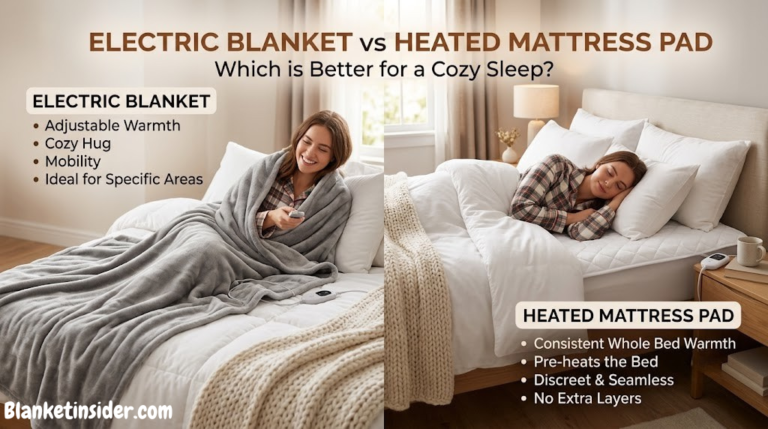
Which Actually Keeps You Warmer?
The Complete Comparison.
Heat from above or heat from below — we break down every factor that matters for a warm, safe, and energy-efficient night’s sleep.
Cold beds are one of the most reliably miserable things about winter. You’ve already made the decision to add some form of electric heat to your sleep environment — now comes the question that actually matters: do you heat from above with an electric blanket, or from below with a heated mattress pad? The two products feel superficially similar (both are electric, both get hot, both have thermostats), but they work in fundamentally different ways and deliver meaningfully different results depending on how you sleep, who you share a bed with, and what you actually need the heat for.
This guide covers every relevant comparison category honestly — heat delivery physics, safety profiles, energy consumption, sleep quality research, maintenance requirements, and total cost of ownership. By the end, you’ll have a clear answer for your specific situation rather than the vague “it depends” non-answers that dominate this topic online. We also cover hybrid approaches and edge cases that neither product handles well, so you can make a fully informed decision.
The short version if you’re in a hurry: A heated mattress pad almost always wins for sleep quality and long-term satisfaction. An electric blanket wins for flexibility, sofa use, lower entry price, and situations where you don’t want to commit to a fixed bed setup. Most people who try both tend to keep the mattress pad permanently and use a lighter electric blanket as a supplemental option. Read on to understand exactly why.
What Each Product Actually Is — and How They Differ Structurally
Before comparing performance, it helps to understand what each product is built to do at a fundamental level. They’re not interchangeable products with different price tags — they solve related problems with genuinely different engineering approaches.
Heat delivered from above
An electric blanket is a standard blanket construction — polyester, fleece, or cotton shell — with thin heating wires woven in a serpentine pattern through the fabric. When plugged in, electrical resistance in the wires generates heat that radiates outward through the fabric. You use it exactly like a regular blanket: on top of you in bed, on a sofa, over your lap at a desk, or draped around your shoulders.
The key structural characteristic is flexibility of use — it goes wherever you go and heats whatever it’s draped over.
Heat delivered from below
A heated mattress pad is a fitted pad, typically 1–2 inches thick, that goes directly on top of the mattress and under your fitted sheet. Heating elements run through the pad and warm the surface you sleep on. Your body weight presses you into the warmth rather than having the warmth rest on top of you. Once installed, it stays on the bed — it’s not a portable product.
The key structural characteristic is direct contact heating — it warms the surface your body is in contact with throughout the night.
The distinction between top-down and bottom-up heat is not just a positional curiosity — it has direct implications for how effectively each product warms the body, how much energy it requires, and how long it needs to run during a typical sleep cycle. Those implications are the core of this comparison.
For context on how both products fit into the broader electrically heated bedding landscape, our guide on what to check before buying any heated blanket covers the universal safety and feature checklist that applies to both product types.
How Each Product Delivers Heat — and Why It Matters for Sleep
Heat transfer happens through three mechanisms: conduction (direct contact), convection (air circulation), and radiation (electromagnetic emission). Understanding which mechanism each product primarily uses explains most of the performance differences between them.
The efficiency gap is the most important number in this whole comparison. An electric blanket radiates heat outward in all directions — downward toward the body but also upward into the air above the blanket and sideways into the room. Estimates from bedding thermal engineers put blanket efficiency (heat reaching the body vs. heat generated) at 65–75% in typical bedroom conditions. The rest heats the ambient air.
A heated mattress pad operates almost entirely through direct conduction. The pad warms the sheet above it; your body surface presses into that sheet; the heat transfers directly into your skin with almost no loss to room air. Efficiency rates of 85–90% are realistic because there’s no open-air gap between the heat source and the heat recipient. Your own body weight keeps you in contact with the warm surface.
Enveloping warmth, air-gap dependent
Creates a warm microclimate around the body. Works well for even, all-around warmth, but heat delivery is affected by body position, blanket coverage, and how tightly the blanket is tucked.
Pre-warming: fast — a bedroom can be pre-warmed in 5–10 minutes by turning the blanket on before bed.
✓ Better for: full-body enveloping warmthConsistent, targeted surface warmth
Warms the specific surface your body is in contact with. Heat output is entirely directed toward the sleeper — none escapes upward into the air. Works regardless of blanket type or sleeping position.
Pre-warming: also fast. A mattress pad takes 15–20 minutes to fully heat the sleep surface, but many have programmable timers to pre-warm before bedtime.
✓ Better for: efficient targeted surface warmthThe Cold Feet Problem — Where Each Product Succeeds and Fails
Cold feet are a specific issue that generates many heated bedding purchases. A heated mattress pad wins this category decisively — cold feet placed on a warm surface receive direct conductive heat from below, which is the most effective way to warm extremities. An electric blanket, because it drapes loosely, often leaves foot-area coverage inconsistent as people move during sleep. The blanket shifts; the feet are exposed. A mattress pad doesn’t shift.
Conversely, for shoulder and upper-body warmth — particularly relevant for people who sit up in bed reading — an electric blanket provides coverage that a mattress pad cannot replicate. The product that gives you what you need depends substantially on where on your body you feel cold.
Explore Top-Rated Electric Blankets
Our comprehensive electric blanket review covers the best options across fleece, sherpa, and dual-control models — safety-tested and comfort-verified.
Read Our Electric Blanket Reviews →Safety Comparison: Fire Risk, Overheating & What the Data Shows
Safety is the category that stops many potential buyers — heated blankets and mattress pads both involve electricity in close proximity to flammable bedding and sleeping humans. The concerns are legitimate but frequently overstated when applied to modern products. Understanding the actual risk profile of each product helps calibrate those concerns appropriately.
The Wire-Folding Issue — The Most Common Safety Concern
The most frequently cited safety concern with electric blankets is wire folding. When thin heating wires are bent at sharp angles repeatedly — through folding, bunching, or prolonged compression — the insulation around the wire can crack. Cracked insulation creates localized heating points (hot spots) that can, over time, cause fires. This risk is real and is the reason most electric blanket manufacturers recommend against using them folded and against tucking them tightly under the mattress.
A heated mattress pad is physically designed to lie flat, secured under a fitted sheet and weighted down by the mattress on one side. It doesn’t fold during normal use. The wire geometry is fixed. This mechanical difference is the primary reason heated mattress pads have a substantially better long-term safety record than electric blankets.
Never fold a heated electric blanket for storage while it’s plugged in. Always unplug before folding. For long-term storage, roll rather than fold to avoid creating sharp wire angles. Replace any electric blanket that shows signs of wire damage, scorch marks, or uneven heating. Our full guide on electric blanket safety covers inspection and storage protocols in detail.
Modern Safety Technology: What UL Certification Covers
Both product types, when purchased from established brands, carry UL (Underwriters Laboratories) certification or equivalent international safety certifications. UL-listed heated bedding must meet specific requirements for overheat protection, auto shut-off timing, cord construction, and fabric flame resistance. The presence of UL listing on a product significantly reduces — though does not eliminate — fire risk compared to uncertified alternatives.
Auto-shutoff is now nearly universal in both product categories. Most models automatically power off after 8–10 hours, which covers a full sleep cycle. Premium models include intermediate temperature cycling — the blanket or pad periodically reduces power to a lower maintenance level rather than running at full output all night, which reduces both energy consumption and thermal stress on the wiring.
Specific Populations to Consider
Both products come with cautions for specific groups. For young children under 5, neither product should be used without close adult supervision — children cannot reliably communicate or respond appropriately to overheating. For people with diabetes or peripheral neuropathy, both products require extra care since reduced skin sensitivity can prevent a person from noticing dangerous heat levels. For infants, neither product is appropriate — safe infant sleep requires a temperature-regulated room, not electric heating devices in the sleep area. See our guidance on baby sleep safety for the correct approach to infant sleep temperatures.
- Safe when used correctly with UL-listed products
- Wire folding remains the primary risk factor
- Not recommended for unsupervised children
- Should be replaced every 5–7 years regardless of apparent condition
- Do not use under heavy mattresses or with pets who may pierce the wires
- Designed to run all night — lower wire stress profile
- Flat, fixed geometry prevents folding damage
- Covered by fitted sheet, reducing pet claw access
- Same replacement schedule (5–7 years) applies
- Caution still required for neuropathy / diabetic users
Read Our Full Electric Blanket Safety Guide
Covers fire risk, safe storage, inspection protocol, and the one thing most people do wrong with electric blankets that dramatically increases risk.
Read the Safety Guide →Sleep Quality: Which One Actually Helps You Sleep Better?
Both products are bought primarily to solve a sleep problem — being too cold to fall asleep or stay asleep. But they address that problem in ways that interact differently with sleep physiology, and one does it significantly better than the other across most situations.
Body Temperature and Sleep Architecture
Sleep researchers have established that the body’s core temperature drops 1–2°F during healthy sleep onset and remains lower throughout deep and REM sleep stages. This core temperature reduction is both a trigger for and a product of good sleep — a warm core signals wakefulness; a cool core facilitates it. What complicates this for cold sleepers is that peripheral body temperature (hands, feet, skin surface) benefits from warmth as a mechanism for drawing heat from the core — a warm periphery promotes core cooling, which promotes sleep.
This means the optimal thermal strategy for sleep is: warm periphery, gradually cooling core. That’s a specific and somewhat counterintuitive heating profile that most people don’t consciously recognize but that their bodies actively pursue.
The diagram above captures why heated mattress pads tend to produce better sleep quality results than electric blankets for all-night use. An electric blanket running at full heat all night can actually interfere with the natural core temperature drop that deep sleep requires — you’re adding heat from above to a body trying to cool its core. A mattress pad warms the peripheral surfaces (back, legs, feet) which helps the periphery-to-core heat redistribution that facilitates sleep onset, while not trapping excess heat against the body in the same way.
Many experienced heated-blanket users arrive at the same solution intuitively: pre-warm the bed with the electric blanket, then turn it off (or significantly down) before sleeping. That pre-warming strategy is effective — but it functionally turns your electric blanket into a bed pre-heater rather than a sleep-through warming solution. A heated mattress pad with a programmable timer achieves the same pre-warming effect more efficiently and can be set to reduce to a maintenance level automatically once you’re asleep.
Restless Sleepers and the Movement Problem
Side sleepers, combination sleepers, and anyone who moves frequently during the night have a consistent complaint about electric blankets: they shift. The blanket that was providing warm coverage when you fell asleep at 11pm is bunched against the wall by 3am, leaving you cold and uncovered. A heated mattress pad stays exactly where it was installed. For people who sleep actively, this difference alone often drives the purchase decision.
Good for falling asleep; less ideal for staying warm all night
- Excellent for pre-warming the bed before sleep
- Blanket shifting affects consistent overnight coverage
- Running all night at high heat may delay sleep onset
- Better for light sleepers who don’t move much
- Sofa use and TV viewing is a genuine advantage
Designed for consistent all-night warmth
- Stays in position through all sleep movement
- Warmth rises from below — doesn’t interfere with core cooling
- Programmable timers allow auto-reduce at sleep onset
- Cold feet heated reliably regardless of sleeping position
- No shifting, no re-tucking, no cold spots from movement
Energy Use & Running Costs: The Numbers Side by Side
Electricity costs are a real and growing concern for households using supplemental electric heating. Both products are significantly more energy-efficient than space heaters for bed warming — but they differ meaningfully from each other in energy consumption, and those differences compound over a full winter season.
| Energy Factor | Electric Blanket | Heated Mattress Pad | Notes |
|---|---|---|---|
| Typical wattage | 100–200W | 60–100W | Pads use less power due to higher efficiency |
| Nightly energy use | ~0.8–1.6 kWh | ~0.5–0.8 kWh | Based on 8-hour use |
| Nightly cost (US avg.) | $0.11–$0.22 | $0.07–$0.11 | At $0.14/kWh average |
| Monthly cost (30 nights) | $3.30–$6.60 | $2.10–$3.30 | Significant annual difference |
| Winter season (5 months) | $16.50–$33 | $10.50–$16.50 | Mattress pad saves ~$10–$20/season |
| vs. space heater | ~85% cheaper | ~92% cheaper | Both vastly more efficient than room heating |
| Preheat only mode | ~$0.03–$0.05 | ~$0.03–$0.05 | Similar cost if used only for pre-warming |
The energy cost difference between the two products reflects the heat-transfer efficiency discussed in Section 2. Because a heated mattress pad loses less energy to room air, it needs to generate less power to achieve the same perceived warmth. Over a five-month winter, that difference amounts to roughly $10–$20 — not a dramatic figure, but meaningful when combined with the product’s other advantages.
Both products are dramatically more energy-efficient than the alternative most people default to when cold: raising the whole-room thermostat. Heating a bedroom from 65°F to 70°F using central heating can cost $0.40–$0.80 per night depending on home insulation and climate — roughly 4–8× the cost of a heated mattress pad and 3–5× the cost of an electric blanket. For energy-conscious households, both heated bedding products pay for themselves within a single winter by enabling lower thermostat settings overnight.
The real energy comparison: If your goal is purely to minimize electricity consumption, a heated mattress pad used on a low setting all night uses less energy than an electric blanket preheat-only approach, because the pad’s efficiency means it needs to run at lower power to maintain the same warmth. Set your pad to level 3 out of 10 and leave it on — it’ll use about the same energy as 20 minutes of a 1,500W space heater.
For EV owners and households thinking about whole-home energy optimization, the context of how heated blanket use compares to larger home heating decisions is covered in our guide on 12V heated blankets and EV energy savings — a different product category, but relevant for understanding the energy math around personal versus room heating.
Health Considerations: EMFs, Arthritis, Pregnancy & More
Both products involve electric current, which generates low-level electromagnetic fields (EMFs). This is an area where concern frequently outpaces evidence, so it’s worth being specific about what is and isn’t known.
EMF Exposure — What the Evidence Says
All electric appliances generate EMFs. The relevant question is whether the field strength and exposure duration from heated bedding products is associated with any measured health outcome. At the power levels used by electric blankets and heated mattress pads (typically under 200W), the generated EMFs are non-ionizing and well within the thresholds considered safe by major health organizations including the WHO and the International Commission on Non-Ionizing Radiation Protection.
Practically, a heated mattress pad has slightly higher EMF proximity to the body than an electric blanket simply because it’s directly beneath you rather than draped over you. Buyers with specific EMF concerns can look for products with low-EMF or EMF-shielded wiring — some brands market this feature specifically. For most users, there is no evidence-based reason to avoid either product on EMF grounds, but the option exists for those who want it.
Arthritis and Joint Pain
This is one of the clearest clinical use cases for both products. Heat therapy is well-established for reducing morning stiffness in arthritic joints — warming the affected area overnight or in the early morning before getting up can meaningfully reduce pain and stiffness during the first hours of the day. For people with arthritis primarily in the hands and wrists, an electric blanket provides more targeted upper-body coverage. For hip, knee, and lower-body arthritis, a heated mattress pad’s direct contact with the relevant joints through the night is more effective. Many arthritis sufferers use both strategically.
Pregnancy
The medical guidance on electric blankets during pregnancy is cautious. The primary concern is not EMFs but overheating: elevated core body temperature (hyperthermia) during early pregnancy has been associated with neural tube defects in animal studies, and the recommendation from most ob-gyn practitioners is to avoid anything that could significantly raise core temperature, including electric blankets, hot tubs, and fever-inducing conditions, during the first trimester in particular. A heated mattress pad used on a low setting is generally considered safer than a wrapping electric blanket because the heat application is to the external body surface from below rather than around the body — but anyone who is pregnant should discuss this with their healthcare provider before using either product.
Diabetic users and neuropathy: Both heated blankets and mattress pads carry elevated risk for people with peripheral neuropathy (often caused by diabetes) because reduced sensation in extremities can prevent detection of dangerous skin temperatures. If you have diabetes or any condition affecting skin sensation, consult your doctor before using either product, and if you do use one, start at the lowest setting and check for redness or skin irritation regularly.
Weighted Blankets vs. Heated Blankets for Anxiety
It’s worth briefly distinguishing heated blankets from weighted blankets in the context of anxiety and sleep. Heated electric blankets provide thermal comfort but not the deep-pressure stimulation that makes weighted blankets effective for anxiety. If anxiety is a primary sleep concern, a weighted blanket is the more appropriate tool — and can be layered with room heating strategies rather than needing to be an electrically heated product itself. See our guide on the best blankets for anxiety for that comparison.
Electric Blanket Reviews: Safety-Tested Models Only
Our reviews only cover UL-listed models with documented auto shut-off. We flag any safety issues found during testing.
Browse Reviewed Heated Blankets →Setup, Washing & Maintenance: The Day-to-Day Reality
Choosing between these two products isn’t just a performance question — it’s also a lifestyle and logistics question. How each product is set up, moved, stored, and cleaned affects whether you’ll actually use it consistently.
Washing — The Practical Difference
Both product types are generally machine washable, but with important caveats. Electric blankets should be washed on a gentle cycle, cold water, and laid flat or air-dried rather than tumble-dried — the heating wires are the vulnerability. Most manufacturers allow one or two washes per season. If you wash your bedding frequently, this limitation becomes an inconvenience. For complete washing instructions, our guide on washing heated blankets without wiring damage gives the definitive protocol.
Heated mattress pads face a different challenge: they’re large, heavy when wet, and require care to avoid wire damage during agitation. The practical solution most people arrive at is using a fitted sheet as a barrier (which gets washed frequently) and washing the pad itself just a few times per season. This is functionally similar to how a mattress protector is handled — the sheet takes the regular laundering duty, and the pad is washed less frequently.
The portability advantage of electric blankets is genuinely significant for some households. If you use your heated blanket on the sofa during evening television more than in bed, the electric blanket is the correct product — a mattress pad cannot follow you to the couch. For a clear picture of when a heated blanket makes more sense than a non-electric alternative for sofa and living room use, see our comparison of a heated blanket versus a space heater for room warming.
Dual-Zone Control: The Game-Changer for Couples Who Sleep Differently
If you share a bed with someone who has different temperature preferences — one of the most common sleep compatibility complaints among couples — dual-zone control is a feature that entirely changes the product calculus. Both electric blankets and heated mattress pads offer dual-zone models, but they implement the feature differently and with very different practical results.
Two controllers, one blanket — imperfect separation
Dual-zone electric blankets have two independently heated halves with separate controllers. The limitation is that the heating zones don’t have a true thermal barrier between them — heat from the warmer side migrates to the cooler side through fabric contact and air. The separation is real but partial.
Another practical issue: dual-zone blankets require that both partners stay on their respective sides, which doesn’t always happen during sleep. If one partner moves significantly, coverage becomes uneven.
✓ Works well for moderate temperature preference differencesTrue zone separation — the better solution
A dual-zone heated mattress pad heats two physically separate halves of the mattress. Because the pad lies flat and is separated by a center seam, there is very little thermal crossover between zones. One side can run at maximum heat while the other side is completely off, and the temperature boundary holds reliably.
Since each person stays in contact with their own zone regardless of sleep movement (you’re lying on it, not wrapped in it), the zoning remains effective through the night.
✓ True zone separation — the definitive solution for temperature-incompatible partnersFor couples where one person runs cold and one runs hot — an extremely common combination — a dual-zone heated mattress pad is genuinely one of the most impactful sleep improvements available at the product’s price point. The ability for the “cold” partner to sleep on a warm pad at maximum heat while the “warm” partner’s side is completely off, with no thermal interference between them, solves a sleep incompatibility problem that can otherwise require separate blankets, separate rooms, or significant nightly negotiation.
If both partners are in agreement that they run cold and want shared warmth, a standard (non-dual-zone) electric blanket can actually deliver a nicer couple experience — you’re both under the same warm cover together in the classic “snuggle under one blanket” configuration. For that use case, there’s a genuine warmth and comfort that a mattress pad doesn’t replicate.
Price, Value & Total Cost of Ownership
| Price Factor | Electric Blanket | Heated Mattress Pad |
|---|---|---|
| Entry-level (Twin) | $25–$45 | $45–$75 |
| Mid-range (Full/Queen) | $45–$80 | $75–$140 |
| Premium (Queen, dual zone) | $80–$150 | $120–$220 |
| King, dual zone | $100–$180 | $150–$280 |
| Expected lifespan | 5–7 years (careful use) | 5–8 years |
| Annual running cost (winter) | $17–$33 | $11–$17 |
| 5-year total ownership (Queen) | $145–$240 | $130–$225 |
The five-year total cost calculation is revealing: despite the higher upfront cost, a heated mattress pad ends up at a similar or lower total cost of ownership over a winter-use lifespan due to lower running costs. The upfront price premium is real but recovers within 3–4 seasons. For buyers who are price-sensitive in the short term, an electric blanket is the lower-risk entry point. For buyers optimizing over multiple years, the mattress pad is the better financial decision.
Worth noting: the comparison above assumes both products are used only during the cold season. Electric blankets used primarily for sofa use year-round rather than bed sleep may accumulate more usage hours and therefore wear faster. Mattress pads used only for winter sleeping may last at the upper end of the lifespan range since they sit dormant — under a sheet but unpowered — for half the year.
The budget-smart approach: Buy an entry-level electric blanket first. Use it for one winter. If you find yourself primarily using it in bed and wish it stayed in position better, upgrade to a heated mattress pad the following season. Your remaining use for the electric blanket (sofa, guest room, travel) makes the first purchase not wasted. Many households end up owning both for different contexts.
Explore Heated Mattress Pads & Electric Blanket Reviews
Our buying guides compare the top models on heat consistency, dual-zone accuracy, and washability — with honest pros and cons for each.
Compare Top Models →Category Scoreboard: Which Wins Where
| Category | Electric Blanket | Heated Mattress Pad | Winner |
|---|---|---|---|
| Heat efficiency | 65–75% | 85–90% | Mattress Pad ✓ |
| Sleep quality (all night) | Good with pre-warm | Excellent | Mattress Pad ✓ |
| Safety profile | Good (if used correctly) | Better (fixed geometry) | Mattress Pad ✓ |
| Energy cost | Higher | Lower | Mattress Pad ✓ |
| Upfront price | Lower | Higher | Electric Blanket ✓ |
| Portability | Excellent | None | Electric Blanket ✓ |
| Sofa / multi-room use | Excellent | Not applicable | Electric Blanket ✓ |
| Dual-zone effectiveness | Partial separation | True separation | Mattress Pad ✓ |
| Cold feet relief | Inconsistent | Reliable | Mattress Pad ✓ |
| Setup ease | Very easy | Moderate (once) | Electric Blanket ✓ |
| Washability | Easier (smaller) | Requires large machine | Electric Blanket ✓ |
| 5-year total cost | ~$145–$240 | ~$130–$225 | Tie / Pad slight edge |
The scoreboard tells a clear story: the heated mattress pad wins across the categories that most directly affect sleep quality and long-term satisfaction, while the electric blanket wins on the practical lifestyle factors — price, portability, and flexibility. Neither result is surprising given the products’ fundamental design differences.
Notably, the categories the electric blanket wins are all about what it is rather than how well it works in bed. If your use case is exclusively in-bed sleep warming, the mattress pad wins 6 of the 6 sleep-specific categories decisively. The electric blanket’s wins are all use-context advantages (sofa, portability, price) that become relevant when the product is used outside the bedroom.
Who Should Buy Which: The Clear Recommendations
🔥 Buy an Electric Blanket If…
- Your primary use is on the sofa, not in bed
- You need portability — multiple rooms, travel, or vehicle use
- Budget is the primary constraint and you want the lowest entry cost
- You share with a partner who is happy with the same heat setting
- You’re renting and don’t want to install a semi-permanent bed fitting
- You run a guest room and want a flexible multi-purpose warming solution
- You want to pre-warm a bed that already has great normal bedding
- You’re buying for a child who needs supervised, controlled warming sessions
🛏️ Buy a Heated Mattress Pad If…
- In-bed sleep quality is the primary goal
- You or your partner are restless sleepers who move frequently
- Cold feet are a persistent problem keeping you awake
- You share a bed with a partner with very different temperature preferences (get dual-zone)
- You want to run heat all night without safety concerns about wire folding
- You have arthritis or joint pain in the lower body or hips
- Energy efficiency over the season is a priority
- You dislike daily bed-making adjustments
The Hybrid Approach — When Both Make Sense
A meaningful percentage of people who research this comparison end up buying both products for different purposes, and that’s a rational outcome rather than an indecisive one. The use cases are complementary rather than overlapping:
- Heated mattress pad as the primary sleep warming solution in the bedroom
- Electric blanket for sofa use, reading in bed above the covers, or as a portable option for a home office or study
In this hybrid configuration, neither product needs to be a premium purchase to work well. A mid-range heated mattress pad ($90–$140 for a queen) combined with a basic fleece electric blanket ($30–$45) covers essentially all the warming use cases a typical household has, at a combined cost comparable to a single premium product in either category.
For broader context on building out a cozy sleep and home environment, our cozy home essentials checklist covers the layered approach to thermal comfort that most experienced cozy-home enthusiasts arrive at over time.
FAQs: Electric Blanket vs Heated Mattress Pad
Can I use an electric blanket and heated mattress pad at the same time?
Technically yes, but it’s generally not recommended for overnight sleeping. Running both simultaneously at any meaningful heat level can cause significant overheating — your body has very little ability to shed heat in that situation. If you want to pre-warm a bed quickly, using both briefly (5–10 minutes) before getting in is fine, then turning off the electric blanket once you’re in bed. For sleeping, choose one. The mattress pad for all-night use; the electric blanket turned off once you’ve warmed up, or used as an additional blanket layer with the heat off.
Which is safer to leave on all night?
A heated mattress pad is generally considered safer for all-night use. Its flat, fixed geometry under the fitted sheet means wires are not subject to folding or bunching during sleep movement. Most heated mattress pads are specifically designed and marketed for all-night operation. Electric blankets can be left on all night if they have a modern auto-shutoff feature and are used flat without bunching, but the conventional guidance has historically been to pre-warm then switch off. If you specifically want all-night heat, invest in a heated mattress pad from a brand with documented auto-shutoff and overheat protection.
Does a heated mattress pad work with a memory foam mattress?
Yes — heated mattress pads are compatible with memory foam mattresses. In fact, there’s an argument that the combination works particularly well: memory foam is known to retain heat, which can cause sleeping hot. A heated mattress pad on a memory foam mattress can be run at a lower heat setting than it would need to be on a standard coil mattress, because the foam’s heat retention supplements the pad’s output. Just verify that the pad’s elasticized corners fit your mattress depth — thicker memory foam mattresses (12″+ deep) may require pads with extended elastic corners.
Can I put a heated mattress pad on top of a mattress topper?
This setup is possible but raises heat-transfer and safety questions worth understanding. A thick foam topper between the heated pad and your body significantly reduces heat transfer efficiency — the foam is an insulator that works against the pad’s purpose. More importantly, a topper trapped between the pad and the mattress below it could trap heat and create hot spots. The recommended configuration is: mattress → heated pad (fitted over mattress) → fitted sheet → optional topper → sleep surface. This way the topper is above the sheet and pad, and you benefit from both the warmth of the pad and the comfort of the topper, with the sheet providing the safety barrier.
Do heated mattress pads work with adjustable beds?
Many heated mattress pads now come in split-king configurations designed specifically for adjustable bed bases, with separate zones and controllers for each side of the bed. The key thing to check is that the pad has flexible wiring construction (look for “adjustable base compatible” in the product description) — stiff wire layouts can be damaged by the repeated bending of an adjustable base. Standard heated mattress pads on fixed beds don’t face this issue. For adjustable bases, always buy a pad that explicitly states adjustable compatibility.
Is a heated electric blanket the same as an electric throw?
Not exactly. An electric throw is typically smaller (50×60 inches or similar), designed primarily for sofa and lap use rather than full-bed coverage. Electric throws are generally less expensive, easier to manage, and better suited for living room use. Standard heated electric blankets come in full bed sizes (twin through king) and are designed for in-bed use. If your primary need is sofa warmth, an electric throw is the more practical and economical choice — there’s no need to buy and manage a full-size heated blanket for that purpose.
What happens if I wash an electric blanket incorrectly?
The primary damage modes from improper washing are: wire insulation cracking from hot water exposure, internal wire breakage from aggressive agitation (especially top-loader with agitator), and control module damage from heat in a dryer. A damaged electric blanket may have visible hot spots, fail to heat in certain areas, produce a burning smell, or trip a circuit breaker. Any of these symptoms means the blanket should be discarded immediately and not repaired. The detailed protocol for safe washing is covered in our guide on washing heated blankets safely.
Which product is better for someone who has chronic cold feet?
A heated mattress pad is definitively better for cold feet. When your feet are placed on a warm surface (the heated pad through the sheet), heat transfers directly through conduction into the soles of your feet — one of the most effective ways to warm extremities. An electric blanket, draped loosely, often shifts away from the feet during sleep movement and can’t deliver the same consistent contact warmth. If cold feet are the primary symptom, a heated mattress pad set to a moderate level will address it more reliably than any other heated bedding option.
Are there heated blanket options that are safe for pets in the bed?
Both product types require caution when pets share the bed. Dogs and cats can apply concentrated weight on heating wires, potentially damaging insulation over time. More critically, sharp claws from cats can pierce wire insulation, creating a fire and shock hazard. A heated mattress pad covered by a fitted sheet offers better protection than a bare electric blanket — the sheet provides a buffer layer, and the pad is less likely to be directly scratched or bunched by a sleeping pet. If pets regularly share your bed, a heated mattress pad is the safer choice, and inspect it periodically for any wire protrusion or damage. For pet-specific bedding recommendations, our guide on tested pet blankets is a useful complement.
How do electric blankets and heated mattress pads compare to a heated mattress pad vs. space heater?
A space heater warms the whole room; a heated mattress pad (or electric blanket) warms only the immediate sleep area. For the goal of staying warm in bed specifically, both heated bedding options are dramatically more efficient than a space heater — you’re not heating the entire room volume to achieve bed warmth. A typical space heater (1,500W) costs roughly 20 cents per hour to run; a heated mattress pad costs about 1 cent per hour. If you’re currently leaving a space heater on overnight to keep warm in bed, switching to a heated mattress pad could save $40–$60 per winter season. The full comparison of heated blanket vs. space heater economics breaks this down in detail.
Electric Blanket vs Heated Mattress Pad: Our Honest Conclusion
After comparing both products across every meaningful category, the verdict is clear for most sleepers — but the right answer still depends on how and where you primarily use it.
🔥 Choose the Electric Blanket If…
You use it primarily outside the bedroom, you need a portable solution, you’re working within a tight budget, or you want to pre-warm a bed that already functions well for sleep. It’s also the right pick if you share with a partner who agrees on temperature and wants that shared-warmth-under-one-blanket feeling.
Best for: sofa and living room use, renters, guest bedrooms, budget-first buyers, and anyone who wants flexibility over fixed performance.
See Electric Blanket Reviews🛏️ Choose the Heated Mattress Pad If…
In-bed sleep quality is the goal. It wins on every sleep-relevant metric: heat efficiency, consistency through the night, cold feet relief, dual-zone accuracy for couples, and long-term running cost. The higher upfront price pays back within a few seasons.
Best for: primary bedroom use, restless sleepers, cold feet sufferers, temperature-incompatible couples (dual zone), and anyone who’s used an electric blanket and wishes it stayed in place.
See Heated Mattress Pad Reviews