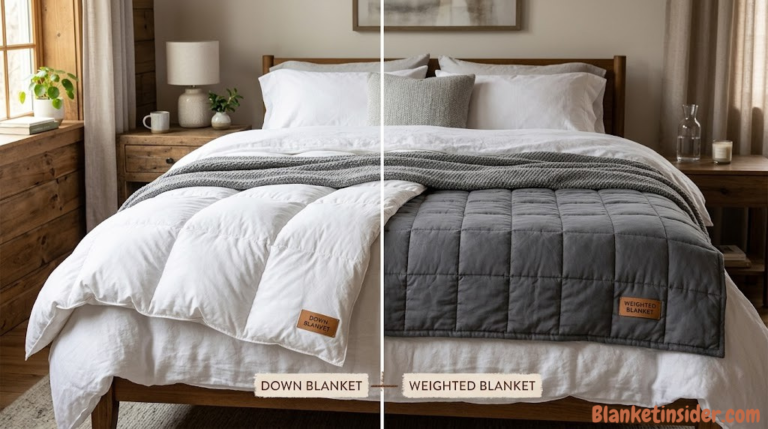
Down Blanket vs Weighted Blanket
Two iconic blanket types, two completely different sleep philosophies. One wraps you in cloud-like warmth; the other calms your nervous system with gentle pressure. Here’s how to pick the one that actually fits your life.
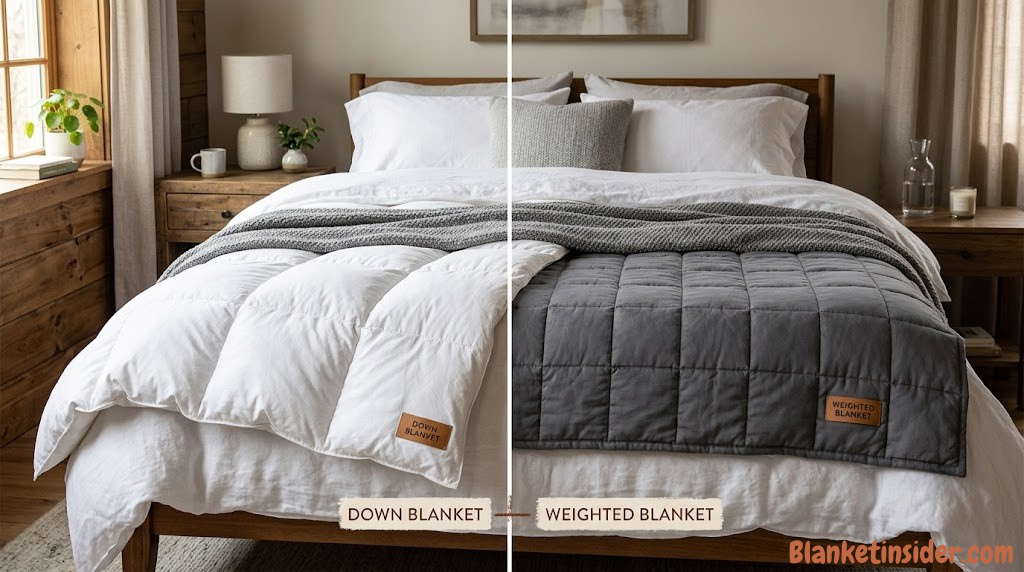
Ask ten people what makes a perfect blanket and you’ll get ten different answers — but nearly every response will orbit around two fundamental desires: warmth and comfort. For decades, down blankets have owned the warmth throne with their impossibly light, insulating fill. But in the last several years, weighted blankets have entered the conversation with a bolder promise: not just comfort, but deep neurological calm — a scientifically supported sense of being held.
So which one do you actually need? The honest answer is that these two blankets are solving different problems. A down blanket is thermal engineering wrapped in luxury. A weighted blanket is sensory therapy disguised as bedding. Understanding that distinction is what makes this comparison so much more useful than a simple feature list.
In this guide, we dig into every dimension that matters — warmth, pressure, sleep quality, materials, allergens, washing, durability, price, and more — so you can make a genuinely informed decision. We’ll also look at whether using both together is a viable (even superior) option. Let’s start with the numbers.
Quick Comparison Overview
Before we get into the deep dives, here’s where each blanket wins and loses across every major category. Use this as your fast-reference table whenever you need to jump straight to a decision.
| Category | Down Blanket | Weighted Blanket | Winner |
|---|---|---|---|
| Warmth | Exceptional — natural thermoregulation | Moderate — depends on shell material | Down ↑ |
| Weight | Very light (1–3 lbs) | Heavy by design (10–25 lbs) | Preference-based |
| Anxiety & Calm | Minimal specific effect | Deep pressure stimulation — proven calming | Weighted ↑ |
| Sleep Quality | Thermal comfort, undisturbed rest | Reduces cortisol, improves sleep onset | Weighted (slight edge) |
| Hot Sleepers | Excellent breathability | Can trap heat unless designed for cooling | Down ↑ |
| Cold Sleepers | Excellent for cold environments | Decent, especially with flannel shell | Down ↑ |
| Allergen Risk | Moderate (dust mites, animal proteins) | Low (most fills are hypoallergenic) | Weighted ↑ |
| Portability | Compresses well, travel-friendly | Heavy, awkward to transport | Down ↑ |
| Ease of Washing | Delicate — requires careful technique | Heavy-load — needs large machine | Tie |
| Longevity | 10–20+ years with proper care | 5–10 years (bead shifting, cover wear) | Down ↑ |
| Price Range | $40–$600+ | $40–$250+ | Weighted (accessible range) |
| Kids & Families | Safe for most ages (over 2) | Not for young children without guidance | Down ↑ |
Both blankets represent excellent choices — just for different kinds of people and different kinds of needs. Let’s explore what makes each one tick.

Explore Top-Rated Down Blankets
Lightweight, breathable, and thermoregulating — the best all-season down blankets on Amazon.
Shop Down Blankets on Amazon →What Is a Down Blanket?
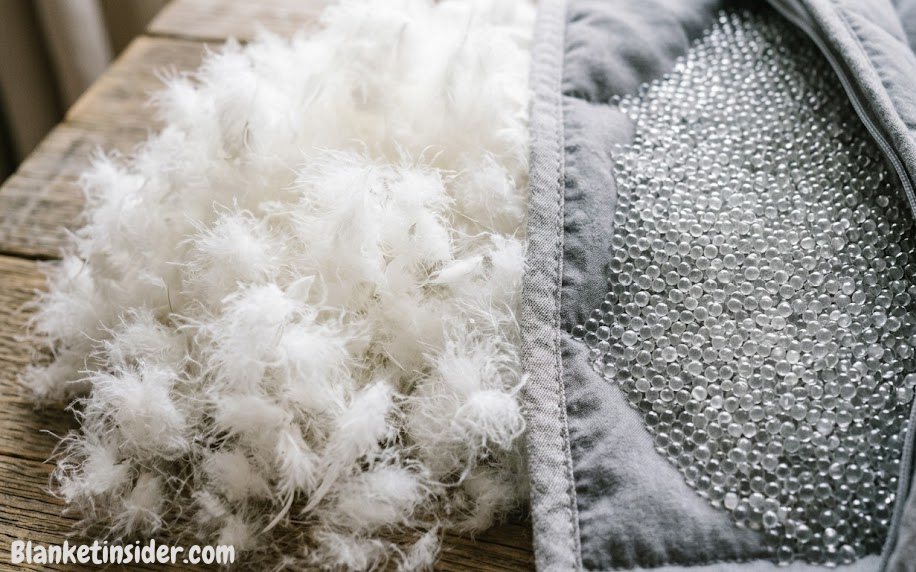
A down blanket — sometimes called a down throw, down comforter, or down duvet — is a type of bedding filled with the soft, fluffy underfeathers found beneath the outer plumage of geese and ducks. These clusters, known as down plumules, are nature’s finest insulation. Unlike the stiff outer feathers you might picture, down has no rigid quill structure. Each plume is a three-dimensional ball of interlocking fibers that trap air exceptionally well, creating a natural insulating layer that keeps you warm without adding significant weight.
The quality of a down blanket is typically measured by fill power — a rating that tells you how many cubic inches one ounce of down occupies when allowed to loft fully. A higher fill power means more air is trapped per ounce, which means warmer insulation with less fill weight. Budget down blankets typically start around 400–500 fill power; premium options reach 700–900 fill power, with ultra-luxury Siberian or Hungarian goose down sometimes exceeding that.
Fill Power Scale
400–500 FP: warm, entry-level
500–650 FP: all-season sweet spot
700–900 FP: lightweight luxury
Fill Types
Goose down (preferred for quality), duck down (affordable), down-alternative (synthetic microfibers)
Shell Fabrics
Cotton cambric, sateen, lyocell, and tight-weave GOTS-certified cotton are the most common premium shells
Typical Weight
1.5–4 lbs for a queen-size blanket, depending on fill power and amount of fill used
Down blankets also differ from down duvets in a subtle but important way: a blanket is typically a finished product ready to use on its own, while a duvet is an insert designed for use inside a removable duvet cover. Understanding this distinction helps when you’re comparing comforters, duvets, and blankets more broadly.
One thing that surprises many people: down is inherently thermoregulating. Unlike a thick wool or polyester fill that applies a fixed level of insulation, down fluffs or compresses slightly in response to body heat and humidity. This makes it one of the few fill materials that genuinely adapts to your body temperature overnight, reducing the dreaded middle-of-the-night overheating that plagues so many sleepers.
Down vs Down-Alternative: True down comes from birds. Down-alternative fills (usually polyester microfibers or Primaloft® clusters) mimic the loft and feel of down but are fully hypoallergenic, more affordable, and easier to wash. If allergens are a concern, a quality down-alternative blanket may be preferable.
The Warmth-to-Weight Ratio: Down’s Greatest Strength
No synthetic fill has yet matched natural down’s warmth-to-weight efficiency. A queen-size down blanket at 700 fill power might weigh just 2 lbs while providing the thermal insulation equivalent to a 6 lb polyester blanket. This ratio is why high-altitude mountaineers and cold-weather athletes still reach for down first — and why sleeping under one feels like being cocooned in warm air rather than buried under material.
This also makes down blankets the go-to choice for travel-friendly warmth — they compress into surprisingly compact packages and bounce back to full loft when unpacked.
What Is a Weighted Blanket?
A weighted blanket is a type of therapeutic bedding intentionally designed to be heavy — typically 10 to 25 pounds for adult sizes. This isn’t dead weight added arbitrarily. The fill material, usually small glass beads or plastic poly pellets sewn into evenly distributed pockets throughout the blanket’s interior, creates a specific type of sensation called Deep Pressure Stimulation (DPS).
DPS is the feeling of firm, even pressure distributed across the body — think of it as the physical sensation of a prolonged hug, a firm massage, or the swaddling instinct that calms newborns. Research in occupational therapy and sleep science has linked this sensation to measurable physiological changes: reduced cortisol (the stress hormone), increased serotonin and dopamine production, and activation of the parasympathetic nervous system. The net effect for many users is a notable reduction in anxiety, faster sleep onset, and improved sleep continuity.
The Science Behind the Weight: A landmark 2020 study published in the Journal of Clinical Sleep Medicine found that chronic insomnia patients using weighted blankets experienced significantly better sleep efficiency and reduced daytime fatigue compared to control groups using standard blankets. The mechanism is the same DPS pathway used in occupational therapy for anxiety and autism spectrum conditions.
How Weighted Blankets Are Built
A well-made weighted blanket has several layers working in concert. The outer shell is typically cotton, bamboo, or a specialized cooling fabric. Inside, you’ll find a grid of small sewn pockets — usually 4–5 inch squares — each individually filled with a measured amount of glass beads or poly pellets. This pocket construction is critical: it distributes the weight evenly across your body, preventing the fill from pooling at the edges or shifting uncomfortably during sleep.
Glass Bead Fill
- Dense, small, heavy for size
- Produces a thinner, more flexible blanket
- Better drape, conforms to body shape
- Quieter than poly pellets
- Standard in premium weighted blankets
Poly Pellet Fill
- Larger and lighter than glass beads
- Produces a bulkier blanket
- Less expensive to manufacture
- Can make slight rustling sound when moving
- Common in budget weighted blankets
For a complete guide to understanding weighted blankets — including how to select the right weight, the best fills, and therapeutic uses — our weighted blanket guide covers everything in detail. We’ve also reviewed several specific models including the Gravity Blanket, YnM Weighted Blanket, Luna Weighted Blanket, and Baloo Weighted Blanket if you want to jump straight to specific product analysis.
Weighted blankets have grown far beyond their occupational therapy origins. Today they’re widely used by people who simply want a more grounding, calming sleep experience — no clinical diagnosis required. If you’ve ever fallen asleep under a pile of blankets and felt unusually calm, you’ve already experienced a rudimentary version of what a weighted blanket systematizes.

Find Your Perfect Weighted Blanket
Glass bead fill, cooling covers, and sizes from 10–25 lbs — explore the best-rated options.
Shop Weighted Blankets on Amazon →Warmth & Temperature Regulation
This is the category where down blankets establish their most decisive advantage. Natural down is the gold standard of insulation not just in bedding but across the entire spectrum of cold-weather gear. The mechanism is elegant: each down cluster creates a three-dimensional web that traps warm air near your body. The more loft the fill maintains, the more air pockets it holds, and the warmer you stay without adding weight or bulk.
Down’s Natural Thermoregulation
What sets down apart from most synthetic insulations is its ability to dynamically adjust to your body’s heat output. When you’re cold and still, the fill lofts to maximum volume, maximizing insulation. When you warm up, it compresses slightly, allowing excess heat to escape. This isn’t marketing language — it’s a physical property of down’s cluster structure that no synthetic material has fully replicated.
For hot sleepers who still need a blanket, this makes quality down a strong candidate. The same thermoregulating property that warms you when cold prevents it from trapping excessive heat when you’re warm. Compare this to a dense polyester blanket, which applies the same insulation level regardless of your body temperature. If thermoregulation during sleep is a priority — especially alongside night sweats — a breathable down blanket often outperforms even purpose-built cooling alternatives.
How Weighted Blankets Handle Heat
Weighted blankets have a more complicated relationship with temperature. The glass bead fill itself is thermally neutral — glass doesn’t insulate the way fiberfill does. The warmth of a weighted blanket comes primarily from its shell fabric and the simple fact of its mass. A cotton-shell weighted blanket at room temperature doesn’t add warmth the way a down blanket does; instead, it reflects your body heat back to you.
This creates two distinct experiences depending on your environment. In a warm room, a weighted blanket can feel stifling — the dense fabric doesn’t breathe as freely as down, and the glass beads hold warmth longer once heated. In a cool room, a weighted blanket with a flannel or cotton shell can feel pleasantly warm, though never as insulating as a high fill-power down blanket.
| Temperature Scenario | Down Blanket Performance | Weighted Blanket Performance |
|---|---|---|
| Cold room (below 65°F) | Excellent — high loft, maximum insulation | Moderate — warmth depends on shell material |
| Cool room (65–70°F) | Ideal — adapts to body temperature | Good — glass beads feel neutral |
| Neutral room (70–75°F) | Very good — light warmth without overheating | Acceptable — can feel warm with cotton shell |
| Warm room (above 75°F) | Manageable — breathable fill lets heat escape | Can feel hot — especially with polyester shell |
| Hot sleeper at any temp | Good choice with cotton/lyocell shell | Risky unless specifically a cooling weighted blanket |
| Cold sleeper seeking warmth | Excellent | Not the primary tool — add a separate blanket |
If warmth is your primary need and you sleep hot, down is the right category to shop. If warmth is secondary to pressure and calm, a weighted blanket in a breathable cotton shell — particularly one with a lower weight like 12 lbs — can work well for most sleep environments. You might also consider pairing a cooling blanket with your weighted blanket in warmer seasons.
Hot Sleepers + Weighted Blankets: Polyester-shell weighted blankets are the biggest culprit for night-time overheating. If you tend to sleep warm and want a weighted blanket, prioritize options with 100% cotton, bamboo, or Tencel/lyocell shells and glass bead fill, which sits more neutrally against the skin than poly pellets.
Weight, Feel & Comfort
This section is where the two blankets diverge most dramatically — not just in numbers but in the entire philosophy of what “comfortable” means at bedtime.
The Down Blanket Experience
Climbing under a quality down blanket is often described as “disappearing into a cloud.” The sensation is of enveloping lightness — the blanket’s weight is nearly imperceptible, yet warmth arrives almost immediately. There’s a loft to quality down that gives it dimensionality: it doesn’t flatten against your body the way a thin fleece does. It floats slightly above, creating an insulating air layer while maintaining a soft, yielding surface wherever it makes contact.
The fill power directly affects this sensation. A 500 fill power blanket lofts moderately and has a slightly firmer hand. A 750 fill power blanket feels almost ethereally light while still delivering serious warmth. High fill power down also tends to drape more fluidly — it moves with your body as you shift positions rather than sliding off in a single slab.
The Weighted Blanket Experience
A weighted blanket feels like the polar opposite — and that contrast is the entire point. The first sensation is undeniably one of substantial weight. Depending on the fill, there may be a slight beaded texture against the surface. The blanket doesn’t float; it conforms to your body, following its contours under gravity’s influence. The glass beads distribute this weight evenly rather than in concentrated zones, which is what separates a properly constructed weighted blanket from simply piling extra blankets on top.
Many first-time users report that it takes two or three nights to fully adjust to the sensation of a weighted blanket. After that adjustment period, most describe the feeling not as “heavy” but as secure — a grounded, contained sensation that feels actively calming rather than restrictive.
| Feel Factor | Down Blanket | Weighted Blanket |
|---|---|---|
| Initial sensation | Feather-light, cloud-like | Dense, grounding, immediately present |
| Body movement | Flows with movement, minimal resistance | Stays in place, slight resistance when turning |
| Drape & conformity | High — wraps body loosely | Very high — glass beads pool to body contours |
| Texture | Smooth shell over plush fill | Bead texture faintly perceptible; shell-dependent |
| Claustrophobia risk | Very low | Moderate — not suited for those who feel trapped |
| Getting out of bed | Easy — light and unintrusive | Requires deliberate effort with heavier models |
One consideration that rarely gets mentioned: mobility during sleep. If you’re a restless sleeper who changes position frequently, a heavy weighted blanket can become slightly unwieldy. Down blankets follow you through your sleep positions without resistance. For couples sharing a bed, a queen or king weighted blanket can create coverage challenges since the weight discourages the kind of casual repositioning that happens unconsciously throughout the night.
If you’re specifically drawn to soft, textured surface feels rather than one of these two options, it’s worth exploring blanket materials more broadly — our comprehensive blanket materials guide covers everything from minky fabric to waffle weave construction.

Down-Alternative Blankets — Best of Both Worlds
All the loft and warmth of down without allergens. Perfect for sensitive sleepers.
Browse Down-Alternative Options →Sleep Quality & Anxiety Relief
Of all the comparison dimensions in this guide, the one that truly separates these two blanket types is their mechanism of action for improving sleep. Down addresses sleep through thermal comfort. Weighted blankets address it through neurological calming. These are genuinely different pathways to the same destination — and understanding which pathway serves you better is the key to making the right choice.
How Down Blankets Improve Sleep
The link between body temperature and sleep quality is well-established in sleep research. Your core body temperature naturally drops during sleep, and the sleep environment’s temperature directly influences how quickly and deeply you fall asleep. A blanket that actively helps maintain ideal sleeping temperature — not too cold that you wake up shivering, not too warm that you shed the blanket — removes a major source of sleep disruption.
Down blankets excel at this because of their thermoregulating properties. They help your body achieve the slight temperature drop associated with sleep onset while preventing the overcorrection that causes waking. For people whose sleep is primarily disrupted by temperature — either running too cold without enough covers or too hot under synthetic alternatives — a quality down blanket can be genuinely transformative.
How Weighted Blankets Improve Sleep
The mechanism here is fundamentally different. Deep Pressure Stimulation activates the parasympathetic nervous system — the “rest and digest” mode that counteracts the “fight or flight” sympathetic nervous system. By doing so, it triggers a cascade of physiological responses that are directly conducive to sleep: reduced heart rate, lower blood pressure, decreased cortisol, and increased serotonin (a precursor to the sleep hormone melatonin).
This is why weighted blankets are particularly effective for individuals who lie awake with racing thoughts, physical restlessness, or general anxiety. The pressure doesn’t silence those thoughts cognitively, but it interrupts the physical manifestation of stress in the body — the tension, the elevated heart rate, the shallow breathing — which in turn makes it easier for the mind to quiet down.
Anxiety, ADHD, and Sensory Processing
For these specific use cases, weighted blankets have a substantial evidence base behind them. Occupational therapists have used deep pressure techniques as a sensory integration tool for decades, and the weighted blanket is essentially a domesticated application of the same principle. If you experience anxiety that manifests physically — muscle tension, restlessness, difficulty staying still — or if you have ADHD traits that make winding down difficult, a weighted blanket addresses these conditions more directly than any thermal insulation product can.
Down blankets, for all their thermal excellence, simply don’t engage this pathway. A down blanket makes your body temperature comfortable; a weighted blanket makes your nervous system comfortable. For many users, both matter — which is exactly why layering the two products together (a weighted blanket beneath a down throw) has become a popular strategy. You can explore more about the best blankets for anxiety across both categories.
✓ Down — Sleep Pros
- Natural thermoregulation reduces temperature-related wake-ups
- Lightweight feel doesn’t restrict movement during sleep
- Adapts to seasonal changes without needing a different blanket
- Excellent for cold or variable sleep environments
- Appropriate for all ages and sizes
✗ Down — Sleep Cons
- Doesn’t address anxiety or hyperarousal at bedtime
- Can cause overheating in very warm rooms or hot sleepers
- Allergen risk may disrupt sleep in sensitive individuals
- Poor quality down can lose loft over time, reducing thermal comfort
✓ Weighted — Sleep Pros
- Deep pressure stimulation reduces cortisol and promotes melatonin
- Faster sleep onset reported by most users
- Reduces nighttime restlessness and movement
- Particularly effective for anxiety, ADHD, and sensory conditions
- Calming effect extends beyond sleep to relaxation generally
✗ Weighted — Sleep Cons
- Can trap heat — problematic for warm sleepers
- Weight can cause discomfort or disturb partner
- Adjustment period of several nights is common
- Not suitable for those with claustrophobia or respiratory issues
- Not recommended for children under 2 and requires guidance for older children
Materials & Construction
The internal materials of your blanket determine not just how it feels and performs today, but how well it will hold up five years from now. Both blanket types have developed sophisticated construction techniques, and understanding what to look for prevents you from spending good money on a product that degrades quickly.
Down Blanket Construction: What the Good Ones Have
A well-constructed down blanket has several layers of quality engineering. The outer shell should be tightly woven enough to prevent down from escaping (called “down-proof” construction) while still being breathable. Look for a thread count above 230 in cotton shells, or look for the word “cambric” which describes a traditional densely-woven cotton fabric specifically designed for this purpose.
The baffle box construction — where the interior is divided into individual chambers separated by fabric walls (baffles) rather than stitched all the way through — is the standard for quality down products. Without baffles, the fill flattens at the stitch lines, creating cold spots. With baffles, each chamber maintains its own independent loft, giving the blanket even warmth distribution.
| Construction Type | What It Is | Pros | Best For |
|---|---|---|---|
| Baffle Box | 3D chambers separated by fabric walls | Best loft, even warmth, no cold spots | Premium quality blankets |
| Sewn-Through | Stitching goes all the way through both shells | Simpler construction, lower cost | Budget options, lighter warmth |
| Karo Step | Offset box pattern | Good loft without baffles | Mid-range compromise |
| Channel Fill | Long diagonal tubes of fill | Good drape, prevents shifting | Throws and lighter blankets |
For certifications, look for the Responsible Down Standard (RDS) or similar ethical sourcing certifications that verify the down was not sourced from live-plucked birds. The OEKO-TEX Standard 100 certification on the shell fabric verifies it’s free from harmful chemicals — important since this is something you’ll sleep against every night.
Weighted Blanket Construction: Quality Indicators
For weighted blankets, the single most important construction element is the pocket size and seam strength. Smaller pockets (around 3–4 inches square) distribute weight more evenly and feel smoother against the body. Larger pockets mean the beads cluster more noticeably. The seam quality matters enormously because each pocket seam holds beads under constant stress — inferior seams will fail over time, allowing beads to migrate and eventually escape.
Premium weighted blankets use glass micro-beads rather than plastic poly pellets. The quality difference is tangible: glass beads are denser, meaning the blanket can achieve its target weight while remaining thinner and more drapeable. Poly pellets achieve the same weight in a bulkier, stiffer package. The cover fabric matters too — look for 100% cotton with at least 280 thread count, or bamboo-derived Tencel for better breathability.
For more details on what weighted blanket construction to prioritize and specific product recommendations, our full weighted blanket review roundup is the place to start. The Bearaby Tree Napper is one high-profile example that takes a completely different construction approach — chunky knit rather than filled pockets — and is worth understanding as an alternative format within the weighted blanket category.
Care, Washing & Durability
Both blanket types require more care than a standard fleece throw, but in different ways. Getting the washing process wrong on either one can cause significant — and sometimes irreversible — damage, so this section is worth reading carefully before you commit to either option.
Washing a Down Blanket
Down is susceptible to clumping when wet if not dried correctly. The cardinal rule: never put a down blanket away until it is completely, thoroughly dry. Moisture trapped in down clusters causes them to mold, producing odors and breaking down the natural oils that give down its loft. Under-drying is the most common cause of down product failure.
Use a large-capacity front-loading washing machine on a gentle, cool cycle with a down-specific detergent (or very mild liquid detergent — no powder, no fabric softener). Dry on low heat with two or three wool dryer balls or clean tennis balls to continually break up clumps as they form. Pause the dryer every 20–30 minutes to fluff the blanket by hand. Expect the full drying cycle to take 2–3 hours for a queen-size blanket.
Properly cared for, a quality down blanket can last 15–25 years without significant fill degradation. The shell is usually what wears out first. For a complete washing walkthrough, our guide on washing blankets without damage is helpful context.
Washing a Weighted Blanket
The main challenge with weighted blankets is capacity: a 20-lb blanket will exceed the load limit of most standard top-loading washing machines with agitators, which can damage both the blanket’s seams and the machine itself. Front-loading machines or top-loaders without agitators handle the load more safely, but for very heavy blankets, a commercial laundromat washer is the practical solution.
Glass bead fill is water-stable and doesn’t clump or degrade when washed. Use cold water, gentle cycle, mild detergent. Dry on low heat or air-dry — the blanket takes much longer to dry than its thin appearance suggests because the dense fill pockets trap moisture. See our detailed guide on how to wash a weighted blanket without damage and our companion piece on washing without ruining the fill for step-by-step instruction.
| Care Dimension | Down Blanket | Weighted Blanket |
|---|---|---|
| Machine washable? | Yes (large-capacity, front-loader preferred) | Yes (large-capacity essential for heavy models) |
| Dryer safe? | Yes — low heat with dryer balls, long cycle | Yes — low heat, extended cycle |
| Dry cleaning? | Acceptable but usually unnecessary | Not recommended — chemicals can damage shell |
| Frequency of washing | Every 2–3 months (use a cover to extend intervals) | Every 1–2 months; covers can reduce full washes |
| Air drying | Works but slow — bead-up risk without dryer balls | Good alternative for glass bead fill |
| Common mistakes | Insufficient drying, fabric softener use | Overloading washer, hot water use |
| Lifespan with proper care | 15–25 years | 5–10 years (fill, seams, cover) |
Storage Considerations
Down blankets should be stored in breathable cotton or linen bags — never vacuum-sealed compression bags, which destroy the cluster structure of down by holding it compressed for extended periods. A quality blanket storage bag keeps down blankets clean and protected without compressing the fill. Alternatively, displaying them over a blanket ladder in the bedroom keeps them lofted and accessible.
Weighted blankets can be folded and stored in a blanket chest, but their weight means you’ll want to store them somewhere accessible — they’re not ideal for high-shelf storage unless you’re comfortable managing 15–20 lbs overhead.

Cooling Weighted Blankets — Best for Warm Sleepers
Bamboo and cotton shell weighted blankets that provide deep pressure without the heat trap.
Shop Cooling Weighted Blankets →Health Considerations & Special Use Cases
Both blanket types have health implications worth understanding before you buy, particularly if you’re shopping for someone other than yourself — a child, an elderly parent, or someone with a medical condition.
Allergens: Down’s Achilles Heel
Traditional down is an animal product and carries two distinct allergen risks. The first is the down itself: some people have genuine allergies to duck or goose feathers. The second — and more common — is that down products can harbor dust mites if not properly maintained. The warm, slightly humid environment of a blanket in regular use is an ideal dust mite habitat, and their waste products are among the most common trigger agents for rhinitis, asthma, and eczema flare-ups.
Modern solutions include:
- Allergy-treated down — rigorously washed to remove allergenic proteins, often certified hypoallergenic
- Down-alternative fills — synthetic microfibers that replicate down’s loft with zero allergen risk
- Dust-proof inner covers — tightly woven microfiber encasements that prevent mite colonization
For individuals with sensitive skin, consider exploring options from our best blankets for eczema roundup, which looks at both down-alternative and weighted options in detail.
Weighted Blankets and Special Populations
Weighted blankets come with specific cautions that down blankets generally don’t. These include:
Young Children
Never use a weighted blanket for children under 2. For older children, use only under occupational therapist or pediatrician guidance with age-appropriate weights.
Respiratory Conditions
Individuals with sleep apnea, COPD, or other respiratory conditions should consult their doctor before using a weighted blanket, as chest pressure can affect breathing.
Limited Mobility
People with limited physical strength may have difficulty repositioning a 15–20 lb blanket at night. Consider lighter weights (10–12 lbs) or have a caregiver assess suitability.
Claustrophobia & Anxiety
Paradoxically, some anxiety sufferers find the weight restrictive rather than calming. Try before committing to a full purchase if possible.
For children’s bedding choices more broadly — including safe sleep guidelines for infants and toddlers — our baby sleep blanket safety timeline and baby blanket reviews provide detailed, age-appropriate guidance.
Down and Ethical Sourcing
One health consideration that’s ethical rather than medical: the sourcing of down feathers. Live plucking and force-feeding practices associated with foie gras production have raised legitimate welfare concerns about down sourcing. Look for products certified under the Responsible Down Standard (RDS) or Global Traceable Down Standard (Global TDS), which verify ethical treatment of birds throughout the supply chain. This doesn’t affect the product’s performance or your health, but it’s worth knowing about when making a purchase decision.
Price, Value & What You Actually Get
The price ranges for both blanket types overlap significantly, but the meaning of price varies considerably between them.
Down Blanket Pricing: Why It Varies So Much
The down blanket market spans from under $50 to well over $600 for the same product category — queen-size, all-season blankets. This extreme range isn’t arbitrary: fill power, fill weight, and shell quality genuinely determine a very different product experience. A $50 down blanket at 300 fill power in a synthetic shell is barely distinguishable from a standard synthetic blanket. A $400 blanket at 800 fill power in GOTS-certified long-staple cotton is a generational purchase that will outlast your mattress.
| Price Tier | Down Blanket | Weighted Blanket |
|---|---|---|
| Budget ($30–$80) | Duck down, 400–500 FP, sewn-through construction, synthetic shell | Poly pellet fill, polyester shell, basic pocket structure |
| Mid-Range ($80–$180) | Goose down, 550–650 FP, baffle box, cotton shell, RDS-certified | Glass bead fill, cotton shell, smaller pockets, removable cover option |
| Premium ($180–$350) | Premium goose down, 700+ FP, baffle box, sateen or lyocell shell, OEKO-TEX | Micro glass beads, bamboo or Tencel shell, seamless corner ties, dual-sided cover |
| Luxury ($350+) | Hungarian/Siberian goose, 800–900 FP, hand-finished baffle box, heirloom-grade shell | Premium beads, cooling tech integration, custom weight options, luxury fabrics |
Weighted Blanket Pricing: Simpler but Still Matters
Weighted blankets have a somewhat more compressed price range — roughly $40 to $250 for most consumer options. The budget options often use poly pellet fill in polyester shells, which compromises both breathability and the quality of the weighted sensation. Mid-range glass bead options in cotton shells represent the sweet spot for most users. Premium options add thoughtful design details: removable outer covers that wash easily, dual-sided textures for seasonal versatility, or specialized cooling or warming constructions.
Cost-Per-Year Analysis
Down blankets, despite higher upfront costs, often win on cost-per-year. A $250 premium down blanket lasting 20 years costs $12.50 per year. A $120 weighted blanket lasting 7 years costs $17.14 per year. This calculation shifts if you buy budget in either category — cheap down loses its fill and loft rapidly, and budget weighted blankets tend to lose bead fill through seam failure. The cost of ownership argument consistently favors investing in quality in both categories.
Resale Consideration: High-quality down blankets from reputable brands (Parachute, Pacific Coast, Brooklinen, LL Bean) retain value better than weighted blankets and can sometimes be found in excellent condition secondhand at a fraction of retail — worth checking if budget is a constraint.
Who Should Choose What?
By now you have the full picture of what each blanket does and how it works. Let’s translate that into concrete recommendations based on the most common buying scenarios.
☁ Choose a Down Blanket If…
- Your primary need is warmth and thermal comfort
- You’re a hot sleeper who still needs some coverage
- You want a versatile blanket for all seasons
- You share a bed and need individual coverage freedom
- You travel frequently and want packable warmth
- You’re buying for a child or older adult
- You appreciate long-term investment in quality
- You want a decorative throw that’s also functional
⚖ Choose a Weighted Blanket If…
- You struggle to fall asleep due to anxiety or restlessness
- You have ADHD, autism spectrum traits, or sensory sensitivities
- You want a tactile, grounding experience at bedtime
- You sleep alone in a temperature-controlled room
- Your sleep is disrupted by hyperarousal rather than cold
- You’ve tried other sleep solutions without success
- You’re comfortable with a brief adjustment period
- You’re looking for a tool to complement CBT or therapy
The Case for Using Both Together
The “down vs weighted” framing of this comparison, including its title, somewhat misrepresents how many people actually end up using these products. A significant number of users ultimately own and use both — and with good reason. The two blankets serve complementary functions that don’t interfere with each other.
The most popular layering approach: use a weighted blanket as your primary sleep layer for its DPS benefits, with a lightweight down throw on top during colder months for thermal comfort. This combination delivers deep pressure stimulation from below, warmth from above, and adds the sensory pleasure of a soft, lofted surface against your hands and face. The total weight remains manageable as long as you’ve chosen a lighter weighted blanket in the 12–15 lb range.
If you’re trying to decide between this combination and just one blanket, consider: if warmth is consistently adequate in your sleep environment but anxiety or hyperarousal at bedtime is the issue, a weighted blanket alone is enough. If temperature varies seasonally but anxiety isn’t a major factor, a premium down blanket handles both problems. Only if you have significant challenges in both areas is the layered approach worth the additional cost.
For other comparisons that might inform your broader bedding setup, our articles on the comforter vs duvet vs blanket question and the heated blanket vs heated mattress pad debate give useful context for building a complete sleep system.
Side-by-Side Score Summary
Here’s how the two blanket types score against each other across every key dimension we’ve covered, presented as a visual reference.

Best Weighted Blankets for Anxiety & Sleep
Glass bead fill, cotton shells, and the right weights — curated picks for real sleep improvement.
Shop Anxiety-Focused Weighted Blankets →Frequently Asked Questions
For anxiety specifically, weighted blankets are generally more effective. The deep pressure stimulation they provide mimics the sensation of being hugged, which activates the parasympathetic nervous system and helps reduce cortisol. Down blankets offer warmth and softness but lack the therapeutic pressure component. If anxiety is your primary concern, a weighted blanket is the more targeted choice.
Yes, but you need to choose wisely. Weighted blankets filled with glass beads and covered in breathable cotton or bamboo can work for hot sleepers. Avoid polyester-shell weighted blankets, which trap heat. Some brands also make cooling weighted blankets. If you run hot, a lightweight cotton weighted blanket (around 12–15 lbs) is usually the best compromise between pressure and breathability. Our cooling blanket guide has more detail on what to look for.
The general guideline is 10% of your body weight, though many users find blankets slightly lighter or heavier than this rule still work well. For adults, this typically means 12–20 lbs. Children should only use weighted blankets under professional guidance. If you share a bed, the blanket should be sized to each person individually or you should choose based on the lighter partner’s weight.
Traditional down is not hypoallergenic — it can harbor dust mites and trigger allergies in sensitive individuals. However, many manufacturers now sell down-alternative blankets filled with synthetic microfibers that mimic the loft and softness of down without the allergen risk. Certified allergy-free down products also exist, using rigorous washing processes to remove proteins that trigger reactions. If allergens are a concern, a down-alternative at the same fill power is usually the smarter buy.
A blanket exceeding 15% of your body weight is generally considered too heavy and can cause discomfort, restrict movement during sleep, or make it difficult to get out from under it in a groggy state. For individuals with respiratory issues, claustrophobia, or joint pain, even lighter weighted blankets may feel too restrictive. Always start on the lighter side and adjust upward if needed.
No. Weighted blankets are a supportive tool, not a replacement for professional therapy or medical treatment. They can complement existing treatment plans by improving sleep quality and reducing physical symptoms of anxiety, but they do not address underlying causes of anxiety, ADHD, autism-related sensory processing issues, or other conditions. Always work with a healthcare provider for these needs.
For most weighted blankets, use a front-loading or large-capacity top-loader without an agitator on a gentle cold cycle. Avoid fabric softener. Tumble dry on low heat, pausing to redistribute fill throughout drying. Blankets over 15 lbs may exceed home washer capacity — use a commercial laundromat machine. Always check the care label first, as some covers are removable and can be washed separately. Our step-by-step guide on washing weighted blankets without ruining the fill covers this in detail.
Fill power measures the loft and insulating efficiency of down — how many cubic inches one ounce of down occupies. For a blanket (rather than a duvet), 500–600 fill power is suitable for all-season use. Higher fill power (700–900) means lighter weight for equivalent warmth, making it ideal for those who want warmth without feeling weighed down. Premium Siberian or Hungarian goose down typically exceeds 700 fill power.
For children under 2 years old, neither is recommended in the crib. For older children, a lightweight down blanket is generally safer and more appropriate for everyday sleep. Weighted blankets for children should only be used under occupational therapist or pediatrician guidance, as incorrect weight can pose risks. Our baby sleep blanket safety timeline outlines age-appropriate bedding choices in detail.
Yes. Down blankets can improve sleep quality by maintaining ideal body temperature throughout the night — they’re naturally thermoregulating, helping you stay warm without overheating. The soft, lightweight feel also reduces physical discomfort. However, they do not provide the deep pressure stimulation that weighted blankets deliver, so their sleep benefits come primarily through thermal comfort rather than neurological calming effects.
Deep pressure stimulation (DPS) is the sensation of firm, evenly distributed pressure across the body — similar to a firm hug or a massage. Research suggests DPS activates the parasympathetic nervous system, reducing heart rate, lowering cortisol, and triggering serotonin and dopamine release. This is why many people feel calmer and sleep better under a weighted blanket. The effect is particularly well-documented in individuals with anxiety, autism spectrum disorder, and ADHD.
Yes, and many people do exactly this. A weighted blanket beneath a down blanket or comforter gives you the deep pressure benefits of the weighted layer plus the thermal loft and cloud-like softness of down. The main consideration is total weight — stacking a 15 lb weighted blanket with a heavy comforter can feel too restrictive. A lightweight down throw over a moderate weighted blanket is a popular and effective combination. See our notes in the “Who Should Choose What?” section above for more detail on optimal layering.
Down Blanket vs Weighted Blanket: The Verdict
After comparing these two blanket types across warmth, weight, anxiety relief, sleep quality, materials, care, health, and price, the conclusion is clear: there is no universal winner — and that’s actually useful information.
Choose a down blanket if your primary concern is thermal comfort, breathable warmth, or all-season adaptability. It’s the better blanket for hot sleepers, cold sleepers, families with children, travelers, and anyone investing in a decades-long bedding relationship. A premium down blanket at 700+ fill power in a quality cotton shell is one of the most satisfying purchases in the entire bedding category.
Choose a weighted blanket if anxiety, restlessness, or hyperarousal at bedtime is your main sleep challenge. The deep pressure stimulation pathway is well-supported by research and is genuinely difficult to replicate by any other means. If you lie awake with a racing mind or physical tension, a weighted blanket addresses those symptoms in a way that no amount of thermal insulation can match.
Consider both if you have significant challenges on both fronts — a weighted blanket for deep pressure, a down layer for warmth when needed. The combination is more common than the comparison format of this guide might suggest, and for good reason: they solve different problems that often coexist in the same bedroom.
Whatever direction you go, buy quality. Both blanket types reward investment and punish cost-cutting — and both will serve you far better as long-term companions than as disposable purchases.