How Big Is a 40 x 30 Blanket? A Visual Size Guide for Babies, Pets, and Lap Use
A 40 x 30 blanket is one of the most searched non-standard sizes out there — and one of the most misunderstood. Here is exactly how large it is, what it covers, and where it genuinely makes sense to use one.
Ask ten people how big a 40 x 30 blanket is and you will get ten different mental pictures. Some imagine a baby blanket. Others picture a throw for the end of a sofa. A few assume it is nearly a bed size, because the numbers sound large when you say them out loud. The truth is more modest — and more useful — than any of those guesses.
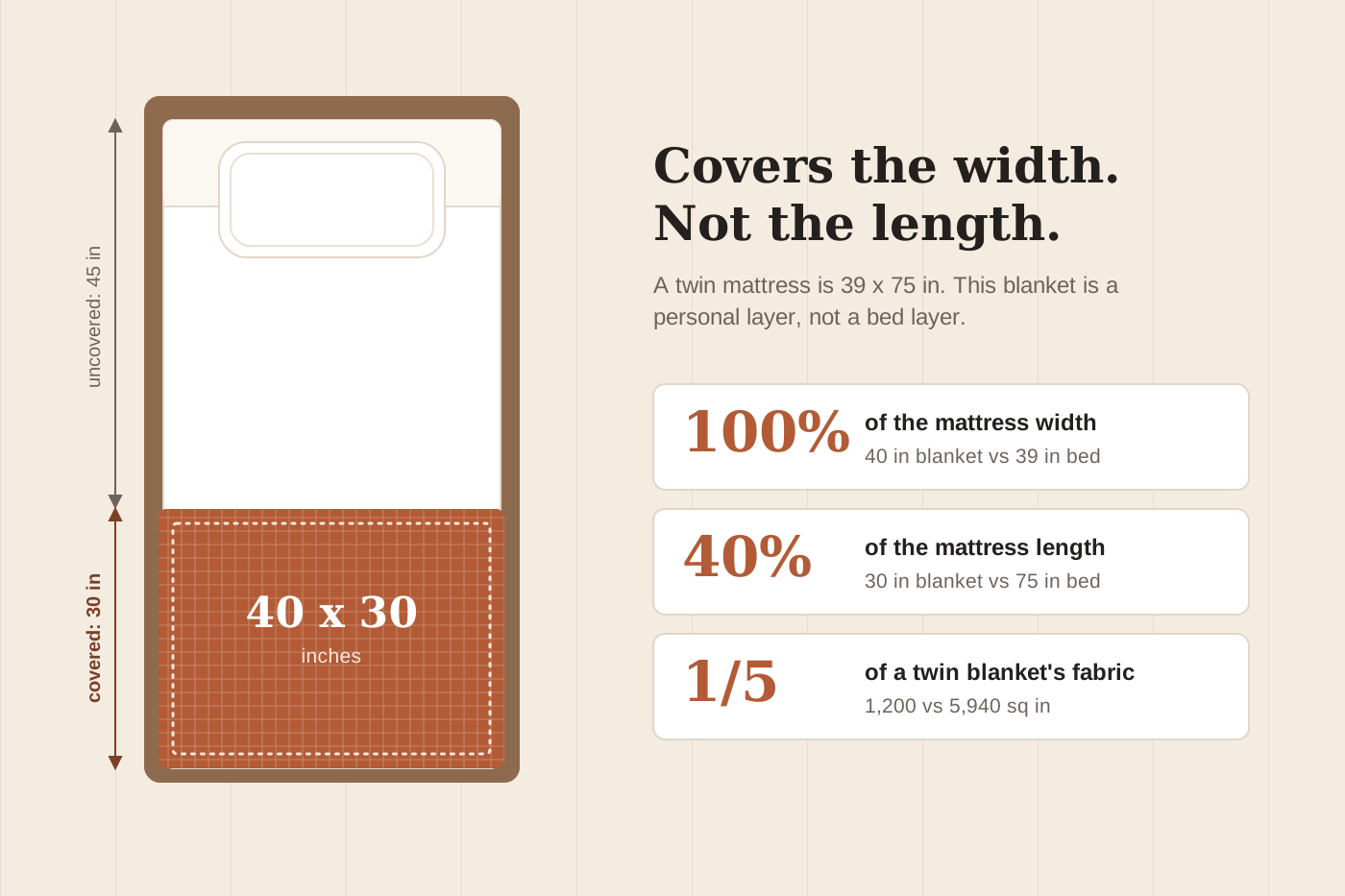
A 40 x 30 blanket measures 40 inches on its long side and 30 inches on its short side. That is 101.6 cm by 76.2 cm, or roughly 3 feet 4 inches by 2 feet 6 inches. Spread flat, it covers a little over 8 square feet. Folded once, it fits easily in a tote bag. Laid over a person’s lap, it reaches from mid-thigh to the lower chest of an average adult. Laid over a twin bed, it covers the full width of the mattress but barely more than a third of its length.
That is the short answer. The longer answer — the one that actually helps you decide whether to buy, sew, or repurpose one — depends entirely on what you want the blanket to do. A 40 x 30 blanket is an excellent stroller blanket and a genuinely useful pet throw. It is a poor substitute for a bed blanket, and it is not the right choice for swaddling a newborn. In this guide we will walk through every dimension, every common use case, and every realistic expectation, so you can picture the size before it arrives at your door.
1. What a 40 x 30 Blanket Actually Means: The Numbers Behind the Size
Blanket sizes are written as two numbers separated by an “x”, and almost always in inches in North American retail listings. The convention is length by width, or sometimes width by length — and this is where the confusion starts, because most manufacturers list the longer number first. So a “40 x 30” blanket is generally 40 inches across the longest edge and 30 inches across the shorter edge. If you rotate it, it is still the same blanket; the labels simply describe two edges of a rectangle.
What matters is the relationship between those numbers. A 30-inch edge is about the width of a standard bath towel. A 40-inch edge is roughly the length of a small loveseat cushion. Together they form a rectangle with a 4:3 ratio — the same proportions as an old television screen or a sheet of poster paper — and those proportions are part of why the size feels familiar to the eye even before you measure it.
40 x 30 in every unit you might need
If you are ordering from a seller who lists metric measurements, or you are buying fabric by the metre, conversions matter more than they seem. A seller advertising a “100 x 75 cm” blanket is selling essentially the same product as one labelled “40 x 30”, with a rounding difference of less than two centimetres on the long edge.
| Measurement | Inches | Centimetres | Everyday Comparison |
|---|---|---|---|
| Long edge | 40 in | 101.6 cm | Width of a small loveseat cushion |
| Short edge | 30 in | 76.2 cm | Width of a standard bath towel |
| Diagonal | 50 in | 127 cm | Length of a small ironing board |
| Total area | 1,200 sq in | 0.77 sq m | About 8.3 square feet |
| As a fraction of a twin bed | ~40% of the sleeping surface | ~40% | Covers the width, not the length |
| Folded in quarters | 15 x 20 in | 38 x 51 cm | About the footprint of a laptop |
Two numbers in that table deserve emphasis. First, the diagonal is exactly 50 inches, because 30 and 40 are part of the famous 3-4-5 right triangle family. That is a genuinely handy trick: if you need to know whether a 40 x 30 blanket will cover something on a bias or fit inside a diagonally-oriented bag, the answer is 50 inches corner to corner.
Second, the folded footprint. Folded in quarters, a 40 x 30 blanket is about the size of a laptop computer. That is why this size is so popular for travel, strollers, and car glove boxes — it delivers warmth without demanding storage space. If you want to read more about how throw dimensions relate to everyday coverage, our guide to the perfect throw blanket size goes deeper into the ergonomics of a single-person layer.
Looking for a Blanket in This Exact Size?
Stroller, receiving, and pet blankets are most commonly sold at 30 x 40 inches.
Check Price on Amazon2. How Big Is 40 x 30 in Real Life? Visual Comparisons You Can Actually Picture
Numbers on a page are notoriously poor at conveying scale. Almost everyone underestimates how big 1,200 square inches really is, and almost everyone overestimates how much of a person it will cover. The fastest way to internalise the size is to compare it to objects you handle every week.
The object comparison method
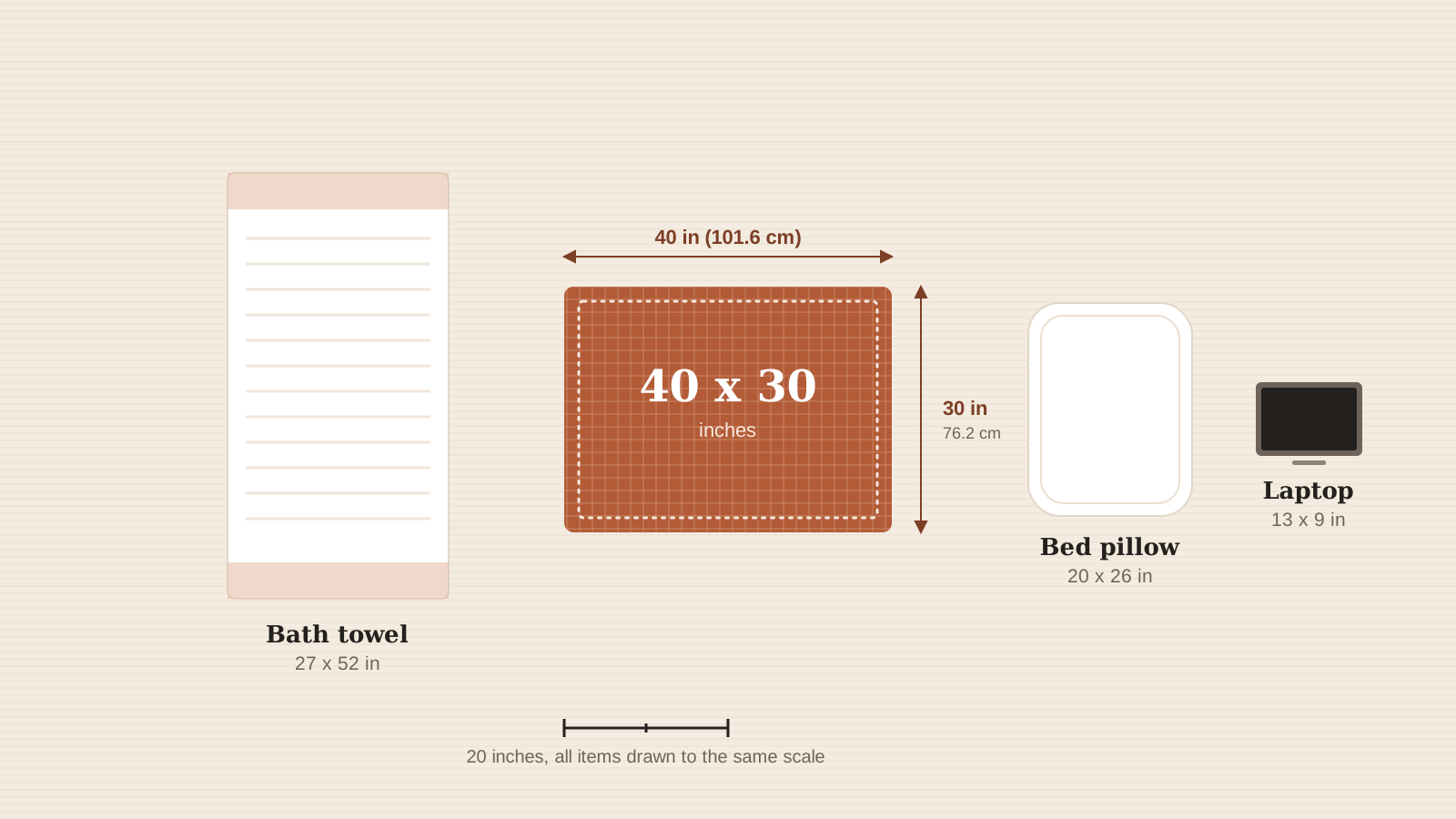
Start with a bath towel. A standard bath towel runs roughly 27 to 30 inches wide and about 52 inches long. Lay one on your bed, and you have a rectangle that is a little narrower and noticeably longer than a 40 x 30 blanket. The blanket is the towel’s width, turned sideways and shortened.
Now think about a standard bed pillow, which is typically around 20 x 26 inches. A 40 x 30 blanket is a bit more than twice the surface area of a pillow — enough to cover a pillow with room to tuck underneath, but not enough to make a pillowcase-style slipcover without piecing fabric together.
Third comparison: a placemat. Standard placemats are about 12 x 18 inches. You could fit almost six placemats into the area of one 40 x 30 blanket. Fourth: a roll of gift wrap. Wrapping paper is usually sold in 30-inch wide rolls, which means a 40 x 30 blanket is exactly one standard width of wrapping paper, cut to 40 inches long. That is a surprisingly accurate mental image, and it is one most people can picture instantly.
What it looks like on a person
Drape a 40 x 30 blanket over the lap of an average adult sitting in a chair and it will cover the thighs from the knees up to the waist, with a small amount left to fold over the midsection. It will not wrap around the shoulders. It will not cover the feet if the legs are extended. For a child between roughly one and five years old, the same blanket covers from chest to toes and can double as a proper small blanket for a nap on the sofa.
This is the single most common surprise people report after buying one: it is a lap layer, not a body layer. If you want to understand the jump up in coverage that comes from a true throw, our comparison of a throw versus a full blanket lays out exactly where each one stops.
Everyday objects and their approximate footprint
| Object | Typical Size | How It Compares to 40 x 30 |
|---|---|---|
| Bath towel | About 27 x 52 in | Similar width, longer — the blanket is squarer |
| Hand towel | About 16 x 30 in | The blanket is roughly 2.5 hand towels in area |
| Standard bed pillow | About 20 x 26 in | Blanket is about twice the surface area |
| Roll of wrapping paper | 30 in wide | One standard roll width, cut 40 in long |
| Yoga mat | About 24 x 68 in | Narrower and much longer than the blanket |
| Laptop computer | About 9 x 13 in | Similar to the blanket folded in quarters |
| Dining placemat | About 12 x 18 in | Nearly six placemats fit inside the blanket |
One more comparison that people find useful when buying for a stroller: most single stroller seats are roughly 12 to 14 inches wide and 25 to 30 inches long in the reclined position. A 40 x 30 blanket is wide enough to drape over a seated child with excess on both sides and long enough to run from the footrest to above the head. That is precisely why 30 x 40 has become the de facto stroller blanket dimension across the industry.
See Stroller-Sized Blankets
Most 30 x 40 blankets are marketed as stroller or receiving blankets.
Check Price on Amazon3. Where a 40 x 30 Blanket Sits on the Standard Blanket Size Chart
The blanket industry does not have one universal governing body that dictates dimensions, but it does have a set of very consistent conventions. Once you see the chart laid out, the 40 x 30 size stops feeling ambiguous and starts feeling obvious: it sits directly between a large receiving blanket and a lapghan, and it is the smallest size that is comfortably useful for an older baby or a medium pet.
| Blanket Type | Common Size (inches) | Typical Coverage | Notes |
|---|---|---|---|
| Lovey / security blanket | 12 x 12 to 16 x 16 | A toddler’s grip, not their body | Comfort object, not bedding |
| Receiving blanket (small) | 30 x 30 | Newborn torso and limbs | Square format, often sold in packs |
| Receiving blanket (large) | 36 x 36 | Newborn to 3 months | The most common “one size up” |
| Focus Size 40 x 30 blanket |
40 x 30 | Stroller, lap, pet, older baby | Also sold as 30 x 40 |
| Swaddle blanket (large muslin) | 47 x 47 | Full swaddle up to several months | Square, generous for wrapping |
| Lapghan | 36 x 48 | Seated adult from lap to chest | Designed for wheelchairs and sofas |
| Throw blanket | 50 x 60 | One adult, curled up | The classic sofa size |
| Twin blanket | 66 x 90 | Twin bed with tuck-in | Roughly 4x the area of a 40 x 30 |
| Queen blanket | 90 x 90 | Queen mattress with drape | Seven times the area of a 40 x 30 |
| King blanket | 108 x 90 | King mattress with deep drape | Nine times the area of a 40 x 30 |
Notice the jump between rows. A 40 x 30 blanket has an area of 1,200 square inches. A standard 50 x 60 throw has 3,000 square inches — two and a half times more fabric. A twin blanket has 5,940 square inches, nearly five times more. Those ratios are why a small blanket can feel perfectly adequate for one job and completely useless for another. If you want the full bed-size breakdown, our blanket size chart by bed size covers every mattress dimension in detail.
The naming problem: what is a 40 x 30 blanket called?
There is no single industry term for this dimension, which is exactly why the question gets searched so often. Depending on the retailer and the material, you will see it listed as a stroller blanket, a large receiving blanket, a crib or toddler “security” blanket, a small pet throw, a buggy blanket, a car seat blanket, or simply a baby blanket. Some sellers reverse the numbers and call it a 30 x 40. Others round it and advertise “40 x 30 approx”.
The result is that two products with completely different names can be the same size, and two products with the same name can differ by several inches in each direction. Always check the stated measurements in the product specification rather than relying on the category name.
Why this size is not a bed blanket
A twin mattress measures about 39 x 75 inches. A 40 x 30 blanket covers the full width of that mattress and less than half the length. It is useful as a decorative runner across the foot of a bed, or as a folded accent layer, but it will not keep a sleeping person covered. This distinction matters if you are buying a gift and want it to be usable rather than merely attractive. For a proper bed-layer gift, the discussion in duvet versus blanket explains the different jobs those two categories do.
Compare Throw and Bed Blanket Sizes
Jump up to a throw if you want full-body coverage on a sofa.
Check Price on Amazon4. Is a 40 x 30 Blanket Big Enough for a Baby?
This is the most common reason people search for the dimensions, so it deserves a careful and safety-conscious answer. The short version: a 40 x 30 blanket is a good size for use with an older baby while awake and supervised, and for use in a stroller or as a cover while being held. It is not an appropriate standalone sleep surface covering for a young infant, regardless of its size.
Where 40 x 30 works well for babies
- Stroller walks. The size drapes over a reclined seat without excess fabric pooling near the face, and it folds small enough to live in a nappy bag.
- Supervised tummy time or floor play. It gives a clean, soft surface for a baby to lie on while you are right there.
- Nursing or feeding cover. 30 inches of width gives reasonable coverage across a parent’s shoulder and the baby’s body.
- Burping and changing layer. A small blanket is easier to rotate through the wash than a full-size one.
- Older baby nap on a parent. If a baby has fallen asleep on your chest and you are awake and alert, a light layer over their back is a normal, practical use.
Where it falls short
For swaddling a newborn, 40 x 30 is tight. Effective swaddling needs a square blanket with enough fabric to wrap across the body and tuck securely — usually 47 x 47 muslin or similar. A rectangular 40 x 30 can manage a rough swaddle on a very small newborn, but it leaves little margin for tucking and becomes unusable within weeks as the baby lengthens. The comparison between receiving blankets, swaddles, and muslin explains how the formats differ, and our guide to whether receiving blankets and swaddles are the same thing clears up a very common mix-up.
Age and fit at a glance
| Age Range | Fit of a 40 x 30 | Best Use | Sleep Use |
|---|---|---|---|
| Newborn to 3 months | Generous for wrapping | Burp layer, nursing cover, floor mat | Not in the sleep space |
| 3 to 6 months | Good all-round size | Stroller, car seat while carrying, play mat | Not in the sleep space |
| 6 to 12 months | Covers torso and legs | Stroller naps with supervision, pram shade | Follow safe-sleep guidance |
| 1 to 3 years | Comfort blanket size | Sofa naps, car rides, toddler bed accent | Age-appropriate once the child can move freely |
| 3 years and up | Lap size | Reading, travel, school quiet time | Fine as a light layer |
If you are choosing a first blanket for a new baby, it is worth reading our roundup of the best baby blankets and, for the earliest weeks specifically, our tested guide to the best swaddle blankets for newborn sleep. When the swaddling phase ends, the transition to a sleep sack is a step many parents find confusing — swaddle versus sleep sack walks through exactly when to switch.
Materials matter more at baby sizes
Because a small blanket is handled constantly — washed repeatedly, chewed, dragged, and tucked — the fabric choice matters more than it would on a decorative throw. Muslin breathes beautifully but offers little warmth. Cotton flannel is warm and washes well. Minky is irresistibly soft but can run warm and requires gentler washing to keep its pile. Our comparison of minky versus fleece for baby blankets and our explainer on what minky fabric is made of will help you choose.
Shop Baby Blankets by Size
Filter for 30 x 40 receiving and stroller blankets.
Check Price on Amazon5. Pets, Crates, and Cars: Where 40 x 30 Really Shines
If there is one use case where the 40 x 30 blanket is almost perfectly optimised, it is pets. The dimensions match the interior footprint of the most commonly purchased crate and bed sizes, the fabric amount is cheap enough that you can own several and rotate them through the wash, and the folded size fits in a car door pocket.

Crate and bed fit
Pet crates are usually sold by their exterior dimensions, and the interior is typically two to four inches smaller on each side once you account for the frame and rounded corners. A 40 x 30 blanket lines the floor of a 36-inch crate reasonably well, sits flat inside a 30-inch crate with room to fold up the sides, and is oversized for a 24-inch crate — which is useful, because the excess can be folded to create a raised edge many dogs prefer.
Round and oval pet beds are a slightly different story. A 40 x 30 blanket laid over an oval bed will cover the sleeping surface and leave the bolster visible. It is also much easier to wash than the bed itself, which is the practical reason most pet owners keep a stack of small blankets on rotation.
| Pet or Space | Typical Size | Fit of a 40 x 30 | Practical Note |
|---|---|---|---|
| Cat bed or window perch | 16 to 22 in across | Full coverage, excess drapes | Fold in half for a thicker nest |
| Small dog crate (24 in) | About 24 x 18 in inside | Oversized | Fold edges up for a bolster effect |
| Medium crate (30 in) | About 30 x 21 in inside | Near-perfect liner | Trim-free, stays put with a grippy underside |
| Large crate (36 in) | About 36 x 24 in inside | Good coverage | Add a second for full floor coverage |
| Car back seat | About 50 in wide | Partial cover | Ideal as a seat-corner protector |
| Sofa arm or chair seat | Varies widely | Targeted protection | Covers the exact spot a pet claims |
Choosing fabric for pets
For pets, durability and washability beat softness every time. A tightly woven cotton or a mid-weight fleece survives repeated hot washes far better than a delicate knit. Avoid loose bouclé or open crochet work for a pet that claws or chews, since loops catch claws and threads pull free. If your pet is a chewer, no blanket is entirely safe when unsupervised.
Behaviour is worth mentioning too, because it changes how you use a small blanket. Cats in particular develop odd attachments to particular textures — kneading, suckling, and licking fabric is common and usually harmless, but if it escalates it is worth understanding why. Our piece on why cats lick blankets covers the likely explanations. For a wider look at materials and sizes for animals, see our guide to the best pet blankets.
Travel with pets
On road trips, a 40 x 30 blanket is the right size to lay across a single seat, line a travel crate, or cover a car boot corner. It folds to roughly the footprint of a laptop and takes up almost no space, which makes it far more practical than a full throw that has to be stuffed into a gap. Because it is small, it also dries quickly after a wet walk — a genuine advantage over a heavy blanket that stays damp for a day.
Find Pet Blankets and Crate Mats
Machine-washable layers sized for crates, sofas, and car seats.
Check Price on Amazon6. Lap Use, Travel, Wheelchairs, and Small Spaces
The second great strength of the 40 x 30 size is portability. It is the largest blanket that still disappears into a bag, and the smallest that still delivers meaningful warmth. That combination makes it a favourite for people who are constantly moving between environments: commuters, travellers, office workers in cold buildings, and anyone using a wheelchair or recliner where a full throw would bunch and drag.
On the sofa, in a recliner, and at a desk
Seated use is where a small blanket earns its keep. A 50 x 60 throw is wonderful when you are curled up, but it drapes onto the floor in a recliner and gets caught in wheels or footrests. A 40 x 30 stays entirely on your lap, which is cleaner, warmer in practice, and far less likely to end up in the dog’s bed. If you work at a desk in an air-conditioned office, a folded 40 x 30 is unobtrusive enough to live in a drawer.
For wheelchair users, lap coverage is a specific and well-documented need. A blanket that is too long catches in the wheels and frays quickly. A 40 x 30 sits above the knees and stops well before the axle line on most manual chairs. Lapghans designed for this purpose tend to run slightly longer — around 36 x 48 — so if you want the extra length, that is the category to look at. Our roundup of the best cozy blankets for the living room includes several options across both sizes.
Travel and transit
Aeroplane cabins, long-distance coaches, and trains are notoriously cold at shoulder height and warm at floor level. A 40 x 30 blanket covers the lap and lower torso without encroaching on a neighbour’s space, and it folds into a daypack side pocket. If you travel with neck or shoulder issues, pairing a small blanket with proper support makes a bigger difference than most people expect — our guide to the best travel blanket and pillow sets for neck pain covers that combination in detail.
For car travel, a 40 x 30 is a good emergency layer to keep behind the seat. It is warm enough to make a difference while waiting for roadside assistance, and small enough that most people actually keep one in the car rather than leaving it at home. If you want something purpose-built for survival situations, our review of the best emergency blankets covers dedicated options.
Outdoor and leisure use
At a picnic, a 40 x 30 blanket is a seat for two rather than a ground cloth for four. At a beach it is a towel-plus. At a kids’ sports match it is exactly the right size to fold over a cold aluminium bleacher seat and then wrap around your own shoulders at half time. Our guides to the best picnic blankets, the best blanket for the beach, and the best blankets for outdoor sports get into what works in each setting.
| Use Case | Suitability | Why It Works | Better Alternative |
|---|---|---|---|
| Sofa lap layer | Excellent | Stays on the lap, no drag | Throw if you want to curl up |
| Wheelchair lap cover | Excellent | Clear of wheels and footplates | Lapghan for extra length |
| Office desk blanket | Excellent | Drawer-sized, discreet | Wearable blanket if hands-free |
| Airplane or coach travel | Very good | Packs small, no neighbour encroachment | Travel set with neck support |
| Stroller or pram | Excellent | Designed around this footprint | None needed |
| Camping seat cover | Good | Fits a folding chair seat | Water-resistant outdoor blanket |
| Full-body bed blanket | Poor | Covers less than half a twin bed | Twin or throw size |
One further niche worth flagging: small blankets are widely used in dementia and memory care as sensory tools. Textured, tactile blankets with different fabrics stitched together can be genuinely calming. If that is your use case, our guide to the best fidget blankets for dementia explains which textures and attachments are helpful and which are best avoided.
Browse Travel and Lap Blankets
Compact layers sized for planes, cars, desks, and recliners.
Check Price on Amazon7. Materials and Fabrics That Make Sense at 40 x 30
Size and fabric are not independent decisions. A 40 x 30 blanket in heavyweight sherpa behaves completely differently from a 40 x 30 blanket in single-layer muslin, even though the footprint is identical. At this size, thickness has an outsized effect because there is so little surface area to distribute warmth — a thick small blanket feels like a hot brick, and a thin small blanket barely registers.
Common fabrics and how they behave at this size
| Fabric | Warmth at This Size | Wash Behaviour | Best Suited To |
|---|---|---|---|
| Cotton muslin | Very light | Softens with every wash | Newborn wraps, summer stroller shade, burp layers |
| Cotton flannel | Moderate | Holds up well, slight shrinkage | Cool-weather stroller use, toddler comfort blankets |
| Polar fleece | Warm | Dries fast, resists pilling if quality is good | Pets, cars, outdoor use, everyday lap layers |
| Sherpa / faux shearling | Very warm | Bulkier in the machine, air-dries slowly | Winter lap use, sofa throws for one |
| Minky | Moderate to warm | Needs gentle care to protect the pile | Baby comfort blankets, sensory blankets |
| Bamboo viscose | Cool and light | Gentle cycle, avoid high heat | Warm climates, sensitive skin, night sweats |
| Wool or merino | Warm even when damp | Requires careful washing or hand washing | Outdoor use, draughty homes, travel |
| Chenille | Warm and heavy for its size | Sheds initially, holds shape well | Decorative throws, sofa accent layers |
| Waffle weave | Light, breathable | Excellent durability | Year-round layering, warm sleepers |
For a full education on what each fibre brings to the table, start with our guide to blanket materials, then narrow down with the head-to-head comparisons: cotton versus polyester, microfibre versus cotton, fleece versus sherpa, and wool versus fleece. If you are buying for a baby, muslin versus cotton is the distinction that matters most.
Which materials to choose for which job
- For a newborn gift: cotton muslin or organic cotton flannel — breathable, easy to wash, and forgiving of frequent laundering.
- For a pet crate: mid-weight polar fleece — quick to dry, warm, and inexpensive enough to own in multiples.
- For winter travel: wool or a wool blend — warmth that survives damp conditions.
- For warm climates: bamboo viscose or waffle weave cotton — a layer that prevents overheating.
- For sensitive skin: smooth-woven cotton or bamboo — fewer raised fibres and finishes.
- For a decorative accent: chenille or a chunky knit — texture that looks considered at small scale.
Texture guides worth reading alongside this section include our explanations of chenille blankets and afghan blankets, plus the frequently confused pairing of minky versus fleece. If cooling is your priority rather than warmth, bamboo versus cotton and the guide to the best bamboo blankets are the right places to look.
8. Warmth, Weight, and Layering: What a Small Blanket Can and Cannot Do
People routinely expect a small blanket to perform like a large one and are then disappointed. The physics is straightforward: warmth is a function of the trapped air held by the fabric, and coverage is a function of area. A 40 x 30 blanket can hold plenty of warm air but it simply cannot cover much of you. Understanding that distinction saves you from buying the wrong product twice.
Insulation versus coverage
Think of it this way. A heavyweight sherpa 40 x 30 blanket might be warmer than a thin 50 x 60 throw per square inch. But the throw covers roughly 2.5 times more of your body, so it keeps you warmer overall. If your goal is to feel cosy while seated and reading, a small thick blanket is genuinely effective. If your goal is to sleep under something, it is not.
Weight is the other half of the equation. A small blanket made from dense fabric will feel substantial and “expensive” in the hand. A small blanket made from a lightweight knit will feel flimsy even if it is well made. Both can be the right purchase — but only if you know which one you want. For reference on how fabric weight is described, many brands quote grams per square metre; higher numbers mean a denser, heavier textile.
Layering strategies that actually work
- Double it up. Folding a 40 x 30 blanket in half doubles the effective thickness over half the area, which is exactly where your lap sits. This is the simplest warmth upgrade available.
- Pair with a throw. Use the small blanket for lap and torso and a larger throw over the legs.
- Use it as a top layer over a sheet. On a warm night, a 40 x 30 over the midsection is a familiar summer arrangement in many households.
- Trap warmth under a coat. A folded small blanket inside a jacket at a cold outdoor event is remarkably effective.
Special categories: thermal, heated, and weighted
Some blankets are engineered rather than simply woven. Thermal blankets use a structure designed to trap air in pockets. Heated blankets contain wiring and require entirely different safety and cleaning rules — worth reading about before purchase in our guides to electric blanket safety, whether electric blankets use a lot of electricity, and the differences between a heated blanket and a heated mattress pad. Our review of the best thermal blankets covers the engineered options.
Weighted blankets are a separate conversation again, because the weight is calibrated to body size. Most weighted blankets start around throw size and go up; a 40 x 30 weighted blanket would be a child-size product. If that is what you are looking for, read weighted blankets for kids and the general weighted blanket guide. For general anxiety applications, the overview of the best blankets for anxiety is a useful starting point.
Looking for Extra Warmth?
Thermal and fleece layers deliver more heat per square inch.
Check Price on Amazon9. Washing, Drying, and Storing a Small Blanket
Small blankets get washed more often than large ones. That is partly because they are used for messier jobs — pets, babies, cars — and partly because they are so easy to throw in the machine that nobody hesitates. The upside is obvious. The downside is that frequent washing is where most small blankets actually wear out, not through use.
General washing principles
- Wash cool or warm, not hot. Heat breaks down elastic fibres and accelerates shrinkage in natural fibres.
- Use a mild detergent. Fabric softener coats fibres and reduces the absorbency of cotton and muslin; it can also flatten the pile on minky and fleece.
- Close any zippers and fasten Velcro. Open fasteners snag loops and pull threads across the whole blanket in one wash.
- Wash separately the first time. New blankets often release dye and lint.
- Tumble low or line dry. High heat is the fastest way to make fleece stiff and cotton stiff-and-shrunk.
- Shake before drying. It reduces creasing and helps the pile recover on textured fabrics.
Care by fabric type
| Fabric | Wash | Dry | Watch Out For |
|---|---|---|---|
| Cotton muslin | Machine, warm | Tumble low or line | Cotton shrinks on first hot wash |
| Cotton flannel | Machine, warm | Tumble low | Pilling if washed with rough items |
| Fleece | Machine, cool | Tumble no-heat or line | Static and matting from softener |
| Sherpa | Machine, cool, gentle | Air dry preferred | Pile clumping if over-dried |
| Minky | Machine, cool, gentle | Tumble low or air | Crushing the raised pile |
| Bamboo viscose | Machine, cool, gentle | Flat or line dry | Fibre weakening when wet |
| Wool | Hand wash or wool cycle | Flat, away from heat | Felting and shrinking |
| Chenille | Machine, cool, gentle | Tumble low | Shedding in early washes |
For fabric-specific walkthroughs, we have detailed guides on washing a minky blanket, washing a wool blanket, and washing heated blankets safely. If your small blanket is a cooling model, the specific instructions in can you wash cooling blankets will protect its performance. Larger items need a different approach — see how to wash a weighted blanket and how to do it without ruining the fill.
Storage for small blankets
Small blankets are the easiest thing in the house to store well, and the easiest to lose in a cupboard. The three systems that work are baskets for everyday rotation, breathable bags for seasonal storage, and ladders or chests for display. Whatever you choose, avoid vacuum-sealing natural fibres for long periods, and make sure anything stored for a season is completely dry first — mildist is the only thing that reliably ruins a well-made blanket.
Our storage guides cover blanket storage bags, blanket baskets, blanket ladders, and blanket chests and storage trunks.
Keep Small Blankets Organised
Baskets, storage bags, and ladders sized for compact throws.
Check Price on Amazon10. What to Look for When Buying a 40 x 30 Blanket
Because this size spans several categories, the buying decision is less about the dimensions themselves and more about construction. Two blankets of exactly 40 x 30 can differ enormously in how they feel, how long they last, and how they behave after twenty washes. Here is what actually matters, in order of importance.
The feature checklist
- Stated measurements, not category names. Confirm 40 x 30 or 100 x 76 cm in the specification table.
- Edge finishing. Look for a proper hem, a bound edge, or a double-turned seam. Raw or single-stitched edges fray fastest on small blankets because they are washed so often.
- Fabric weight and feel. Decide whether you want light-and-breathable or dense-and-warm before you compare options.
- Reversible construction. Many small blankets are backed with a second fabric, which adds warmth and improves durability.
- Washability. Machine washable is close to essential for anything used by pets or babies.
- Colourfastness. Deeply saturated dyes can run on early washes — test a corner if you are unsure.
- Texture stability. For pile fabrics, check whether the pile is knitted in or glued. Knitted-in lasts far longer.
- Intended use matching. A decorative knit is lovely on a sofa and hopeless in a dog crate.
Pros and cons of the size itself
Why 40 x 30 works
- Folds to roughly the size of a laptop
- Fits standard crates and stroller seats
- Washes and dries quickly at home
- Cheaper to buy in multiples and rotate
- Unlikely to drag on the floor when seated
- Excellent gift size for new parents and pet owners
Where it falls short
- Will not cover an adult for sleeping
- Too small for effective newborn swaddling
- Feels skimpy as a decorative sofa throw
- Categorisation varies, so sizes drift between sellers
- Not a substitute for a bed blanket on any mattress
- Can be mislabelled as “throw” by some retailers
Where to buy and what to expect
You will find this size across general online marketplaces, baby specialists, pet supply retailers, and handmade marketplaces. Mass-market listings are usually consistent and inexpensive. Handmade listings are often better finished and can be customised in fabric and binding, at a higher price. In every case, read the specification section rather than relying on the photographs — product images are frequently shot with a blanket draped over furniture, which makes estimating size impossible.
If you are buying as a present, presentation matters more than with most household items. Our gift blanket guide covers how to choose a blanket for someone else without guessing wrong on size or material. And if you are furnishing a small space, the cozy home essentials checklist puts blankets in context with everything else that makes a room feel settled.
11. DIY: Making Your Own 40 x 30 Blanket
A 40 x 30 blanket is one of the most beginner-friendly sewing projects that exists. It is a rectangle, there are no curves, no closures, and no fitting. If you have ever wanted to make something useful in a single afternoon, this is the project.
Fabric requirements
Most quilting and apparel fabric is sold on bolts 44 to 45 inches wide. Since your long measurement is 40 inches, you can cut the rectangle across the width of the fabric, which means you only need enough length for the 30-inch side plus seam allowance and any shrinkage. In practice that means a little under a yard of a single fabric, and the same again if you are lining it with a second fabric. Buying slightly more is always wise, because cutting straight across the grain on the first attempt is harder than it looks.
Three construction approaches
1. The single-layer hemmed blanket
Cut one rectangle, fold each edge over twice, and stitch. This is the lightest result and the quickest. It suits muslin, flannel, and cotton lawn.
2. The two-layer backed blanket
Cut two rectangles of different fabrics, place them right sides together, stitch around the edge leaving a gap, turn through, and topstitch closed. This gives a warmer, more finished result and is the most common handmade approach.
3. The no-sew tied blanket
Use two layers of fleece, cut fringes around the edge, and tie them together in pairs. It requires no machine at all and takes under an hour. The result is warm, slightly stretchy, and machine washable. It is a favourite for kids’ projects and charity donations.
Finishing details worth the extra time
- Square the corners. Trim and press before stitching to get clean right angles.
- Use a longer stitch length. A slightly longer stitch looks better on blanket-weight fabric.
- Topstitch the edge. It keeps the layers from rolling and adds a professional finish.
- Pre-wash the fabric. Cotton shrinks; pre-washing means your finished blanket keeps its dimensions.
- Consider a label. A small woven label makes a handmade blanket feel like a real gift.
If you would rather crochet or knit, a 40 x 30 rectangle is very achievable with a simple stitch pattern and a medium-weight yarn. Our guide to the best crochet blankets shows styles that work well at small scale, and the explainer on afghan blankets covers the tradition and terminology. For yarn inspiration, our piece on merino wool benefits explains why premium yarn feels noticeably different in a small project.
12. Beyond the Basics: Creative Uses, Gifting, and Getting More From a Small Blanket
Once you stop thinking of a 40 x 30 blanket as a “small blanket” and start thinking of it as a soft rectangle of exactly the right size for dozens of jobs, it becomes one of the most versatile textiles in a home. Here are the uses that owners consistently report as favourites, plus a few that make genuinely thoughtful gifts.
Uses people love
- Photography backdrop. A neutral small blanket photographs beautifully as a surface for newborn or pet photography.
- Seat cushion cover. Folded and tied over a hard dining chair, it adds softness where guests actually sit.
- Desk knee rug. Especially useful in buildings where the air conditioning runs cold all year.
- Reading nook layer. Draped over the arm of a chair, it signals “this is a place to sit”.
- Prayer or meditation mat layer. Small, portable, and easy to keep clean.
- Picnic seating for one. Clean, dry, and just enough for a solo lunch in a park.
- Play mat for small toys. Instantly defines a play area on a wooden floor.
- Beach towel alternative. Softer than a towel and dries almost as fast if it is cotton.
- Gift wrap itself. Fold a blanket around a present and tie it with ribbon — zero waste, and the wrapping becomes part of the gift.
Gifting a 40 x 30 blanket
This is one of the safest gift sizes in the category. A throw can be too big for a small apartment. A bed blanket requires knowing someone’s mattress size. A 40 x 30 blanket has no such requirements — it will be used in a pram, on a lap, in a car, or by a pet regardless of the recipient’s home. Add a handwritten note explaining the size and the intended use and the gift becomes far more considered.
For occasion-based gifting, we have guides to choosing a blanket as a gift, plus curated lists including the best Christmas throw blankets and the best blankets for winter.
Combining small blankets into bigger coverage
A practical trick that solves the “it is too small” complaint: buy two or three matching 40 x 30 blankets and use them together. On a sofa, one per person means nobody fights over a single throw. On a bed, two side by side cover most of a twin mattress. For pets, rotating three through the wash means there is always a clean one on the bed. The economics usually work out favourably compared with buying one large premium blanket, and the maintenance is far easier.
What to do when it is worn out
Small blankets have a long tail of usefulness even after they stop being display-worthy. A retired 40 x 30 becomes a cleaning rag, a packing layer for fragile items, a garage rag, a moving-day furniture protector, or a donation to an animal shelter — most shelters accept clean blankets gratefully. Very little needs to go to waste.
If you are in the market for something larger alongside a small blanket, our reviews of the best king-size blankets, the best fleece blankets, and the best waffle-weave blankets cover the upsized options. For comfort-focused lounging rather than sleeping, the wearable blankets with sleeves category solves the coverage problem entirely differently.
Find Your Next Small Blanket
Stroller, pet, lap, and travel blankets in one place.
Check Price on AmazonFrequently Asked Questions About 40 x 30 Blankets
How big is a 40 x 30 blanket in feet?
A 40 x 30 blanket measures approximately 3 feet 4 inches by 2 feet 6 inches. That gives a total surface area of roughly 8.3 square feet, or about 1,200 square inches. In everyday terms, it is a little larger than a bed pillow laid flat and noticeably smaller than a standard throw blanket.
Is a 40 x 30 blanket big enough for an adult?
For sitting and covering the lap, yes — it is genuinely a good size for that. For sleeping or wrapping around the body, no. An average adult will find it covers the thighs and lower torso but not the shoulders or feet. If you want full coverage, look at a 50 x 60 throw or larger.
What is a 40 x 30 blanket called?
There is no single standard name. It is most often sold as a stroller blanket, a large receiving blanket, a small pet throw, or a buggy or car seat blanket. Some sellers reverse the dimensions and list it as 30 x 40. Always check the stated measurements rather than relying on the product name.
Can a 40 x 30 blanket be used for a baby?
Yes, while the baby is awake and supervised — as a stroller cover, a nursing cover, a play mat, or a burping layer. It should not be placed in a crib with a sleeping infant. Loose blankets of any size are discouraged in an infant’s sleep space; for the recommended timeline, see our guide on when a baby can sleep with a blanket.
Is 40 x 30 big enough for a dog crate?
It fits a 24 or 30 inch crate well and covers most of a 36 inch crate floor. For small crates it will be oversized, which works if you fold the excess up along the sides to create a soft edge. Measure the interior of your crate before ordering, since exterior dimensions can be several inches larger.
What size is 40 x 30 in centimetres?
40 x 30 inches converts to approximately 101.6 x 76.2 centimetres. Many sellers round this to 100 x 75 cm or 100 x 80 cm, which is functionally the same product for almost every use.
Does 40 x 30 mean length by width?
Usually, yes. The larger number is normally listed first and refers to the longer edge. Because a blanket is a rectangle that can be rotated, the practical result is the same either way — the two sides measure 40 inches and 30 inches.
Is a 40 x 30 blanket a throw blanket size?
Not by the usual definition. A standard throw is around 50 x 60 inches. A 40 x 30 is better described as a lap blanket, stroller blanket, or small pet throw. Some retailers use the word “throw” loosely, so check the measurements.
How much fabric do I need to make a 40 x 30 blanket?
For a single-layer blanket, a little under one yard of 44 to 45 inch wide fabric is sufficient. For a two-layer backed blanket, buy around a yard of each fabric. Always add extra if you want a wide border or if the fabric is likely to shrink.
Can I use a 40 x 30 blanket as a stroller blanket?
Yes — this is arguably its ideal use. It drapes over a reclined stroller seat without excess fabric pooling near the face, and it folds small enough to keep in a nappy bag. Most blankets marketed as stroller blankets are close to 30 x 40 inches for exactly this reason.
How do I wash a 40 x 30 blanket?
Machine wash on a cool or warm gentle cycle with mild detergent, then tumble dry on low or line dry. Skip fabric softener on cotton, muslin, fleece, and minky. Wool and bamboo need gentler handling — hand washing or a dedicated wool cycle, and flat drying for bamboo.
Where can I buy a 40 x 30 blanket?
General online marketplaces, baby retailers, pet supply stores, and handmade marketplaces all carry this size. Search for “30 x 40 receiving blanket”, “stroller blanket”, or “small pet throw” to surface the widest selection, and confirm the dimensions in the specification section before buying.
Still Deciding on Size?
Compare 30 x 40 options alongside throws and lapghans.
Check Price on AmazonSo, How Big Is a 40 x 30 Blanket, Really?
It is 40 inches by 30 inches, roughly 3 feet 4 by 2 feet 6, with a 50-inch diagonal and a little over 8 square feet of coverage. It folds to about the footprint of a laptop. On a twin bed it covers the width and less than half the length. On an adult’s lap it reaches from knees to waist. On a toddler it runs chest to toes. On a medium dog crate it is a near-perfect liner.
That is the honest summary. It is not a bed blanket and it never pretended to be. What it is, is one of the most useful textile sizes in a household: small enough to travel, big enough to matter, cheap enough to own in multiples, and versatile enough that you will find uses for it long after you have forgotten what you originally bought it for.
If you are buying one for a stroller, a pet, a car, a desk, or a gift, you now have everything you need to choose with confidence — the exact measurements, the fabric implications, the safety context, and the buying checklist. The only thing left is to decide which job you want it to do first.
Find the Right 40 x 30 Blanket Today
Compare sizes, fabrics, and finishes across top-rated options.
Check Price on Amazon