What Is the Perfect Throw Blanket Size? Every Dimension, Use Case & Buying Decision Explained
From compact lap warmers to generous king-draping throws — nail the right dimensions every single time.
What Even Is a Throw Blanket — and Why Does Size Matter So Much?
Walk into any home goods store and the “throw” section will occupy more shelf space than any other single textile category. Yet most shoppers grab the first cozy-looking square they see, take it home, and discover it barely covers their knees on the sofa — or swallows the armchair entirely. The size you choose changes everything: warmth coverage, visual proportions, washability, and whether the blanket actually gets used or just sits folded on a shelf looking pretty.
A throw blanket is technically any small, decorative blanket — distinct from a full bed blanket by its more compact footprint and its role as an on-demand layer rather than primary bedding. That distinction sounds minor, but it creates a massive spectrum of sizes, from 40×30 inches (the 40×30 lap and travel format loved for its portability) all the way to 60×80 inches, which is essentially a twin-bed blanket sold under the “throw” label.
Size isn’t just a physical number either. The perceived coziness of a throw depends on how generously it wraps — and a blanket that’s technically the right measurement can feel skimpy if the fabric is rigid, or luxuriously oversized if it’s a drapey waffle-knit. We’ll unpack all of that. But first, the numbers.
Still, depending on your sofa depth, your height, whether it’s a gift, or whether it’s heading to the beach or into a stroller, that number shifts. This guide breaks down every scenario so you can shop with confidence.
Standard Throw Blanket Sizes at a Glance
The market has settled on a loose set of standard dimensions, though manufacturers round up and down by a few inches. Here’s how the landscape breaks down, from smallest to largest:
Ideal for lap use, children, pets, strollers, and car travel. Not meant to cover an adult torso fully.
A step up from mini — great for petite users, armchairs, and reading nooks.
The industry benchmark. Covers most adults seated or semi-reclined on a sofa. Fits standard washing machines easily.
Good for taller users, double occupancy snuggling, and bed-foot draping on a full or queen.
Approaches twin-bed territory. Perfect for tall people, sectionals, or wearable blankets.
Below is a more detailed reference table that maps dimensions to common use cases, recommended users, and sofa fits:
| Dimensions (inches) | Category Name | Best For | Coverage Rating |
|---|---|---|---|
| 40×30 | Lap / Travel | Kids, pets, travel, strollers | Partial |
| 50×36 | Compact | Petite adults, reading chairs, gifts | Partial–Good |
| 50×60 | Standard | Average adults, sofas, gifting | Full Body (seated) |
| 54×72 | Large | Tall adults, couples, bed accent | Full Body (reclining) |
| 60×80 | Oversized | Very tall users, sectionals, wearables | Generous |
| 60×72 | Wide Throw | Two-person sharing, king-bed accent | Full — Side Drape |
The visual above gives you a sense of the proportional differences. That jump from standard (50×60) to large (54×72) is actually quite meaningful in real-world use — roughly a six-inch addition in width and twelve more inches of length — which makes the difference between just covering your feet while lying on the sofa and having a blanket that stays tucked in when you roll over.
Matching Throw Size to Your Sofa or Couch
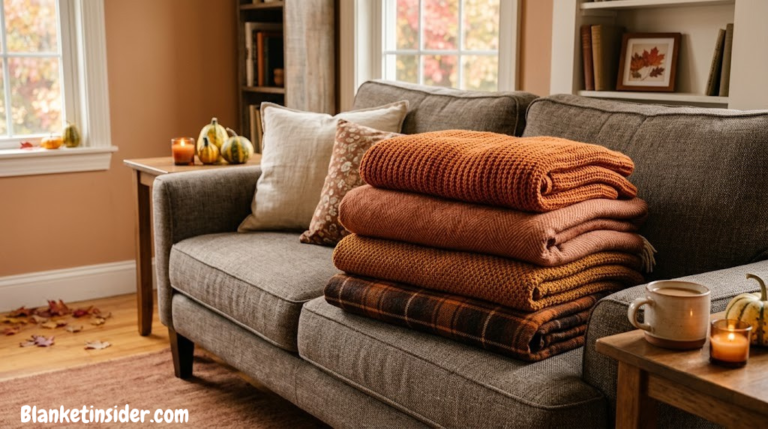
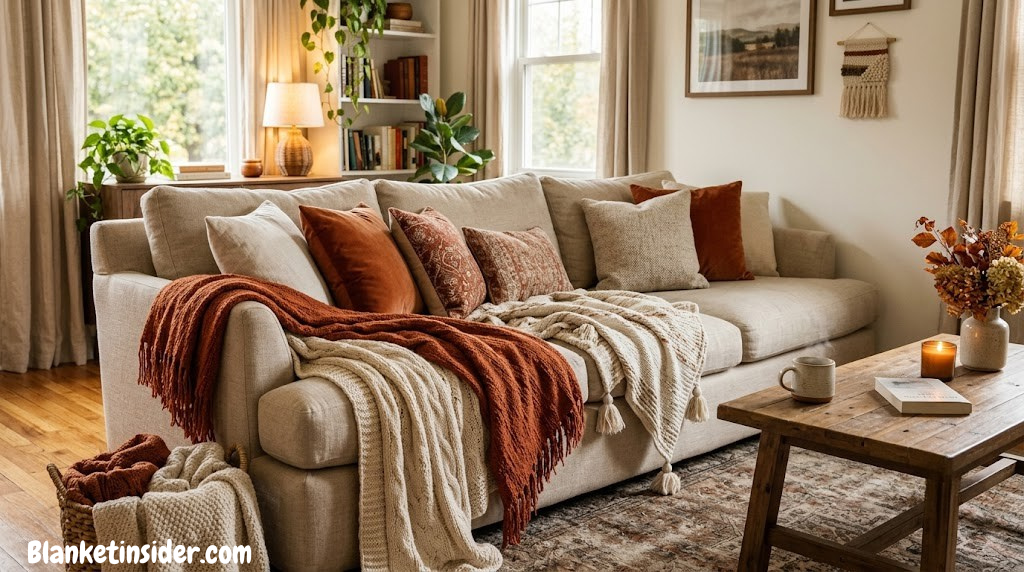
The couch is the spiritual home of the throw blanket. And yet the mismatch between throw dimensions and sofa proportions is one of the most common buyer regrets in home textiles. A throw that’s too small looks like a dish towel draped over a sectional. One that’s too large pools awkwardly on the floor and gets kicked off within twenty minutes.
Interior designers typically approach throw-to-sofa proportion using a simple rule: the throw should span roughly one third to two thirds of the sofa’s length when folded and draped over one end, or cover the seat cushion area when fully unfurled. Here’s how different sofa configurations map to throw dimensions:
Loveseat (60–70 inches wide)
The standard 50×60 works beautifully here, draped diagonally over one armrest. If you prefer the “neatly folded over the back” look, a 54×72 gives you slightly more fabric to work with while still staying proportionate.
Standard 3-Seat Sofa (80–90 inches wide)
This is the most common living room configuration. A 50×60 can cover one person seated, but it will feel a little skimpy draped as décor. Step up to 54×72 for visual impact and enough fabric to actually use. Two throws — one at each end — is the designer move.
Large Sectional (110+ inches wide)
Sectionals are notoriously hard to dress. A single throw gets dwarfed by the scale. Go either oversized (60×80) placed at the chaise section, or layer two to three 50×60 throws distributed across the sofa. If you’re checking out the best cozy blankets for living rooms, most of those recommendations come with sectional pairing notes.
Accent Chair or Reading Chair
A 40×30 is sufficient as a decorative drape, but if you actually want warmth while reading, go with a 50×36 or 50×60. The compact 40×30 is better suited to its dedicated lap and travel role.

Best-Selling 50×60 Throw Blankets on Amazon
The most-purchased throw size — soft, washable, and sofa-ready. Dozens of textures and colors available with Prime shipping.
Shop 50×60 Throws on Amazon ›Throw Blankets on Beds: Accent Draping Done Right
Interior designers have been using throw blankets as bed accessories for decades — layered at the foot of the bed, folded over the corner of a duvet, or tossed artfully over one side. The trick is matching the throw size to the bed size so the proportions feel intentional rather than accidental.
This is a separate question from choosing between a throw and a full blanket for sleeping. Here we’re specifically talking about decorative use.
Twin / Single Bed
A standard 50×60 or 54×72 laid width-wise across the foot of the bed covers nicely and lets a little fabric drape over the sides. Because twin beds are just 38–39 inches wide, even the 50-inch-wide throw has overhang — which is ideal for that relaxed, layered look.
Full / Double Bed (54 inches wide)
A 54×72 is nearly perfect here. Draped widthwise, the blanket reaches the edge of the mattress, creating clean side drops. A 60×72 wide throw gives you a couple extra inches of side drape — useful if you have a high mattress with a thick pillow-top.
Queen Bed (60 inches wide)
The queen is the hardest to dress with a throw because most throws are narrower than the mattress. Go with a 60×80 oversized throw draped widthwise, or choose a 54×72 and accept that it won’t reach the edges — keeping it centered is the design move in that case. If you’re shopping for a king-size blanket, that page also has queen size context.
King Bed (76–80 inches wide)
A single throw on a king bed will look doll-sized. Either layer two 50×60 throws side by side at the foot, or use a wide 60×80 throw centered on the bottom third of the mattress. A knit or chunky chenille blanket works especially well here because the texture adds visual weight that compensates for width limitations.
| Bed Size | Mattress Width | Recommended Throw | Draping Style |
|---|---|---|---|
| Twin / Single | 38–39″ | 50×60 or 54×72 | Widthwise at foot with side drape |
| Full / Double | 54″ | 54×72 or 60×72 | Widthwise, flush to edges |
| Queen | 60″ | 60×80 (centered) | Centered accent or diagonal corner drape |
| King / Cal-King | 76–80″ | Two 50×60s or one 60×80 | Layered at foot — texture matters |
Matching Throw Size to Your Height and Body
Body size is arguably the most overlooked sizing factor. A throw that perfectly suits a 5’4″ person will leave a 6’2″ person with cold ankles every single time. And it’s not just about height — it’s about how you actually use the blanket. Do you wrap it around your shoulders like a cape? Tuck it under your feet? Pull it up to your chin?
Height-Based Sizing Guide
Here’s a practical breakdown for seated use (the most common throw scenario):
| User Height | Seated Coverage Need | Best Throw Size | Notes |
|---|---|---|---|
| Under 5’2″ | Shoulder to ankle | 50×60 | Standard works well; petite adults even have overhang to tuck |
| 5’2″–5’9″ | Shoulder to ankle | 50×60 (optimal) | The sweet spot; 54×72 offers extra tucking room |
| 5’10″–6’1″ | Shoulder to ankle (barely) | 54×72 | 50×60 will leave shins/ankles exposed when seated reclined |
| 6’2″+ | Needs generous length | 60×80 | Oversized provides the shoulder-to-foot coverage tall people need |
There’s also the question of width. Most people focus on length (height coverage) but the 50-inch width of a standard throw is comfortable for one person but gets tight if you’re broad-shouldered or if two people share the blanket. A 60×80 oversized provides genuine two-person coverage — though some couples prefer two separate throws. If you’re exploring options that wrap completely around you, the guide to wearable blankets with sleeves covers oversized formats designed for full-body wrapping.

Oversized 60×80 Throw Blankets for Tall Users
Finally a throw that actually reaches your ankles. Shop oversized options in fleece, knit, and sherpa materials.
Browse Oversized Throws on Amazon ›How Material and Construction Affect Perceived Size
This is the part nobody talks about in sizing guides, and it’s surprisingly important. Two throws that measure an identical 50×60 inches on the label can feel dramatically different in actual use — and it comes down to fabric behavior.
Stretch and Drape
Chunky knit blankets and loosely woven throws have significant stretch. A 50×60 knit can easily stretch to 54×66 under light tension — effectively giving you a larger size without paying for it. On the other hand, a tightly woven cotton throw is dimensionally accurate but less forgiving, and it stays exactly at 50×60. This matters when you’re buying a knit throw versus a woven one: the knit will feel more generous.
Materials like minky fabric and fleece have a similar stretch benefit, with the added bonus of a silky tactile quality that makes them feel softer against the skin — which translates to perceived warmth and comfort even at the same dimensions. If you’re deciding between those two, the minky vs. fleece comparison is worth reading.
Loft and Thickness
A thick sherpa or sherpa blanket adds loft. Loft means the blanket traps air and creates a visual and tactile sense of bulk that’s larger than its flat dimensions suggest. A 50×60 sherpa can feel equivalent to a 54×60 flat-knit in terms of coverage because the raised pile fills gaps at the edges. This also affects washing — lofty throws need more drum space in the machine.
Post-Wash Shrinkage
Cotton throws, especially those that are not pre-washed, can shrink 5–8% after the first wash. A 50×60 cotton throw may become a 46×56 throw after its first hot-water cycle. If you’re buying cotton, size up one size and use cold water — or look for a pre-washed or pre-shrunk label. For material-specific care, the guide on washing cooling blankets and the guide on washing weighted blankets cover different material concerns in detail.
Woven vs. Knit Constructions
Woven (e.g., Waffle, Herringbone)
- Dimensionally stable — size is reliable
- Stays put on furniture
- Minimal shrinkage if pre-washed
- More structured drape
Knit (e.g., Chunky, Cable)
- Size can vary — stretch adds coverage
- Slides and shifts more on smooth fabrics
- Snag-prone on rough surfaces
- Can grow or distort over time
If precise dimensions matter — say, you’re buying for a specific chair and want it to hang a measured distance off the armrest — go woven. If you want maximum cozy coverage and don’t mind the variability, knit wins.
The waffle blanket buying guide goes deep on GSM and weave construction if you want to understand fabric weight in relation to size perception. And for the classic material comparison, the cotton vs. polyester blanket guide is the starting point for understanding the most common throw materials.

Best Chunky Knit Throws — Generous Coverage in Every Stitch
Knit throws stretch and feel larger than their label dimensions. Explore the most popular styles on Amazon.
Shop Chunky Knit Throws on Amazon ›Gifting a Throw Blanket: Choosing the Right Size for Someone Else
Throw blankets are consistently one of the most gifted home textile items — housewarming presents, holiday gifts, sympathy gifts, birthday boxes. The problem is that you’re choosing a size without knowing the recipient’s sofa dimensions, height, or usage style. Here’s how to navigate that.
The safe default for gifting is always 50×60 inches. It covers the broadest range of users, fits in standard gift boxes, doesn’t look overwhelmingly large or disappointingly small, and is exactly what most people mean when they think “throw blanket.”
Gifting by Recipient Type
| Gift Recipient | Recommended Size | Why |
|---|---|---|
| College student / dorm | 50×60 | Works on dorm furniture and doubles as couch-to-bed use. See dorm essentials. |
| Tall adult (6’+ or unknown) | 54×72 | Skewing larger is safer — nobody complains a gift is too cozy |
| Baby shower / infant | 40×30 or 30×40 | Swaddle-appropriate; standard for baby blanket gifting |
| Senior / elderly person | 50×60 | Easy to manage weight and dimensions in a chair or wheelchair lap |
| New homeowner | 50×60 or 54×72 | Fits any sofa; a rich texture like chenille or sherpa elevates the gift |
| Traveler / frequent flyer | 40×30 or 50×36 | Compact enough for carry-on; pairs well with a travel pillow |
| Anxiety / sensory sensitivity | 48×72 (weighted) | Weighted throws have specific sizing logic; see the weighted blanket guide |
| Pet owner | 40×30–50×60 | Dedicating a blanket to the dog or cat is a thoughtful gift; see best pet blankets |
If you’re leaning toward a luxurious fabric, the gift blanket guide covers both sizing and material selection with specific product recommendations for every budget level.
Specialty & Niche Throw Sizes You Should Know About
Beyond the mainstream sizes, there are several specialty formats that serve specific functions. Knowing they exist can save you from buying the wrong thing entirely.
Weighted Throw Blankets
Weighted blankets follow different sizing logic. Unlike regular throws where bigger is generally better for coverage, a weighted throw should match your body weight — typically 7–12% of body weight. The most common weighted throw size is 48×72 inches, which covers an adult torso and is lighter than full weighted blankets (which run 60×80). The weighted blanket sizing guide explains this weight-to-size relationship thoroughly, and if you’re curious about specific products, the Gravity blanket review and YnM weighted blanket review cover popular 48×72 models.
Electric / Heated Throws
Most heated throws come in one size: 50×60 inches. This is deliberately standardized because the wire layout is engineered for that footprint — going larger would require significantly more complex wiring and heavier construction. The heated blanket buying checklist explains the dimensional constraints of electric throws in more detail. Some brands offer a larger 60×80 heated throw for couples, but these are less common. Always check the electric blanket safety guidelines regardless of size.
Infrared Sauna Blankets
These aren’t decorative throws at all — they’re therapeutic wraps typically around 70×71 inches designed to fully enclose an adult body. The MiHigh infrared sauna blanket review and LifePro infrared blanket review cover those dimensions in context.
Emergency / Thermal Blankets
Emergency mylar blankets are typically 52×84 inches — full-body coverage is the priority over aesthetics. The best emergency blankets guide covers both emergency and everyday thermal options. For outdoor winter use, the thermal blanket comparison is a useful next read.
Fidget and Sensory Blankets
Fidget blankets, designed for dementia patients and individuals with sensory processing needs, typically measure 14×14 inches to 18×18 inches as lap pads — much smaller than regular throws. The fidget blanket guide has sizing context for caregivers and therapists.
Throw Sizes for Children, Babies, and Pets
The adult-centric sizing guides rarely address the people (and animals) who actually use the most blankets per capita in any home: children and pets. Both have specific requirements that diverge significantly from standard adult throws.
Baby Blankets and Infant Throws
Baby blankets occupy a distinct size category. The standard swaddle blanket is 40×40 inches (square), while receiving blankets run 30×30 to 40×40. Stroller blankets are typically smaller — 28×35 inches — to stay within the pram without trailing on the ground. The 2026 baby blanket review round-up covers these categories with safety context included.
A crucial point: the American Academy of Pediatrics advises against loose blankets in the sleep environment for babies under 12 months. For sleep, size-appropriate sleep sacks replace blankets entirely. The baby sleep blanket safety timeline maps out exactly when and how blankets can be introduced safely. And if you’re confused about the difference between swaddles, receiving blankets, and muslin wraps, the receiving blanket vs. swaddle vs. muslin guide clarifies each format.
Toddler and Child Throws
For toddlers (12 months to 3 years), a 40×50 or 40×60 inch throw hits the right dimensions — large enough to cocoon a small child on the sofa, small enough to be manageable and light. Most “toddler blankets” sold commercially fall in this range. For older children (ages 4–10), the standard 50×60 works well — they’ll grow into it. The best swaddle blankets guide also includes transitional sizes for older infants and young toddlers.
Pet Throws
Pets don’t need the same size-to-body-coverage ratio as humans. A throw for a large dog on the sofa is mostly about protecting the upholstery — not about the dog feeling cozy under it. That means:
| Pet Type / Size | Recommended Throw Size | Primary Purpose |
|---|---|---|
| Small dog or cat (<20 lbs) | 40×30 or 36×48 | Cozy nest; can be bunched for burrowing breeds |
| Medium dog (20–50 lbs) | 50×60 | Sofa protection + nesting |
| Large dog (50–90 lbs) | 50×60 or 54×72 | Furniture protection; dog likely won’t stay under it |
| Extra large dog (90+ lbs) | 60×80 or waterproof blanket | Sofa/car seat protection; see waterproof pet blankets guide |
For pets, material and washability often matter more than precise size. The best waterproof pet blankets covers durable options that hold up to repeated washing and resists pet dander, odor, and moisture.

Washable Pet Throws — Protect Your Sofa from Fur & Claws
Machine-washable, scratch-resistant, and available in sizes for every pet. Top-rated by dog and cat owners.
Shop Pet Throws on Amazon ›Outdoor, Travel, and On-the-Go Throw Sizes
Throws that leave the house operate under a different set of constraints. Packability, weather resistance, and weight become as important as coverage dimensions. Standard 50×60 throws are often awkward to pack — they’re too large for a regular tote but not large enough to double as an outdoor blanket for a group of people.
Beach Blankets
Beach use requires bigger-than-throw dimensions. A beach blanket typically runs 60×70 to 60×80 inches, allowing a single person to lie fully outstretched without touching sand. Sandproof outdoor blankets used for concerts and picnics often run even larger — 60×90 or 72×90. The best beach blanket guide breaks down the size-to-activity mapping for outdoor use.
Travel and Airplane Throws
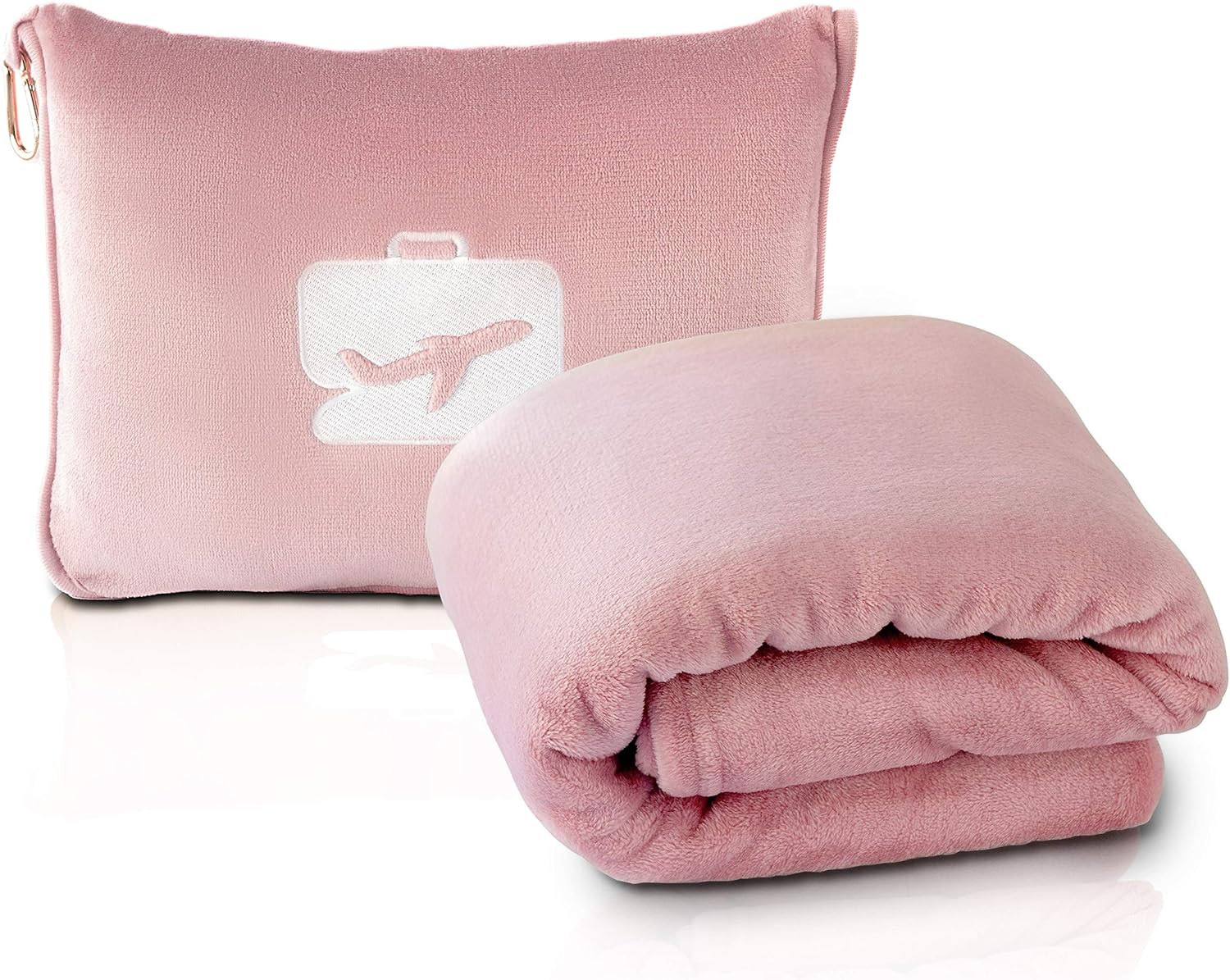
Airline-compatible travel throws are usually 40×50 to 50×50 inches and packable into their own carrying pouch. The key is compressed volume, not just folded size. The travel blanket and pillow set guide covers packable formats and sizing for different seat types (window seats vs. middle seat vs. business class lie-flat). For car road trips, the cozy car road trip guide has specific recommendations for backseat use and charging-compatible heated car throws.
Car and 12V Heated Throws
Heated car blankets plug into a 12V or USB outlet and are typically 40×58 to 50×60 inches — sized to cover a front or back seat occupant without draping onto controls. The 12V heated blanket and EV range guide has detailed size specs for car use, including EV-specific considerations.
Outdoor Sports and Stadium Throws
Stadium blankets — those fleece or waterproof throws you take to football games — run 50×60 to 60×70. The outdoor sports blanket comparison shows the dimensional differences between waterproof, heated, wool, and fleece stadium options.
Your Complete Throw Blanket Buying Checklist
Before you click “add to cart,” work through this checklist. It takes two minutes and will save you the frustration of a return.
Step 1 — Determine Primary Use
Will this throw primarily live on a sofa, drape over a bed, travel with you, go outdoors, or be given as a gift? Your answer sets the size category immediately. Sofa use → 50×60 or 54×72. Bed accent → 54×72 or 60×80. Travel → 40×50. Outdoor → 60×80+.
Step 2 — Account for User Height
If the primary user is over 5’10”, start at 54×72. If they’re under 5’4″, a 50×60 will feel generous. For groups or couples, go 60×80 or plan for two separate throws.
Step 3 — Choose Material for Your Climate
Hot/humid climate: cotton, bamboo, or waffle weave. Cold climate: sherpa, fleece, or chunky knit. For year-round use, a mid-weight knit or cotton blend is the versatile choice. If you sleep hot, the cooling blanket guide has size-matched options. For wool vs. alternatives, the wool vs. fleece blanket comparison is helpful.
Step 4 — Check Machine Washability at Your Size
Standard 50×60 throws fit comfortably in a typical home washing machine (top-load or front-load). At 60×80, you may need a commercial machine or laundromat. Always check the care label — some oversized knit throws require dry cleaning or hand washing. The guide on washing weighted blankets without ruining fill covers a related size/machine compatibility challenge.
Step 5 — Match Storage to Size
Larger throws need more storage real estate. A 60×80 oversized won’t fold neatly into a standard basket. Consider a blanket ladder (great for 50×60 and 54×72 folded once), a blanket chest for multiple throws, or a large storage bag for off-season storage. The blanket ladder guide and blanket chest guide both have size-matched recommendations.
| Checklist Factor | 50×60 | 54×72 | 60×80 |
|---|---|---|---|
| Average adult full coverage (seated) | Yes | Yes+ | Generous |
| Tall adult full coverage | No | Yes | Yes+ |
| Standard home washer fits | Easy | Usually yes | Tight / commercial |
| Folds neatly in standard basket | Yes | Depends on basket | Needs large container |
| Works on loveseat | Perfect | Slight excess | Overwhelms it |
| Works on 3-seat sofa | One person | One+ / accent | Two people |
| Works on king bed accent | Too small | Centered only | Proper accent |
| Gift suitability (unknown recipient) | Safest choice | Good for taller people | May overwhelm |

Shop All Throw Blanket Sizes — Sorted by Dimension
Browse the complete range from compact lap throws to oversized 60×80 blankets, all on Amazon with Prime shipping and easy returns.
Browse All Throw Sizes on Amazon ›Quick-Pick by Use Case
50×60 Standard
The universal sofa throw. Works for most adults, most sofas, and most budgets.
54×72 Large
Drapes with intent over queen beds. Also the upgrade pick for taller sofa users.
50×60 Standard
Universally appropriate. Nobody has ever returned a gift throw for being “too standard.”
40×50 Travel Size
Packs into a carry-on pocket. Pairs with a neck pillow for long-haul comfort.
40×50 Toddler / 50×60 Child
Scale with age. Toddlers (1–3) need 40×50; school-age kids step up to standard.
50×60 (medium–large dogs)
Standard size protects most sofa cushions. Go waterproof for muddy dogs.
Frequently Asked Questions
The most common and widely available throw blanket size is 50×60 inches. This dimension covers the vast majority of adults when seated on a sofa — from shoulders to toes for average height users — and it fits comfortably in a standard home washing machine. It’s the size you’ll encounter most frequently in home goods stores, online marketplaces, and in gifting contexts. If you’re ever unsure which size to buy, 50×60 is the safe default.
For most adults between 5’2″ and 5’9″, a 50×60 throw provides full shoulder-to-ankle coverage when seated or semi-reclined on a sofa. Taller adults (5’10” and above) will often find their ankles exposed, especially if they tend to pull the blanket up toward their chin. In that case, stepping up to a 54×72 or 60×80 provides more comfortable full-body coverage.
For a queen bed (60 inches wide), a 60×80 throw draped widthwise across the foot provides the most balanced look. For a king bed (76–80 inches wide), a single standard throw will look too small — either use two 50×60 throws side by side at the foot, or choose a 60×80 centered as a focal accent. If you want full-width coverage on a king, look for “king-size throws” labeled at 90×108 inches, which cross into blanket territory.
Sectional sofas are wider than any standard throw, so the best approach is layering two to three throws rather than trying to find a single large one. Place one 50×60 or 54×72 throw on the chaise section and another at the opposite corner of the sofa. This creates a designer-layered look and ensures every seat has a reachable throw nearby. For purely decorative use on the back of the chaise, a 60×80 oversized throw has enough visual weight to feel proportionate.
A throw is a smaller, decorative blanket typically used as a supplemental layer rather than primary bedding. Standard throw dimensions (50×60 to 60×80 inches) are noticeably smaller than full bed blankets, which run 90×108 (full), 90×108 (queen), and 108×108 (king) inches. Throws are also usually less structured, come in more decorative textures, and are designed to be displayed on furniture when not in use. The throw vs. full blanket breakdown covers this in depth.
Yes, some throw blankets shrink after washing, particularly those made from untreated cotton or natural fibers. Cotton throws can shrink 5–8% in the first wash if hot water is used. Polyester and acrylic throws are generally shrink-resistant. Wool throws require special care and can shrink or felt dramatically if machine-washed in warm water. Always use cold water for first washes, follow the care label carefully, and consider sizing up one size when buying untreated cotton throws if precise dimensions matter to you.
The universally safe gift size is 50×60 inches. It works for almost every adult, fits any standard sofa, and is neither too large (imposing) nor too small (underwhelming). If you know the recipient is tall (over 5’10”) or has a large sectional, bumping to 54×72 is a thoughtful upgrade. For babies and toddlers, 40×30 to 40×50 is the appropriate gift range. For elderly recipients who use wheelchairs or recliners, a 50×60 is practical and manageable.
A throw can work as a supplemental sleeping layer on top of sheets, but it isn’t designed to replace a full bed blanket. A 60×80 oversized throw can adequately cover a single adult in bed — but for most people, the dimensions fall short of providing full coverage on a queen or king mattress. For actual sleeping use, a full blanket or duvet is the more appropriate choice. Throws are best thought of as accent and on-sofa layers, not primary sleeping coverage.
An oversized throw typically refers to 60×80 or larger dimensions. You need one when you’re taller than average (5’10″+), when you want to share a throw with a partner, when you’re using it on a large sectional, or when you want it to function as a foot-of-bed accent on a queen or king. They’re also the format of choice for wearable blankets, where wrapping-around-the-body coverage is the whole point. The tradeoff is that they can be harder to wash in a home machine and harder to store neatly.
For anxiety and sensory needs, many people find weighted throws — typically 48×72 inches with 5–15 lbs of fill — more effective than regular throws because the deep-pressure stimulation provides a calming effect. For purely sensory texture preferences (seeking softness, certain fabrics), a standard 50×60 in an ultra-plush material like minky or sherpa is the most common choice. The best blankets for anxiety guide covers both weighted and non-weighted options with size context.
Final Word: Your Perfect Throw Blanket Size
Here’s the simplified truth: for 80% of buyers, the 50×60 standard throw is the perfect size. It covers most adults, works on most sofas, fits every washing machine, folds into any basket or chest, and ships in a gift box without drama. Start there.
If you’re taller than 5’10”, step up to 54×72 without hesitation — you’ll never go back to cold ankles. If you have a large sectional or king bed, think in terms of layering two standard throws rather than hunting for a single throw large enough to cover everything. And if you’re shopping for a baby, a traveler, or a pet, the 50×60 standard doesn’t apply — use the specific size tables in those sections above.
The throw blanket market is enormous, material options are dizzying, and sizes can vary by an inch or two between brands. But the sizing framework is actually quite simple once you match use case to dimension. You now have everything you need to choose with confidence — and to never, ever end up with cold ankles again.
Shop the Perfect Throw Blanket on Amazon ›