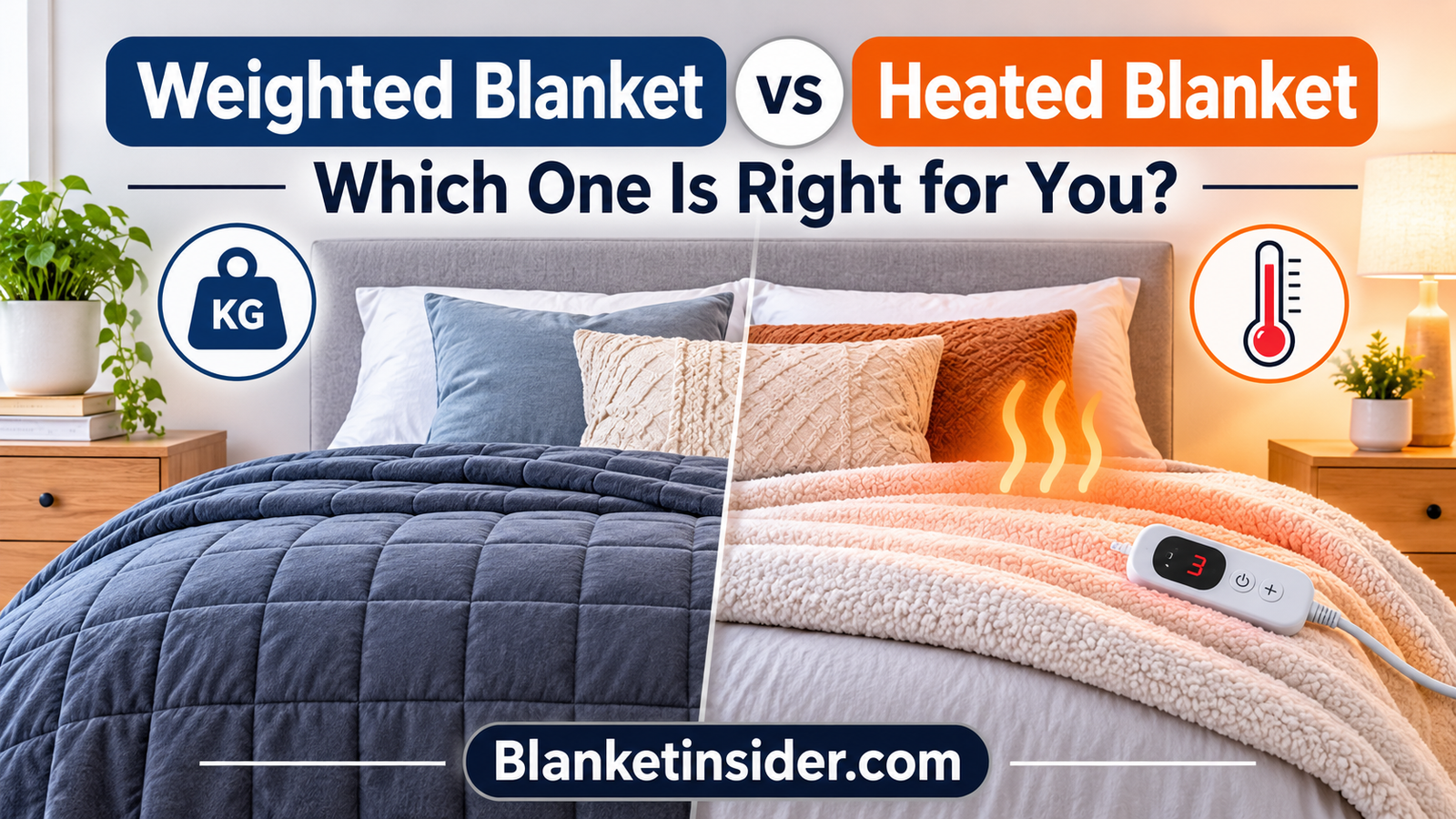
Weighted Blanket vs. Heated Blanket: Which One Is Right for You?
One drapes you in gentle pressure. The other plugs in and warms you up. Here is how to tell which one actually solves the problem that is keeping you awake.
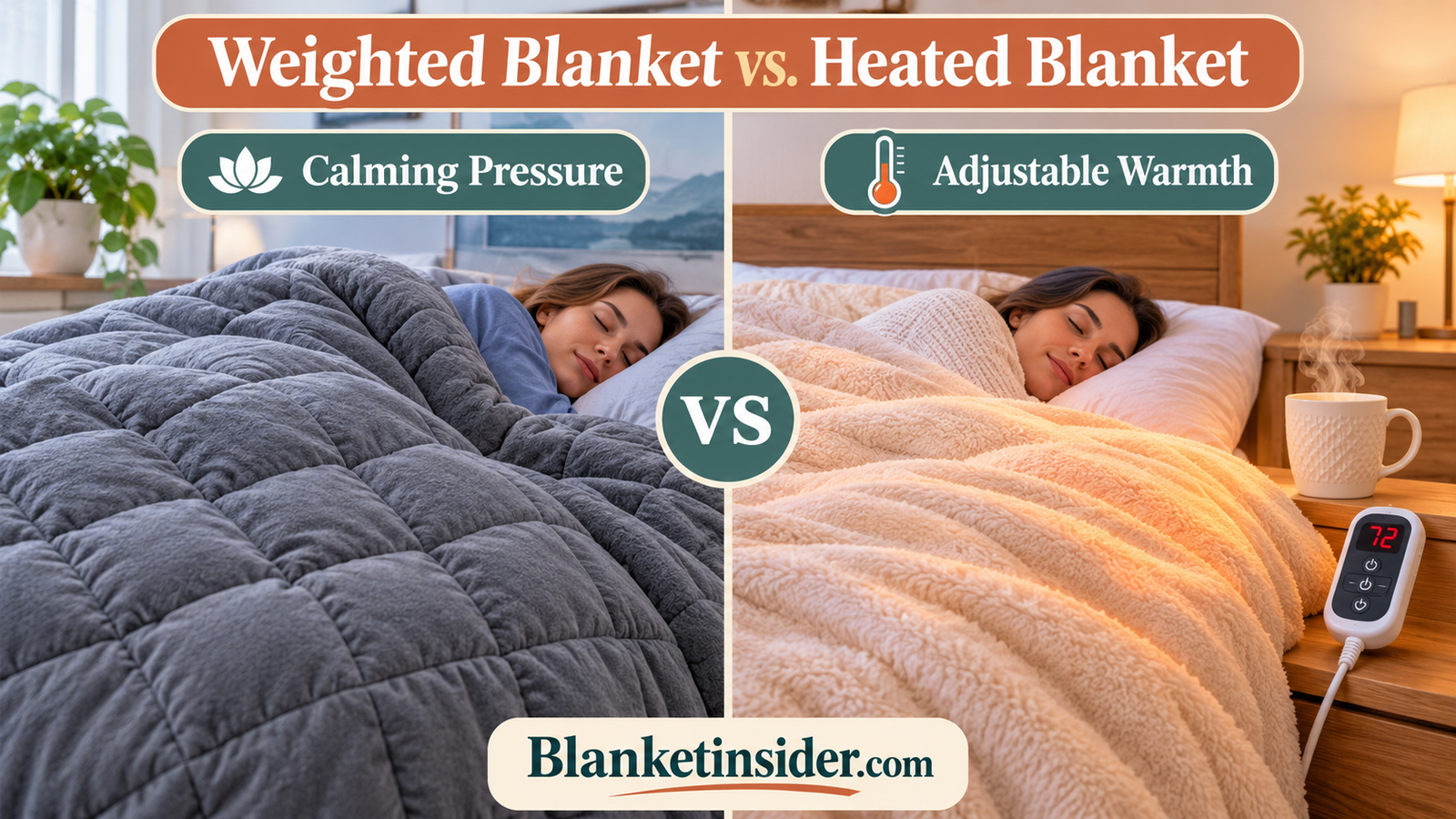
Here is the short answer: a weighted blanket gives you calming pressure, a heated blanket gives you warmth, and the right one depends entirely on what is keeping you from sleeping well. If your mind races at bedtime, the problem is usually tension, and weight helps. If your feet are ice cubes and the bedroom never quite gets warm, the problem is temperature, and an electric blanket helps. Plenty of people need one and not the other. Some people, in a cold room on a restless night, are happy with both.
It is easy to see why the two get confused. They both live at the foot of the bed, they both come in throw and blanket sizes, they both get described as “cozy,” and both are sold as sleep aids. But they solve different problems through completely different mechanisms. One works with gravity and touch. The other works with heating wires, a controller, and a wall outlet.
This guide walks through both in detail: how each one works, how they feel, how warm they get, what the safety picture looks like, how you clean them, what they cost to own over time, and how to choose between them based on your sleep problem, your bedroom, your body, and your partner. You will find quick comparison tables throughout so you can skim to the answer and dig in only where you need to.
Quick answer, right up front
Choose a weighted blanket if your main issue is a racing mind, restlessness, or feeling unsettled at bedtime.
Choose a heated blanket if your main issue is cold — cold bedroom, cold sheets, cold feet, or a partner who runs colder than you.
Choose both (or a hybrid) if you deal with cold and restlessness, and you are comfortable following basic safety guidance for electric bedding.
Quick Comparison: Weighted Blanket vs. Heated Blanket
| Feature | Weighted Blanket | Heated Blanket | What It Means For You |
|---|---|---|---|
| Feel | Heavy, hug-like, grounding. Drape is dense and close to the body. | Light and soft at rest; the sensation is radiant warmth rather than pressure. | Pick by sensation: pressure versus warmth. |
| Warmth | Naturally warm from density and fill, but not adjustable. Runs warm for some sleepers. | Actively adjustable heat with multiple settings, often with timers. | Fixed insulation versus control you can turn up or down. |
| Power source | None. Gravity and fill do all the work. | Wall outlet, power cord, and controller. Needs a reachable socket. | One travels anywhere; the other follows the outlet. |
| Best for | Restlessness, racing thoughts, sensory-seeking comfort, feeling “unmoored” at bedtime. | Cold sleepers, chilly bedrooms, stiff muscles, pre-warming the bed before you get in. | Match the blanket to the actual problem. |
| Safety notes | Weight choice matters. Not ideal for very small children, some older adults, or anyone who cannot lift the blanket off unaided. | Follow the maker’s directions: inspect cords, avoid folding or bunching while on, replace worn units. | Both have a short list of sensible rules. |
| Upkeep | Heavy to launder; many need a large machine or a removable cover. Air-drying is often safest for the fill. | Cord and controller must be handled carefully; washing instructions vary by model and age of the unit. | Check the label before either one touches water. |
| Price range | Typically mid-priced for a standard blanket, higher for premium covers and specialty fills. | Typically mid-priced as well, with throws on the lower end and dual-control or mattress-pad styles higher. | Roughly comparable to own; the real cost difference shows up in care and lifespan. |
Section 01Weighted Blanket vs. Heated Blanket: The Quick Answer
If you only read one part of this guide, read this one. The entire weighted blanket versus heated blanket decision comes down to a single question: is your problem tension, or is it temperature? Everything else — size, fabric, care, cost — is a secondary consideration that you solve after you have answered that first question.
Who should choose a weighted blanket
A weighted blanket is the better fit when bedtime feels restless rather than cold. People tend to reach for one when they describe lying down and feeling “wired,” when their legs will not settle, when they toss and turn looking for a comfortable position, or when the simple feeling of being held helps them switch off. It is also the better choice for people who dislike electric bedding on principle — no cords, no outlet, no controller to lose behind the bed frame.
It is a strong pick for sensory seekers: people who already sleep under two or three regular blankets because one never feels like enough, who curl up under a throw on the couch every evening, or who find calm in a firm hug or a snug swaddle of clothing. Because a weighted blanket works entirely on pressure and drape, it is also a low-maintenance option in terms of setup — you unfold it and it works.
The trade-offs are real. It is heavier to make the bed and heavier to wash. It can feel warm, because density traps heat. And the weight needs to suit the person using it — a blanket that is comfortable for one sleeper can feel oppressive to another. If you are unsure about sizing for a specific bed, start with our weighted blanket calculator or skim the best weighted blankets roundup to see what range of weights and sizes is typical.
Who should choose a heated blanket
A heated blanket is the better fit when the bedroom is the problem. Cold sleepers know the feeling: the sheets are cold when you get in, your feet stay cold for an hour, and the room temperature never quite catches up. A heated blanket addresses that directly and, unlike a stack of quilts, it gives you a dial or button so you can adjust the warmth instead of guessing.
It also suits people who want to pre-warm the bed before getting in — a genuinely underrated pleasure in winter — and people dealing with stiff or achy muscles at the end of the day who find gentle warmth soothing. If you want the fastest, most controllable route to a warm bed, this is it. Our guide to the best electric blankets covers the shapes and feature sets worth looking at.
The trade-offs: it needs an outlet, it adds a cord to the bedroom, it has a controller, and it is an appliance that deserves reasonable care and periodic inspection. It also does nothing for restlessness. If your issue is a racing mind at midnight, warmth alone will not fix it.
Can you use both?
Yes, and plenty of people do — but with a little thought. A weighted blanket over a heated blanket or mattress pad is a common combination in cold climates: the heat source keeps the bed warm, and the weight keeps you feeling settled. The things to watch are total thickness (thick layers can trap heat and make the room feel stuffy), the location of cords and controllers, and how the heat distributes under an extra-heavy top layer.
There are also products that attempt to combine the two ideas, plus a growing range of breathable and cooling options for people who love the weight but sleep hot. We will cover stacking, hybrids, and alternatives in detail near the end of this guide.
Decision table by sleep problem and climate
Use the table below as a shortcut. Find the row that sounds most like your situation and read across.
| Your Situation | Better Pick | Why |
|---|---|---|
| Racing mind, restlessness, trouble winding down | Weighted blanket | Pressure and deep-touch comfort target tension, not temperature. |
| Cold bedroom, cold sheets, cold feet | Heated blanket | Adjustable active heat solves a temperature problem directly. |
| Hot sleeper, night sweats, warm climate | Neither, or a cooling weighted option | Heat adds to overheating; dense fills trap warmth. Breathable materials help. |
| Cold room and restless sleep | Both, layered thoughtfully | Warmth below, weight on top — with attention to cords and total thickness. |
| Shared bed with different temperature needs | Heated blanket with separate controls | Individual settings avoid the nightly thermostat argument. |
| Shared bed where one partner wants pressure | Weighted blanket sized for two | A too-small weighted blanket drifts to one side; correct sizing matters. |
| Small bedroom, few outlets, frequent travel | Weighted blanket | No power needed and no setup, though it is bulkier to pack. |
| Achy muscles at the end of the day | Heated blanket | Soothing warmth is the sensation most people find helpful here. |
Still deciding? Start with the problem you actually have
Weighted blankets are the comfort-and-calm option; heated blankets are the warmth option.
Browse Weighted Blankets on AmazonSection 02What Is a Weighted Blanket?
A weighted blanket is a blanket with added mass — usually distributed evenly across its surface through small, dense fill materials sewn into stitched compartments. That is the entire idea. There are no wires, no settings, and nothing to plug in. It works because it is heavy, and because that weight is spread across your body rather than concentrated in one spot.
How weighted blankets work (deep pressure)
The sensation people describe is “deep pressure” — the kind of firm, even contact you get from a tight hug, a swaddle, or a lead apron at the dentist’s office. The theory is straightforward: steady, distributed pressure feels grounding to many people, and that grounding sensation helps the body settle. You do not need to overthink the science to use one well; the practical question is simply whether firm, even weight feels comforting to you.
That is why weighted blankets show up in conversations about relaxation, restlessness, and sensory comfort. Some people like the pressure on their chest and torso. Others prefer it across their legs. Most find that once they settle under it, the blanket discourages the constant shifting and re-arranging that keeps them awake.
For a deeper look at the mechanics and the everyday experience, our full weighted blanket guide covers sizing, materials, and realistic expectations. If you want the plain-English version of what one actually does at bedtime, see what does a weighted blanket do.
What they’re filled with (glass beads, plastic pellets, and others)
The fill determines how the blanket feels, how heavy it is for its size, how quietly it moves, and how it washes. Common options include:
- Glass beads. Fine, dense, and quiet. Because they are small and heavy, they keep the blanket slim rather than bulky, and they move with you instead of pooling. This is the most common fill in higher-end blankets.
- Plastic poly pellets. Larger, lighter, and slightly noisier. They add bulk to reach the same weight, which can make the blanket feel thicker.
- Steel shot beads. Very dense and low-profile, sometimes used alongside other fills.
- Natural or fabric fills. Cotton, wool, glass-free options, or knitted constructions where the weight comes from the yarn itself rather than loose beads.
Loose-bead blankets rely on stitched compartments to keep the fill in place, while knitted weighted blankets use chunky, dense yarn to create the weight. Knitted styles are notably more breathable — no beads, no ticking noise — which makes them a frequent pick for people who love the pressure but overheat easily. If that sounds like you, read our Bearaby Tree Napper review to see how a knit construction compares to a beaded blanket in daily use.
How the weight is spread (baffles and stitching)
Even distribution is what separates a good weighted blanket from a frustrating one. If the fill can migrate, it collects in one corner and the blanket feels lumpy and uneven. Manufacturers prevent this with internal baffles or box quilting: a grid of small stitched compartments, each holding a measured amount of fill.
Smaller compartments generally mean better weight distribution and less shifting. Stitching quality matters too — seams carry a lot of stress when you drag a fifteen-pound blanket off the bed, and reinforced seams hold up far better over time. The outer shell fabric and an optional duvet-style cover also protect those seams from daily wear.
Common sizes and styles
Weighted blankets come in roughly three families:
- Personal sizes meant to sit on top of one person and drape down the sides — the classic use case.
- Bed sizes matched to twin, full, queen, or king mattresses for couples or for people who want the whole bed covered.
- Throw sizes for the couch, reading chair, or travel.
It is worth noting that a weighted blanket is sized for the person, not just the mattress. A weighted blanket that is too wide can hang over the edge of the bed and slowly slide off overnight. For a refresher on how regular blanket sizes work before you compare, see the blanket size chart by bed size. And if you are buying for a shared bed, sizing deserves extra attention — best weighted blanket for couples walks through the trade-offs. For a plain comparison against everyday bedding, see weighted blanket vs. regular blanket and weighted blanket vs. gravity blanket.
Looking for calming pressure without the plug?
Browse weighted blankets by weight, size, and fill type.
Check Price on AmazonSection 03What Is a Heated Blanket?
A heated blanket (also called an electric blanket) is a blanket with flexible heating wires woven or sewn into its layers, connected to a cord and a controller that plugs into a wall outlet. Turn it on, choose a setting, and the blanket warms up and holds that warmth at a steady level. That is the whole mechanism, and it is remarkably effective at what it does.
How electric blankets work
Thin, insulated heating elements run through the blanket in a pattern that spreads warmth evenly. A control unit regulates the current so the blanket reaches and maintains your chosen temperature rather than simply getting hotter and hotter. Most modern designs use low-voltage wiring with layered insulation and are designed to distribute heat without hot spots.
The practical advantage is control. A stack of quilts gives you whatever insulation it gives you; a heated blanket gives you a dial. If you are the person who adds a blanket, removes it, sticks one foot out, then pulls it back in — this is a much simpler solution.
Heating wires, controllers, and heat settings
Controllers usually offer several heat levels plus a timer or auto shut-off. Some blankets have a single controller for the whole blanket; others have dual controls so each side of the bed can be set independently, which is genuinely helpful for couples who sleep at different temperatures. Prewarm features let you run the blanket for a set period before bedtime so the sheets are already warm when you get in.
Wiring has become thinner and more flexible over the years, which improves how the blanket drapes. Still, you can usually sense the difference between a heated blanket and a regular one — it is slightly stiffer, and the cord exit point is a firm patch near the foot of the bed. For real-world impressions of how controllers and settings behave day to day, see our Sunbeam heated blanket review, and for a rundown of shapes and feature sets, the best electric blankets guide.
Auto shut-off and safety features
Modern heated blankets are built around layers of protection: overheat protection, auto shut-off timers, and insulation systems designed to prevent the wiring from exceeding safe temperatures. Auto shut-off is one of the most useful features in practice — it means you can fall asleep without wondering whether you remembered to turn the dial down.
That said, an electric blanket is still an electrical appliance that lives in a soft, movable, occasionally damp environment. Respect the basics: read the manufacturer’s instructions, keep the cord and controller from being pinched or trapped under the mattress, do not fold or bunch the blanket while it is operating, and stop using any unit that looks worn or damaged. Our detailed electric blanket safety guide covers inspection, storage, and everyday habits.
Two very common follow-up questions are worth answering early: can you leave an electric blanket on all night and how long do electric blankets last. Both come down to the same idea — follow the maker’s directions and replace on condition, not just on habit.
Throws, full-bed blankets, and mattress pads
Heated bedding is not one product. It comes in several formats, each with a different job:
- Heated throws. Smaller, lighter, made for the couch or a reading chair. Easy to move room to room.
- Full-bed heated blankets. Sized for twin through king, designed to cover the whole mattress and stay tucked in.
- Heated mattress pads. Sits underneath you rather than on top, warming the mattress itself. Many people find this more even and less “on the nose” than top heat.
The blanket-versus-pad distinction matters more than it looks. If you want to feel warmth immediately against your body, choose a blanket. If you want the bed itself to be warm and would rather sleep under your own familiar bedding, choose a pad. We compare the two directly in heated blanket vs. heated mattress pad and again in electric blanket vs. heated mattress pad.
Want warm sheets before you get in?
Compare heated blankets, throws, and mattress pads by size and control type.
Check Price on AmazonSection 04Comfort and Feel
Specs and safety matter, but most people end up choosing between these two blankets on feel alone. And the two could hardly feel more different: one is about being held down gently, the other is about being warmed through.

The hug-like pressure of a weighted blanket
Describe a weighted blanket to someone who has never used one and the word that almost always comes up is “hug.” The weight settles across you and holds you in place. Your shoulders relax. Your legs stop fidgeting. There is a firmness to it that ordinary bedding simply does not have, and for people who crave that firmness, nothing else compares.
The sensation is strongest when the blanket is draped over the torso and hips. Some sleepers prefer to pull it higher; others like the weight concentrated on their legs. Because the blanket conforms as you move, it feels close rather than floaty. That closeness is exactly the point.
The warm, cozy feel of a heated blanket
A heated blanket feels like a warm surface waiting for you. The sensation is radiant rather than compressive: you get in and the sheets are already warm, and that warmth continues as long as the blanket is on. For anyone who has spent ten minutes curled in a ball waiting for the bed to stop being cold, this is the entire appeal.
Texture varies widely here. Heated blankets come in plush fleece, soft microfleece, sherpa-backed styles, and smoother woven fabrics. The fabric you choose shapes the experience as much as the heat does — a plush sherpa-style surface feels indulgent, while a smoother weave feels lighter and cleaner against the skin. For texture comparisons, see sherpa vs. fleece blanket, fleece vs. sherpa blanket, and our explainer on what a sherpa blanket is.
Weight, bulk, and how each drapes
A weighted blanket is, by definition, heavy — that is a feature, but it changes how the bed behaves. Making the bed takes more effort. The blanket holds its position and rarely slides off. It drapes tightly and hugs every contour. Some people find it substantial and reassuring; others find it confining after a week.
A heated blanket is much lighter. It drapes like a normal blanket but is slightly stiffer because of the internal wiring, and it has a cord that needs to route to an outlet. Both are easy to layer: weighted blankets often have removable duvet-style covers, and heated blankets usually work fine as a mid-layer under a comforter.
Comfort for side, back, and stomach sleepers
- Side sleepers tend to do well with both. A weighted blanket drapes naturally over the hip and shoulder curve; a heated blanket adds warmth without restricting movement.
- Back sleepers often like weighted blankets best, because the pressure distributes evenly across the chest and legs when lying flat.
- Stomach sleepers are the group most likely to find a heavy blanket uncomfortable on the chest and hips. A lighter weight or a throw size that covers only the lower body tends to work better.
There is also a simple bedding question: how do these compare to the comforter you already own? We look at that in weighted blanket vs. comforter and down vs. weighted blanket. And if you are choosing a throw for the couch rather than the bed, sizing is easier than people expect — see perfect throw blanket size and throw vs. full blanket.
Shop by feel, not just by spec
Plush, knit, sherpa, or smooth — texture changes the whole experience.
Check Price on AmazonSection 05Warmth and Temperature Control
This is the section where heated blankets have a clear structural advantage — but not for everyone. Warmth is only a win if you are actually cold.
Cold sleepers and chilly bedrooms
If you are the person wearing socks to bed in October and still waking up cold, a heated blanket solves the problem directly. It warms the bed before you get in and maintains a steady temperature all night. Older homes, top-floor apartments with poor insulation, and bedrooms over garages are exactly where this earns its keep.
Weighted blankets help here too, but indirectly. Density and fill trap body heat, so a weighted blanket does keep you warmer than a single sheet. It simply cannot be adjusted — you get whatever insulation its construction provides, and no more.
Hot sleepers and night sweats
This is where heated blankets are a non-starter and weighted blankets need careful selection. Adding active heat to a body that is already overheating is a recipe for a bad night. Hot sleepers who still want the pressure of a weighted blanket should look at breathable covers, lighter weights, and open-knit constructions rather than dense, plush shells.
If overheating is your main concern, you may actually be shopping in a different category altogether. Start with the best blankets for night sweats, then read the cooling blanket guide and cooling blanket vs. regular to understand what “cooling” actually means in bedding. Sheet material plays a role too — bamboo vs. cotton sheets for cooling in humid climates covers that side of the equation.
Adjustable heat vs. fixed insulation
Think of it this way: a weighted blanket is a fixed insulator with a side benefit of pressure. A heated blanket is a thermostat you can drape over yourself. If your comfort needs change through the night — you fall asleep cold and wake up warm — only one of these can respond.
The counterpoint is simplicity. A weighted blanket never needs adjusting, never heats unevenly, and never requires a controller. If you know your body runs at a consistent temperature and you simply want more warmth, layering a thicker duvet may be all you need.
Season-by-season use
- Winter. Heated blankets shine. Weighted blankets also work well here, and combining the two is popular.
- Spring and autumn. The swing seasons are weighted-blanket territory, since temperatures are moderate but sleep is often restless.
- Summer. Most heated blankets go into storage. A lightweight or cooling weighted option can still be useful if pressure helps you sleep.
If you rotate bedding as the weather changes, a seasonal organizer helps more than you would think. Try the seasonal blanket selector, and see best blanket for winter and best thermal blankets for cold-weather specifics.
Warmth comparison table
| Scenario | Weighted Blanket | Heated Blanket | Better Fit |
|---|---|---|---|
| Very cold bedroom in winter | Warm, but fixed output | Warm and adjustable | Heated blanket |
| Mild room, restless sleep | Comfortable, calming | Unnecessary warmth | Weighted blanket |
| Hot sleeper, warm climate | Can overheat unless breathable | Too warm | Cooling weighted or light layer |
| Cold feet, warm body | General warmth only | Targeted, controllable warmth | Heated blanket or pad |
| Warm bedroom but cold sheets at bedtime | Helps after a while | Fixes it before you get in | Heated blanket |
| Summer with air conditioning | Moderate insulation | Low or off setting only | Weighted (lightweight) |
Where else to look
If warmth is genuinely your only concern, you may not need either blanket. A heated blanket is one way to warm a bed; a space heater is another. We compare the trade-offs in heated blanket vs. space heater.
Cold sleeper? Take control of the temperature
Adjustable heat beats piling on layers you cannot regulate.
Check Price on AmazonSection 06Sleep, Stress, and Relaxation
Both blankets are marketed as sleep aids, and both have plenty of devoted users. But they work through different feelings, and being honest about what each one does — and what the evidence can and cannot tell you — makes for a much better decision.
How people use weighted blankets for calm and sleep
The most consistent user feedback about weighted blankets is about settling down rather than falling asleep faster. People describe feeling calmer after getting under one, feeling less restless in their legs and shoulders, and finding it easier to stay in one position through the night.
That pattern shows up across a wide range of people — students during exam season, adults with busy minds, people who find comfort in sensory input, and anyone who already piles on blankets for the feeling of it. If you are specifically exploring comfort options for stress at bedtime, see do weighted blankets help with anxiety, best blankets for anxiety, and do weighted blankets help with ADHD.
How warmth helps people wind down
Warmth is a comfort cue all on its own. A warm bath, a warm drink, a warm bed — these are the classic wind-down rituals for a reason. Climbing into a pre-warmed bed removes the jolt of cold sheets, which for many people is the moment that wakes them back up.
There is also a practical angle: warmth relaxes tense muscles at the end of a long day, which is why heated blankets are popular with people who spend a lot of time on their feet or at a desk. If your evenings involve stiff shoulders and a cold bedroom, warmth is the lever that moves.
What research does and doesn’tshow (keep claims general)
It is worth being careful here. Weighted blankets have been studied in small trials and surveys, and results have been mixed: some studies report improvements in self-reported calm and sleep quality, others find little measurable difference. Individual experience varies enormously. The honest summary is this: many people find weighted blankets comforting and helpful, the mechanism is plausible, and the evidence base is still developing.
Heated bedding has a clearer, more practical benefit — it keeps you warm — and warmth itself is a well-established comfort. Beyond that, claims about sleep quality should be treated as personal experience rather than guaranteed outcome.
Neither blanket is a treatment for a sleep disorder, a mental health condition, or chronic pain. If those are in play, the blanket is a comfort accessory, not a solution. For more on realistic expectations and reported downsides, see weighted blanket side effects, can you sleep with a weighted blanket every night, and our general weighted blanket review.
When neither is the answer
Sometimes the honest recommendation is “not these.” If your bedroom is too bright, noisy, or warm, no blanket fixes that. If your mattress is the problem, no blanket fixes that either. If stress and worry are the root cause, a comfort object helps at the margins but is not a substitute for addressing the source.
And there are comfort options outside these two categories entirely. Weighted blankets are used alongside other sensory tools for people who benefit from grounding input — see best fidget blanket for dementia for one example of how comfort bedding is adapted for specific needs. Others explore whether grounding-style bedding does anything for them: grounding sheet review and do grounding sheets work cover that question honestly.
Shopping for comfort at bedtime?
Start with the sensation that helps you settle — pressure or warmth.
Check Price on AmazonSection 07Safety Considerations
Neither blanket is dangerous when used as directed, and both come with a short list of sensible rules. This section is not meant to alarm anyone — it is meant to make sure the person using the blanket is the right person, and that everyday habits stay sensible.
Heated blanket safety (cords, wear, overheating, and manufacturer directions)
The core safety principle for heated bedding is simple: follow the manufacturer’s directions. Those instructions are written for the specific unit you own, and they cover the details that matter — whether the blanket can be used overnight, how to route the cord, how to wash it, and when to stop using it.
Good everyday habits include:
- Keeping the cord and controller from being pinched between the mattress and the bed frame, or trapped under furniture legs.
- Not folding, bunching, or piling heavy objects on the blanket while it is switched on.
- Inspecting the cord, plug, and controller periodically and retiring any unit with visible damage.
- Keeping the blanket flat and evenly spread rather than wrapped tightly around a limb.
- Not using an electric blanket that is soaking wet or damaged, and never attempting to repair heating wires yourself.
Fire-related questions come up a lot in this category. The question is usually about static or electrical faults rather than the blanket’s normal operation — see can static electricity from a blanket cause a fire for a clear explanation, and electric blanket safety for the full checklist.
Weighted blanket safety (weight choice and who shouldn’t use one)
Weighted blanket safety is mostly about choosing an appropriate weight and making sure the user can move freely beneath it. A blanket that is too heavy can feel restricting, and the user needs to be able to push it off without assistance.
General sizing guidance is often given as a percentage of body weight, with lighter blankets recommended for lighter people and heavier blankets for heavier adults. That is a starting point, not a rule — comfort, mobility, and sleeping position matter just as much as the number. Our weighted blanket calculator is a quick way to get a sensible range, and are weighted blankets safe covers the details.
Kids, older adults, pets, and people with health concerns
- Children. Weighted blankets are not generally intended for babies or very small children, and bedding for infants has its own rules entirely. See when can baby sleep with blanket and best baby blankets for the safe-bedding picture. If you are choosing for an older child, weighted blanket for kids covers weight selection and supervision, and swaddle vs. sleep sack explains the infant transition.
- Older adults. Mobility and the ability to remove the blanket independently are the key considerations.
- Pets. Pets love warm blankets, which is exactly why heated bedding deserves caution around animals who may chew cords or cannot move away from a hot surface. If your pet has claimed the couch, see best pet blankets instead.
- Health concerns. Anyone with circulation, respiratory, mobility, or temperature-regulation issues should check with a clinician first.
Why to ask a doctor if you have a medical condition
This is the one place where “ask a professional” is genuinely useful rather than filler. Circulatory conditions, breathing difficulties, chronic pain conditions, certain neurological conditions, pregnancy, and post-surgical recovery can all change the calculus around both pressure and applied heat. A short conversation with a doctor or physiotherapist is a low-cost way to avoid an uncomfortable or counterproductive experience.
Safety comparison table
| Safety Topic | Weighted Blanket | Heated Blanket |
|---|---|---|
| Main risk to manage | Too much weight or restricted movement | Electrical wear, cord damage, overheating from misuse |
| Power-related | None | Requires outlet, cord routing, and inspection |
| Auto shut-off | Not applicable | Common and recommended |
| Children | Not for babies or very small children | Follow maker’s age guidance; supervise use |
| Older adults | Choose lighter weight; ensure easy removal | Check dexterity for controls and cord handling |
| Pets | Generally fine; size appropriately | Cord chewing and hot surfaces are the concern |
| Medical conditions | Ask a clinician about pressure and mobility | Ask a clinician about heat and circulation |
Safety features are worth paying for
Look for auto shut-off, overheat protection, and clear care instructions.
Check Price on AmazonSection 08Power, Setup, and Convenience
Convenience is where the two categories genuinely part ways. One blanket works the second you unfold it. The other needs a socket, a cord, and a controller — which is a small amount of friction every single night.
Cords, plugs, and outlets
Heated blankets need a reachable outlet near the bed, and the cord has to route there safely. In older bedrooms with one socket behind a nightstand, this can be genuinely annoying. Extension cords are generally not a great answer for heated bedding, so outlet placement can end up deciding where the bed goes.
Weighted blankets have no such requirement. Unfold, drape, sleep. If your bedroom has limited outlets or you simply dislike having more cables in the room, that simplicity is a real advantage.
Controllers and timers
Controllers add capability and add clutter. On the plus side: multiple heat settings, prewarm timers, auto shut-off, and dual-zone control for couples. On the minus side: a device to keep track of, batteries in some designs, and a small learning curve the first week.
If you are buying for a shared bed, dual controls are one of the most useful features available — one side can be warm while the other stays neutral. If you want to dig into what heated bedding costs to run as well as how it behaves, see do electric blankets use a lot of electricity.
Travel and portability
Neither blanket is a great travel companion compared to a light fleece throw, but weighted blankets have the edge on independence and heated blankets have the edge on packability. A weighted blanket works anywhere, but it is bulky and heavy in a suitcase. A heated blanket packs flat and light but is useless without a compatible outlet — and overseas travel adds plug and voltage questions.
For travel specifically, purpose-built options work better. See the travel blanket size and packing calculator and our guide to the best travel blanket and pillow set for neck pain and sleep quality. Driving or road-tripping opens another option entirely: 12V heated blankets and EV range covers in-vehicle heated blankets.
Heated throws and weighted throws for couches
A huge number of these blankets never go near a bed. Heated throws are a staple of the sofa in cold months — light, warm, and easy to move. Weighted throws are the couch version of the hug sensation, popular for reading, watching television, and simply winding down in the evening.
For the couch, a throw size is almost always better than a full blanket. It drapes neatly over one person without swallowing the whole sofa. If you want the throw experience without either kind of technology, there are excellent textile options too — wearable blankets with sleeves and best cozy blankets for living room cover both routes.
And if your “setup” problem is really a storage problem — a growing blanket collection in a small space — practical solutions exist: best blanket storage bags, best blanket baskets, and best blanket ladders.
Prefer no cords at all?
A throw-size weighted blanket works on the couch and in the car.
Check Price on AmazonSection 09Cleaning and Care
Care is the least glamorous part of blanket ownership and the part most likely to shorten a blanket’s life. Both types can be washed, but each has specific constraints, and ignoring them usually means a ruined fill, a damaged wire, or both.
Washing weighted blankets
The challenge is weight. A heavy blanket can strain a home washing machine, especially a top-loader with an agitator. Many people wash a weighted blanket in a large front-loading machine at a laundromat, or — better — use a removable duvet cover and wash the cover far more often than the inner blanket.
Fill type matters. Glass beads are generally washable but heavy; some knitted weighted blankets are machine washable on a gentle cycle; natural fills may require more delicate handling. Cold or cool water and a gentle cycle are the safest defaults, and harsh spin cycles can damage stitching and shift fill.
Our step-by-step guides cover this properly: how to wash a weighted blanket and how to wash a weighted blanket without ruining the fill.
Washing heated blankets
Heated blankets can often be washed, but only when the design allows it, and only with the cord and controller handled correctly. Many models require disconnecting the controller entirely before washing. Some older or damaged units should not be laundered at all.
The universal rule is: check the label and the manual first. Water, wringing, and heat in a dryer can all damage heating elements. If the instructions are unclear, err on the side of spot cleaning and using a removable cover.
See how to wash a heated blanket, can you wash a heated blanket, and wash heated blankets safely for detailed, safety-first instructions.
Drying, storing, and handling
Weighted blankets often dry best flat or on a low-heat, long-cycle tumble with plenty of room to move. Damp beads clumping in one corner are a common frustration, which is another reason the cover-and-inner-blanket system is so popular.
Heated blankets should be stored loosely folded or rolled rather than tightly compressed, with the cord coiled gently and not kinked. Both blankets benefit from being stored clean and fully dry — moisture is the enemy of fills and electronics alike.
Storage gear helps more than people expect: best blanket chests and storage trunks for long-term linen protection, and for fabric-specific care, see how to wash a wool blanket and how to wash a minky blanket. For specialty fabrics, can you wash cooling blankets is worth a read before you experiment.
How care affects lifespan
Most weighted blankets wear out through stitching fatigue and fill clumping rather than fabric failure. Most heated blankets are retired because of cord, controller, or wiring issues rather than because the fabric wore out. In both cases, gentle handling extends life noticeably: use a cover, wash less often than you think, and store loosely.
Care comparison table
| Care Task | Weighted Blanket | Heated Blanket |
|---|---|---|
| Machine washing | Possible, but heavy — large machine recommended | Only if the model allows; controller must be disconnected |
| Spot cleaning | Works well between full washes | Often the safest option |
| Drying | Low heat or air dry; redistribute fill afterward | Follow the label strictly; avoid high heat |
| Storage | Loose fold in a breathable bag | Loose fold, cord coiled without sharp bends |
| Best habit | Use a removable duvet cover | Inspect cords and follow the manual |
Make care easier from day one
A removable cover or a breathable storage bag adds years to a blanket.
Check Price on AmazonSection 10Cost and Value
Blanket prices vary widely by size, material, brand, and features, so this section stays descriptive. What matters more than the sticker price is what a blanket costs you over the years you own it.
Typical price ranges (descriptive only)
Weighted blankets sit in a broad mid-range, with throws and smaller sizes at the accessible end and premium covers, natural fills, and larger bed sizes at the higher end. Heated blankets occupy a similar mid-range, with simple throws on the lower end and dual-control or mattress-pad styles higher.
In other words, sticker price is roughly comparable. Where they differ is in the extras: weighted blankets often benefit from a separate cover, and heated blankets sometimes need a replacement controller or a second unit for a shared bed. Look at the complete setup you need, not just the headline item.
Energy use of a heated blanket
Heated blankets are among the most efficient ways to feel warm, because they heat the person and the bed rather than the entire room. That is the core argument for choosing one over running a space heater all night. The practical savings depend on your home, your heating system, and how long the blanket runs — but as a category, electric bedding is inexpensive to operate.
For the numbers behind that claim and how to think about it in your own home, see do electric blankets use a lot of electricity and heated blanket vs. space heater.
How long each type lasts
A well-cared-for weighted blanket lasts a long time — the fabric is usually the last thing to fail. The failure points are stitching and fill clumping, both of which slow down with gentle washing and a protective cover.
Heated blankets are typically replaced on a condition-and-age basis rather than because they stopped working. Worn cords, damaged controllers, and outdated safety standards are all good reasons to retire a unit. See how long do electric blankets last for a practical timeline.
Cost-per-use thinking
Both of these are items you use almost every night for years, which makes them unusually good value per use. A blanket used nightly for several years costs a fraction of a cent per night. That is the framing worth holding on to when deciding between a cheaper option and one that will genuinely last.
It also explains why spending a little more on the right weight, the right control type, or a better cover pays off. If you want a sense of what different models feel like in practice before committing, our hands-on reviews are a useful reference: YnM weighted blanket review, Luna weighted blanket review, Baloo weighted blanket review, Degrees of Comfort weighted blanket review, Layla weighted blanket review, and on the heated side, Biddeford heated blanket review and Serta heated blanket review.
Compare real options side by side
Filter by size, weight, and control type to find your fit.
Check Price on AmazonSection 11How to Choose Between Them
You now know how each blanket works, how it feels, how warm it gets, what it costs, and what to watch for. Here is how to turn all of that into one decision you will be happy with for years.
Match to your main goal (calm, warmth, or both)
Start with a single sentence: “I want this blanket to ______.” If the answer is “help me feel calmer and less restless,” buy a weighted blanket. If the answer is “keep me warm,” buy a heated blanket. If the answer is both, decide which problem is worse on a bad night and buy that one first — you can always add the second later.
Most disappointment comes from buying a heated blanket to solve restlessness, or a weighted blanket to solve a genuinely cold room. Those products were never going to work for those problems.
Match to your climate and bedroom
- Cold climate, cold room, hard floors, big windows: heated blanket, ideally with a prewarm timer.
- Moderate climate, well-insulated room: weighted blanket, possibly lightweight.
- Warm or humid climate, hot sleeper: cooling or breathable options first; consider a light weighted blanket only if pressure helps.
- Highly variable climate: both, used seasonally.
Room factors matter more than people expect. A bedroom with one radiator, poor curtains, or a single drafty window will feel cold regardless of bedding. Sometimes the better fix is layered bedding — see best blanket for winter — or a different blanket type entirely, like the options in best blanket materials.
Match to your body, size, and sleeping position
For weighted blankets, body weight and bed size together determine the right option. Too heavy feels restrictive; too light loses the point. Too wide for the mattress means the blanket slides off. Use the weighted blanket calculator for a starting range, then adjust for sleeping position — side sleepers and stomach sleepers usually prefer slightly less weight than back sleepers.
For heated blankets, bed size is the main variable, along with whether you want dual controls. A blanket that is too small leaves cold edges; one that is too large drags on the floor and can bunch.
Your partner’s preferences
Couples have three common conflicts: temperature, weight, and blanket-stealing. Heated blankets solve the temperature one when they have dual controls. Weighted blankets can be bought in bed sizes for sharing, though one partner’s preferred weight rarely matches the other’s exactly.
There is also the “two blankets” approach, which is quietly popular in colder countries: each person uses their own blanket, and a shared top layer covers the bed neatly at the foot. For shared-bed sizing ideas, see best weighted blanket for couples, and for mattress matching, blanket size chart by bed size and best king size blanket.
Size and layering options
Layering is the secret weapon of blanket ownership. A weighted blanket works well under a lightweight comforter; a heated blanket works well under a duvet, which helps hold the warmth in and keeps the heated layer from feeling too direct. Both work well with a top sheet, which also keeps the heavier or wired layer cleaner.
Small sizes deserve their own note: throws, lap blankets, and stroller or travel sizes follow different sizing logic than bed blankets. See how big is a 40 x 30 blanket, perfect throw blanket size, and the blanket size guide calculator. When you want a single tool that points you in the right direction overall, try find your perfect blanket.
Ready to pick your winner?
Weighted for calm, heated for warmth — or start with whichever hurts most tonight.
Check Price on AmazonSection 12Using a Weighted and Heated Blanket Together (and Alternatives)
If you are torn between the two, there is a third path: use both, use a hybrid, or choose a different kind of bedding entirely that solves your problem better.
Can you stack them? What to watch for
Stacking is common and works well in practice. The usual arrangement is a heated blanket (or heated mattress pad) closest to the mattress and a weighted blanket on top, or the reverse if you prefer the weight directly on you and the heat below.
Watch for three things:
- Total thickness. A heavy blanket over a heated blanket can trap more heat than you expect. Start on a lower heat setting.
- Cords and controllers. Keep the cord routed clear of the weighted blanket’s weight, and never trap a cord where it can be pinched.
- Weight on wiring. Follow both manufacturers’ guidance on layering; if either one advises against it, listen to that.
Heated weighted blankets
Some products combine weight and heat in a single blanket. They are a small but growing category, and they solve the layering problem neatly. The trade-offs are the same as any hybrid: more complexity, more care instructions, and a single point of failure. If you like the idea, look closely at how the weight is distributed and how the controls work, and read the safety guidance in full before use.
If you are deciding between heated bedding formats at the same time, electric blanket vs. heated mattress pad and heated blanket vs. heated mattress pad are the two comparisons to read first.
Cooling and breathable options
For hot sleepers who still want pressure, the answer is a breathable weighted blanket: open-knit constructions, lighter covers, and moisture-friendly fabrics. These keep the drape and the sensation while letting heat escape.
Material choice does a lot of work here. Bamboo-derived fabrics and certain cotton weaves breathe well; plush synthetics hold heat. Compare options in cooling blanket guide, best bamboo blankets, bamboo vs. cotton blanket, and best blankets for eczema if skin sensitivity is also in play.
Other options (comforters, duvets, throws, mattress pads)
Sometimes neither a weighted nor a heated blanket is the answer — the answer is better bedding. Layering correctly, choosing the right fill weight, or adding a mattress pad can fix a sleepless night more effectively than either specialty blanket.
It helps to know what each bedding type actually is before comparing. Start with comforter vs. duvet vs. blanket, duvet vs. blanket, duvet vs. comforter, and quilt vs. blanket. If weight is the question, weighted blanket vs. comforter covers the direct comparison.
And if the real problem is the whole setup rather than one blanket, our roundup of best cozy blankets for living room is a good place to browse for texture and layering inspiration.
Want warmth without the extra layer?
A heated mattress pad warms the bed while you sleep under your own bedding.
Check Price on AmazonQuestionsFrequently Asked Questions
What is the difference between a weighted blanket and a heated blanket?
A weighted blanket uses added mass — usually glass beads or similar fill sewn into stitched compartments — to create gentle, even pressure across your body. A heated blanket uses flexible heating wires, a cord, and a controller to add adjustable warmth. One works through pressure and gravity; the other works through heat and electricity. They solve different problems: tension and restlessness versus cold.
Which is better for sleep, a weighted or heated blanket?
Neither is universally “better.” A weighted blanket tends to help people who feel restless, wired, or unsettled at bedtime. A heated blanket tends to help people whose bedroom or sheets are too cold. If temperature is not your problem, warmth alone is unlikely to improve your sleep, and the same is true in reverse.
Can you use a weighted blanket and a heated blanket together?
Yes, many people do — usually with the heated blanket or mattress pad closest to the mattress and the weighted blanket on top. Watch total thickness so you do not overheat, keep cords and controllers clear of the weight, and follow both manufacturers’ instructions. Start on a lower heat setting than you think you need.
Are heated blankets safe to sleep with?
Modern heated blankets are designed with layered insulation, overheat protection, and auto shut-off timers. Used according to the manufacturer’s directions — cords routed safely, no folding or bunching while on, units retired when worn — they are widely used and considered safe. Always read the instructions for your specific unit, since guidance varies by model and design.
Are weighted blankets safe for everyone?
Not quite. They are generally not intended for babies or very small children, and they may not suit anyone who cannot easily lift the blanket off. Weight should match the user, and people with mobility, circulatory, respiratory, or other medical concerns should check with a clinician first. See are weighted blankets safe for a fuller discussion.
Which is better for anxiety?
Weighted blankets are the option most often discussed in the context of stress and feeling unsettled, because deep, even pressure is the sensation people find grounding. Heated blankets are more about physical comfort and warmth. Evidence for both is limited and individual experiences vary widely, so treat either as a comfort aid rather than a treatment.
Which is better for cold sleepers?
A heated blanket, clearly. It adds adjustable warmth and can pre-warm the bed before you get in. Weighted blankets do trap some body heat, but their output is fixed and unadjustable. If your feet are cold every night, controllable heat is the more direct fix.
Do weighted blankets make you hot?
They can. Density and fill trap body heat, and plush covers trap more of it. Hot sleepers should look for lighter weights, breathable covers, and open-knit constructions. If overheating is a persistent problem, cooling-focused bedding may serve you better — start with cooling blanket guide and best blankets for night sweats.
How do I wash a weighted blanket versus a heated blanket?
Weighted blankets are heavy and often need a large machine; many people use a removable cover and wash that instead. Heated blankets can sometimes be machine washed, but usually only with the cord and controller disconnected, and only if the model allows it. In both cases, check the care label first: how to wash a weighted blanket and how to wash a heated blanket walk through it.
Is there a heated weighted blanket?
Yes. A small but growing category combines weight and heating elements in one product. The advantage is a single layer instead of two. The trade-offs are added complexity, more detailed care instructions, and the safety considerations of heated bedding. Read the manufacturer’s guidance in full before using one.
How heavy should a weighted blanket be?
Most sizing advice starts with a percentage of body weight and then adjusts for personal preference, bed size, and sleeping position. Side and stomach sleepers often prefer a lighter option, while back sleepers tolerate more. The goal is “firm and comforting,” not “pinned.” Our weighted blanket calculator gives you a sensible starting range.
Which lasts longer?
It depends on care. Weighted blankets typically wear out through stitching fatigue and fill clumping; heated blankets are usually retired because of cord, controller, or wiring wear, or because safety standards have moved on. Both last years when handled gently — washed sparingly, stored loosely, and covered where possible. See how long do electric blankets last for a practical timeline.
Still weighing it up?
Browse both categories and compare by size, weight, and control type.
Check Price on AmazonConclusionSo, Which One Should You Buy?
Here is the whole decision in one place. Choose a weighted blanket if your nights are restless rather than cold — if your mind is busy, your body will not settle, and the feeling of being held down gently is what helps you switch off. Choose a weight that suits you, use a cover to keep care simple, and go for a breathable construction if you run warm.
Choose a heated blanket if cold is the enemy — cold bedroom, cold sheets, cold feet, or a partner who runs colder than you. Prioritize auto shut-off and overheat protection, look at dual controls for a shared bed, and follow the manufacturer’s directions on cords, storage, and washing.
Choose both if you deal with cold and restlessness, layering a heated blanket or mattress pad under a weighted blanket and starting on a lower heat setting than you expect to need. And if the answer is really “none of the above,” there are plenty of excellent comforters, duvets, quilts, and breathable blankets that solve the same problem more simply.
Your first action: decide whether your problem is racing thoughts or cold nights. That single answer tells you which blanket to look at first — everything else in this guide is refinement.
Keep ReadingYou May Also Like
The Complete Weighted Blanket Guide
Weights, fills, covers, and how to choose one that actually suits how you sleep.
Read guide → SafetyElectric Blanket Safety
Inspection habits, cord routing, storage, and when to retire an older unit.
Read guide → Hot SleepersBest Blankets for Night Sweats
Breathable, moisture-friendly options for anyone who overheats under heavy bedding.
Read guide → ToolsWeighted Blanket Calculator
Get a sensible starting weight based on body weight, bed size, and sleeping position.
Try the tool → ComparisonHeated Blanket vs. Heated Mattress Pad
Top-down warmth or a warm mattress? Two routes to the same cozy result.
Compare → CareHow to Wash a Weighted Blanket
Machine settings, drying, and how to avoid clumped fill and strained stitching.
Read guide → ComfortBest Blankets for Anxiety
Comfort-focused options for people looking for a calmer wind-down routine.
Read guide → SizingBlanket Size Chart by Bed Size
Match your blanket to twin, full, queen, or king without guesswork.
See the chart → CoolingCooling Blanket Guide
What “cooling” really means in bedding, and which fabrics actually breathe.
Read guide → RoundupBest Weighted Blankets
A curated look at the weights, sizes, and constructions worth considering.
See picks → RoundupBest Electric Blankets
Throws, full-bed blankets, and mattress pads compared by feature set.
See picks → LibraryBlanket Reviews & Cozy Living Guides
Every guide, comparison, and review in one place.
Explore →Explore MoreMore Guides & Comparisons
Browse the rest of the library by topic.
Weighted & Specialty Blankets
Materials & Fabric Comparisons
Wool, Knits & Texture Guides
Bedding Structure & Layers
Heated Bedding Deep Dives
- Can you leave an electric blanket on all night?
- How long do electric blankets last?
- Do electric blankets use a lot of electricity?
- Heated blanket vs. space heater
- Electric blanket vs. heated mattress pad
- Can static electricity from a blanket cause a fire?
- Wash heated blankets safely
- Can you wash a heated blanket?
Care & Storage
Baby, Kids & Family
Cozy Home & Dorm Living
Outdoor, Travel & Seasonal
Wellness, Tech & Alternatives
Quick Comparisons
Comparisons, buying guides, and care advice for every kind of blanket.
Explore All Blanket Guides