Acrylic vs Wool Throw: Which Blanket Is Worth Your Money?
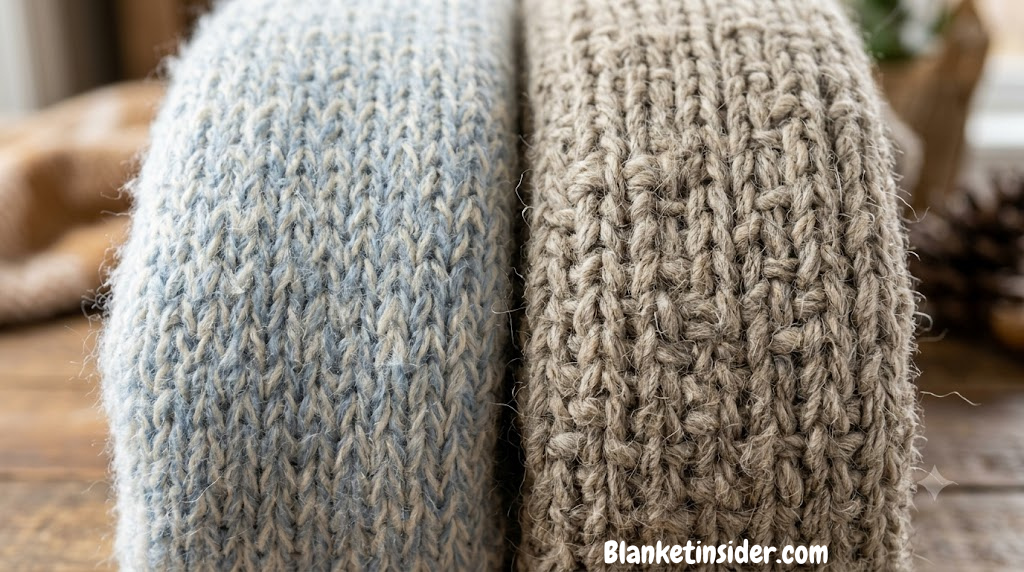
Texture tells the story — acrylic’s synthetic sheen vs. wool’s natural fiber crimp, side by side.
1 What We’re Actually Comparing — and Why It Matters
You’re standing in front of two throw blankets. One is labeled 100% wool. The other says 100% acrylic. The wool throw costs three times more. The acrylic throw feels silky smooth in the store. You hesitate.
That hesitation is the right instinct. These two materials are fundamentally different at the fiber level, and those differences ripple out into every aspect of your experience — from how warm you feel on a winter night to what happens the first time you toss the blanket in the washing machine, to how the throw looks draped across your sofa five years from now.
This guide breaks down every meaningful difference between acrylic and wool throw blankets. We’ll cover warmth and thermoregulation, softness, durability, washing requirements, allergen risk, environmental footprint, and cost. By the end, you’ll know exactly which material is right for your life, your budget, and your values — with no guesswork required.
If you’ve ever wondered about the broader landscape of the best blanket materials, this comparison sits at one of the most important crossroads: the natural-versus-synthetic debate that every textile buyer eventually faces. And if you’re also considering knit or woven options, our guide to wool vs fleece blankets adds useful context on how wool compares to other synthetics.

Editor’s Pick — Wool
100% Pure Merino Wool Throw Blanket
Naturally warm, breathable, and soft enough for sensitive skin. Ethically sourced and built to last decades.
View on Amazon →2 Fiber Science & Origins: Where These Materials Come From
Understanding what these materials are at a molecular and structural level explains nearly every performance difference you’ll encounter in daily use. This isn’t just trivia — it directly informs how warm, soft, durable, and eco-friendly each throw will be in your home.
What Is Wool?
Wool is a protein fiber grown by sheep (and a few other animals, including cashmere goats, alpacas, and angora rabbits). The most common wool used in throw blankets comes from Merino sheep, Corriedale sheep, or blended fine-wool breeds. Each fiber is a complex biological structure: a cortex surrounded by overlapping scale-like cells called cuticle cells, with an inner medulla in some coarser grades.
This architecture is what gives wool its remarkable properties. The natural crimp in the fiber creates millions of tiny air pockets that trap warmth. The cuticle scales allow the fiber to absorb moisture vapor without feeling wet. And because wool is a protein (keratin), it behaves more like human skin than any synthetic can approximate.
If you want to explore how wool performs across different temperature conditions, our in-depth look at merino wool’s thermoregulation science explains the biochemistry in detail. And if you’re weighing wool against premium wool alternatives, the cashmere vs merino wool comparison covers the upper end of the natural fiber spectrum.
What Is Acrylic?
Acrylic fiber is a synthetic polymer — specifically, polyacrylonitrile — derived from petroleum byproducts. It was invented in the mid-20th century partly as a wool substitute, designed to mimic wool’s soft, warm, and light feel while being cheaper to produce and easier to care for.
Unlike wool’s biological complexity, acrylic fibers are extruded through tiny holes (spinnerets) to create continuous filaments that are then crimped mechanically to mimic wool’s natural texture. The crimping creates the appearance and feel of wool but lacks the natural thermoregulatory properties of a living fiber.
🐑 Wool — Fiber Profile
🧪 Acrylic — Fiber Profile
The fiber structure diagram above illustrates a critical truth: wool’s natural crimp is biological, arising from the helix of protein molecules inside each fiber. Acrylic’s crimp is imposed mechanically and tends to relax over repeated washing, which is one reason acrylic throws lose loft and warmth over time while good wool throws do not.

Editor’s Pick — Acrylic
Premium Soft Acrylic Throw Blanket — Multiple Colors
Machine-washable, lightweight, and incredibly soft. Great value for everyday sofa use or gifting.
View on Amazon →3 Warmth & Thermoregulation: The Core Difference
Warmth is usually the first question people ask about a throw blanket, and it’s where the gap between wool and acrylic is most scientifically meaningful. Both materials will keep you warm — but they do it in completely different ways, and one of them adapts to your body while the other simply insulates.
How Wool Regulates Temperature
Wool’s thermoregulatory ability is one of the most studied properties in textile science. Here’s what actually happens:
- Moisture absorption: Wool fibers can absorb up to 30% of their own weight in moisture vapor from the air and from your body. As moisture is absorbed, the fiber releases a small amount of heat — a process called the heat of sorption — which creates a gentle warming effect. This is purely chemical, not mechanical.
- Moisture buffering: When you get warm and slightly perspire, wool wicks that moisture away from your skin and distributes it through the fiber structure, cooling you slightly. When you cool down, the process reverses, keeping you warm.
- Air trapping: The natural crimp creates a three-dimensional loft that traps millions of tiny air pockets. Air is one of the best natural insulators available, and wool holds more air per gram than almost any other textile material.
- Wet warmth: Unusually for a textile, wool retains a significant portion of its insulating ability even when wet. This is why wool blankets have been trusted by outdoor enthusiasts, military personnel, and first responders for centuries.
How Acrylic Provides Warmth
Acrylic’s warmth mechanism is simpler and more passive: it traps air through its mechanically crimped structure and creates a thermal barrier between your body and the cooler ambient air. It does not actively manage moisture or adapt to body temperature changes.
A thick acrylic throw can feel very warm — sometimes warmer than a lighter wool throw — because the insulation value is primarily determined by loft thickness. However, if you tend to sleep warm or alternate between feeling hot and cold at night, acrylic provides no adaptive response. You’re either too warm or not warm enough, with no middle ground.
Warmth Ratings Head-to-Head
For year-round sofa use where temperatures fluctuate, a wool throw offers a comfort envelope that no acrylic blanket can match. That said, if your goal is maximum warmth on a tight budget for straightforward cold-night use — perhaps for a dorm room or a guest room that only gets used in winter — a thick acrylic throw delivers genuine, reliable warmth at a fraction of the cost. Our guide to the best cozy blankets for the living room covers both types with current product picks.
4 Softness & Texture: The Hand-Feel Test
Touch is personal. The way a throw feels against your skin can make or break the experience of using it — especially if you like to pull a blanket up to your face while reading or napping. And here, the comparison between wool and acrylic gets nuanced in ways that surprise most buyers.
Why Not All Wool Feels the Same
Wool softness is measured in microns — the diameter of each individual fiber. The lower the micron count, the softer the fiber, because thinner fibers bend rather than prickle when they contact skin.
- Ultra-fine Merino (15–18.5 microns): Extraordinarily soft. Many people with sensitive skin can wear this directly against bare skin without any irritation. Think baby-soft cashmere territory.
- Fine Merino (18.5–22 microns): Very soft. The standard for premium merino throws. Suitable for most skin types.
- Medium Merino / Corriedale (22–30 microns): Noticeably softer than traditional wool but may feel slightly prickly on very sensitive skin.
- Coarse wool (30+ microns): The itchy wool that gave all wool a bad reputation. Rarely used in quality throws today, but common in budget “wool blend” products.
The practical implication: premium merino wool throws feel dramatically softer than you might expect if your only reference point is a scratchy old wool blanket from decades ago. Fine merino changes the entire conversation.
How Acrylic Achieves Softness
Modern acrylic has come a long way. High-quality acrylic throws — particularly those using micro-fiber acrylic or brushed acrylic techniques — can feel genuinely plush and smooth. In a blind touch test, many people struggle to distinguish a premium acrylic throw from a mid-grade merino.
The key differences emerge over time. Acrylic fibers have lower tensile strength than wool, meaning they break more easily under friction. Broken fibers create pilling — those small fuzzy balls that form on the surface of cheaper throws. Pilling is a softness killer. A throw that feels luxurious in month one can feel rough and matted by month six if the acrylic quality is low or care instructions aren’t followed.
Softness: Side-by-Side
| Quality Tier | Wool Throw | Acrylic Throw | Which Feels Better? |
|---|---|---|---|
| Budget ($15–$35) | Often coarse — 28–35 microns, prickly on bare skin | Surprisingly soft initially, but pills quickly | Acrylic short-term |
| Mid-range ($35–$80) | Comfortable — 22–28 microns, minimal prickle | Soft and plush, moderate pilling after 6–12 months | Tie |
| Premium ($80–$200+) | Ultra-fine merino — 16–20 microns, cashmere-like | Very soft, but fibers degrade faster than wool | Wool long-term |
For those researching softer natural alternatives in the same family, our guide to chenille blankets and the softest throw fabrics explores which textures rank highest for touch. And for synthetic comparisons, sherpa vs fleece gives context on how two other popular synthetics compare in feel.

Softest Option — Premium Wool
Fine Merino Wool Throw — Naturally Soft & Hypoallergenic
18–20 micron merino — the sweet spot between cashmere luxury and everyday durability. Machine-washable superwash treatment available.
View on Amazon →5 Durability & Longevity: The Long Game
A throw blanket isn’t a consumable — or at least, it shouldn’t be. If you’re spending money on something designed to provide comfort day after day, you want to know how long it will last before it needs replacing. And here, the difference between wool and acrylic is not subtle.
Wool’s Exceptional Durability
Well-maintained wool throws regularly outlast the furniture they’re draped over. Properly cared-for wool blankets passed down through families are not unusual — some quality wool throws are still in daily use after 20 to 30 years. This durability comes from several sources:
- Natural elasticity: A wool fiber can be stretched up to 30% beyond its natural length and spring back without breaking. This elastic memory means wool throws maintain their shape, don’t distort with use, and resist the formation of permanent creases or thinning areas.
- Protein fiber strength: Wool’s protein structure makes it naturally resistant to abrasion compared to many synthetics. The cuticle scales that cause some prickle also protect the inner cortex from wear.
- Moth resistance when stored properly: The primary threat to wool is moth larvae, which consume the keratin in fibers when wool is stored in dark, undisturbed conditions. This is a storage issue, not a use issue. Clean wool stored with appropriate moth deterrents (cedar, lavender sachets) remains in excellent condition for decades.
- Natural soil resistance: Wool’s waxy outer coating (lanolin) gives it natural resistance to water-based stains. Many spills bead up on wool surfaces rather than soaking in, buying time for clean-up.
Acrylic’s Durability Challenges
Acrylic fibers are petroleum-based plastics, and like most plastics, they undergo gradual degradation with repeated mechanical stress (washing, friction, UV exposure). The most visible sign is pilling, but the structural decline happens at the fiber level long before pilling becomes severe:
- Fiber breakage: Each wash cycle mechanically stresses acrylic fibers. Short, broken fibers accumulate on the surface as pills. Eventually, the overall fiber density decreases, the blanket becomes thinner, and its warmth and structure diminish.
- Loss of loft: Acrylic’s mechanical crimp gradually relaxes with heat and repeated washing. As loft decreases, the insulating air pockets collapse, reducing warmth and the plush feel.
- Irreversibility: Unlike wool, which can be professionally re-blocked and restored to some degree, acrylic degradation is irreversible. Once an acrylic throw starts pilling significantly or loses its loft, the decline continues.
| Timeline | Wool Throw (properly cared for) | Acrylic Throw (machine washed regularly) |
|---|---|---|
| Year 1 | Full performance, may soften slightly | Full performance, minimal pilling |
| Year 2–3 | Unchanged, natural patina developing | Visible pilling begins, slight loft reduction |
| Year 5 | Still performing at near-original level | Moderate pilling, noticeably thinner |
| Year 10 | Some wear at high-friction points, otherwise excellent | Significantly degraded — likely replaced |
| Year 20+ | Possible with good care — heirloom quality | N/A — likely replaced 2–3 times |
For those who love cozy living spaces and want blankets that last, our best blanket ladders guide and best blanket chests for linen protection show how to store and display quality throws to extend their lifespan further.
6 Washing & Care: The Practical Reality
A throw blanket gets used constantly. It gets coffee spilled on it, pets sleeping on it, and the occasional accidental drag across a dusty floor. How easy it is to clean is a legitimate practical consideration — and one where acrylic has a genuine, meaningful advantage over traditional wool.
Washing an Acrylic Throw
Acrylic throws are among the easiest home textiles to care for. Most can be machine-washed on a regular or delicate cycle with standard laundry detergent, then tumble-dried on low heat. There are no special soaking requirements, no flat drying, and no risk of catastrophic shrinkage if you get the temperature slightly wrong.
- Check the care label — most acrylic throws are fully machine-washable on warm or cool.
- Wash in a gentle or delicate cycle to reduce mechanical fiber stress and slow pilling.
- Use a mild detergent — avoid fabric softeners, which coat synthetic fibers and reduce breathability.
- Tumble dry on low heat. High heat can cause acrylic fibers to warp or melt at the micro-level, accelerating pilling and loft loss.
- Remove promptly from dryer — folding while warm prevents permanent creasing.
Washing a Wool Throw
Traditional (non-superwash) wool requires more careful handling. Wool felts — an irreversible matting of fibers — when exposed to a combination of heat, water, and agitation simultaneously. Understanding this helps you avoid the most common care mistakes.
- Check the label for “superwash” or machine-washable designation. If present, treat like delicate acrylic.
- For non-superwash wool, hand wash in cool water with a specialist wool detergent (Eucalan, Woolite, or similar).
- Submerge gently — never wring, twist, or scrub. Squeeze water through the fibers without agitation.
- Rinse thoroughly with cool water of the same temperature to avoid thermal shock to the fibers.
- Roll the throw in a clean dry towel to absorb excess water — never wring.
- Lay flat on a clean surface, reshape gently while damp, and allow to dry away from direct heat or sunlight.
- Full drying may take 12–24 hours depending on blanket weight and humidity.
For more guidance on blanket washing across different materials, our detailed walk-through on how to wash blankets without damage covers essential techniques. And if you’re also managing other specialty blankets in your home, our guide on washing cooling blankets offers complementary care advice.
| Care Factor | Wool | Acrylic | Easier for? |
|---|---|---|---|
| Machine washable? | Superwash only | Yes — most grades | Acrylic |
| Dryer safe? | Flat dry only (non-superwash) | Low heat tumble dry | Acrylic |
| Detergent type | Wool-specific | Standard or gentle | Acrylic |
| Wash frequency needed | Less often (wool resists odor) | More often | Wool |
| Stain resistance | Excellent (lanolin) | Moderate | Wool |
| Odor resistance | Excellent — odor stays low | Moderate — holds odors | Wool |
| Risk of ruining on first wash | Moderate (if non-superwash) | Very low | Acrylic |

Best of Both — Superwash Wool
Machine-Washable Merino Wool Throw Blanket
Superwash-treated wool that survives the machine. All the warmth and longevity of merino without the hand-wash hassle.
View on Amazon →7 Weight, Drape & How They Feel In Use
Beyond raw warmth and softness, a throw blanket’s drape — how it falls, molds to your body, and behaves when tossed casually over a chair — is a surprisingly important quality metric. It determines whether your throw feels cozy and enveloping or stiff and awkward.
Wool’s Drape and Weight Characteristics
Quality wool throws tend to have a substantial, satisfying weight that contributes to a feeling of being wrapped and held. This is partly why wool has remained the gold standard in traditional throws and blankets — the weight adds a gentle grounding sensation without the extreme heaviness of a weighted blanket. Wool also has a natural memory that allows it to drape beautifully over furniture, pooling at the edges in a way that looks intentional and elegant.
Fine merino throws, being lighter than traditional wool, offer a different experience — airy and fluid rather than substantial. This makes them excellent for travel throws or lighter seasons. For heavier winter-weight wool, the throw becomes almost a cocoon-like experience that many people find deeply comforting — something our guide on weighted blanket benefits explores from a therapeutic angle.
Acrylic’s Drape and Weight Characteristics
Acrylic throws tend to be lighter per unit of warmth than wool. They also have a different relationship with gravity — acrylic’s synthetic polymer structure gives fibers a slight stiffness even when soft, which can make throws feel more two-dimensional and less fluid. A loosely knit acrylic throw drapes better than a tightly woven one, but neither achieves the natural liquid fall of a quality wool blanket.
For decorative purposes — like tossing a throw artfully over a sofa arm for a magazine-ready living room — wool holds its position and shape more elegantly. Acrylic tends to slide or bunch unless weighted.
For those choosing a throw specifically for living room display or as a cozy home essential, our cozy home essentials checklist and guide to the best living room throws address both function and aesthetic beautifully.
Weight Comparison
| Throw Type | Typical Weight (50×60″) | Feel | Best For |
|---|---|---|---|
| Fine merino wool (lightweight) | 250–400g | Airy, fluid, elegant | Travel, mild climates, layering |
| Mid-weight merino wool | 400–600g | Substantial, enveloping | General use, sofa, gift |
| Heavy-weight wool (Shetland, Donegal) | 600–900g | Cocooning, serious warmth | Cold climates, winter couch use |
| Budget acrylic (thin) | 200–350g | Light, airy, slightly stiff | Kids rooms, guest rooms |
| Premium chunky acrylic | 400–700g | Plush, fluffy, modern look | Decor-focused living room throws |
8 Allergens & Skin Sensitivity: The Truth About “Wool Allergy”
One of the most persistent misconceptions in bedding and blanket buying is that wool is broadly allergenic. This myth causes many buyers who would genuinely benefit from wool to automatically reach for acrylic. The reality is considerably more nuanced.
The Prickle Factor vs True Allergy
When people say they are “allergic to wool,” they are almost always describing one of two things, neither of which is a true allergy:
- Mechanical prickle: Coarse wool fibers (above 28–30 microns) are stiff enough that they mechanically stimulate skin pain receptors, causing an itching or prickling sensation. This is not an immune response. It happens to nearly everyone with coarse wool, regardless of whether they have any allergies at all. The solution is fine-grade wool (under 20 microns), which bends against the skin rather than resisting it.
- Lanolin sensitivity: Lanolin is the natural wax secreted by sheep skin that coats the wool fiber. Some people have a contact dermatitis reaction to lanolin. This is more common than a true wool protein allergy but still affects only a small percentage of the population. Superwash-treated wool has most lanolin removed, and alpaca wool contains no lanolin at all.
- True wool protein allergy: Genuine immunological allergy to wool keratin protein is extremely rare. If you have this, you will know it — the reaction goes far beyond skin itchiness to systemic immune responses.
Acrylic and Skin Sensitivity
Acrylic is synthetically derived and contains no proteins, lanolin, or animal-sourced components, making it hypoallergenic by default. However, it is not entirely without risk for sensitive individuals:
- Chemical residues: Acrylic manufacturing requires significant chemical processing, and some dye residues or finishing agents can trigger contact dermatitis in chemically sensitive individuals. Natural, undyed, or low-dye wool is often safer in this regard.
- Static electricity: Acrylic generates significant static electricity, which can be uncomfortable for people with certain skin conditions and can attract pet hair, dust, and allergens. Wool’s natural moisture content significantly reduces static build-up.
- Dust mite considerations: Wool’s natural fiber structure is less hospitable to dust mites than acrylic’s synthetic polymer environment. For people with dust mite allergies, wool may actually be a better choice — despite the common assumption otherwise.
9 Eco-Impact & Sustainability: A Significant Difference
Environmental consciousness has become a genuine factor in textile purchasing decisions. If you care about the footprint of the products in your home, the wool vs acrylic comparison has one of the clearest outcomes in the entire blanket materials space.
Wool’s Environmental Profile
Wool is one of the most sustainable textile fibers available when sourced responsibly. Here’s why:
- Renewable: Sheep grow a new fleece every year. Wool is not a finite resource — it is a continuous agricultural byproduct.
- Biodegradable: Wool decomposes naturally in soil within months to a few years, returning nitrogen and other nutrients. A wool throw left in landfill becomes compost material.
- Carbon storage: Sheep pastures sequester carbon, and wool itself stores the carbon captured by the grass the sheep ate. A quality wool blanket contains stored carbon for the duration of its long life.
- Low energy processing: Compared to synthetic manufacturing, wool scouring and spinning uses relatively low energy, especially for smaller scale artisan production.
- Certifications to look for: ZQ Merino, Responsible Wool Standard (RWS), and Oeko-Tex certifications indicate responsible farming, animal welfare, and safe chemical processing.
Acrylic’s Environmental Profile
Acrylic’s environmental story is significantly more problematic:
- Petroleum-based: Acrylic is made from acrylonitrile, a chemical derived from petroleum and propylene. Its production draws on non-renewable fossil fuel resources.
- Microplastic shedding: This is acrylic’s most serious environmental issue. Every time an acrylic throw is washed, it sheds thousands of microscopic plastic fibers that pass through standard washing machine filters and enter waterways. Research has found acrylic to be one of the highest microplastic shedders among synthetic textiles.
- Non-biodegradable: Acrylic does not biodegrade. A disposed acrylic throw will persist in landfill for hundreds of years, slowly fragmenting into smaller microplastic particles.
- Carbon-intensive manufacturing: The petroleum refining, chemical synthesis, and energy-intensive spinning processes that produce acrylic fiber generate significantly more greenhouse gas than wool production.

Eco-Conscious Pick
RWS-Certified Merino Wool Throw — Responsibly Sourced
Responsible Wool Standard certified. Animal welfare verified, chemical processing audited, and fully biodegradable at end of life.
View on Amazon →10 Cost & Value: What You’re Really Paying For
Price is often the deciding factor in blanket purchases — and it’s also the area where the comparison is most misleading if you only look at the upfront tag rather than the total cost of ownership over time.
Price Ranges at a Glance
| Tier | Acrylic Throw (50×60″) | Wool Throw (50×60″) | Notes |
|---|---|---|---|
| Budget | $12–$30 | $35–$60 | Wool at budget level often blended with synthetics |
| Mid-range | $30–$70 | $60–$150 | Best value zone for both categories |
| Premium | $70–$130 | $150–$400+ | Premium wool includes fine merino, Shetland, alpaca blends |
| Luxury / Designer | Rare — acrylic rarely justified at premium prices | $400–$1000+ | Pure cashmere or artisan hand-loomed throws |
Cost Per Year: The Real Calculation
When you factor in replacement frequency, the economics shift dramatically:
| Scenario | Acrylic Option | Wool Option | 10-Year Cost |
|---|---|---|---|
| Budget buyer | $22 throw × 4 replacements | $50 throw × 1.5 replacements | Acrylic $88 / Wool $75 |
| Mid-range buyer | $55 throw × 3 replacements | $110 throw × 1 replacement | Acrylic $165 / Wool $110 |
| Premium buyer | $100 throw × 2.5 replacements | $200 throw × 1 replacement | Acrylic $250 / Wool $200 |
The pattern is consistent: over a 10-year horizon, a good wool throw almost always costs less than repeated acrylic replacements, even accounting for its higher upfront price. The “expensive” label on wool throws is largely a perception driven by comparing sticker prices in isolation.
11 Aesthetics & Home Décor: Living With Your Throw
A throw blanket spends the majority of its time on display. It’s draped over a sofa arm, folded over a blanket ladder, or stacked in a storage basket — visible to anyone who enters your living space. How each material ages visually, and how it works in different design contexts, matters as much as warmth for many buyers.
Wool’s Aesthetic Qualities
Wool has an inherent visual sophistication that comes from its natural fiber irregularities and depth of color. Because wool absorbs dye deeply into the fiber structure (rather than just coating the surface as with many synthetics), wool throws develop a richness of color that only deepens slightly over time rather than fading to a flat wash.
Wool throws in traditional patterns — herringbone, houndstooth, plaid, cable-knit, and the iconic Pendleton-style designs — carry an authority that is difficult to replicate in synthetic materials. The slight natural variation in fiber texture gives the finished textile a handcrafted quality that reads as intentional and elevated rather than manufactured.
For those building a layered, cozy home aesthetic, wool throws work naturally alongside other natural textiles — linen cushions, cotton rugs, rattan furniture. For ideas on how to display and store throws as part of your living space design, our best blanket ladders guide and best blanket baskets are worth exploring.
Acrylic’s Aesthetic Strengths
Acrylic’s manufacturing flexibility gives it significant advantages in the aesthetics department that shouldn’t be dismissed. Because acrylic takes dye at the fiber production stage with extreme precision, acrylic throws offer colors and patterns that are impossible or prohibitively expensive to achieve in wool:
- Vivid, saturated color palettes with no color bleed or variation
- Trendy seasonal colorways that change faster than artisan wool production allows
- Extremely fluffy “faux-shearling” and chunky knit styles that appeal to modern maximalist décor trends
- Matching sets across multiple pieces (blankets, cushions, runners) at accessible price points
For buyers who decorate seasonally or prefer trend-forward, bold aesthetics over the quieter elegance of natural fibers, acrylic’s color and style versatility is a genuine advantage. Our piece on throw blankets as gifts explores how color and style factor into gifting choices specifically.
12 Who Should Buy What: The Definitive Recommendation
There is no universally correct answer in the acrylic vs wool throw debate — but there is almost always a correct answer for you, based on your lifestyle, values, and priorities. Use this section as your final decision guide.
Complete Head-to-Head Summary
| Category | Wool Throw | Acrylic Throw | Winner |
|---|---|---|---|
| Warmth | Excellent — adaptive | Good — passive | Wool |
| Thermoregulation | Superior — biological | None | Wool |
| Initial softness (budget) | Often coarse | Usually soft | Acrylic |
| Long-term softness | Improves with care | Decreases with washing | Wool |
| Durability | 15–30 years | 3–7 years | Wool |
| Ease of washing | Moderate (superwash) / Difficult (non-superwash) | Very easy | Acrylic |
| Weight & drape | Superior — fluid and natural | Lighter, more structured | Wool |
| Allergen risk | Low (fine grades) / Moderate (coarse) | Very low | Acrylic (generally) |
| Eco-impact | Excellent — biodegradable | Poor — microplastics, petroleum | Wool |
| Upfront cost | Higher | Lower | Acrylic |
| Cost per year | Lower (long lifespan) | Higher (needs replacing) | Wool |
| Décor aesthetics | Natural elegance, classic patterns | Color variety, trendy styles | Tie |
| Odor resistance | Excellent | Moderate | Wool |
| Pilling tendency | Low (quality grades) | Moderate to high | Wool |
| Outdoor use | Good — retains warmth when damp | Fair — poor wet warmth | Wool |
Buy a Wool Throw If…
🐑 Wool Is Right For You
- You run hot and cold and want adaptive temperature regulation
- You’re investing in a forever throw you want to keep for decades
- Sustainability and biodegradability matter to your purchasing decisions
- You want a throw that looks beautiful draped over furniture long-term
- You travel or camp and want warmth even in damp conditions
- You or someone in your household has dust mite sensitivity
- You prefer natural materials and want to reduce plastic in your home
- You can absorb the higher upfront cost for lower long-term total spend
🧪 Acrylic Is Right For You
- You need an easy machine-wash-and-dry solution for a high-use household
- Budget is your primary constraint and you can’t spend $100+ upfront
- You want to match a specific vivid or trend-forward color palette
- The throw is for a child’s room, a pet corner, or another heavy-use zone
- You’re buying a throw as a short-term seasonal item you expect to update
- You have a confirmed lanolin allergy and want to avoid all wool byproducts
- You love the chunky knit or faux-shearling textures only available in acrylic
- You want an affordable gift throw that looks great without a premium price
By Use Case: Quick Picks
For those making travel decisions, our guide to the best travel blanket and pillow sets covers lightweight merino and compact acrylic options side by side with current product picks. And for the beach or outdoor sports, the outdoor sports blanket comparison adds context on performance under real outdoor conditions.

Best Acrylic — Chunky Knit Style
Chunky Hand-Knit Style Acrylic Throw Blanket
On-trend chunky knit design that is impossible to replicate in wool at this price. Perfect for living room décor and gifting.
View on Amazon →Frequently Asked Questions
Final Verdict: Choose With Confidence
Acrylic throws are a smart, practical, wallet-friendly choice for everyday households — easy to wash, available in every color, and genuinely comfortable. Wool throws are a long-term investment in comfort, sustainability, and quality that pays off over years or even decades of use. Neither is a wrong choice — and knowing which one fits your life is the whole point of this guide.
If warmth, longevity, and eco-consciousness define what you value, go wool. If effortless care, budget accessibility, and style flexibility matter most, go acrylic — and buy the best quality you can afford to slow the pilling clock.
Keep Exploring
Your throw research doesn’t have to stop here. A few companion guides worth reading:
- Wool vs Fleece Blanket — how wool compares to another popular synthetic
- Cotton vs Polyester Blanket — the natural vs synthetic debate in a different material pairing
- Sherpa vs Fleece — which plush synthetic wins for sofa snuggling
- Comforter vs Duvet vs Blanket — where throws fit in the broader bedding picture
- The Complete Guide to Blanket Materials — every fiber type rated
- Outdoor Blanket Guide — wool and synthetic options for outdoor use
- What Is a Sherpa Blanket — materials, care, and when to choose it
- Best Blankets for Night Sweats — wool’s moisture management in action