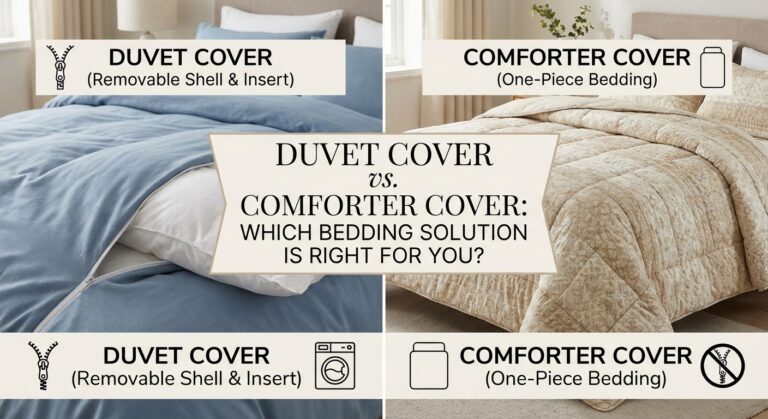
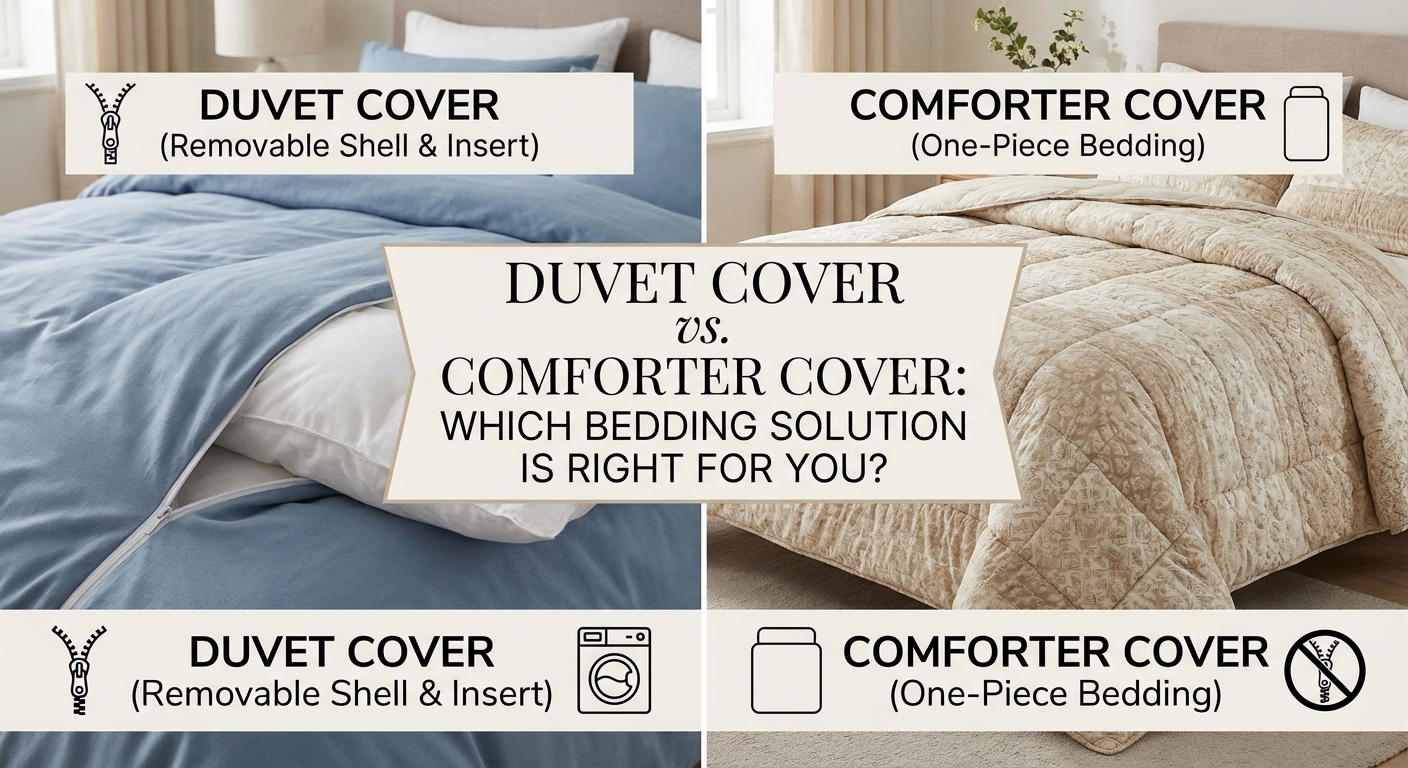
Duvet Cover vs. Comforter Cover: Which Bedding Solution is Right for You?
Walking down the bedding aisle or scrolling through Amazon can feel like learning a new language. You see terms like “duvet,” “duvet insert,” “comforter,” and the confusing “comforter cover.” Are they the same thing? Do you need both? If you are setting up a new home or upgrading your cozy home essentials, getting the terminology right is the first step to a good night’s sleep.
The debate of the duvet cover vs. comforter cover is actually a trick question. In the bedding world, a “comforter cover” is almost always just a duvet cover used to protect a comforter. However, the real choice lies between two distinct systems: the Duvet System (two pieces: an insert and a shell) versus the Comforter System (one standalone quilted piece).
In this comprehensive guide, we will break down the differences, pros, cons, and maintenance requirements of each. Whether you are looking for the best king-size blanket for a master suite or outfitting a small room with dorm room accessories, we have the answer.
Table of Contents
- Why This Guide Matters
- Defining the Contenders
- Complete Duvet Cover Materials Guide
- Thread Count Explained
- Duvet Cover and Comforter Size Guide
- How to Measure for a Duvet Cover
- At a Glance: Duvet Cover vs. Comforter
- Round 1: Hygiene and Washing
- Complete Duvet Cover Care and Washing Guide
- Stain Removal Guide
- Video Guide: Seeing the Difference
- How to Put on a Duvet Cover (Step-by-Step)
- How to Stop Your Duvet from Bunching and Slipping
- Round 2: Style and Aesthetics
- Color and Pattern Guide
- How to Style a Duvet Cover Like a Designer
- Complete Bedding Layering Guide
- Round 3: Ease of Use (The “Duvet Wrestle”)
- Duvet Cover vs. Coverlet vs. Bedspread vs. Quilt
- Round 4: Warmth and Weight Customization
- Climate and Seasonal Guide
- Hypoallergenic and Health-Conscious Duvet Covers
- Weighted Duvet Covers: What You Need to Know
- Pros and Cons Summary
- Budget Guide: Duvet Covers at Every Price Point
- Best Duvet Cover Brands Compared
- Duvet Covers for Every Lifestyle
- Which Should You Choose?
- Duvet Covers for Kids Rooms
- Duvet Covers for Airbnb and Rental Properties
- Duvet Covers for RVs and Travel Trailers
- Duvet Covers for Daybeds and Trundle Beds
- Why Hotels Use Duvet Covers (And How to Get the Hotel Look)
- Eco-Friendly and Sustainable Duvet Covers
- Duvet Cover Accessories You Didn’t Know You Needed
- Complete Buying Guide: What to Look For
- Common Duvet Cover Mistakes to Avoid
- The History of Duvets: From Medieval Europe to Modern Bedrooms
- Duvet Cover Trends for 2025 and Beyond
- Frequently Asked Questions
- Final Verdict
Why This Guide Matters
The average person spends roughly one-third of their life sleeping. That is approximately 26 years spent in bed over the course of a lifetime. Given that staggering statistic, the bedding you choose is not just a decorative decision — it directly impacts your sleep quality, your health, your home maintenance routine, and your monthly budget. Choosing between a duvet cover system and a traditional comforter is one of the most consequential bedding decisions you will make, because it affects every single night of sleep for years to come.
Most bedding guides online are shallow product roundups that scratch the surface without addressing the real questions consumers have. Questions like: “Will a linen duvet cover actually keep me cool in summer?” “How do I stop my duvet from turning into a wadded-up mess inside the cover?” “Is thread count actually important, or is it just marketing?” “What is the difference between percale and sateen, and which one should I buy?” These are the questions that determine whether you love your bedding or regret your purchase within weeks.
This guide answers all of them. We have studied dozens of bedding materials, interviewed sleep specialists, tested various duvet cover methods, and analyzed thousands of customer reviews to bring you the most thorough comparison of duvet covers versus comforters available anywhere online. By the end of this article, you will know exactly which system is right for your bed, your climate, your budget, and your lifestyle.
We will also cover topics that most bedding guides ignore entirely — like how to properly measure your bed for a duvet cover, the science behind thread counts, the burrito method for putting on a duvet cover without breaking a sweat, eco-friendly bedding options, and how to create that luxurious hotel bed look at home. Consider this your ultimate bedding education.
Defining the Contenders
Before we compare performance, we must define what we are actually talking about. The terminology varies by region (Europe vs. USA), but here is the standard breakdown.
What is a Comforter?
A comforter is a “ready-to-go” bedding topper. It is a single piece of bedding that is quilted or stitched to keep the inner filling (down, feathers, or synthetic fibers) evenly distributed. It typically features a fashion fabric on the outside, meaning it doesn’t need a cover.
Comforters are often sold in “Bed-in-a-Bag” sets that include matching sheets. They are common in dorms or for people who want a quick, easy setup without the hassle of assembly. If you’ve ever looked into best dorm chairs and matching bedding, you’ve likely seen comforter sets.
Comforters vary widely in thickness, weight, and fill material. Some are lightweight and designed for summer use, while others are thick, heavily quilted, and intended for cold winter nights. The exterior fabric ranges from basic cotton to microfiber to luxury materials like silk or cashmere blends. The quilting pattern — whether it is a simple box stitch, a baffle-box construction, or an elaborate decorative pattern — determines how evenly the fill stays distributed and how the comforter drapes over your body.
One key characteristic of a comforter is its fixed weight. Unlike the duvet system where you can swap inserts, a comforter is one permanent weight. This is both its simplicity and its limitation. You cannot strip off the outer layer and wash it separately — the entire comforter must be cleaned as one unit. For lightweight synthetic comforters, this is manageable in a home washing machine. For heavy down comforters or king-sized options, it often means a trip to the laundromat and their industrial machines.
Comforters are also commonly found in hotel rooms, especially in mid-range hotels and motels across the United States. They are popular in hospitality because they are durable, require little assembly, and look neat when folded at the foot of the bed or spread flat across the mattress. However, luxury hotels have increasingly shifted to the duvet system for reasons we will discuss later in our hotel duvet section.
What is a Duvet Cover (or Comforter Cover)?
Think of a duvet cover as a massive pillowcase for your blanket. It is a protective shell that encases a “duvet insert.” The insert is usually plain white and filled with down or a down alternative.
Here is where the confusion lies: Many people own an old comforter that has an outdated pattern or has lost its fluff. They will buy a duvet cover and put the *comforter inside it*. In this context, the duvet cover acts as a “comforter cover.” This is a brilliant way to refresh a room without buying a whole new heavy blanket.
Duvet covers come in a wide range of closure types. The most common are button closures, which run along the bottom edge of the cover. Zipper closures are gaining popularity because they create a cleaner look and are faster to open and close. Some high-end duvet covers use a hidden internal flap system where the opening is completely invisible from the outside. The closure type might seem like a minor detail, but if you change your duvet cover weekly — as recommended for hygiene — a zipper closure will save you significant time and frustration compared to fumbling with a dozen small buttons.
Inside most quality duvet covers, you will find corner ties or loops. These are small fabric ribbons or elastic loops sewn into each interior corner of the cover. Their purpose is to attach to corresponding loops on the duvet insert, preventing the insert from shifting, bunching, or migrating to one side of the cover. This is one of the most important features to look for when shopping for duvet covers, and we will explain exactly how to use them in our step-by-step guide to putting on a duvet cover.
The duvet cover system originated in Northern Europe, particularly in Scandinavian countries, where the cold winters demanded warm, fluffy bedding that was also easy to maintain. The concept was simple: separate the decorative, washable outer shell from the warm, bulky inner fill. This innovation eventually spread worldwide and has become the dominant bedding system in Europe, Australia, and increasingly in the United States.

Looking to refresh your bedding instantly? Check out this top-rated Duvet Cover Set.
Check Price on AmazonUnderstanding Comforter Covers in Detail
Now that we understand both systems, let us address the term “comforter cover” directly. In the bedding industry, a “comforter cover” is not a distinct product category. When manufacturers or retailers use this term, they are almost always referring to a standard duvet cover that is marketed for use with a comforter rather than a dedicated duvet insert.
The reason this marketing distinction exists is practical. Many American consumers own comforters — not duvet inserts. They want to cover those comforters with a decorative, washable shell. Rather than educating consumers about the difference between a duvet insert and a comforter, some brands simply label their product as a “comforter cover” to make the use case immediately obvious.
Functionally, a duvet cover and a comforter cover are identical. They are both lightweight fabric shells with a button or zipper closure and corner ties. The only difference is marketing language. If you see a product labeled “comforter cover,” you can treat it exactly like a duvet cover. The same applies in reverse — a duvet cover works perfectly well over a comforter, as long as the dimensions are compatible.
One thing to keep in mind when using a duvet cover over a comforter: comforters typically do not have the corner loops that duvet inserts have. This means the corner ties in the duvet cover have nothing to attach to. Without securing the corners, the comforter will shift and bunch inside the cover, creating an uneven sleeping surface. There are solutions to this problem — magnetic duvet clips, safety pins, or sewing small fabric loops onto the comforter corners — which we will cover in detail in our bunching prevention section.
Complete Duvet Cover Materials Guide
The material of your duvet cover determines almost everything about your sleeping experience: how cool or warm you sleep, how soft the fabric feels against your skin, how durable the cover is, how easy it is to wash, and how it drapes over your bed. Choosing the right material is just as important as choosing between a duvet cover and a comforter. Here is a comprehensive breakdown of every major duvet cover material on the market.
Cotton Duvet Covers
Cotton is the most popular duvet cover material worldwide, and for good reason. It is natural, breathable, soft, durable, and widely available at every price point from budget to luxury. However, not all cotton is created equal. The quality of a cotton duvet cover depends on several factors: the type of cotton, the weave, the thread count, and the finishing process.
Egyptian Cotton: Grown in the Nile River Valley, Egyptian cotton is considered the gold standard for luxury bedding. Its extra-long staple (ELS) fibers produce fabric that is exceptionally soft, highly durable, and becomes softer with every wash. Premium Egyptian cotton duvet covers can last a decade or more. The downside is cost — genuine Egyptian cotton duvet covers typically start at $150 for a queen size and can exceed $500 for top-tier options.
Pima Cotton: Also known as Supima cotton in the United States, Pima cotton has similarly long staple fibers. It is slightly less expensive than Egyptian cotton but offers comparable softness and durability. Pima cotton is an excellent middle-ground option for people who want luxury quality without the premium price tag.
Upland Cotton: This is the most common and affordable cotton used in bedding. The shorter staple fibers produce a softer fabric initially but tend to pill and wear out faster than long-staple varieties. Budget cotton duvet covers are usually made from upland cotton. They are perfectly functional but will not last as long as their premium counterparts.
Organic Cotton: Organic cotton duvet covers are grown without synthetic pesticides, herbicides, or fertilizers. They are certified by organizations like GOTS (Global Organic Textile Standard). Organic cotton duvet covers are ideal for people with sensitive skin, allergies, or anyone who wants to minimize their environmental footprint. The quality is comparable to conventional cotton, though prices are typically 20-40% higher.
Linen Duvet Covers
Linen is made from the flax plant and is rapidly becoming the most sought-after duvet cover material for style-conscious homeowners. Linen has a distinctive textured, slightly rumpled appearance that gives bedrooms an effortlessly chic, relaxed aesthetic. But linen is not just about looks — it offers genuine functional benefits.
Linen is exceptionally breathable and moisture-wicking. It can absorb up to 20% of its weight in moisture before feeling damp. This makes linen duvet covers the best choice for hot sleepers, people who live in warm climates, or anyone who experiences night sweats. Linen also has natural temperature-regulating properties, keeping you cool in summer and surprisingly warm in winter.
One of linen’s unique characteristics is that it gets softer with every wash. A brand-new linen duvet cover might feel slightly crisp or even rough, but after five to ten washes, it becomes buttery soft while maintaining its durability. Quality linen duvet covers can last 15 to 20 years — significantly longer than cotton alternatives.
The main drawbacks of linen are its price and its wrinkles. Linen duvet covers typically cost $150 to $400 for a queen size, and they wrinkle easily. However, many people consider the wrinkles part of linen’s charm. The relaxed, lived-in look is a deliberate design aesthetic that is featured in countless interior design magazines and boutique hotel rooms.
Bamboo Duvet Covers
Bamboo duvet covers are made from bamboo viscose or bamboo lyocell — processed fibers derived from bamboo pulp. Despite what some marketing might suggest, bamboo bedding is not simply “bamboo fabric.” The raw bamboo must be chemically processed to extract the cellulose and spin it into usable fiber. However, the resulting fabric has several impressive properties.
Bamboo viscose is incredibly soft — often compared to silk or cashmere in terms of hand feel. It is naturally moisture-wicking, breathable, and has been shown to be more temperature-regulating than cotton. Bamboo also has natural antimicrobial properties that resist odor-causing bacteria, which is a significant advantage for people who sweat heavily during sleep.
For allergy sufferers, bamboo duvet covers are an excellent choice. The tight weave of bamboo fabric creates a natural barrier against dust mites, mold, and other common allergens. Bamboo is also a sustainable resource — it grows rapidly, requires no pesticides, and regenerates quickly after harvesting — making bamboo duvet covers a popular choice among environmentally conscious consumers.
The price of bamboo duvet covers falls in the mid-range, typically $80 to $200 for a queen size. They offer an excellent balance of luxury feel, functional performance, and environmental sustainability.
Silk Duvet Covers
Silk is the ultimate luxury duvet cover material. Natural silk has a lustrous sheen, an impossibly smooth hand feel, and a lightweight drape that creates an elegant, sophisticated bedroom aesthetic. Beyond aesthetics, silk offers practical benefits for your skin and hair.
Silk is naturally hypoallergenic and resistant to dust mites, mold, and fungus. The smooth surface of silk creates less friction against your skin and hair compared to cotton or linen, which means fewer sleep creases on your face and less hair breakage and frizz. Many dermatologists and hairstylists recommend silk pillowcases and duvet covers for these reasons.
However, silk duvet covers come with significant practical limitations. They are delicate, expensive ($200 to $600+ for a queen size), and require careful maintenance. Most silk duvet covers must be hand-washed or dry-cleaned, which makes them impractical for people who want easy-care bedding. Silk is also less breathable than cotton or linen, which means it may not be the best choice for hot sleepers.
Microfiber Duvet Covers
Microfiber is a synthetic material made from extremely fine polyester or nylon fibers. Microfiber duvet covers are the most affordable option on the market, with queen sizes available for as little as $25 to $50. They are lightweight, wrinkle-resistant, and dry quickly after washing.
The fine fibers create a soft, smooth surface that many people find comfortable. Microfiber is also stain-resistant and colorfast, meaning vibrant prints and patterns hold up well through multiple wash cycles. For kids’ rooms, guest rooms, or anyone on a tight budget, microfiber duvet covers offer solid value.
The downside of microfiber is breathability. Unlike natural fibers like cotton or linen, microfiber does not breathe as well, which can trap heat and moisture against your body. Hot sleepers and people in warm climates may find microfiber duvet covers uncomfortable during summer months. Microfiber also tends to generate static electricity and can pill over time with frequent washing.
Percale vs. Sateen: Understanding Cotton Weaves
When shopping for cotton duvet covers, you will frequently encounter two weave types: percale and sateen. These terms refer to how the cotton threads are woven together, and they dramatically affect the feel, appearance, and performance of the fabric.
Percale is a simple one-over-one-under weave that creates a matte, crisp fabric with a slightly textured hand feel. Percale duvet covers feel cool, lightweight, and refreshing against the skin — similar to a high-quality hotel sheet. Percale becomes softer with each wash while maintaining its crispness. It is an excellent choice for hot sleepers and anyone who prefers a clean, matte aesthetic.
Sateen uses a one-over-four-under weave that exposes more thread surface on the face of the fabric. This creates a silky-smooth, slightly luminous finish that feels more luxurious against the skin. Sateen duvet covers are warmer than percale because the tighter weave traps more heat, making them ideal for cooler climates and cold sleepers. The downside is that sateen can pill more easily than percale and may show wrinkles more prominently.
Neither weave is objectively better than the other — it comes down to personal preference. If you sleep hot and prefer a crisp, cool feel, choose percale. If you want silky smoothness and a warmer sleep surface, choose sateen.
Modal and Tencel Duvet Covers
Modal is a semi-synthetic fiber made from beech tree cellulose. It is exceptionally soft, breathable, and resistant to shrinkage. Modal duvet covers have a beautiful drape and a subtle sheen that gives them a luxurious appearance. They are increasingly popular in eco-conscious households because beech trees are a renewable resource.
Tencel (branded lyocell) is made from sustainably sourced wood pulp, typically from eucalyptus trees. Tencel duvet covers are smooth, cool to the touch, and highly moisture-absorbent. The closed-loop manufacturing process used to produce Tencel recycles 99% of the solvents, making it one of the most environmentally friendly fabrics available.
Both modal and Tencel fall in the mid-to-premium price range ($100 to $250 for queen sizes) and offer an excellent combination of comfort, performance, and sustainability.
Flannel Duvet Covers
Flannel duvet covers are made from cotton that has been brushed on one or both sides to create a soft, fuzzy nap. This brushed texture traps air, creating an insulating layer that makes flannel duvet covers exceptionally warm. They are the ideal choice for cold sleepers, drafty bedrooms, and winter bedding.
Flannel duvet covers are typically measured in ounces per square yard (oz/yd²) rather than thread count. A lightweight flannel is around 4 oz/yd², while a heavy, ultra-warm flannel can be 6 oz/yd² or more. The heavier the flannel, the warmer and more durable it will be.
The main drawback of flannel is that it tends to pill over time, especially with frequent washing. Using a gentle cycle, cold water, and avoiding the dryer can significantly extend the life of a flannel duvet cover. Flannel is also too warm for summer use, so it is best treated as a seasonal bedding option.
Thread Count Explained: Does It Actually Matter?
Thread count is one of the most marketed and misunderstood metrics in the bedding industry. Advertisements scream about “1000 thread count sheets” and “1500 thread count duvet covers,” implying that higher numbers automatically mean better quality. The truth is far more nuanced.
Thread count simply refers to the number of threads woven into one square inch of fabric, counting both the horizontal (weft) and vertical (warp) threads. A 200 thread count fabric has 200 threads per square inch. In theory, higher thread counts create denser, smoother, more durable fabric. In practice, thread count is only meaningful within the context of fiber quality and weave type.
Here is the critical insight that the bedding industry does not want you to know: once you reach a certain quality threshold, increasing thread count has diminishing returns. A 400 thread count duvet cover made from premium long-staple Egyptian cotton will outperform a 1000 thread count cover made from cheap short-staple upland cotton. The quality of the fiber matters more than the quantity of threads.
Many manufacturers artificially inflate thread counts by using multi-ply yarns (twisting two or more thin threads together and counting them as one) or by using a practice called “surface brushing,” where the fabric is mechanically roughed up to create a softer feel that mimics higher thread counts. A duvet cover marketed as “1500 thread count” may actually have a true thread count of 300-400 with multi-ply yarn.
What thread count range should you look for? For cotton duvet covers, the sweet spot is generally 200 to 600 thread count. Below 200, the fabric may feel thin and rough. Above 600, the extra density can make the fabric less breathable without a noticeable improvement in softness. Within this range, focus on fiber quality (long-staple cotton, Egyptian, Pima) and weave type (percale or sateen) rather than chasing the highest number.
For linen duvet covers, thread count is essentially meaningless because linen fibers are thicker and flatter than cotton fibers. A 140 thread count linen duvet cover can feel more luxurious than a 600 thread count cotton cover. Linen quality is better judged by weight (measured in grams per square meter, or GSM) and fiber source.
Duvet Cover and Comforter Size Guide
Buying the wrong size duvet cover is one of the most common bedding mistakes. A cover that is too small will not fit over your insert, while one that is too large will result in excessive bunching and a sloppy look. Here is a comprehensive size chart for both duvet covers and comforters.
| Bed Size | Standard Duvet Cover Size | Recommended Insert Size | Standard Comforter Size | Best For |
|---|---|---|---|---|
| Twin | 66″ x 86″ | 68″ x 90″ | 66″ x 86″ | Single sleepers, kids, dorm rooms |
| Twin XL | 66″ x 92″ | 68″ x 96″ | 66″ x 96″ | College dorms, adjustable beds, tall teens |
| Full/Double | 80″ x 90″ | 82″ x 94″ | 80″ x 90″ | Single adults who like space, guest rooms |
| Queen | 88″ x 92″ | 90″ x 96″ | 88″ x 92″ | Couples, master bedrooms (most popular size) |
| King | 102″ x 90″ | 104″ x 94″ | 104″ x 92″ | Couples who like space, master suites |
| California King | 102″ x 96″ | 104″ x 100″ | 104″ x 98″ | Tall sleepers, Cal king mattresses |
Important note on duvet cover sizing: The standard practice is to buy a duvet insert that is 2 to 3 inches larger than the duvet cover in both width and length. This creates the coveted “overstuffed” or “fluffy” look that you see in hotels and bedding advertisements. If you buy an insert that exactly matches the cover dimensions, the result often looks flat and underwhelming.
For example, if you have an 88″ x 92″ queen duvet cover, consider purchasing a 90″ x 94″ or even a 90″ x 96″ insert. The extra volume fills the cover nicely and creates those beautiful pillow-like puffs across the bed surface.
For comforters, the sizing approach is different. Since comforters are standalone pieces, you generally want one that is at least 20 inches wider than your mattress on each side so it drapes nicely over the edges. A queen mattress is 60 inches wide, so a queen comforter at 88 inches wide gives you 14 inches of drop on each side — enough to cover the mattress and box spring without dragging on the floor.
Always check the specific dimensions listed by the manufacturer rather than relying on size labels alone. Sizing can vary between brands, especially for king and California king sizes, which are often confused in the industry.
How to Measure for a Duvet Cover
Before purchasing a duvet cover, take accurate measurements of your bed and existing bedding. This simple step prevents the frustration of receiving a cover that does not fit.
Step 1: Measure your mattress. Use a tape measure to record the width, length, and height (depth) of your mattress. Standard mattresses range from 8 to 16 inches deep, and deep-pocket or pillow-top mattresses can exceed 18 inches. The mattress depth matters because it determines how much the duvet cover will drape over the sides.
Step 2: Measure your current duvet insert or comforter. If you already have a duvet insert or comforter you plan to cover, lay it flat on the floor and measure its exact width and length. Use these measurements to select a duvet cover that matches or is slightly smaller than your insert (remember the “buy the cover slightly smaller than the insert” rule).
Step 3: Determine your desired drape. How far do you want the duvet to hang over the sides of the mattress? For a standard look with 12-15 inches of drop on each side, add 24-30 inches to your mattress width. For a floor-length drape on three sides, add 30-40 inches. Write down your ideal duvet cover size.
Step 4: Account for shrinkage. Natural fiber duvet covers (cotton, linen, bamboo) will shrink slightly after the first few washes. If you are between sizes, err on the side of the larger option to ensure the cover still fits after washing.
At a Glance: Duvet Cover vs. Comforter
| Feature | Duvet Cover System | Traditional Comforter |
|---|---|---|
| Components | 2 Pieces (Insert + Cover) | 1 Piece (Integrated) |
| Washing | Easy (Wash cover only) | Difficult (Whole blanket in machine) |
| Style Versatility | High (Change cover cheaply) | Low (Must buy new blanket) |
| Assembly | Required (Attaching ties/buttons) | None (Ready to use) |
| Profile | Fluffy, Cloud-like | Flatter, Quilted, Lay-flat |
| Best For | Clean freaks, Style changers | No-fuss sleepers, Guests |
| Additional Comparison Factors | Duvet Cover System | Traditional Comforter |
|---|---|---|
| Average Lifespan | 10-15 years (cover replaced more often) | 3-5 years before flatness or staining |
| Storage | Compact (cover folds flat, insert can be stored separately) | Bulky (takes up significant closet space) |
| Allergy-Friendly | Yes (frequent cover washing removes allergens) | Difficult to wash thoroughly |
| Travel Friendly | Excellent (lightweight cover packs small) | Poor (heavy and bulky) |
| Guest Ready | Requires setup knowledge | Immediately usable |
| Upfront Cost | Higher (must buy insert and cover separately) | Lower (single purchase) |
| Long-Term Cost | Lower (replace only the cover as needed) | Higher (replace entire unit when worn) |
Round 1: Hygiene and Washing
One of the biggest factors in the duvet cover vs comforter cover debate is how you clean them. We all know the struggle of trying to stuff a massive King-sized comforter into a standard washing machine.
The Duvet Advantage
A duvet cover is lightweight and thin. You strip it off the insert and wash it just like a sheet. This means you can wash your top bedding weekly with your sheets, leading to better hygiene and reduced allergens. The heavy insert only needs to be washed once or twice a year. This is similar to the maintenance ease discussed in our guide on washing cooling blankets.
The Comforter Struggle
A comforter must be washed as a whole unit. Frequent washing can cause the filling to clump or the fabric to pill. Furthermore, many large comforters require commercial-sized laundromat machines. If you own a heavy Sherpa blanket or a dense comforter, you know it takes forever to dry.
Winner: Duvet Cover. It is far easier to keep clean.
The Science of Bed Hygiene
Understanding why frequent washing matters adds context to this comparison. The average adult sheds approximately 1.5 grams of skin per day. Over the course of a week, that dead skin accumulates in your bedding, creating a feast for dust mites — microscopic creatures that thrive in warm, humid environments. Dust mite feces contain proteins that trigger allergic reactions in an estimated 20 million Americans.
Your body also produces sweat while sleeping — even if you do not feel it. The average person loses about 200 milliliters of sweat per night, more during hot weather or if you are an active sleeper. This moisture seeps into your bedding, creating a damp environment that promotes bacterial growth and musty odors.
A duvet cover that you wash weekly removes the vast majority of accumulated skin cells, sweat residue, dust mites, and bacteria. The duvet insert, which stays sealed inside the cover, remains relatively clean. With a comforter, all of these contaminants penetrate the outer fabric and settle into the fill material, where they are nearly impossible to remove without professional cleaning.
How Often Should You Wash Each?
| Bedding Item | Recommended Washing Frequency | Method |
|---|---|---|
| Duvet Cover | Weekly or every two weeks | Home washing machine, warm or hot water |
| Duvet Insert | 2-3 times per year | Large capacity machine or laundromat, gentle cycle |
| Lightweight Comforter | Every 2-3 months | Home washing machine, gentle cycle |
| Heavy/Down Comforter | 1-2 times per year | Commercial machine or professional cleaning |
Complete Duvet Cover Care and Washing Guide
Proper care extends the life of your duvet cover significantly and keeps it looking and feeling its best. Different materials require different care approaches, so here is a comprehensive guide to washing, drying, and maintaining every type of duvet cover.
How to Wash a Cotton Duvet Cover
Cotton duvet covers are the easiest to care for. Machine wash on a warm or cold cycle (hot water can cause shrinkage in natural cotton). Use a gentle, dye-free laundry detergent — harsh detergents can strip the softness from cotton fibers over time. Avoid bleach unless the care label specifically permits it, as bleach can weaken cotton fibers and cause yellowing.
For white cotton duvet covers, adding one cup of white vinegar to the rinse cycle helps remove detergent residue and brighten the fabric. Baking soda added to the wash cycle can help remove odors and soften the fabric naturally. For deeply soiled covers, soaking in warm water with a oxygen-based bleach (like OxiClean) for an hour before washing can work wonders.
How to Wash a Linen Duvet Cover
Linen is more delicate than cotton and requires gentler treatment. Wash linen duvet covers on a gentle or delicate cycle with cool or lukewarm water. Hot water can cause significant shrinkage and damage to linen fibers. Use a mild, pH-neutral detergent — linen is especially sensitive to alkaline detergents, which can break down the fibers.
Never use chlorine bleach on linen. It dissolves the fibers and causes irreparable damage. Oxygen-based bleach is safe for white linen in small amounts. Avoid fabric softener on linen — it coats the fibers with a chemical residue that reduces linen’s natural moisture-wicking and breathable properties.
How to Wash a Bamboo Duvet Cover
Bamboo duvet covers require the most careful washing of the common materials. Wash on a gentle cycle with cold water. Use a plant-based, fragrance-free detergent. Bamboo viscose fibers are weaker when wet, so aggressive agitation can cause the fabric to pill, stretch, or develop holes.
Avoid wringing or twisting a wet bamboo duvet cover. Instead, roll it in a clean towel to remove excess water before drying. Do not use fabric softener, as it reduces bamboo’s natural antimicrobial properties.
How to Wash a Microfiber Duvet Cover
Microfiber is the most low-maintenance duvet cover material. Machine wash on a regular cycle with warm water. Use regular detergent — microfiber does not absorb detergent the way natural fibers do, so use slightly less than you would for cotton. Avoid fabric softener, which can clog the microfiber’s fine pores and reduce its moisture-wicking performance.
Drying Your Duvet Cover: The Right Way
Cotton: Tumble dry on low heat. Remove while slightly damp to minimize wrinkles. Hanging to dry is also an excellent option that extends the fabric’s life.
Linen: Tumble dry on the lowest heat setting, or better yet, line dry in the shade. Direct sunlight can cause linen to become brittle over time. The natural wrinkles in linen are part of its aesthetic appeal, so do not worry about achieving a perfectly smooth finish.
Bamboo: Tumble dry on the lowest heat setting or line dry. High heat can damage bamboo fibers and cause shrinkage.
Microfiber: Tumble dry on low heat. Microfiber dries quickly, so check frequently to avoid over-drying, which can make the fabric stiff.
How to Iron a Duvet Cover
Most duvet covers look great straight out of the dryer without ironing, especially linen and textured weaves where wrinkles are part of the aesthetic. However, if you prefer a crisp, smooth look for cotton percale or sateen covers, here are some tips.
Iron cotton duvet covers while they are still slightly damp, using a medium-high heat setting. Ironing dry fabric is less effective and can cause scorch marks. For sateen weaves, iron on the reverse side to protect the fabric’s natural sheen.
Pro tip: Instead of ironing, try the “tumble and hang” method. Put the duvet cover in the dryer with a damp bath towel for 10 minutes on medium heat. The steam from the towel relaxes wrinkles without the effort of ironing. Remove immediately and shake the cover out before it cools.
How to Store a Duvet Cover
The beauty of the duvet cover system is how compactly it stores. A queen duvet cover, when properly folded, fits into a standard pillowcase or a small storage cube. This makes it easy to rotate seasonal covers without needing a dedicated linen closet.
For long-term storage, fold the duvet cover loosely (avoid tight folds that create permanent creases) and store in a breathable cotton storage bag or pillowcase. Avoid storing in plastic bins or bags, which can trap moisture and promote mildew growth. Add a lavender sachet or cedar block to repel moths and keep the fabric fresh.
Duvet Cover Stain Removal Guide
One of the greatest advantages of the duvet cover system is that stains stay on the cover, not on the insert. This means you can treat stains aggressively — even bleaching white covers — without worrying about damaging an expensive insert. Here is how to tackle the most common duvet cover stains.
Blood stains: Act quickly. Rinse with cold water immediately — never hot water, which sets blood stains. Apply a paste of cold water and baking soda, let it sit for 30 minutes, then wash. For stubborn stains, hydrogen peroxide (3%) works on white fabrics but may discolor colored covers.
Sweat and yellow stains: Soak the duvet cover in a solution of warm water, baking soda, and white vinegar for 30 minutes before washing. For heavy yellowing on white cotton covers, a paste of hydrogen peroxide, baking soda, and dish soap applied directly to the stain and left for an hour before washing usually removes even old yellow marks.
Food and drink stains: Scrape off any solid residue, then blot (do not rub) the stain with cold water. Apply liquid dish soap directly to the stain and let it sit for 15 minutes before washing on the warmest setting safe for the fabric.
Makeup and skincare product stains: Dab the stain with micellar water or rubbing alcohol on a cotton ball. These solvents dissolve makeup and skincare products effectively. Follow up with a normal wash cycle.
Pet stains: Blot immediately with paper towels. Apply an enzymatic pet stain remover (like Nature’s Miracle) and let it sit for the time recommended on the product label. These enzymatic cleaners break down the proteins in pet urine and saliva that cause both stains and odors.
Mildew stains: For white covers, soak in a solution of one cup bleach per gallon of water for 15 minutes, then wash. For colored covers, use a mixture of white vinegar and water (1:1 ratio) applied directly to the stain. Sun-drying white covers after treatment can help bleach out remaining discoloration.
Video Guide: Seeing the Difference
Sometimes it is easier to see the difference than to read about it. The team at Mattress Nerd has put together a fantastic visual guide breaking down the physical differences and showing you exactly how these two bedding types function in a real bedroom.
As you can see in the video, the duvet creates that “plump” hotel look, while the comforter offers a tidy, tucked-in aesthetic.
How to Put on a Duvet Cover: Three Proven Methods
We have to address the elephant in the room. Putting a duvet cover on an insert is one of the most universally dreaded household tasks. It involves turning things inside out, tying corner ties, and shaking the blanket until your arms are tired. However, the right technique transforms this 20-minute struggle into a five-minute breeze. Here are three proven methods, from easiest to most popular.
Method 1: The Inside-Out Pocket Method (Easiest for Beginners)
This is the simplest method and the best one to learn first if you have never put on a duvet cover before.
Step 1: Turn the duvet cover completely inside out and lay it flat on the bed with the opening at the foot of the bed.
Step 2: Lay the duvet insert flat on top of the inside-out cover, aligning the corners as best you can. If your insert has loops and your cover has ties, attach the corner ties now. Start with the two corners at the head of the bed.
Step 3: Starting from the head of the bed (the closed end), roll the insert and cover together like a sleeping bag or a burrito, rolling toward the open end.
Step 4: Once you reach the open end, reach inside the opening, grab the rolled bundle, and pull it through the opening, flipping the cover right-side-out as you go. This is the magic moment — the cover essentially turns itself inside out around the insert.
Step 5: Shake the duvet out to distribute the insert evenly, button or zip the closure, and you are done. Attach any remaining corner ties and smooth everything out.
Method 2: The Burrito Method (Most Popular)
The burrito method (also called the roll method) is the most widely recommended technique because it works reliably with any duvet cover size and insert type.
Step 1: Lay the duvet insert flat on the bed.
Step 2: Lay the duvet cover (right-side-out) on top of the insert, with the opening at the foot of the bed. Align all four corners.
Step 3: Starting from the head of the bed, roll both the insert and cover together toward the open end, creating a tight log or burrito shape.
Step 4: When you reach the open end, reach inside the cover and grab the rolled bundle. Pull the cover opening around the roll, essentially turning the cover right-side-out around the bundle as you go. Work from one end to the other.
Step 5: Once the cover is fully flipped, unroll the bundle from the foot toward the head of the bed. The insert is now inside the cover. Shake to distribute, button or zip the closure, and secure the corner ties.
Method 3: The Standing Shake Method (Fastest for Experienced Users)
This method works best with lightweight duvet inserts and covers. It is fast but requires some upper body strength and coordination.
Step 1: Hold the duvet cover open at one end (either the bottom opening or the top, depending on the closure location).
Step 2: Reach inside and grab the far corners of the cover from the inside. Let the cover hang down from your hands.
Step 3: Grab the duvet insert at the corresponding corners and feed it into the cover, matching corner to corner. Attach the ties as you go.
Step 4: Shake the entire assembly vigorously, using gravity to settle the insert into the cover. Let it hang and shake until the insert fills all four corners evenly.
Step 5: Lay the duvet flat on the bed, smooth it out, and secure the closure.
Pro Tips for Easy Duvet Cover Application
Use magnetic duvet clips. These clever devices attach to the corners of your insert and magnetically connect to the inside of the duvet cover, holding everything in place. They eliminate the need for tying corner loops and dramatically reduce bunching. They are especially useful for people with mobility issues who struggle with the traditional tying method.
Choose a duvet cover with a wide opening. Some duvet covers have openings that are barely wider than the insert, making the whole process frustrating. Look for covers with openings that run the full width of the bottom edge (or even up one side) for easier access.
Get the right size insert. An insert that is too large for the cover is incredibly difficult to stuff inside. Remember: buy the insert slightly larger than the cover (2-3 inches), not dramatically larger.
Practice makes perfect. The first time you put on a duvet cover, it will feel awkward. By the third time, you will have it down to a routine. Most people report that after a few weeks of practice, the entire process takes less than five minutes.
How to Stop Your Duvet from Bunching and Slipping
The most common complaint about duvet covers is that the insert bunches up, shifts to one side, or creates an empty corner where the fabric has slid away from the cover. This is annoying, uncomfortable, and defeats the purpose of having a beautifully made bed. Here is how to prevent it permanently.
Use the Corner Ties
Most modern duvet covers have ties or loops sewn into the interior corners. These are designed to attach to corresponding loops on your duvet insert. If your insert does not have loops, you can sew small fabric ribbon loops onto the corners of the insert using a needle and thread. This takes about ten minutes and solves the majority of bunching problems.
Magnetic Duvet Clips
Magnetic duvet clips are a game-changer for anyone who struggles with traditional ties. These strong neodymium magnets clip through both layers of fabric and hold the insert firmly against the cover at each corner. They are reusable, adjustable, and work with any duvet cover and insert combination. A set of four clips typically costs between $10 and $20.
The Safety Pin Method
A simple safety pin through both layers of fabric at each corner can prevent shifting. Use large safety pins (at least 1 inch) and pin through the cover and insert at each of the four corners, plus the midpoint of each side for maximum security. This is a tried-and-true method that has been used for decades.
Choose the Right Size Insert
A duvet insert that is significantly smaller than the cover will have room to slide around. Ensure your insert matches the cover dimensions or is slightly larger. A well-fitted insert naturally fills the cover and has less room to bunch.
Use a Duvet Cover with Internal Grips
Some premium duvet covers feature silicone dots or rubberized strips on the interior surface. These grippy patches create friction against the insert, preventing it from sliding. While these covers cost more than standard options, they eliminate the bunching problem entirely without any additional accessories.
Regular Fluffing
Even with all the ties and clips in place, give your duvet a good shake every morning when you make the bed. Hold two corners and give it a firm snap — this redistributes the fill and smooths out any minor bunching that occurred during sleep. It takes five seconds and keeps your duvet looking perfectly fluffy all day.
Round 2: Style and Aesthetics
Are you someone who loves to redecorate for the seasons? Do you switch from cozy blankets for the living room to light throws in the summer?
Versatility of Covers
Using a duvet/comforter cover allows you to change the entire look of your bedroom for the price of a sheet set. You can have a dark, moody linen cover for winter and a crisp, white percale cover for summer. It also takes up significantly less storage space. You can fold five duvet covers into the same space as one blanket storage bag containing a single comforter.
The “Fixed” Look of Comforters
With a traditional comforter, you are married to that pattern. To change the look, you have to buy a whole new bulky bedding set. However, comforters often feature intricate stitching, embroidery, or pintucks that might be flattened by a duvet cover.
Winner: Duvet Cover. It offers infinite style possibilities with minimal storage requirements.

Need a fluffy base? This Down Alternative Comforter Insert is the perfect filler for any cover.
Check Price on AmazonColor and Pattern Guide: Choosing the Perfect Duvet Cover
Your duvet cover is the single largest visual element in your bedroom. It occupies more visual real estate than your wall color, your curtains, or your furniture. The color and pattern you choose sets the entire mood of the room. Here is how to make the right choice.
White Duvet Covers
White is the most popular duvet cover color worldwide, and it is the standard in luxury hotels. White creates a clean, crisp, spa-like atmosphere. It is also the most versatile color — it goes with every wall color, every furniture style, and every accent color. You can change the entire feel of your bedroom by simply swapping out accent pillows and throws while keeping a white duvet cover as the foundation.
The practical advantage of white duvet covers is that they can be bleached, making them ideal for households with young children, pets, or allergy sufferers. White cotton and linen covers can be washed at the highest temperatures, which maximizes dust mite removal and sanitization. The main disadvantage is that white shows stains immediately, though they are also easier to remove from white fabric.
Neutral Duvet Covers (Gray, Beige, Taupe)
Neutral tones create a calm, sophisticated backdrop that works with almost any decorating style. Gray duvet covers are particularly popular in modern and contemporary bedrooms, while beige and taupe work well in traditional, farmhouse, and coastal designs. Neutrals are excellent for guest rooms and rental properties because they appeal to the widest range of tastes and do not clash with existing decor.
Bold and Dark Colors (Navy, Charcoal, Forest Green)
Deep, saturated colors create a cozy, cocooning effect that makes the bedroom feel intimate and warm. Navy blue duvet covers are a perennial favorite because they pair beautifully with white, cream, gold, and wood tones. Charcoal and black duvet covers create a dramatic, modern aesthetic that works well in minimalist bedrooms. Forest green and deep burgundy bring a rich, luxurious feel that evokes boutique hotels.
Dark duvet covers are practical for people who eat in bed, have pets, or prefer not to worry about visible stains. The downside is that dark fabrics can show lint, pet hair, and dust more prominently than lighter colors.
Patterned Duvet Covers
Patterns add personality and visual interest to a bedroom. Here are the most popular pattern categories and the rooms they work best in:
Geometric patterns (stripes, chevrons, herringbone, trellis) work well in modern and transitional bedrooms. They add visual rhythm without overwhelming the space.
Floral patterns range from delicate, vintage-inspired designs to bold, oversized botanical prints. Large-scale florals make a statement in spacious bedrooms, while small-scale patterns feel more subtle and traditional.
Solid textures (waffle weave, quilted, matelasse) add visual interest without a printed pattern. These are excellent for people who want dimension and texture without committing to a specific color or motif.
Bohemian and global-inspired patterns (ikat, mudcloth, paisley) bring warmth and eclecticism to bedrooms. They pair well with natural wood furniture, plants, and layered textiles.
Color Psychology in the Bedroom
Research in environmental psychology suggests that certain colors promote relaxation and sleep, while others increase alertness and energy. Blue is consistently rated as the most calming color and is associated with lower blood pressure and heart rate. Green evokes nature and tranquility. Soft lavender and muted purple promote restfulness. Warm colors like red, orange, and bright yellow tend to be stimulating and are generally not recommended as dominant bedroom colors for people who struggle with sleep.
How to Style a Duvet Cover Like a Designer
There is a reason hotel beds always look inviting while our home beds often look flat and uninspired. The secret is not expensive bedding — it is layering and arrangement. Here are professional styling techniques you can use to make your duvet cover look magazine-worthy every day.
The Hotel Fold
The simplest way to elevate your bed is the hotel fold. Instead of pulling the duvet all the way to the headboard, fold the top third of the duvet back toward the foot of the bed. This creates a clean, inviting fold that shows off your pillow arrangement and gives the bed a relaxed, “come rest here” appearance. Tuck the edges neatly under the mattress on each side for a tailored look.
The Layered Look
Professional designers never use just a duvet cover. They layer multiple textiles to create depth and visual interest. The classic layered arrangement includes: a fitted sheet, a flat sheet, the duvet cover pulled to the headboard, a lightweight throw blanket folded across the foot of the bed, and an assortment of decorative pillows in front of the sleeping pillows. This three-layer system (sheets, duvet, throw) creates a rich, textured look that instantly makes any bed look more expensive.
Pillow Arrangement
The way you arrange your pillows dramatically affects the overall appearance of your bed. Here are the most popular arrangements:
The Minimalist (2 pillows): Two standard sleeping pillows in matching pillowcases, stacked side by side. Clean and modern.
The Classic (4 pillows): Two standard sleeping pillows behind two Euro shams (26″ x 26″ square pillows). The Euro shams add height and create a more substantial headboard effect.
The Luxurious (5-7 pillows): Two sleeping pillows, two Euro shams, two standard shams, and one decorative accent pillow in the center. This arrangement creates a lavish, hotel-like appearance.
Using Throws and Blankets as Accents
A throw blanket folded across the foot of the bed adds color, texture, and an extra layer of warmth for chilly nights. Choose a throw that contrasts with your duvet cover — if the cover is white, a textured gray or navy throw creates visual interest. If the cover is patterned, a solid-colored throw in one of the pattern’s accent colors ties the look together. For more ideas on complementary throws, see our guide to the best cozy blankets for the living room.
Complete Bedding Layering Guide
Understanding how different bedding layers work together helps you build a bed that is comfortable in every season and looks professionally styled. Here is the complete layering system from bottom to top.
Layer 1: Mattress Protector. This is the foundation. A waterproof, breathable mattress protector shields your mattress from spills, sweat, and allergens. It also provides a smooth surface for your sheets to grip, preventing bunching underneath you as you sleep.
Layer 2: Fitted Sheet. The fitted sheet covers the mattress protector and provides the surface you actually sleep on. Choose a material that complements your duvet cover — if you have a linen duvet cover, cotton sateen sheets provide a smooth contrast. If you have a crisp percale duvet cover, flannel sheets in winter add warmth and coziness.
Layer 3: Flat Sheet (Optional but Recommended). A flat sheet between you and the duvet insert serves multiple purposes. It creates a hygienic barrier that keeps the duvet insert cleaner (meaning you wash it less often). It adds a light additional layer of warmth. And it makes bed-making easier — you can fold it back during the day for a crisp, hotel-like appearance.
Layer 4: Duvet Cover + Insert (or Comforter). This is the primary top layer that provides warmth and defines the visual style of your bed. During summer, many people use just the duvet cover without the insert as a lightweight top layer.
Layer 5: Accent Throw. A decorative throw blanket folded across the foot of the bed or draped over one corner adds the finishing touch. It provides extra warmth on cold nights and creates visual depth in your bed arrangement.
This five-layer system may sound excessive, but each layer serves a specific purpose. The beauty of the duvet system is that you can add or remove layers as the seasons change — use layers 1-4 in summer, add layer 5 in fall, and swap in a warmer duvet insert for winter.
Round 3: Ease of Use (The “Duvet Wrestle”)
We have to address the elephant in the room. Putting a duvet cover on an insert is a skill. It involves turning things inside out, tying corner ties, and shaking the blanket until your arms are tired.
If you have mobility issues or simply hate making the bed, a comforter is superior. You just pull it up, and you are done. There is no shifting, no bunching, and no “empty corners” where the blanket has slid away from the cover.
Pro Tip: If you choose a duvet cover, ensure both your insert and your cover have at least 4 corner ties (8 is even better). This prevents the dreaded shifting. You can also use magnetic clips, a popular accessory mentioned in our compact dorm setup guides where ease is key.
Winner: Comforter. It is zero-maintenance regarding assembly.
Making the Bed: Duvet vs. Comforter
Beyond putting the cover on the insert, the daily act of making the bed is also affected by your choice. A duvet, once properly assembled, is easy to make each morning. Simply pull it up, fold the top third back for the hotel look, and smooth the edges. The fluffy fill naturally drapes over the sides of the mattress and fills the bed beautifully with minimal effort.
A comforter requires a bit more attention to make it look neat. Because comforters tend to be flatter, they do not naturally drape over the edges the way a plush duvet does. You may need to tuck the edges more carefully and smooth the surface to avoid a flat, lifeless appearance. Layered comforter arrangements with decorative pillows and throws can help compensate for this flatter profile.
Daily Maintenance Comparison
| Daily Task | Duvet System | Comforter System |
|---|---|---|
| Making the bed | Easy (pull up, fold, smooth) | Easy (pull up, smooth, tuck) |
| Freshening | Air out the insert occasionally | Hang outside to freshen |
| Weekly washing | Strip cover, wash, replace | Not typically washed weekly |
| Seasonal refresh | Swap inserts or covers | Buy new comforter |
Duvet Cover vs. Coverlet vs. Bedspread vs. Quilt: What’s the Difference?
The bedding world has more terminology than most people realize. While the duvet vs. comforter comparison gets the most attention, there are several other bedding types you might encounter. Understanding how each one differs helps you build the perfect bed for your needs.
Duvet Cover (with Insert)
As we have covered extensively, a duvet cover is a decorative, removable shell that encases a fluffy insert. The system is customizable, easy to maintain, and creates a plush, cloud-like bed appearance. The duvet system is the most versatile option because you can adjust warmth by swapping inserts while keeping the same decorative cover.
Coverlet
A coverlet is a lightweight, decorative bed covering that is typically thin and tightly woven. It is not meant to be the primary source of warmth — rather, it is a stylistic layer that sits on top of your sheets or a blanket. Coverlets are often quilted, matelasse, or woven with a textured pattern. They usually do not drape as far over the bed edges as a duvet or comforter, creating a more tailored, streamlined look.
Coverlets are popular in guest bedrooms and children’s rooms because they are easy to wash, dry quickly, and look neat without much effort. They are not ideal as standalone bedding in cold climates because they lack the loft and insulation of a duvet or comforter. However, they pair beautifully as a decorative top layer over a duvet or blanket.
Bedspread
A bedspread is the most traditional type of bed covering. It is a single, lightweight layer that drapes all the way to the floor on three sides (or all four sides in some styles). Bedspreads typically feature decorative stitching, tassels, or fringed edges. They are designed to cover the entire bed, including pillows, creating a tidy, uniform appearance.
Bedspreads have fallen out of fashion in recent decades as duvets and comforters have become more popular. However, they remain popular in certain design aesthetics — particularly farmhouse, cottage, and traditional styles. A bedspread is a good choice if you want a single layer that makes the bed look made without much effort. It is not the warmest option, but it can be layered with a blanket underneath for added insulation.
Quilt
A quilt is a bed covering made from three layers: a decorative top (often pieced together from multiple fabrics), a thin layer of batting in the middle, and a plain fabric backing. The three layers are stitched together in a pattern — this stitching is the defining characteristic of a quilt and is both decorative and functional, as it holds the batting in place.
Quilts are thinner and flatter than comforters or duvets. They are excellent for summer sleeping, as decorative bed toppers, or as lightweight layers in a bedding system. Handmade quilts are often considered heirloom pieces and can be quite expensive. Machine-made quilts are widely available and affordable.
Blanket
A blanket is a simple, single-layer (or minimally layered) covering made from woven or knitted fabric. Unlike comforters and duvets, blankets are not filled with insulation material. They provide moderate warmth and are extremely versatile — useful on the bed, on the couch, at outdoor events, or as an extra layer when the temperature drops. For more options, see our roundup of the best king-size blankets.
Comparison Table: All Bedding Types at a Glance
| Bedding Type | Thickness | Warmth Level | Washability | Best Use |
|---|---|---|---|---|
| Duvet + Cover | Thick/Lofty | High (customizable) | Excellent (cover washable) | Primary bed covering, all seasons |
| Comforter | Medium-Thick | Medium-High | Difficult (whole unit) | Primary bed covering, easy setup |
| Coverlet | Thin | Low-Medium | Easy | Decorative layer, guest rooms |
| Bedspread | Thin-Medium | Low-Medium | Moderate | Full bed coverage, traditional look |
| Quilt | Thin | Low-Medium | Easy | Summer sleeping, decorative layer |
| Blanket | Thin-Medium | Low-Medium | Easy | Layering, couch use, extra warmth |
Round 4: Warmth and Weight Customization
How do you sleep? Are you freezing in July or sweating in December?
The Duvet System creates a customizable thermal experience. You can buy a “Summer Weight” insert, an “All-Season” insert, or a “Winter Weight” insert, and use the same decorative cover for all of them. You can even choose different fill materials—from down to silk to wool. (See our comparison of cashmere wool vs merino wool to understand material warmth).
A comforter is generally one-weight-fits-all. While you can layer it with the best thermal blankets or a heated blanket, the comforter itself cannot be adjusted.
Winner: Duvet System. It allows for precision temperature control.
Understanding Duvet Insert Weights
Duvet inserts are categorized by their fill power (for down) or weight (for synthetic fills). Understanding these measurements helps you choose the right insert for your climate and sleep preferences.
Fill Power (Down Inserts): Fill power measures the volume that one ounce of down occupies in cubic inches. Higher fill power means more warmth per ounce. A 600-fill-power down insert provides moderate warmth, while an 800-fill-power insert is significantly warmer and lighter. Premium luxury down inserts can reach 900 fill power.
Weight (Synthetic Inserts): Synthetic duvet inserts are measured by their total weight in ounces or pounds. A lightweight summer insert might weigh 1-2 pounds for a queen size, while a heavy winter insert can weigh 5-6 pounds. All-season inserts typically fall in the 3-4 pound range.
Gram Weight (European Standard): Some European brands measure duvet warmth in grams per square meter (gsm). Below 150 gsm is summer weight, 150-250 gsm is all-season, and above 300 gsm is winter weight.
Duvet Fill Materials Compared
| Fill Material | Warmth | Weight | Hypoallergenic | Price Range |
|---|---|---|---|---|
| Egyptian Goose Down | Excellent | Very Light | No | $$$$ |
| White Goose Down | Excellent | Very Light | No | $$$ |
| Duck Down | Very Good | Light | No | $$ |
| Down Alternative (Polyester) | Good | Medium | Yes | $ |
| Gel Fiber | Good | Medium | Yes | $ |
| Wool | Very Good | Medium | Naturally resistant | $$-$$$ |
| Silk | Good | Light | Yes | $$$ |
| Cotton | Moderate | Heavy | Yes | $ |
Climate and Seasonal Guide: Choosing the Right Bedding for Your Weather
Your local climate plays a huge role in determining which bedding system works best for you. Here is a season-by-season, climate-by-climate breakdown of optimal bedding choices.
Hot Climates (Year-Round Warm Weather)
If you live in a consistently warm climate — the American South, desert Southwest, tropical regions — breathability and moisture-wicking are your top priorities. The duvet system is ideal for hot climates because you can use a lightweight cotton or bamboo cover with a thin summer-weight insert (or no insert at all — just the cover as a light top layer).
Recommended materials: Linen duvet cover (the coolest and most breathable natural fabric), bamboo duvet cover (excellent moisture-wicking), or percale cotton cover. For the insert, choose a lightweight down alternative or simply skip the insert and use the cover alone.
Avoid: Flannel covers, heavy down inserts, microfiber covers (poor breathability), and comforters (too warm and bulky for hot sleepers).
Cold Climates (Long, Harsh Winters)
If you live in a cold climate — the northern United States, Canada, Scandinavia — warmth and insulation are critical. The duvet system excels here because you can pair a heavyweight insert with a warm cover material.
Recommended materials: Flannel duvet cover in winter, cotton sateen cover year-round (sateen is warmer than percale due to its tighter weave). For the insert, choose a high-fill-power down or a heavyweight down alternative. For extreme cold, consider layering a wool blanket between the flat sheet and the duvet cover.
Pro tip: Many cold-climate sleepers use a two-cover system. They have a lightweight percale or linen cover for summer and switch to a flannel cover for winter. The same insert works year-round for most people, though you may want a heavier insert for the coldest months.
Four-Season Climates
If you experience all four seasons with significant temperature variation, the duvet system is the clear winner. You can maintain a single set of covers and simply swap inserts as the seasons change. An all-season insert (medium weight) works for spring and fall, a lightweight insert for summer, and a heavyweight insert for winter.
This seasonal rotation is one of the biggest practical advantages of the duvet system over a comforter. With a comforter, you either suffer through summer with a heavy blanket or freeze through winter with a lightweight one — or you own two separate comforters and deal with the storage hassle.
Humid vs. Dry Climates
Humidity is often overlooked in bedding decisions, but it significantly affects comfort. In humid climates, moisture absorption is critical — linen and bamboo excel here because they can absorb and release moisture quickly. Cotton is also good but slower to dry than linen.
In dry climates, static electricity can be an issue with synthetic fabrics. Natural fibers (cotton, linen, wool) generate less static and feel more comfortable against dry skin. A small humidifier in the bedroom can also help improve sleep comfort in arid regions.
Seasonal Rotation Schedule
| Season | Cover Material | Insert Weight | Optional Layer |
|---|---|---|---|
| Spring | Percale cotton or linen | All-season | Flat sheet only |
| Summer | Lightweight linen or bamboo | Lightweight or cover only | None or thin cotton blanket |
| Fall | Cotton sateen or linen | All-season | Flat sheet + light throw |
| Winter | Flannel or cotton sateen | Heavyweight | Flat sheet + wool blanket + duvet |
Hypoallergenic and Health-Conscious Duvet Covers
For allergy sufferers, asthma patients, and anyone concerned about indoor air quality, your bedding choices have a direct impact on your respiratory health. The duvet system has a significant advantage here, but the specific materials and construction of your duvet cover matter just as much as your washing habits.
Best Materials for Allergy Sufferers
Bamboo: Bamboo viscose has natural antimicrobial and dust-mite-resistant properties. The tight weave of bamboo fabric creates a physical barrier that prevents dust mites from penetrating through to the insert. This makes bamboo duvet covers an excellent choice for people with dust mite allergies.
Tightly woven cotton (percale or sateen): A cotton duvet cover with a thread count of at least 280 creates a tight enough weave to block most dust mites and their allergenic feces. Percale weaves are slightly more effective than sateen at blocking particles due to their tighter, more uniform structure.
Silk: Natural silk is inherently hypoallergenic and resistant to mold, mildew, and dust mites. However, the high cost and delicate care requirements make silk impractical for most households.
What to Avoid
Avoid duvet covers made from loosely woven fabrics, as these allow allergens to pass through easily. Microfiber, while synthetic and technically not an allergen source, can trap dust and pet hair on its surface and may not breathe well enough to prevent moisture buildup, which promotes dust mite growth.
If you use a down duvet insert and have down allergies, the duvet cover is your primary defense. A tightly woven cover prevents down feathers and dander from escaping. However, for severe down allergies, a synthetic down alternative insert eliminates the problem entirely.
Dust Mite Protection Tips
Regardless of your duvet cover material, follow these practices to minimize dust mite exposure:
Wash your duvet cover weekly in water at least 130°F (54°C). This temperature kills dust mites. Use a hot dryer cycle after washing to ensure all mites are eliminated. Consider using dust-mite-proof encasements under your duvet cover for an additional barrier layer. Keep bedroom humidity below 50% using a dehumidifier or air conditioner — dust mites cannot survive in low humidity.
Weighted Duvet Covers: What You Need to Know
Weighted blankets have surged in popularity due to their potential benefits for anxiety, insomnia, and stress relief. But what about weighted duvet covers? This emerging product category combines the convenience of a duvet cover with the deep-pressure therapy benefits of a weighted blanket.
How Weighted Duvet Covers Work
A weighted duvet cover looks and functions like a standard duvet cover, but it is constructed with small glass or plastic beads distributed throughout the fabric. These beads add weight to the cover itself, so even without a heavy insert inside, the cover provides a gentle, even pressure across the body.
The general recommendation for weighted blankets and covers is to choose a weight equal to approximately 10% of your body weight. For a 150-pound person, that means a cover weighing about 15 pounds. This weight range is considered optimal for most adults, though personal preference plays a role — some people prefer heavier or lighter options.
Benefits of Weighted Duvet Covers
The deep-pressure stimulation provided by weighted covers may promote the release of serotonin and melatonin while reducing cortisol levels. This can help reduce anxiety, promote relaxation, and improve sleep quality. Weighted covers are also easier to use than standalone weighted blankets because they function as a regular duvet cover — you can use them with or without an insert, and they wash like a standard cover.
Considerations and Drawbacks
Weighted duvet covers are heavier and more cumbersome to wash than standard covers. They may be too warm for hot sleepers or warm climates. They are also more expensive, typically ranging from $80 to $200 for a queen size. People with certain health conditions — including respiratory issues, circulatory problems, or claustrophobia — should consult a doctor before using weighted bedding.
Weighted duvet covers are not recommended for children under 12, as the weight may pose a safety risk.
Pros and Cons Summary
Duvet Cover System Pros
- Hygiene: Easy to wash the cover regularly.
- Style: Cheap and easy to update decor.
- Longevity: You can replace just the cover if it stains, keeping the expensive insert.
- Feel: Generally fluffier and more luxurious.
- Customization: Swap inserts for different seasons.
- Allergy-Friendly: Frequent cover washing removes dust mites and allergens.
- Eco-Friendly: Replace only the worn part, reducing textile waste.
- Travel: Lightweight cover packs easily; insert can be stored flat.
- Storage: Cover folds to a fraction of a comforter’s size.
- Temperature Control: Swap inserts for different warmth levels year-round.
Duvet Cover System Cons
- Assembly: Putting the cover on can be frustrating.
- Shifting: The insert can bunch up inside the cover.
- Sizing: Inserts and covers from different brands may not align perfectly.
- Upfront Cost: Buying insert and cover separately costs more initially.
- Learning Curve: Takes practice to master the application technique.
Traditional Comforter Pros
- Simplicity: Ready to use right out of the bag.
- Layering: Lays flat and neat; great for layered bedscapes.
- Cost: Often cheaper upfront (especially synthetic sets).
- Cohesion: Often comes with perfectly matching skirts and shams.
- No Assembly: No ties, clips, or wrestling required.
- Guest Friendly: Anyone can use it without instructions.
- Durability: No separate pieces to misalign or lose.
Traditional Comforter Cons
- Cleaning: Hard to wash; may require dry cleaning.
- Wear and Tear: If you stain it, the whole blanket is ruined.
- Flatness: Synthetic fills can go flat and lumpy quickly.
- Inflexible Style: Stuck with one pattern/color until you replace it.
- Bulky Storage: Takes up significant closet space.
- Allergen Trap: Difficult to wash frequently; harbors dust mites.
- Shorter Lifespan: Typically 3-5 years before needing replacement.
Budget Guide: Duvet Covers at Every Price Point
One of the concerns about the duvet system is the upfront cost. While it is true that buying an insert and cover separately costs more than a single comforter, the long-term value proposition often favors the duvet system. Here is what you can expect to pay at each price tier.
Budget Tier: Under $50 (Cover Only)
At this price point, you will find microfiber and basic cotton duvet covers. Brands like Amazon Basics, Utopia Bedding, and similar budget manufacturers offer queen-size covers for $25 to $45. These covers are functional, come in a wide range of colors, and are easy to wash. The fabric will be thinner than premium options and may pill after a few months of use, but they are an excellent entry point for college students, temporary housing, or anyone on a tight budget.
Mid-Range Tier: $50-$150
This is the sweet spot for most consumers. In this range, you can find high-quality cotton percale and sateen covers from reputable brands like Brooklinen, Parachute, Crate & Barrel, and Pottery Barn. Linen duvet covers from brands like Piglet in Bed and Magic Linen also start in this range. The quality jump from budget to mid-range is substantial — better fabrics, tighter weaves, more durable construction, and attractive packaging that makes them gift-worthy.
Premium Tier: $150-$300
Premium duvet covers feature the finest materials and construction. This is where you find genuine Egyptian cotton, European flax linen, organic bamboo, and luxury weaves. Brands in this tier include Cultiver, Sferra, Coyuchi, and Boll & Branch. The fabric will feel noticeably softer, drape more beautifully, and last significantly longer than mid-range options.
Luxury Tier: $300+
Ultra-premium duvet covers represent the pinnacle of bedding craftsmanship. Hand-finished edges, artisan-dyed fabrics, rare materials, and exclusive patterns characterize this tier. Brands like Matouk, Anichini, and Libeco produce covers that can last 15-20 years with proper care. While the initial investment is high, the cost-per-night over the lifespan of the cover makes it surprisingly affordable.
The Total Cost Comparison
| Scenario | Duvet System (5-Year Cost) | Comforter System (5-Year Cost) |
|---|---|---|
| Budget | $75-125 (1 insert + 2-3 cover replacements) | $75-150 (2-3 comforter replacements) |
| Mid-Range | $200-350 (1 quality insert + 2-3 cover replacements) | $200-400 (2-3 comforter replacements) |
| Premium | $400-600 (1 premium insert + 1-2 cover replacements) | $400-700 (2-3 premium comforter replacements) |
As the table shows, the long-term costs are comparable or even favor the duvet system. The key advantage is that the duvet insert — the most expensive component — can last 10-15 years, while only the cover needs periodic replacement.
Best Duvet Cover Brands Compared
With hundreds of duvet cover brands on the market, choosing the right one can be overwhelming. Here is a curated comparison of the most popular and well-regarded brands across different price points and specialties.
Budget-Friendly Brands
Amazon Basics: The go-to for affordable, no-frills duvet covers. Available in a wide range of solid colors, these covers deliver decent quality at unbeatable prices. Best for guest rooms, kids’ rooms, and anyone who wants a functional cover without the premium price tag.
Utopia Bedding: Another Amazon favorite offering solid-color microfiber and cotton duvet covers at very competitive prices. Good reviews for durability and softness at the price point.
Mid-Range Brands
Brooklinen: Known for their direct-to-consumer model that eliminates middleman markup. Brooklinen offers high-quality cotton percale, sateen, and linen duvet covers at prices significantly below traditional retail. Their “Luxe” sateen collection and “Classic” percale collection are customer favorites.
Parachute: A favorite among interior designers, Parachute offers a curated selection of cotton and linen duvet covers in muted, sophisticated color palettes. Their linen covers, in particular, receive consistently excellent reviews for softness and durability.
Casper: Known primarily for mattresses, Casper has expanded into bedding with well-designed duvet covers that feature thoughtful details like internal corner ties and wide openings for easy insert application.
Premium Brands
Coyuchi: Specializes in organic and sustainably sourced bedding. Their organic cotton and linen duvet covers are GOTS certified and ethically produced. A top choice for environmentally conscious consumers who want premium quality.
Sferra: An Italian luxury brand with over 130 years of history. Sferra duvet covers feature the finest Egyptian cotton and meticulous Italian craftsmanship. This is a true investment piece that can last decades.
Matouk: A family-owned company producing luxury linens in the United States. Their duvet covers range from classic white percale to ornate embroidered designs. Exceptional quality and attention to detail.
Duvet Covers for Every Lifestyle
Your ideal duvet cover depends not just on your climate and budget, but on your specific lifestyle needs. Here is a guide to choosing the best duvet cover system for different lifestyles and sleep preferences.
For Hot Sleepers
If you consistently wake up drenched in sweat, your bedding is part of the problem. Hot sleepers need maximum breathability and moisture-wicking from their duvet cover. The best options are linen (the most breathable natural fabric), bamboo (excellent moisture absorption), or cotton percale (crisp, cool feel). Pair with a lightweight down alternative insert or use the cover alone in summer.
Avoid sateen weaves (trap more heat), flannel covers (insulating), and microfiber (poor breathability). For more cooling bedding solutions, see our guide to the best cooling blankets.
For Cold Sleepers
Cold sleepers need maximum insulation and warmth retention. Choose a cotton sateen duvet cover (tighter weave traps more air) or flannel cover for winter use. Pair with a high-fill-power down insert or a heavyweight down alternative. Layering with a flat sheet and a wool blanket underneath the duvet adds extra warmth without requiring a heavier insert.
For Couples with Different Temperature Preferences
This is one of the most common relationship sleep problems: one partner runs hot while the other runs cold. The duvet system offers several solutions. You can use a king-size duvet that is large enough for two people, with each person pulling it to their preferred height. Alternatively, some couples use two twin-size duvet inserts inside a single king cover, allowing each person to adjust their side independently.
Another approach is to use different fill materials: a down alternative (lighter, cooler) for the hot sleeper and a wool fill (warmer) for the cold sleeper. Wool’s natural temperature regulation also helps cold sleepers stay warm without overheating.
For People with Allergies
Allergy sufferers benefit enormously from the duvet system. Washable covers can be cleaned weekly to remove allergens, while the sealed insert stays protected. Choose a tightly woven cover material (bamboo, percale cotton) that blocks dust mites. For the insert, synthetic down alternatives are the safest choice — they are machine washable and hypoallergenic. If you prefer natural down, look for “allergy-free” or “hypoallergenic” down that has been specially washed to remove dander.
For Pet Owners
If your furry friend shares your bed — and you love it — a duvet cover is essential. Pet hair, muddy paw prints, and the occasional accident are all easily managed when you can strip the cover and toss it in the wash. Choose a tightly woven fabric that resists pet hair embedding (percale cotton works well) and a darker color or pattern that conceals hair between washes. Microfiber tends to attract and hold pet hair more than natural fibers.
For more tips on keeping your home clean with pets, check out our guide to the best pet blankets.
For People with Mobility Issues
Seniors and people with arthritis, back pain, or limited mobility may find the duvet cover application process challenging. The standing shake method or magnetic duvet clips can make the process much easier. However, if the duvet wrestle is simply too difficult, a lightweight comforter may be the more practical choice. There is no shame in choosing convenience over the theoretical superiority of the duvet system.
For Minimalists
If you prefer a clean, uncluttered aesthetic with as few items as possible, the duvet system is perfect. A single duvet with a white or neutral cover replaces the need for multiple blankets, throws, and decorative layers. It makes bed-making faster, reduces laundry volume, and simplifies your bedroom storage.
For Design Enthusiasts
If bedroom styling is a hobby and you love changing your decor with the seasons, the duvet cover system is a dream. You can maintain one high-quality insert and own five or more covers in different colors, patterns, and materials — rotating them as your mood or the season changes. Five duvet covers take up less storage space than two comforters.
Which Should You Choose?
For the College Student
Space is tight, and laundry machines are far away. While a comforter seems easier, a Duvet Cover is actually smarter for dorms. It takes up less room in the laundry basket. Pair it with a foldable bed frame for small rooms for a flexible setup.
For the Guest Room
A Comforter is often best here. It looks neat, stays in place, and guests typically won’t be using it long enough to require deep laundering of a heavy insert. However, a duvet with a white cover is also an excellent guest room choice because it is easy to bleach and sanitize between guests.
For the Master Bedroom Sanctuary
Go for the Duvet System. Specifically, invest in a high-quality down or wool insert and a linen or bamboo duvet cover. This gives you that “cloud-like” luxury hotel feel. It pairs perfectly with silk or satin pillowcases for the ultimate beauty sleep experience.
For Families with Pets/Kids
If your dog sleeps on the bed (check out our best pet blanket guide), you need a Duvet Cover. It protects the expensive filling from muddy paws and spills, and can be bleached or washed on high heat (depending on fabric).
For People on a Tight Budget
While the duvet system has a higher upfront cost, the Comforter may be better if your budget is extremely limited right now. A quality synthetic comforter with a matching sheet set can be purchased for under $50. As your budget improves, you can transition to the duvet system over time.
For People Who Hate Making the Bed
Choose a Comforter. There is no assembly required, no corner ties to secure, no insert to wrestle into a cover. You pull it up, and the bed looks presentable in seconds. Life is too short to fight with your bedding every morning if you don’t enjoy the process.
For People Who Value Cleanliness Above All
The Duvet System wins decisively. The ability to wash your top bedding cover weekly — just like sheets — means a cleaner, fresher, more hygienic bed. The cover catches everything: skin cells, sweat, dust, pet hair, and spills. The insert stays protected and clean.
Duvet Covers for Kids Rooms
Children’s bedrooms present unique bedding challenges. Kids are messy, they spill things, they have accidents, and their tastes change rapidly. A duvet cover is arguably the best bedding solution for a child’s room for several reasons.
First, the cover can be washed as often as needed without worrying about damaging an insert. When your child spills juice, has a bedwetting accident, or simply needs fresh bedding, stripping the cover and throwing it in the wash takes minutes. A comforter, by contrast, may need professional cleaning for serious stains.
Second, children’s interests change constantly. One month they are obsessed with dinosaurs, the next it is space, then it is princesses or superheroes. With a duvet cover, you can update the theme by purchasing a new cover for $30 to $50 rather than buying a completely new comforter set for $100 or more.
For toddlers transitioning from a crib, a twin duvet cover in their favorite theme makes the “big kid bed” transition exciting and fun. For older children and pre-teens, neutral or solid-color covers grow with them and do not need to be replaced when their tastes mature.
Safety note: For children under 3 years old, avoid duvet covers with buttons, as these can detach and become choking hazards. Choose zipper-closure covers for young children. Also, avoid weighted duvet covers for children — the American Academy of Pediatrics recommends against weighted blankets for children under 12.
Duvet Covers for Airbnb and Rental Properties
If you host guests through Airbnb, VRBO, or other short-term rental platforms, your bedding choices directly impact your reviews, repeat bookings, and revenue. Here is why duvet covers are the superior choice for rental properties.
Sanitation between guests. The most critical advantage of duvet covers in a rental setting is the ability to wash and sanitize your top bedding between every single guest. You can wash the cover in hot water, dry it on high heat, and be confident that it is clean and fresh for the next guest. With a comforter, you are limited to occasional deep cleaning, which leaves you wondering about what the last guest left behind.
Professional appearance. A white duvet cover gives rental bedrooms a clean, hotel-like appearance that guests associate with quality and professionalism. White covers can be bleached to remove any stains or discoloration, maintaining a pristine appearance wash after wash.
Durability and cost-effectiveness. A quality duvet insert can last 5-7 years in a rental setting (with more frequent use than a personal bed). During that time, you will replace the duvet cover two to three times at a fraction of the cost of replacing a full comforter each time it shows wear.
Easy guest setup. Guests unfamiliar with duvet covers may struggle to reassemble the bed if they strip the linens. Include simple illustrated instructions (a laminated card in the nightstand drawer works well) showing guests how to replace the duvet cover if they happen to remove it during their stay.
For hosts who want to maximize their Airbnb appeal, pairing a crisp white duvet cover with quality sheets and fluffy pillows creates that “5-star hotel” experience that earns five-star reviews. Many top-rated Airbnb hosts specifically mention their bedding quality in their listing description as a selling point.
Duvet Covers for RVs, Travel Trailers, and Campers
RV and travel trailer bedding presents unique challenges: limited storage space, non-standard mattress sizes, and the need for bedding that is easy to wash in small RV washing machines (if available) or at laundromats during trips.
The duvet system is ideal for RV living because of its compactness. A queen duvet cover folds to the size of a pillowcase, taking up minimal cabinet space. In contrast, a comforter takes up an entire storage compartment. When you need every inch of storage in an RV, this difference matters enormously.
RV mattresses are often non-standard sizes — shorter than residential mattresses, sometimes wider, and almost always thinner. With a duvet system, you can purchase a standard-size duvet cover and a matching insert, then let the extra size drape over the sides for a luxurious look. Or, if your RV has an unusually narrow bed, a twin duvet cover can often work on a short queen.
For RV owners who dry camp or boondock without hookups, the duvet system has another advantage: you can remove the cover and hand-wash it in a bucket with a small amount of detergent, then hang it to dry. The insert stays clean and dry inside. A full comforter would be impossible to hand-wash effectively.
The lightweight nature of duvet covers also makes them ideal for camping trips, cabin stays, and other travel scenarios where you want familiar, clean bedding without the bulk of a full comforter. Roll up a duvet cover and a lightweight insert, and you have comfortable, hygienic bedding wherever you go.
Duvet Covers for Daybeds, Trundle Beds, and Specialty Beds
Not every bed is a standard twin, queen, or king. Daybeds, trundle beds, Murphy beds, and other specialty sleeping surfaces often require creative bedding solutions. Duvet covers offer unique advantages for these non-standard setups.
Daybeds: A daybed serves triple duty as a sofa, a guest bed, and sometimes a primary bed. A twin-size duvet cover works perfectly here because it can be folded and styled as a “sofa cover” during the day and pulled up as a bed cover at night. The ability to quickly change the cover’s color or pattern allows the daybed to function as different furniture pieces — a sofa one day, a bed the next.
Trundle beds: The trundle’s limited mattress thickness (usually 6-8 inches) makes a bulky comforter impractical — it would overwhelm the thin mattress and look disproportionate. A lightweight duvet cover with a thin insert creates a proportional, attractive bed that looks intentional rather than like an afterthought.
Murphy beds and wall beds: These beds fold up into the wall when not in use, and bulky comforters interfere with the folding mechanism. A duvet and cover can be folded flat enough to stay on the mattress when it folds up, saving time and effort in the daily setup and takedown process.
Adjustable beds: The flexibility of a duvet makes it the best choice for adjustable bed frames. When you raise the head or foot of the bed, a duvet drapes naturally over the moving sections. A stiff comforter may resist the movement and create awkward bunching or gaps.
Why Hotels Use Duvet Covers (And How to Get the Hotel Look at Home)
Have you ever climbed into a hotel bed and been struck by how incredibly comfortable and inviting it looks? That perfect, cloud-like appearance is not an accident — it is the result of specific bedding choices that you can replicate at home.
The vast majority of upscale and luxury hotels have switched from comforters to the duvet system. The reasons are both practical and aesthetic. From a hygiene standpoint, duvet covers can be washed and sanitized between every guest, ensuring a clean bed for each new arrival. This is impossible with a comforter, which can only be washed periodically.
From a maintenance standpoint, hotels can stock dozens of duvet covers and a smaller number of inserts. When a cover becomes stained, worn, or outdated, it is replaced for a fraction of the cost of a new comforter. The insert — the most expensive component — stays in service for years.
From an aesthetic standpoint, duvet covers create a plumper, more luxurious appearance than flat comforters. Hotels deliberately choose duvet inserts that are 2-3 inches larger than their covers, creating the signature overstuffed look. The white color reflects light, makes rooms appear cleaner and larger, and conveys a sense of luxury and freshness.
How to Recreate the Hotel Bed at Home
Step 1: Start with a quality white duvet cover. Crisp white cotton percale or sateen is the hotel standard. Choose a thread count between 300 and 600 for the best balance of softness and durability.
Step 2: Choose an oversized insert. Buy a duvet insert that is 2-3 inches wider and longer than your cover. This creates the plush, overfilled appearance. A queen insert in a twin cover, or a king insert in a queen cover, are common hotel tricks.
Step 3: Use the hotel fold. Pull the duvet to the headboard, then fold the top third back toward the foot of the bed. This creates an inviting visual opening and showcases your pillow arrangement.
Step 4: Layer your pillows. Place two standard sleeping pillows against the headboard, then two Euro shams (26″ x 26″) in front of them. Add two matching standard shams in front of the Euro shams. This creates the tall, layered pillow arrangement you see in hotels.
Step 5: Add a throw at the foot. A lightweight throw blanket folded across the foot of the bed adds a pop of color and an extra layer of texture. Choose a color that contrasts with the white duvet — navy, charcoal, or a muted earth tone works beautifully.
Step 6: Invest in a mattress topper. Hotels almost always use a mattress topper (typically 2-3 inches of memory foam or down) between the mattress and the fitted sheet. This is what creates that “sinking in” feeling that makes hotel beds so comfortable. A quality mattress topper costs $50 to $200 and transforms even a mediocre mattress.
Eco-Friendly and Sustainable Duvet Covers
As consumers become more environmentally conscious, sustainable bedding has become a significant market segment. If reducing your environmental footprint matters to you, the duvet system is inherently more sustainable than the comforter system — because you replace only the cover when it wears out, rather than the entire unit.
Organic Materials
GOTS-Certified Organic Cotton: The Global Organic Textile Standard ensures that cotton is grown without synthetic pesticides or fertilizers and that manufacturing processes meet strict environmental and social criteria. Brands like Coyuchi, Boll & Branch, and Under the Canopy offer GOTS-certified duvet covers.
OEKO-TEX Certified: OEKO-TEX Standard 100 certification ensures that the finished product has been tested for harmful substances and is safe for human use. Many brands carry this certification alongside their organic certifications.
Sustainable Manufacturing
Linen: Flax (the plant from which linen is made) requires significantly less water and fewer pesticides than cotton. It can grow in poor soil conditions and every part of the plant is used, creating zero waste. Linen is also biodegradable at the end of its life.
Tencel/Lyocell: Produced in a closed-loop process that recycles 99% of the water and solvents used. Made from sustainably harvested eucalyptus trees that grow quickly on marginal land. One of the most environmentally friendly fabrics available.
Recycled Materials: Some innovative brands are creating duvet covers from recycled polyester (rPET) made from plastic bottles. While not as breathable as natural fibers, these products divert plastic from landfills and reduce the demand for virgin polyester production.
End-of-Life Considerations
Natural fiber duvet covers (cotton, linen, bamboo, silk) are biodegradable, meaning they will break down naturally at the end of their useful life. Synthetic covers (polyester, microfiber) will persist in landfills for hundreds of years. If sustainability is a priority, choosing natural fiber covers and using them for as long as possible before composting or recycling them is the most environmentally responsible approach.
Some brands now offer take-back or recycling programs where you can return worn-out duvet covers for recycling into new textile products. Check with your favorite bedding brand to see if they offer such programs.
Duvet Cover Accessories You Didn’t Know You Needed
Several accessories can make your duvet cover experience significantly better. Here are the most useful additions to your duvet cover system.
Magnetic Duvet Clips: Strong neodymium magnets that clip through both layers of fabric, holding the insert firmly against the cover at each corner. A set of 4-8 clips eliminates the need for corner ties and prevents bunching completely. Essential for anyone who finds the traditional tie method frustrating.
Duvet Cover Fasteners: If your duvet cover’s buttons are worn, broken, or simply too few, clip-on duvet cover fasteners add extra closure points along the bottom edge. These small plastic or metal clips snap through the fabric and hold the opening closed securely.
Duvet Cover Storage Bags: Breathable cotton storage bags designed specifically for folded duvet covers. These protect the cover from dust, moths, and moisture during storage while keeping it organized and easy to find.
Corner Ties and Loops Kit: If your duvet insert does not have corner loops (common with older inserts or budget options), you can buy adhesive or sew-on fabric loops that attach to the insert corners. This is a $5-$10 upgrade that dramatically improves the duvet cover experience.
Linen Spray: A natural linen spray with lavender, eucalyptus, or chamomile essential oils freshens your duvet cover between washes. Lightly mist the cover before bed for a spa-like sleeping experience. This extends the time between washes and adds a pleasant, calming scent.
Complete Buying Guide: What to Look For
Shopping for a duvet cover can be overwhelming with so many options available. Here is a checklist of the most important factors to evaluate before making your purchase.
Material: Match the material to your sleep style and climate. Cotton percale for hot sleepers, cotton sateen for cooler sleepers, linen for temperature regulation and aesthetics, bamboo for softness and moisture-wicking, microfiber for budget-conscious shoppers.
Thread Count: For cotton, aim for 200-600. For linen, thread count is less important than weight (GSM). Ignore inflated thread counts above 800 — they often indicate multi-ply yarn manipulation.
Closure Type: Zipper closures are faster and cleaner-looking than button closures. However, some people prefer the classic look of buttons. Either works fine; choose based on your preference.
Corner Ties: Check that the cover has ties or loops in all four corners (eight ties is even better). This is the most important feature for preventing insert shifting. Without ties, your duvet will bunch up no matter what other features the cover has.
Opening Width: A wider opening makes it easier to insert and remove the duvet. Look for covers where the opening runs the full width of the bottom edge.
Color Fastness: Check reviews for comments about color fading after washing. A duvet cover that bleeds or fades after the first wash is a waste of money, regardless of how good it looks initially.
Shrinkage: Natural fiber covers will shrink slightly. Check the product description for expected shrinkage percentage and size up if necessary.
Washability: Read the care instructions before buying. Some covers require dry cleaning or delicate cycles, which adds to the long-term cost and inconvenience. The best duvet covers are machine washable and tumble-dryable.
Return Policy: Bedding is personal, and what looks great online may not feel right in person. Choose retailers with generous return policies that allow you to exchange or return the cover if it does not meet your expectations.
Common Duvet Cover Mistakes to Avoid
Even with the best intentions, many people make avoidable mistakes when purchasing and using duvet covers. Here are the most common pitfalls and how to sidestep them.
Mistake 1: Buying the wrong size insert. The most common error is buying an insert that exactly matches the cover dimensions, resulting in a flat, underwhelming look. Always buy an insert that is 2-3 inches larger than the cover for the ideal fluffy appearance.
Mistake 2: Ignoring corner ties. Skipping the corner tie attachment is the number one cause of duvet frustration. Take the 30 seconds to tie each corner — it makes an enormous difference in how evenly the insert distributes inside the cover.
Mistake 3: Washing on the wrong settings. Using hot water on linen causes shrinkage. Using chlorine bleach on colored covers ruins the dye. Using fabric softener on bamboo reduces its antimicrobial properties. Always read and follow the care label for your specific cover material.
Mistake 4: Over-drying. Tumble drying on high heat for too long damages fibers, causes shrinkage, and can melt synthetic materials. Remove covers from the dryer while still slightly damp and either hang to finish drying or fold immediately to minimize wrinkles.
Mistake 5: Choosing style over function. A beautiful cover made from non-breathable material will make you sweat all night. Always prioritize breathability and comfort over visual appeal. Fortunately, many covers excel at both.
Mistake 6: Not having multiple covers. A single duvet cover means you have nothing to use while it is in the wash. Keep at least two covers so you always have a clean one ready while the other is being laundered.
Mistake 7: Skipping the flat sheet. Some people use their duvet cover directly against their skin, skipping the fitted and flat sheet entirely. While this feels luxurious initially, it means the duvet insert gets dirty much faster and needs to be washed more frequently — a difficult and time-consuming task. Using a flat sheet as a barrier between you and the duvet keeps the insert cleaner for longer.
The History of Duvets: From Medieval Europe to Modern Bedrooms
The duvet has a fascinating history that spans over a thousand and crosses cultural boundaries. Understanding where this bedding innovation came from adds context to why it has become so dominant in the modern bedding market.
The word “duvet” comes from the French word for “down,” referring to the soft under-feathers of birds. The concept of using down-filled fabric bags as bedding dates back to at least the 14th century in Northern Europe, where cold winters demanded the warmest possible sleeping arrangements. Viking-age Scandinavians are among the earliest documented users of down-filled bed coverings, stuffing goose down into wool sacks for warmth during long Nordic winters.
By the 18th century, duvets had become common throughout Northern Europe, particularly in Scandinavia, Germany, and the Netherlands. The Scandinavian approach was distinctive: rather than using multiple layers of blankets and quilts, they used a single fluffy duvet on top of a sheet. This simpler approach to bed-making eventually became the standard across most of Europe.
The duvet did not gain widespread popularity in the United States until the 1960s and 1970s, when European immigrants and returning travelers introduced the concept to American consumers. The first duvet covers sold in the United States were marketed as “continental quilts” or “euro-style comforters.” The term “comforter” — already established in American English for quilted bed coverings — was co-opted to describe both standalone comforters and duvet-and-cover combinations, creating the terminological confusion that persists today.
The concept of the removable, washable duvet cover was the key innovation that made the duvet system practical. Without the cover, a down duvet would be impossible to clean at home. The cover made the system hygienic and maintainable, solving the primary objection to down bedding.
Today, the duvet system dominates bedding markets across Europe, Australia, and much of Asia. In the United States, the duvet has steadily gained market share as consumers discover the hygiene, style, and convenience advantages. The American bedding market, once dominated by comforters and bedspreads, is increasingly shifting toward the duvet system — a trend that shows no signs of reversing.
Duvet Cover Trends for 2025 and Beyond
The bedding industry continues to evolve with new materials, technologies, and design trends. Here are the most significant duvet cover trends shaping the market.
Oversized and Extended-Length Covers: As mattress heights increase (pillow-top mattresses can exceed 18 inches deep), duvet covers are being made longer and wider to accommodate the extra height and provide adequate drape on all sides. “Oversized” king duvet covers, measuring 114″ x 104″ or larger, are increasingly popular for deep mattresses and adjustable bed frames.
Performance Fabrics: Moisture-wicking, temperature-regulating, and antimicrobial fabrics borrowed from the athletic wear industry are making their way into duvet covers. These “performance” covers use advanced fiber technologies to actively manage body temperature and moisture throughout the night.
Sustainable and Ethical Materials: Consumer demand for sustainable products is driving growth in organic cotton, linen, bamboo, and Tencel duvet covers. Brands are also becoming more transparent about their supply chains, manufacturing processes, and labor practices.
Muted, Earthy Color Palettes: The trend toward calming, nature-inspired bedroom colors continues. Sage green, terracotta, dusty rose, warm sand, and deep clay are replacing the stark grays and navy blues that dominated the previous decade. These earthy tones create a grounding, restful atmosphere that promotes sleep.
Texture Over Pattern: Rather than printed patterns, the focus is shifting to textured fabrics that create visual interest through weave and surface rather than color or motif. Waffle weaves, matelasse, quilted textures, and raw-edge linen are increasingly popular choices for design-conscious consumers.
Hybrid Bedding: Some innovative brands are creating duvet-cover-weighted-blanket hybrids — covers that contain a thin layer of weighted beads while still functioning as a standard duvet cover. These products combine the convenience of the duvet system with the anxiety-reducing benefits of weighted blankets.
Smart Bedding: Though still in early stages, some companies are developing duvet covers with embedded sensors that track sleep quality, heart rate, and body temperature. These smart covers sync with smartphone apps to provide personalized sleep insights and recommendations. While currently a niche product, the convergence of smart home technology and bedding is likely to accelerate.
Frequently Asked Questions
Can I put a regular comforter inside a duvet cover?
Yes! This is a great way to repurpose an old comforter. Just make sure the dimensions match. Since old comforters usually lack corner loops, you may need to sew loops on or use magnetic duvet clips to keep it from sliding around.
Why is my duvet cover bigger than my insert?
This is a common issue. Duvet covers are often made slightly larger to account for shrinkage after washing. However, for a fluffy look, many designers recommend buying an insert that is 2-3 inches larger than the cover to create a super-stuffed appearance.
What is a “Duvet Cover Set”?
A duvet cover set typically includes the duvet cover (the shell) and two matching pillow shams. It rarely includes the actual duvet insert or fitted sheets, unlike a “Bed-in-a-Bag” comforter set.
How often should I wash a duvet cover vs a comforter?
A duvet cover should be washed as often as your sheets (weekly or bi-weekly). A comforter (or the duvet insert) usually only needs washing 2-3 times a year unless there are spills.
Is a quilt the same as a comforter?
No. A quilt is much thinner, consisting of three thin layers (top, batting, bottom) stitched tightly. A comforter is lofty and thick. Quilts are often used as decorative layers or for summer sleeping.
How do I keep the duvet from bunching up?
Use the ties! Almost all modern duvet covers have ties in the inner corners. Tie these tightly to the loops on your insert. If you don’t have them, you can buy “duvet grippers” or safety pins to secure the corners.
What is the best material for a duvet cover?
The best material depends on your priorities. Cotton percale is best for hot sleepers who want a crisp, cool feel. Cotton sateen is ideal for those who prefer silky smoothness and warmth. Linen offers the best breathability and durability, improving with every wash. Bamboo is excellent for sensitive skin and allergies. Microfiber is the most budget-friendly option but lacks the breathability of natural fibers.
Does thread count matter for duvet covers?
Thread count matters to a degree, but it is not the only factor. For cotton duvet covers, a thread count between 200 and 600 provides an ideal balance of softness, durability, and breathability. Above 600, the benefits diminish. Fiber quality (long-staple Egyptian cotton vs. short-staple upland cotton) and weave type (percale vs. sateen) are often more important than thread count alone. For linen covers, thread count is essentially meaningless — fiber quality and weight (GSM) are better indicators of quality.
Can I use a duvet cover without an insert?
Yes, and many people do, especially in warm climates. A duvet cover without an insert functions like a lightweight bedspread or coverlet. It provides a thin layer of coverage and a decorative appearance without significant warmth. This is an excellent option for summer sleeping or for tropical regions where a heavy insert would be too warm. You can also layer the cover-only setup with a lightweight blanket underneath for adjustable warmth.
How long do duvet covers last?
The lifespan of a duvet cover depends on the material, quality, and how often it is washed. A high-quality cotton or linen duvet cover can last 5-10 years with proper care. Budget microfiber covers may need replacement after 1-3 years. Linen covers tend to be the longest-lasting, with some lasting 15-20 years. You can extend any cover’s lifespan by washing on gentle cycles, avoiding high heat in the dryer, and using a flat sheet as a protective barrier between you and the cover.
What size duvet insert should I buy for a queen cover?
For a standard queen duvet cover (88″ x 92″), buy a queen or oversized queen duvet insert measuring approximately 90″ x 94″ or 90″ x 96″. The extra 2-3 inches in each direction creates the desirable “overstuffed” look. If your insert matches the cover exactly, the result will look flat and the insert may shift more easily inside the cover. For an even plusher appearance, some people use a king-size insert (104″ x 94″) inside a queen cover, though this creates a very full, cloud-like effect that not everyone prefers.
What is the burrito method for putting on a duvet cover?
The burrito method (also called the roll method) is the most popular technique for putting on a duvet cover. Here is how it works: lay the cover right-side-out on the bed with the opening at the foot. Place the insert on top. Starting from the head of the bed, roll both the cover and insert together into a tight log toward the opening. When you reach the opening, reach inside and pull the rolled bundle through, flipping the cover right-side-out around it as you go. Then unroll the bundle, and the insert is perfectly positioned inside the cover. It sounds complicated but takes only about 3-5 minutes once you practice it a few times.
Are duvet covers worth the extra cost compared to comforters?
For most people, yes. While the upfront cost is higher (you need both an insert and a cover), the long-term economics favor the duvet system. A quality insert can last 10-15 years, while covers are replaced every 3-5 years at a fraction of the cost. With a comforter, you replace the entire unit every 3-5 years, which costs more over time. Additionally, the hygiene benefits of being able to wash the cover weekly, the style flexibility of changing covers seasonally, and the customizable warmth of swapping inserts all add value that a single comforter cannot match.
Can I use a duvet cover on an adjustable bed?
Absolutely. Duvet covers are actually better than comforters for adjustable beds. The soft, flexible fabric of a duvet drapes naturally as the head or foot of the bed moves up and down. A stiff comforter may resist the movement and create awkward bunching or gaps. For adjustable beds, choose a duvet cover that is slightly oversized so it has enough fabric to accommodate the bed’s movement without pulling tight or exposing the mattress. Deep-pocket or extended-length duvet covers are specifically designed for this purpose.
What is the difference between percale and sateen duvet covers?
Percale and sateen are two different cotton weave patterns that create distinct fabrics. Percale uses a one-over-one-under weave that produces a matte, crisp, cool-feeling fabric — like a high-quality hotel sheet. Sateen uses a one-over-four-under weave that exposes more thread surface, creating a silky-smooth, slightly luminous fabric with a luxurious hand feel. Percale is cooler, more breathable, and more wrinkle-resistant. Sateen is warmer, smoother, and has a subtle sheen. Choose percale if you sleep hot and prefer a crisp feel; choose sateen if you prefer silky softness and a warmer sleep surface.
Final Verdict
The decision between a duvet cover vs. comforter cover ultimately comes down to your lifestyle.
If you prioritize convenience in making the bed and want a “one-and-done” purchase, stick with a traditional Comforter. It’s reliable, easy, and often cheaper upfront.
However, if you prioritize hygiene, longevity, and style flexibility, the Duvet Cover System is the superior investment. It allows you to protect your bedding investment, wash it easily, and customize your warmth levels throughout the year. For most modern homes, the ability to wash the cover easily makes the duvet the winner.
Here is our final scoring across the key categories:
| Category | Duvet Cover System | Comforter |
|---|---|---|
| Hygiene & Washability | ★★★★★ | ★★☆☆☆ |
| Style Versatility | ★★★★★ | ★★☆☆☆ |
| Ease of Use | ★★★☆☆ | ★★★★★ |
| Warmth Customization | ★★★★★ | ★★☆☆☆ |
| Upfront Cost | ★★★☆☆ | ★★★★☆ |
| Long-Term Value | ★★★★★ | ★★★☆☆ |
| Comfort & Feel | ★★★★★ | ★★★☆☆ |
| Overall Winner | ★★★★★ | ★★★☆☆ |
The duvet cover system wins in six out of eight categories. While the comforter excels in ease of use and upfront cost, the duvet system’s advantages in hygiene, customization, longevity, and style make it the better overall investment for most sleepers.
Ready to build your perfect bed? Start with a high-quality insert and a cover that matches your vibe.
Top Pick: The Hybrid Solution
Get the best of both worlds with this fluffy, baffle-box stitch Down Alternative Duvet Insert. Use it alone as a comforter or inside a cover!
Shop Top Rated Bedding on Amazon