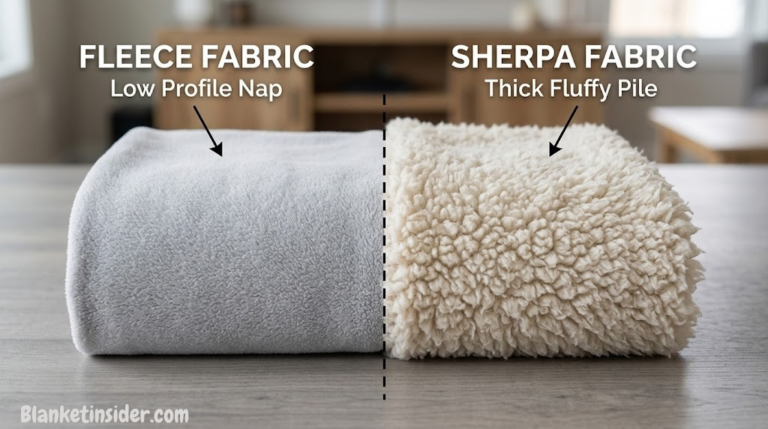
Fleece vs Sherpa Blanket:
The Real Difference
Both are synthetic, both are cozy — but they are built completely differently. This guide breaks down the actual fiber construction, real-world warmth, care demands, pilling behavior, and which fabric deserves a spot in your home.
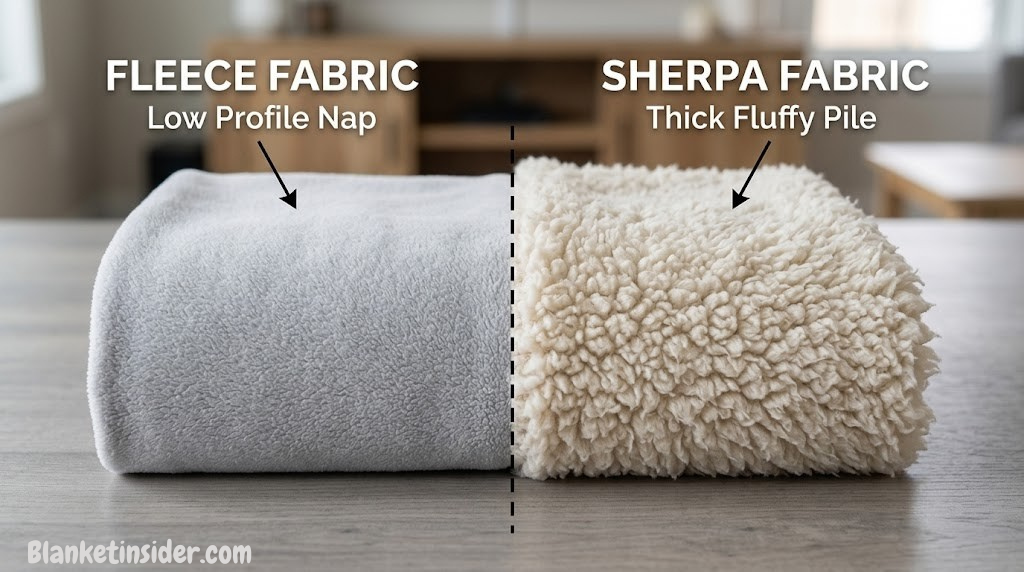
Left: standard fleece pile — uniform height, straight loops. Right: Sherpa pile — variable-height curls mimicking natural wool nap.
If you’ve ever stood in a bedding aisle or scrolled endlessly through Amazon trying to figure out what actually separates a fleece blanket from a Sherpa blanket — you’re in good company. Both are soft, warm, synthetic, and reasonably priced. Both are machine washable. And both are described with words like “ultra-plush” and “cozy” so frequently that the marketing language becomes useless.
This guide cuts through all of that. Fleece and Sherpa are genuinely different fabrics with different construction methods, different thermal profiles, and different ideal use cases. Once you understand those differences, the right choice for your bed, sofa, nursery, or outdoor kit becomes obvious. And if you’re exploring the broader landscape of blanket materials, our guide on all major blanket fabrics gives this comparison useful context.
What Are Fleece and Sherpa — and Where Did They Come From?
Both fleece and Sherpa are synthetic fabrics, typically made from polyester (PET) — the same polymer used in plastic bottles. But that shared origin is where the similarity ends. Their manufacturing processes, pile structures, and how each fabric behaves in use are as different as two fabrics made from the same raw material can be.
Fleece: The Engineered Synthetic That Changed Outerwear
Modern fleece was invented by Malden Mills in the late 1970s under the Polartec brand name, and it revolutionized outdoor and cold-weather clothing almost immediately. The core principle: take polyester fibers, knit them into a base fabric, and then mechanically brush or “nap” one or both sides to raise the fiber ends into a dense, soft pile. The result is a lightweight, breathable, insulating fabric that dries quickly and costs far less than wool.
The word “fleece” technically comes from natural wool fleece — the shorn coat of a sheep — but in modern textile usage it almost exclusively refers to this synthetic pile fabric. Fleece blankets are the direct domestic descendant of fleece outdoor gear: the same fabric construction, scaled up and sold without the weather-resistance treatment used on outdoor clothing. If you want to understand how fleece compares to the natural fiber it was designed to replace, our wool vs fleece blanket comparison covers that specific question in depth.
Sherpa: The Wool Mimic That Found Its Way Into Living Rooms
Sherpa fabric is named after the Sherpa people of the Himalayas — a reference to the association with extreme cold-weather insulation. But as a textile, Sherpa is a specific construction of synthetic fleece: a fabric with a knitted back layer and a deliberately irregular, high-loft pile on the face that is engineered to mimic the texture of natural sheepskin or lamb’s wool.
Where standard fleece pile is cut or brushed to a uniform height — giving it a consistent, flat-pile surface — Sherpa pile is constructed with variable loop heights, crimped or curled fiber tips, and a much denser, thicker surface layer. Run your fingers through both fabrics and you’ll feel the difference immediately: fleece has a smooth, uniform plush; Sherpa has that characteristic chunky, irregular, almost cloud-like depth.
For a detailed standalone deep-dive into what Sherpa is and how it’s manufactured, our complete guide to Sherpa blankets covers the material science comprehensively. For the close cousin comparison between Sherpa and standard fleece construction, the article you’re reading is the right place to be.
🔑 The Core Naming Confusion
All Sherpa fabric is technically a type of fleece — it’s built on the same synthetic knit-and-pile foundation. But not all fleece is Sherpa. Think of it this way: “fleece” is the broader category, and “Sherpa” is a specific high-pile construction within that category. When people use “fleece” in everyday conversation, they typically mean the flat-pile, smooth-back version. When they say “Sherpa,” they mean the dual-layer, curly-pile construction that feels like a sheepskin-lined jacket.

Bedsure Plush Fleece Throw — Machine-Washable, 50″×60″
Top-rated standard fleece throw with thousands of reviews. Ultra-light, available in 30+ colors, and perfectly sized for sofa use.
Shop on AmazonFabric Construction: How Each Blanket Is Actually Made
Construction is where the story really starts. Understanding how these fabrics are built explains nearly everything about their performance — why one pills more, why the other is heavier, why their textures feel so different even though they’re made from the same raw polymer.
Standard Fleece: Single-Layer Pile Construction
Classic fleece blankets are typically a single layer of fabric. Polyester yarns are knitted into a jersey-type base, and then one face (or both faces for double-sided fleece) is mechanically napped: small wire brushes scratch the surface repeatedly, pulling fiber loops upward and cutting them to create a uniform pile. The result is a consistent, flat-pile surface that’s soft from the first touch.
The pile height on standard fleece is typically 3–5mm — short enough that individual fibers aren’t really distinguishable to the hand, giving that smooth, homogeneous plushness. Anti-pill fleece goes one step further: after napping, the surface is sheared to remove the protruding loose fiber ends that would otherwise migrate and tangle into pills during use and washing. The quality of this anti-pill finishing is the single biggest predictor of how a fleece blanket will look after two years of regular washing.
Some fleece blankets are double-sided — the same pile construction on both faces — while others have a flat knit back and a pile front. Double-sided options feel more substantial and are warmer for their weight. You can also find specialty constructions like coral fleece (longer, more textured pile), Minky fleece (ultra-fine microfiber pile, extremely soft), and French terry (looped back, flat front). Our Minky vs fleece comparison covers the softest end of the fleece spectrum in detail.
Sherpa: Dual-Layer Construction with Engineered Curl
Sherpa is almost always a dual-layer product. The back face is typically a flat knit — smooth, firm, and structural — while the face is constructed with deliberately variable-height pile that is then curled, crimped, or teased to create the characteristic irregular nap. Some Sherpa blankets achieve this through tufting long loops and then allowing them to curl naturally; others use mechanically crimped fibers that are incorporated during the knitting stage itself.
The pile height on Sherpa is typically 15–25mm — three to five times taller than standard fleece. This dramatic difference in pile depth is the primary reason Sherpa insulates better and weighs more than standard fleece. All that extra fiber volume traps significantly more still air, which is how insulation fundamentally works regardless of material.
Weight: The Construction Consequence
The pile depth difference translates directly into weight. A standard fleece throw blanket (50″×60″) typically weighs 600g–900g. A comparable Sherpa blanket — same dimensions — typically weighs 1,200g–1,800g: roughly twice as heavy. This isn’t a defect; it’s the natural result of having three to five times more pile fiber by volume. If you’re looking for something to toss in a bag for travel or camping, standard fleece wins on weight. If you want that cocoon-like weighted comfort, Sherpa’s heft is part of its appeal.
For fleece: flip it over and check the back. Premium fleece has a consistent, tight knit back without visible holes or distortion. For Sherpa: pull the pile gently between two fingers. The curl should spring back; flat, matted Sherpa that doesn’t recover indicates low-quality fiber bonding that will deteriorate quickly with washing.
Warmth & Insulation: Which Blanket Actually Performs in the Cold?
Both fleece and Sherpa insulate purely through air entrapment — there’s no natural fiber thermoregulation at play the way there is with wool or down. The amount of still air each fabric can trap is determined by pile loft, and pile loft is a direct function of pile height and density. This makes the comparison fairly mathematical: more pile volume = more trapped air = more warmth.
Sherpa Wins on Raw Warmth, By a Clear Margin
With 3–5 times the pile volume of standard fleece, Sherpa traps significantly more still air and delivers meaningfully warmer insulation for the same blanket dimensions. A typical mid-weight Sherpa blanket will keep you comfortably warm at temperatures 10–15°F colder than a standard fleece blanket of the same size. For genuinely cold rooms, camping in cool weather, or people who run cold, this difference is noticeable and practically significant.
This is why Sherpa is the standard lining for premium cold-weather jackets, boots, and sleeping bags — it’s not just the texture that makes it popular in outerwear; it’s genuine thermal performance. When you see those fleece-lined Sherpa blankets with plush Sherpa on one side and smooth fleece on the back, you’re getting a construction that maximizes both the thermal performance of the Sherpa pile and the smooth, skin-friendly feel of the fleece back.
Fleece Warmth Is Lighter and More Layerable
Standard fleece isn’t cold — it’s genuinely warm, especially in mid-weight constructions (around 200–300 g/m²). But its warmth-to-weight ratio actually favors it for milder conditions: you can get comfortable warmth without feeling overloaded. For households where blankets are used year-round, a good mid-weight fleece covers a wider ambient temperature range before it becomes too warm to sleep under comfortably.
Fleece also layers more gracefully than Sherpa. Two fleece blankets stacked on a bed add warmth incrementally without the combined weight becoming uncomfortable. Sherpa’s heft means that two Sherpa blankets can feel very heavy, particularly for lighter sleepers or people who move around in their sleep.
🏕️ The Outdoor Consideration
Both fabrics retain most of their insulating value when damp — a property they share with each other and that distinguishes them favorably from down. For camping in mild-cool conditions, fleece’s weight advantage makes it the practical choice. For genuinely cold camping (below 40°F/4°C), Sherpa’s superior insulation starts to justify its extra weight and bulk. Our outdoor blanket comparison guide covers cold-weather material choices in detail.

Catalonia Sherpa Blanket — Reversible Fleece & Sherpa, 60″×80″
One of Amazon’s best-reviewed Sherpa blankets — dual-layer with smooth fleece back and thick Sherpa face, available in 20+ colors. Machine washable.
Shop on AmazonSoftness & Texture: The Feel That Sells
Ask ten people why they bought their blanket and at least eight of them mention how soft it felt in the store. Softness is arguably the primary purchase driver for both fleece and Sherpa — so it’s worth understanding what each fabric actually delivers and how that changes over time.
Fleece Softness: Immediate, Consistent, and Easy to Maintain
Premium fleece delivers a smooth, velvety softness that is immediately apparent from the first touch. The uniform pile creates a consistent hand — run your palm across it and there’s a pleasing resistance-free glide. High-quality anti-pill fleece maintains this texture remarkably well over time, washing after washing, because the anti-pill finishing prevents the fiber degradation that would otherwise roughen the surface.
Fleece softness has a certain clean, modern quality to it — it doesn’t feel especially luxurious in the way cashmere or fine merino does, but it’s universally pleasant and never scratchy. For people who find heavily textured fabrics overwhelming against their skin, fleece’s uniformity is a genuine comfort. This is particularly relevant for sensory-sensitive users or anyone with conditions like eczema — our best blankets for eczema guide explores the skin properties of different fabrics in detail.
Sherpa Softness: Deep, Cloud-Like, Intensely Tactile
Sherpa has a different quality of softness — less a smooth glide and more a deep, sinking sensation as your hand (or face, or whole body) disappears into the pile. The irregular curl of the Sherpa fiber creates a random surface that plays with light and touch in a way uniform fleece doesn’t, giving it that characteristic voluminous, almost three-dimensional quality that photographs beautifully and feels indulgent in use.
The challenge with Sherpa softness is preservation. The high pile that makes Sherpa so tactile is also more vulnerable to matting, tangling, and flattening than the short pile of standard fleece. High-quality Sherpa made from fine denier fiber maintains its curl and spring better than cheaper versions, but no Sherpa blanket will look and feel as pristine after 50 washes as it did on day one. This is the central tradeoff: fleece ages more gracefully; Sherpa starts better but declines faster.
🧴 The Softener Trap
Using fabric softener on either fleece or Sherpa is one of the most common care mistakes. Softener coats synthetic fibers with a waxy residue that initially makes them feel smoother — but over time, it actually reduces loft, accelerates pilling on fleece, and causes Sherpa pile to mat and clump permanently. If you want your blankets to stay soft long-term, skip the softener and dry on low heat (or air dry) instead.
Initial vs Long-Term Softness
In the first wash cycle, both fabrics typically maintain most of their initial softness. By wash 20–30, standard anti-pill fleece still feels largely the same, while lower-quality Sherpa has usually developed some matting and flattening of the curl. By wash 50+, the difference is dramatic: good fleece still has its pile; entry-level Sherpa has become essentially a flat, matte surface that no longer resembles what it was when new.
Premium Sherpa made from higher-quality fiber (look for blankets with a higher GSM rating and descriptions mentioning “long fiber” or “microfiber Sherpa”) holds up significantly better than budget options. Spending an extra $20–30 on quality Sherpa pays for itself in longevity of texture in a way that’s harder to measure with standard fleece (where even budget options perform reasonably well long-term).
Weight, Breathability, and the Overheating Question
Both fleece and Sherpa are purely synthetic — neither has the active moisture management of natural fibers like wool. What breathability they offer comes entirely from the open structure of the pile, allowing some air movement between fibers.
Fleece: Lighter, More Breathable, Better in Warm Conditions
Standard fleece is the more breathable of the two, primarily because its shorter pile offers less resistance to airflow and traps less body heat. Mid-weight fleece (around 200 g/m²) performs well as a year-round blanket in temperature-controlled environments — warm enough for cool evenings without becoming stifling on warmer nights. This versatility makes standard fleece the practical default for living rooms, guest rooms, and anywhere the temperature varies through the day or night.
That said, fleece is not inherently breathable the way cotton or linen are — synthetic fibers don’t absorb moisture, so perspiration sits at the skin surface rather than being wicked away. For hot sleepers or anyone in a humid climate, this can be a persistent discomfort issue regardless of which synthetic you choose. For those situations, natural fiber options remain the better solution — our guide to blankets for night sweats covers moisture-management alternatives.
Sherpa: Warmer and Less Breathable — A Winter Fabric
Sherpa’s dense, deep pile effectively seals in body heat — which is exactly what you want in genuinely cold conditions, but becomes a liability in warmer environments. Using a Sherpa blanket in a room above 65°F (18°C) is often uncomfortable for anyone except cold sleepers. In summer, Sherpa is typically relegated to the back of the closet.
The weight issue is also real: a queen-size Sherpa blanket can weigh 3–4 lbs, which is satisfying for some people (particularly those who enjoy the deep-pressure sensation of a weighted blanket) and uncomfortable for others. Light sleepers or anyone who moves around frequently in bed may find Sherpa’s weight disruptive to sleep quality. If you’re drawn to the heavy, grounding feel of Sherpa but prefer a more intentional weight distribution, our weighted blanket guide explores purpose-built heavy blankets designed with even distribution in mind.
Most Sherpa blanket owners naturally treat them as winter-only items, swapping to standard fleece or cotton in warmer months. If you want a single blanket that works year-round, standard fleece (particularly mid-weight, 200 g/m² options) is considerably more versatile. Sherpa is a winter performance fabric — excellent at what it does, but defined by that specificity.
Durability, Pilling & How Each Fabric Ages
Both fleece and Sherpa are more durable than their price points might suggest — neither will develop holes or structural failure quickly. The durability question for these fabrics is almost entirely about surface appearance over time, specifically pilling and pile degradation.
Standard Fleece Pilling: The Universal Complaint
Fleece pills. This is the single most consistent complaint across all fleece blanket reviews at every price point, and it’s worth understanding why. During use and washing, friction causes fiber ends to migrate to the surface. Since fleece is napped by pulling fiber ends upward, there is always a reservoir of loose fiber that can eventually reach the surface and tangle into pills.
Anti-pill fleece is specifically engineered to remove these surface fibers before they reach the product, typically using a shearing process that cuts away the loose ends after the initial napping stage. Quality anti-pill fleece with proper care can stay pill-free for 30–50 washes or more. Budget fleece without anti-pill finishing may start showing surface bobbles within 10–15 washes.
The irony: pilling doesn’t actually reduce fleece’s warmth or function — it just looks bad. A heavily pilled fleece blanket that’s three years old is no less warm than it was when new. The functional lifespan of fleece is actually quite long; what drives replacement decisions is usually aesthetic rather than performance degradation.
Sherpa Matting: The Bigger Long-Term Problem
Sherpa doesn’t pill the same way standard fleece does — the long, curled fibers are less prone to migrating into classic pea-sized pills. Instead, Sherpa’s failure mode is matting: the curled pile gradually loses its spring, lies flat, and stops resembling the original fluffy texture. This process is accelerated by heat, agitation, weight pressure, and fabric softener use.
Matted Sherpa looks significantly worse than a pilled fleece blanket because the texture change is so dramatic — a matted Sherpa doesn’t just look worn, it looks fundamentally different from what you bought. For this reason, Sherpa blankets typically require more careful handling and lower-heat washing to maintain their appearance over time.
| Durability Factor | Fleece | Sherpa | Winner |
|---|---|---|---|
| Pilling Resistance | Good (anti-pill) / Poor (budget) | Low pill risk — different failure mode | Context-dependent |
| Pile Matting Risk | Low (short pile holds shape) | Moderate–High (long pile flattens) | Fleece |
| Appearance After 50 Washes | Good (quality anti-pill) | Variable — depends on quality tier | Fleece |
| Structural Integrity | Excellent — base rarely fails | Excellent — base rarely fails | Tie |
| Snag Resistance | Moderate (loops can catch) | Low — long pile is very snag-prone | Fleece |
| Recovery After Compression | Good — short pile rebounds | Fair — tall pile takes time to recover | Fleece |
| Expected Useful Life | 3–8 years (quality-dependent) | 2–6 years (quality-dependent) | Fleece |
The Role of Quality Tier
The quality of the original fabric matters far more for longevity than the type (fleece vs Sherpa). A $60 premium anti-pill fleece will outlast a $20 entry-level Sherpa by years of maintained appearance. A $80 premium long-fiber Sherpa will outperform a $15 budget fleece easily. Price doesn’t perfectly predict quality, but it roughly correlates with the fiber grade, density, and finishing that determine long-term performance.

Chanasya Anti-Pill Fleece Throw Blanket — Tested for Long-Term Softness
Premium anti-pill fleece construction that resists the most common long-term degradation issue. Available in queen and king sizes with excellent durability reviews.
Shop on AmazonFor households that need blankets washed frequently — pet blankets, children’s rooms, guest rooms that see high turnover — fleece’s robustness to regular washing gives it a meaningful practical advantage. Sherpa requires enough care attention that it’s less suited to environments where blankets are washed weekly without ceremony.
Environmental Impact: The Honest Picture for Synthetic Fabrics
Both fleece and Sherpa are synthetic petroleum-based fabrics. Neither is biodegradable. Neither has a clean environmental story. But understanding the nuances helps make more sustainable purchasing decisions within the synthetic category.
Microplastic Shedding: The Shared Problem
Every wash cycle of either fleece or Sherpa releases polyester microfibers into wastewater. Studies have found that a single synthetic fleece jacket can shed over 1.7 million microfibers per wash, with many passing through treatment systems and entering waterways. Blankets, with their larger surface area, shed comparably or more.
Sherpa likely sheds more microfibers per wash cycle than standard fleece, simply because it has a significantly greater volume of fiber per square meter that can be released. The long, curled fibers of Sherpa may also be more vulnerable to mechanical breaking during agitation, releasing shorter fiber fragments that are harder for water treatment systems to capture.
Recycled Polyester: A Partial Answer
Many modern fleece and Sherpa products are made from recycled PET (rPET) — polyester derived from recycled plastic bottles. This is a genuinely positive development: rPET production uses significantly less energy and water than virgin polyester, and it diverts plastic waste from landfill. However, rPET fabrics still shed microplastics during washing — the recycled origin doesn’t change the microplastic problem.
If sustainability matters to your purchasing decision: choose rPET-certified products when available, use a Guppyfriend wash bag (which captures microfibers during the wash cycle) with both fleece and Sherpa, wash less frequently (air out rather than machine wash after each use), and use cold water and shorter cycles. These practices won’t eliminate the environmental footprint, but they meaningfully reduce it.
| Eco Factor | Fleece | Sherpa |
|---|---|---|
| Biodegradability | None (synthetic polymer) | None (synthetic polymer) |
| Microplastic Shedding | Moderate per wash | Moderate–High per wash (more fiber) |
| rPET Available? | Yes — widely available | Yes — increasingly available |
| Lifespan / Replacement Rate | 3–8 years | 2–6 years |
| Manufacturing Energy | Moderate (same base polymer) | Moderate–High (more fiber per blanket) |
| Recyclability | Technically recyclable; limited programs | Technically recyclable; limited programs |
From a purely environmental standpoint, neither material is an ideal choice. If sustainability is your top priority, natural fiber alternatives — particularly certified wool or organic cotton — remain significantly better choices from a lifecycle perspective. Our bamboo blanket guide and broader bedding comparison resource cover more sustainable alternatives in detail.
Cost, Value & What You Actually Get for Your Money
Both fleece and Sherpa blankets are among the most affordable soft blanket options available, which is part of their widespread popularity. But the price ranges, value tiers, and what the money actually buys differ between the two.
Fleece Price Range and Value Tiers
Entry-level fleece throws start around $10–20 and are genuinely functional, if likely to pill within a year of regular washing. Mid-range fleece in the $25–60 band typically incorporates anti-pill finishing, better GSM density, and more consistent construction — these represent the sweet spot for most buyers. Premium fleece from outdoor brands like Patagonia, Columbia, or Polartec-based manufacturers runs $70–150 and delivers professional-grade performance, anti-pill guarantees, and often recycled-content certifications.
The performance gap between the $25 and $70 tier in fleece is meaningful; the gap between $70 and $150 is smaller. For everyday home use, mid-range fleece ($30–55) delivers most of what you’d get from the top tier at less than half the price.
Sherpa Price Range and Value Tiers
Sherpa blankets typically start around $20–30 for entry-level single-sided constructions. Mid-range options in the $40–80 band are where quality starts to become meaningful — these use higher-denier fibers with better curl retention, better-bonded pile layers, and improved care durability. Premium Sherpa from established brands can run $90–180 for larger sizes.
The quality gap in Sherpa is larger and more visible than in fleece: a $20 Sherpa blanket will look dramatically different after 20 washes than an $80 version. The matting and pile collapse that cheap Sherpa undergoes happens quickly and irreversibly, while quality Sherpa preserves its texture through proper care. If you’re going to buy Sherpa, the case for spending more is stronger than it is for fleece.
| Tier | Fleece Price | Sherpa Price | Quality Jump? |
|---|---|---|---|
| Budget | $10–25 | $18–35 | Moderate improvement at mid-range |
| Mid-Range | $25–65 | $40–85 | Best value zone for both |
| Premium | $70–150+ | $90–200+ | Strong jump from budget on Sherpa; smaller on fleece |
Both fleece and Sherpa quality can be roughly inferred from GSM (grams per square meter) when listed. For fleece: 150 g/m² is lightweight, 200–250 g/m² is mid-weight (the best all-season range), 300+ g/m² is heavy. For Sherpa: less than 300 g/m² is thin, 400–500 g/m² is good quality, 600+ g/m² is premium. Multiply the blanket’s listed weight by its area (in square meters) to calculate GSM when it isn’t provided directly.
Best Uses by Lifestyle: The Right Blanket for the Right Context
Context changes everything in blanket selection. The right choice for a sofa throw in a climate-controlled apartment is different from the right choice for a truck bed camping trip or a college dorm room. Here’s a clear breakdown of where each fabric shines.
Travel & Camping
Fleece packs light, dries fast, and handles rough handling. Perfect for the car road trip kit or weekend camping.
Fleece WinsCold-Climate Sleeping
Sherpa’s deep pile delivers noticeably better warmth for cold rooms and winter nights where maximum insulation matters.
Sherpa WinsPet Blankets
Fleece’s robustness to frequent washing makes it ideal for pet use. Sherpa can mat quickly under pet claws.
Fleece WinsGift Giving
Sherpa’s impressive first appearance and plush feel make it the more gift-worthy of the two. Check our blanket gift guide for pairings.
Sherpa WinsYear-Round Living Room
Fleece’s versatility across temperatures makes it the better year-round sofa companion. Sherpa gets retired for summer. Browse cozy living room blankets.
Fleece WinsWinter Bedroom Layer
A Sherpa blanket as a top layer in winter — especially those with a smooth fleece back — provides exceptional warmth for the coldest nights.
Sherpa WinsThe Dorm Room Question
College dorms present a specific use case where both materials appear frequently. Fleece is the go-to budget choice that handles the high-washing demands of dorm life with minimal care overhead. Sherpa makes an excellent statement throw for a dorm sofa or reading chair — it photographs well and impresses visitors in a way standard fleece doesn’t. If you’re setting up a dorm room from scratch, our dorm room essentials guide covers exactly where blankets fit into the overall setup.

Chanasya Sherpa Fleece Blanket — Plush Reversible, Gift-Ready Packaging
Premium reversible design with smooth fleece back and deep Sherpa face — the most popular Sherpa blanket style on Amazon, and arrives in gift-ready packaging.
Shop on AmazonBabies, Kids & Pets: Safety and Practical Considerations
When blankets are going to be used by the most vulnerable members of a household — infants, young children, and pets — the selection criteria shift significantly toward safety, skin gentleness, and maintenance practicality.
Infants: Neither Fleece Nor Sherpa in Sleep Environments
The most important blanket safety principle for infants under 12 months is that no loose blanket of any material — including fleece, Sherpa, cotton, or anything else — should be placed in a sleep environment. The risk of suffocation and Sudden Infant Death Syndrome (SIDS) associated with loose bedding in cribs and bassinets is well documented. Our detailed baby sleep blanket safety timeline covers exactly when and how blankets can safely be introduced to a baby’s sleep environment.
For supervised, awake use with infants — tummy time mats, swaddle wraps during holding, and stroller covers — both fleece and Sherpa can be appropriate for older infants. For newborns, lighter and more breathable materials are generally recommended; fleece is sometimes used for supervised tummy time padding, while Sherpa’s deep pile raises concerns about very young faces potentially being pressed into it. Our baby blanket material review covers safe options across all material types for different developmental stages.
Toddlers and Children
For children old enough to manage their own blankets, both fleece and Sherpa are popular choices. Fleece wins on practicality for kids: it handles the high washing frequency that childhood demands (food spills, muddy hands, sick days) better than Sherpa, and it’s available in every character print and color imaginable. Sherpa is a lovely bedtime companion blanket for older children — the deep, cloud-like texture has strong sensory appeal for kids who enjoy tactile comfort. For children with sensory processing differences or anxiety, our best blankets for anxiety guide covers the specific properties that matter.
Pets
Fleece is the clear winner for pet use. Pet blankets need frequent machine washing, must survive scratching and chewing without catastrophic damage, and ideally shouldn’t cost a fortune since they’ll be destroyed eventually. Standard fleece handles all of this. Sherpa blankets used for pets mat quickly from claws and constant repositioning, and the deep pile can trap pet hair in ways that are difficult to clean thoroughly. For a fully tested review of pet-specific blanket options, our best pet blankets guide covers purpose-built options across materials and price points.
✅ Fleece for Kids/Pets
- Survives frequent machine washing
- Wide color/character print availability
- Lightweight and easy to carry
- Affordable to replace when worn
- No deep pile to trap pet hair
⚠️ Sherpa for Kids/Pets
- Mats quickly under pet claws
- Requires careful cold-wash treatment
- Deep pile traps pet hair deeply
- Higher cost when frequent replacement is needed
- Not safe for unsupervised infant use
Full Comparison and Final Verdict
| Category | Fleece | Sherpa | Winner |
|---|---|---|---|
| Construction | Single-layer, uniform short pile | Dual-layer, variable tall curled pile | Different |
| Pile Height | 3–5mm | 15–25mm | Sherpa (warmth) |
| Warmth (Cold Conditions) | Good | Excellent — 10–15°F advantage | Sherpa |
| Year-Round Versatility | Excellent | Mostly winter use | Fleece |
| Weight (Queen Size) | 600g–900g | 1,200g–1,800g | Fleece (lightness) |
| Initial Softness | Very soft, uniform | Exceptional, deep, cloud-like | Sherpa |
| Long-Term Softness | Good (anti-pill versions) | Degrades faster if not cared for | Fleece |
| Pilling Behavior | Yes — anti-pill needed | Low pills; mats instead | Tie (different issues) |
| Ease of Care | Very easy — robust washing | Needs cold, gentle care | Fleece |
| Travel / Portable Use | Excellent — light, packable | Bulky and heavy | Fleece |
| Pet / High-Use Contexts | Excellent | Poor — mats quickly | Fleece |
| Gift Appeal / Appearance | Casual and pleasant | Impressive and luxurious-looking | Sherpa |
| Sticker Price | $10–150 | $20–200 | Fleece (lower floor) |
| Eco Footprint | Moderate (less fiber per blanket) | Higher (more fiber, more shedding) | Fleece (marginally) |
⚡ Choose Fleece When…
- You need a year-round blanket for the sofa or guest room
- It’s going to be washed frequently — kids, pets, high-use environments
- You travel, camp, or need something that packs light
- Appearance maintenance isn’t something you want to think about
- Budget is a constraint and you need reliable warmth without the premium
- You’re hot-natured and need something that won’t overwhelm you
- You need multiple blankets for different rooms or uses
🔥 Choose Sherpa When…
- Maximum warmth on cold winter nights is the priority
- You want a statement throw that looks impressive and tactile
- You’re giving a blanket as a gift and first impressions matter
- You’re a cold sleeper who runs below comfortable temperature at night
- You love the sensory comfort of deep, cloud-like pile
- The blanket will be used seasonally rather than year-round
- You’re willing to follow care instructions to preserve the texture
For those who genuinely can’t choose, the reversible fleece-Sherpa construction that combines a smooth fleece back with a Sherpa face is an excellent middle path — you get the tactile drama of Sherpa against your skin and the practicality of smooth fleece as the outer face when folded on a sofa. These reversible blankets also tend to be better-made than single-face Sherpa at similar price points, because they have to perform well on both faces.
For more context on the broader blanket material landscape, our full guide to blanket materials covers every major fiber in use today. And if you’re still deciding between multiple comparison options, our articles on Sherpa vs fleece (reverse angle) and Minky vs fleece cover adjacent comparisons that may answer remaining questions.

Reversible Sherpa-Fleece Throw — The Ideal Compromise Pick
Smooth fleece on one side, plush Sherpa on the other. Get both textures in one blanket — and the construction is usually higher-quality than single-face alternatives.
Shop Reversible Fleece-Sherpa on AmazonFrequently Asked Questions
Not exactly. All Sherpa is technically a type of fleece — both are synthetic pile fabrics made from polyester. But Sherpa is a specific construction within the fleece family, characterized by a dual-layer design (flat knit back + tall, curled pile face) that creates a texture mimicking natural sheepskin or wool fleece. When people say “fleece blanket” without qualification, they typically mean the single-layer, uniform short-pile fabric that is distinct from Sherpa’s dense, curly, longer-pile construction. The key differences are pile height (3–5mm for standard fleece vs 15–25mm for Sherpa) and weight (Sherpa is roughly twice as heavy for the same dimensions).
Sherpa is warmer, and meaningfully so. Because Sherpa has three to five times more pile volume per square meter than standard fleece, it traps significantly more still air — and still air is how insulation works. A typical mid-weight Sherpa blanket will keep you comfortable at ambient temperatures 10–15°F lower than a comparable standard fleece blanket. For cold climates, cold sleepers, or genuinely freezing winter nights, Sherpa’s thermal advantage is real and practical. If you just need comfortable warmth for a temperature-controlled room year-round, standard fleece covers most situations adequately.
Sherpa doesn’t pill in the classic sense (small, round balls of fiber migrating to the surface) the way standard fleece does. Instead, Sherpa’s failure mode is matting — the tall, curled pile gradually flattens, loses its curl, and stops resembling the original texture. This can happen from heat exposure during washing and drying, from the weight of a person sitting on it, or simply from extended use over time. The cure for pilling (a fabric shaver) doesn’t fix matted Sherpa. Preventing matting requires cold-water washing, gentle cycles, and low-heat drying — habits that standard fleece doesn’t require nearly as strictly.
Yes, but only on a low heat setting. High heat is the primary cause of permanent matting in Sherpa pile — the synthetic fibers can partially melt and fuse when exposed to excessive heat, creating a flat, stiff surface that doesn’t recover. Low heat or the tumble-only (no heat) setting is safe for most Sherpa blankets. Air drying is the safest option of all if you want to preserve the pile long-term. Many Sherpa owners prefer to air-dry and only use the dryer on low for a brief period at the end to restore some fluffiness. Always check the specific blanket’s care label, as construction quality affects heat tolerance.
Matting in Sherpa after washing is almost always caused by one of three things: water temperature too high (warm or hot water accelerates pile collapse), dryer heat too high (partial fiber melting fuses pile together), or fabric softener use (softener coats and bonds fibers, causing clumping). The fix for mild matting: wash in cold water on gentle, air dry or dry on the lowest heat setting, and never use fabric softener. After drying, gently fluff the pile by hand or use a wide-tooth comb to carefully work through matted sections while the blanket is still slightly damp. Prevention is much easier than reversal — once Sherpa is severely matted, it won’t fully recover.
For infants under 12 months, no loose blanket of any material is recommended for unsupervised sleep due to suffocation risk — this applies to both fleece and Sherpa equally. For supervised and awake-time use, standard fleece is generally safer with very young infants because the flat, short pile doesn’t create the same face-obscuring risk that Sherpa’s deep pile potentially does. For older babies, toddlers, and children, both are safe and widely used; fleece is more practical because it handles the high washing frequency of child use without the care overhead that Sherpa requires. Our baby sleep safety timeline covers age-appropriate blanket use comprehensively.
Microfiber fleece (sometimes called Minky, coral fleece, or micro plush) is a specific type of standard fleece made from extremely fine-denier fibers that are brushed into a very dense, short pile. The result is a surface that’s smoother and softer than regular fleece but still has the uniform, flat-pile structure of the fleece family. Sherpa, by contrast, has a deliberately irregular, tall, curled pile on one face and a flat knit back on the other. Microfiber fleece is lighter and more uniform; Sherpa is thicker, heavier, and more texturally dramatic. For the most detailed comparison of microfiber fleece options, our guide to Minky fabric covers this specific construction.
For most camping situations, standard fleece is the more practical choice. It weighs roughly half what Sherpa weighs for the same warmth, compresses into a much smaller pack size, and dries faster when wet. For camping in temperatures above 40°F (4°C), mid-weight fleece is typically adequate. In genuinely cold camping conditions below 40°F, Sherpa’s thermal advantage becomes worthwhile, but its bulk and weight are real tradeoffs. Many serious outdoor users prefer mid-weight fleece in a sleeping bag liner configuration, which maximizes warmth-to-weight efficiency better than any single blanket of either type. Our outdoor blanket comparison covers camping material choices in depth.
For mild flattening: wash in cold water on a delicate cycle with no fabric softener, then dry on the lowest heat setting or air dry. While the blanket is still slightly damp, gently pull the pile in all directions by hand to encourage the curl to re-form. A pet slicker brush (soft bristle version) or a wide-tooth comb can be used carefully to work through clumped sections — use very light pressure and work from the tips down rather than pulling from the root. For more stubborn matting, some people have success with a very brief, cool tumble in the dryer with two or three clean tennis balls that gently agitate the pile. Severe matting from high-heat damage generally cannot be reversed — prevention through proper cold-wash care is the only reliable solution.
Static electricity from synthetic blankets is a genuine phenomenon — both fleece and Sherpa build static charge through friction, particularly in low-humidity environments. In normal household use, this causes minor zaps and hair-standing-up effects, which are annoying but not dangerous. The sparks from clothing or blanket static are typically far too weak to ignite common household materials. However, it’s sensible to avoid using synthetic blankets near open flame (fireplaces, candles) anyway — not because of static specifically, but because synthetic polyester melts and ignites more readily than natural fibers like wool when directly exposed to flame. Our dedicated article on whether blanket static can cause fire covers this question thoroughly.
The Bottom Line
Fleece and Sherpa are both excellent blanket materials — genuinely warm, consistently soft, and affordable across a wide range of price points. The choice between them is less about which is “better” in the abstract and more about which is better for your specific situation.
If you live in a climate that swings between seasons, have kids or pets, or want one blanket that handles everything without ceremony: standard fleece, particularly a quality anti-pill mid-weight option, is the right answer almost every time. It does most things well, requires very little care attention, and won’t disappoint you after two years of heavy use.
If you want maximum warmth for genuinely cold winters, love the sensory indulgence of sinking into something cloud-soft, or are looking for a blanket that photographs beautifully and impresses as a gift: Sherpa is worth the slight extra care overhead and higher initial cost. Just buy quality — budget Sherpa disappoints quickly, while premium Sherpa genuinely delivers on its promise.
And if you can’t pick? The reversible fleece-Sherpa construction gives you both experiences in one blanket — smooth and practical on one face, deep and plush on the other. Most people who own one end up wondering why they waited so long to get it. For further reading, our comparison of wool vs fleece and our deep-dive on what Sherpa blankets actually are make great companion reads.
BlanketInsider.com is reader-supported. When you purchase through our Amazon affiliate links, we may earn a small commission at no extra cost to you.
All Blanket Materials · Wool vs Fleece · Minky vs Fleece · Comforter vs Duvet · Best King Blankets