

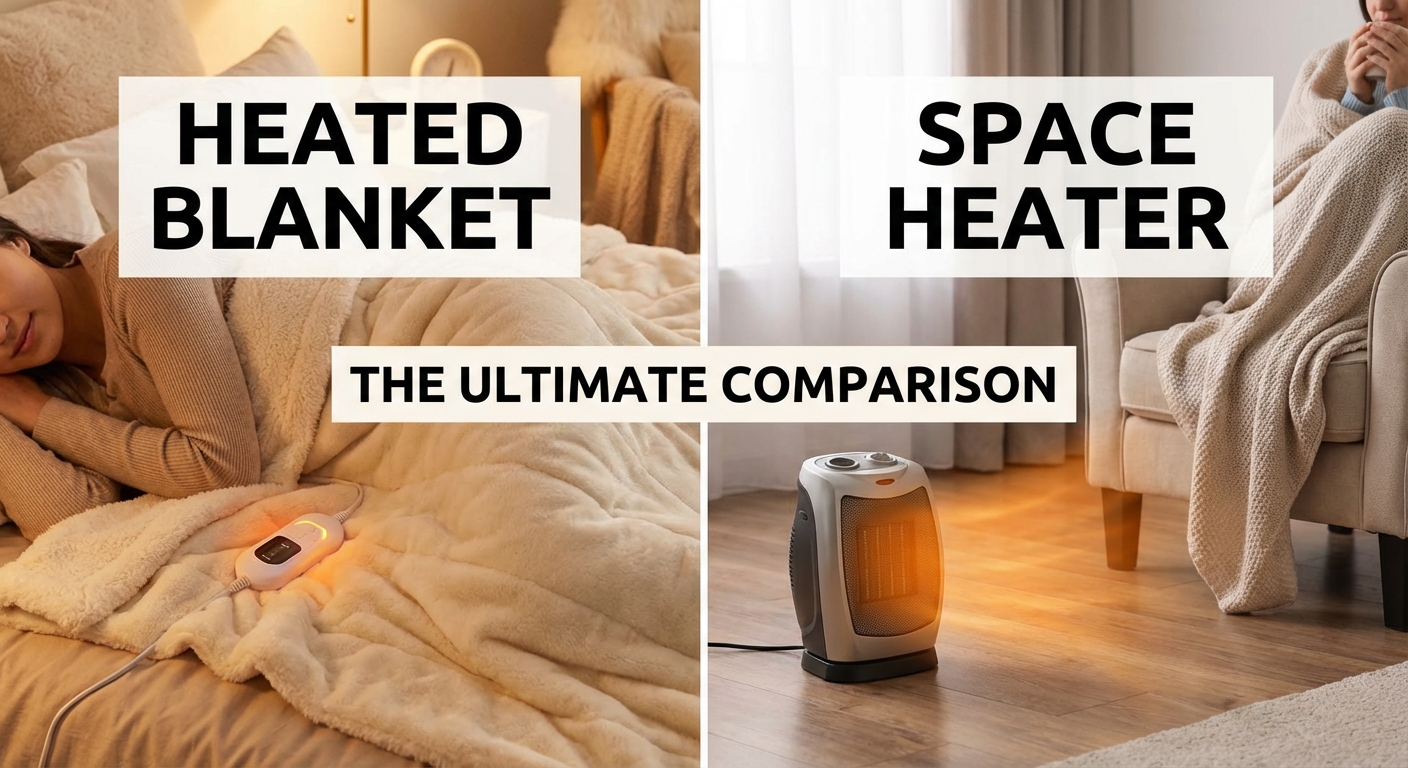
Heated Blanket vs. Space Heater: The Ultimate Winter Warmth Showdown
As winter settles in and the mercury drops, the eternal battle for thermal comfort begins in homes around the world. For many, cranking up the central thermostat is simply too expensive or inefficient, leading to the search for localized heating solutions. This brings us to the two heavyweight champions of personal warmth: the heated blanket and the space heater.
Choosing between a heated blanket vs. a space heater isn’t just about getting warm; it’s a decision that impacts your electricity bill, your safety, your sleep quality, and even your skin health. While space heaters are designed to warm the air around you, heated blankets focus on direct contact warmth. But which one reigns supreme for your specific lifestyle?
At Blanket Insider, we take comfort seriously. Whether you are trying to stay warm in a drafty dorm room or looking for the perfect setup for a movie night, we’ve analyzed every angle. In this comprehensive guide, we will break down the costs, safety features, efficiency, and comfort levels of both contenders to help you decide which winter warrior deserves a spot in your home.
At a Glance: The Tale of the Tape
Before we dive deep into the mechanics and economics, here is a quick breakdown of how these two heating methods compare side-by-side.
| Feature | Heated Blanket (Electric Blanket) | Space Heater (Ceramic/Oil/Fan) |
|---|---|---|
| Primary Heating Method | Direct conduction (Contact heat) | Convection or Radiation (Air/Ambient heat) |
| Energy Consumption | Very Low (60W – 100W avg) | High (750W – 1500W avg) |
| Cost to Run (Est.) | 1–2 cents per hour | 20–30 cents per hour |
| Warm-up Time | Fast (5–10 minutes) | Varies (Instant to 30 mins) |
| Portability | High (Foldable, lightweight) | Medium (Bulky, requires floor space) |
| Safety Risk | Overheating, wiring damage | Fire hazard, tripping, burns |
| Best For | Sleeping, lounging on the couch | Warming a small room, home office |

Want the best of both worlds? Check out top-rated options on Amazon.
See Best Heated Blankets on AmazonContender 1: The Heated Blanket
The heated blanket, often referred to as an electric blanket, is essentially a blanket with integrated electrical heating wires. These wires are insulated and woven into the fabric—often fleece, microfiber, or sherpa—to provide direct warmth to the user. Unlike older models that were stiff and potentially hazardous, modern heated blankets are plush, smart, and incredibly safe.
How It Works
When plugged in, electricity flows through the internal wires, generating resistance heat. Because the blanket is draped directly over your body, the heat is trapped immediately against your skin and clothes, creating a micro-climate of warmth. This is known as conduction heating. You don’t need to heat the air in the room; you only need to heat yourself.
Variations and Styles
Heated blankets come in various forms to suit different needs:
- Standard Electric Throw: Perfect for the couch. If you are looking for cozy blankets for the living room, this is the tech-enhanced version.
- Bedding Size (Twin to King): Designed to stay on the bed all night, often with dual controls for partners.
- 12V Travel Blankets: These plug into car cigarette lighters, making them essential for a cozy car road trip.
- Heated Mattress Pads: These go under you rather than over. Check out our comparison of heated blanket vs. heated mattress pad for more details.
✅ Pros of Heated Blankets
- Incredible Efficiency: Uses a fraction of the power of a heater.
- Targeted Warmth: Heats you, not the empty corners of the room.
- Therapeutic Benefits: Heat helps relax muscles and soothe arthritis.
- Smart Features: Auto-shutoff and multiple heat settings are standard.
❌ Cons of Heated Blankets
- Restricted Movement: You are tethered by a cord.
- Wiring Texture: Sensitive sleepers might feel the wires inside.
- Maintenance: Washing requires care (see our guide on how to wash a heated blanket).
Contender 2: The Space Heater
The space heater is a compact appliance designed to heat a single room or a specific area. Unlike central heating which pushes air through an entire house, a space heater focuses its energy output on a smaller footprint. They are the go-to solution for drafty offices, basements, or rooms with poor insulation.
Types of Space Heaters
Not all space heaters are created equal. The technology used changes how the heat is delivered:
- Ceramic Heaters: Pass electricity through a ceramic plate. A fan then blows the hot air out. These are fast and safe but can dry out the air.
- Oil-Filled Radiators: Look like old-school radiators. They heat oil inside sealed fins. They are silent and retain heat well but take longer to warm up.
- Infrared Heaters: Emit light that heats objects (and people) directly, similar to the sun, rather than heating the air.
- Propane Heaters: Generally for outdoor use or emergencies, though indoor-safe models exist.
The Ambient Advantage
The biggest advantage of a space heater is that it raises the ambient temperature. If you are sitting at a desk typing, a heated blanket might restrict your arms. A space heater under the desk keeps your legs warm while leaving your hands free. For students setting up a compact dorm desk setup, a small ceramic heater is often a staple.
✅ Pros of Space Heaters
- Room-Filling Warmth: Makes the air comfortable to breathe and move in.
- Freedom of Movement: No wires attached to your body.
- Shareable: Multiple people in the room benefit from one unit.
- Fast Acting: Fan-forced models circulate warm air instantly.
❌ Cons of Space Heaters
- High Energy Cost: Can significantly spike electric bills.
- Fire Risk: High wattage generates intense heat; tipping over is a hazard.
- Dry Air: Can dry out skin, eyes, and sinuses.
- Noise: Fan models can be distracting.

Round 1: The Cost Showdown (Energy Efficiency)
When comparing a heated blanket vs. space heater, the most significant difference lies in your monthly utility bill. Let’s crunch the numbers to see the disparity.
The Math
Most space heaters run at 1,500 watts (1.5 kW). On the other hand, a typical heated blanket runs between 60 and 100 watts (0.1 kW).
Assuming the US average electricity cost is roughly $0.15 per kilowatt-hour (kWh):
- Space Heater Cost: 1.5 kW x $0.15 = $0.225 per hour.
- Heated Blanket Cost: 0.1 kW x $0.15 = $0.015 per hour.
The Verdict
Running a space heater for 8 hours a night (while you sleep) would cost approximately $1.80 per night, or roughly $54.00 per month. Running a heated blanket for the same 8 hours would cost approximately $0.12 per night, or roughly $3.60 per month.
Winner: Heated Blanket. It is nearly 15 times cheaper to operate. If your goal is purely financial savings, the blanket is the undisputed champion.
Round 2: Safety Concerns
Both devices involve generating heat using electricity, which inherently carries some risk. However, the nature of these risks differs.
Space Heater Risks
Space heaters are consistently cited by fire safety organizations as a leading cause of home heating fires. The risks include:
- Clearance Issues: Placing the heater too close to curtains, bedding, or furniture (combustibles).
- Tip-Overs: If a pet knocks it over, it can burn the carpet (though modern units have tip-over switches).
- Circuit Overload: Because they draw 1500W, they can easily trip breakers or overheat old wiring.
Heated Blanket Risks
Heated blankets have a safer reputation today than they did in the 1990s, but risks remain:
- Internal Wire Damage: Crimping or folding the blanket can damage wires, creating hot spots.
- Overheating Body Temp: Using them on infants or those with low sensitivity (diabetics) can cause burns or heat stroke. (See: when can baby sleep with blanket for age guidelines).
- Wear and Tear: Old blankets without auto-shutoff are dangerous.
Winner: Tie (Context Dependent). A heated blanket is generally safer to leave on while sleeping (if it has a timer), whereas a space heater should never be left unattended or running while you sleep. However, space heaters don’t suffer from the wear-and-tear wiring issues that blankets do.
Round 3: Comfort & Health Impact
Warmth is about feeling good, but it shouldn’t come at the cost of your health.
Air Quality and Hydration
Space heaters, particularly fan-forced ceramic ones, are notorious for drying out the air. This lowers the humidity in your room, leading to dry skin, chapped lips, and irritated sinuses. If you use a space heater, you might need a humidifier to counteract this.
Heated blankets do not alter the room’s humidity. They keep your natural moisture intact. Furthermore, for those looking for skin benefits, using a heated blanket in conjunction with high-quality bedding—like silk pillowcases (read about silk vs satin pillowcase benefits)—can prevent the winter “dry out.”
Sleep Quality
Experts suggest sleeping in a cool room (around 65°F) with a warm bed for the best rest. A space heater warms the room, potentially making it too stuffy. A heated blanket allows you to keep the room cool for breathing while your body stays toasty. This mimics the cozy feeling of heavy bedding, similar to the benefits of weighted blankets (see weighted blanket care).
Winner: Heated Blanket. It promotes better sleep hygiene and doesn’t degrade air quality.
Which is Better For You? Usage Scenarios
Still on the fence? Let’s look at specific scenarios to see which device fits your life.
Scenario A: The Drafty Office
You are working from home or in a cubicle. Your hands are cold while typing.
Verdict: Space Heater. A small ceramic heater under the desk warms the bubble around you. A blanket would slide off or get caught in the wheels of your chair. (Check out best chairs for ergonomic setups).
Scenario B: Movie Night
You are on the sofa watching Netflix with a partner. The house is chilly.
Verdict: Heated Blanket. Sharing an oversized heated throw enhances the “snuggle factor.” It’s much cozier than hot air blowing in your face. Plus, you can explore cozy home essentials to elevate the experience.
Scenario C: The Dorm Room
Dorm rooms often have strict rules about appliances. Space heaters are frequently banned due to fire codes.
Verdict: Heated Blanket (or Bedding). While some dorms ban electric blankets too, they are often more accepted than coil heaters. Alternatively, layering with a high-quality Sherpa vs fleece blanket might be the safest non-electric route. If space is tight, consider space-saving dorm storage to keep your blankets organized.
Scenario D: Active Living Area
You are moving around, cooking, or cleaning.
Verdict: Space Heater. You can’t wear a plugged-in blanket while cooking dinner. An oil-filled radiator can keep the kitchen/living area warm enough for you to function without bulky layers. (See kitchen tools for cozy homes).
Ready to make a choice?
Browse All Heating Solutions on AmazonMaintenance: Cleaning and Storage
Buying the device is one thing; living with it is another.
Cleaning a Heated Blanket
Contrary to popular belief, most modern heated blankets are machine washable! However, you must detach the controller and follow specific instructions. Never dry clean them, as the chemicals can ruin the insulation.
Read our full guide: How to Wash a Heated Blanket safely.
Cleaning a Space Heater
Space heaters accumulate dust, which can smell like burning when you turn them on after a long summer. Maintenance involves vacuuming the intake vents and wiping down the exterior. They are generally easier to clean but harder to store due to their rigid shape.
Storage
Blankets can be folded (carefully, don’t crimp wires!) and placed in bags. Heaters take up closet floor space. If you are tight on space, check out best blanket storage bags for the off-season.
Frequently Asked Questions
1. Can I leave a heated blanket on all night?
Yes, modern heated blankets are designed for overnight use, provided they have an auto-shutoff timer and overheat protection. However, it is often recommended to use the blanket to pre-heat the bed and turn it off (or to a low setting) when you get in.
2. Which is cheaper to buy upfront?
They are comparable. You can find budget space heaters for $25-$40, and budget heated throws for the same price. High-end oil radiators and King-sized dual-control blankets both range into the $100+ territory.
3. Do heated blankets emit radiation?
Heated blankets emit extremely low frequency (ELF) electromagnetic fields (EMF). While this has been a topic of study, current consensus suggests that modern blankets pose no significant health risk. If you are concerned, simply use the blanket to warm the bed, then unplug it before sleeping.
4. Can I use a heated blanket and a space heater together?
You can, but it is generally redundant and creates a “sauna effect.” It’s better to choose one method. Using both simultaneously also increases the load on your electrical circuit.
5. Are there cordless heated blankets?
Yes! Battery-operated heated blankets exist. They are great for camping or stadiums (see best blankets for outdoors), but they usually have a shorter battery life (2-4 hours) compared to plug-in models.
6. What if I have a memory foam mattress?
Be careful. Memory foam reacts to heat. A heated blanket on top of memory foam is usually fine, but a heated mattress pad under memory foam can damage the foam’s structure. Always check the mattress manufacturer’s warranty.
Final Verdict: Who Wins?
In the battle of heated blanket vs. space heater, there is no single winner—only the right tool for the job.
Choose a Heated Blanket if:
- You want to save maximum money on electricity bills.
- You are looking for a solution primarily for sleeping or lounging.
- You prefer a cool room but a warm body.
- You want therapeutic heat for aches and pains.
Choose a Space Heater if:
- You need to warm a room for multiple people.
- You need to move around the room freely (cooking, working).
- You dislike the feeling of wires or heavy fabric on your body.
- You need to heat a space quickly to take the chill off the air.
Ultimately, many households benefit from owning both—a space heater for the home office during the day, and a heated blanket for the bedroom at night. Whichever you choose, stay warm, stay safe, and enjoy the cozy season!
Ready to upgrade your winter comfort?
Don’t wait until the next blizzard hits. Secure your warmth today.
Shop Best Sellers on Amazon