How to Pick a Blanket
for Outdoor Use
— Key Features Explained
Eight decisions stand between you and a blanket that actually performs outdoors. This guide walks through every one — step by step, feature by feature.
Picking an outdoor blanket sounds simple until you’re standing in the cold and your “outdoor” blanket is soaking through from the damp grass beneath you. Or it’s so bulky it took up half your pack. Or it shed all over your camping gear. Or it’s the wrong size for two people to actually use together.
The outdoor blanket category has expanded enormously over the past decade — there are now purpose-built options for every type of outdoor activity, from ultralight backpacking throws to reinforced stadium blankets that double as seat cushion pads. Most of them look similar in product photos. Almost none of them are interchangeable in real use.
This guide breaks the selection process into eight clear decisions. Work through them in order and by the end you’ll know exactly which features matter for your specific situation — and which features are padding the price without adding value.
How to use this guide: Each step builds on the last. Don’t skip ahead — the activity you establish in Step 1 changes which features matter in every subsequent step. Treat it like a filter: by Step 8, you’ll have a very precise picture of what you actually need.
Define Your Primary Outdoor Activity
The activity determines everything. Start here — don’t skip this step.
Before any spec sheet or fabric comparison, you need one clear answer: what is this blanket primarily for? The outdoor blanket category covers vastly different use cases, and a blanket optimized for one is actively wrong for another.
Figure 1.1 — Activity-to-priority decision tree. Identify your primary activity before evaluating any specs.
The five major outdoor blanket use cases are camping and hiking, beach and picnic, stadium and tailgate, road trips, and backpacking. Each creates a genuinely different set of requirements, and the product you’d buy for one would be a wrong choice for another.
Camping
Needs ground protection, insulation for cold nights, and packability into a bag. Weight matters if you’re hiking to the campsite.
Insulation firstPicnic / Beach
Ground coverage and waterproof backing are non-negotiable. Warmth is secondary. Easy shake-off and washability are valued.
Waterproofing firstStadium / Tailgate
Maximum warmth for sitting still in cold air. Packability is moderate. Wind-blocking outer layer is highly useful.
Warmth firstRoad Trips
Versatility: used as car blanket, picnic layer, and emergency warmth. Doesn’t need ultralight packability but should fold down reasonably.
Versatility firstIf you use blankets outdoors across multiple contexts — beach in summer, stadium in fall, camping in spring — you likely need two different blankets rather than one compromise. A single blanket that tries to serve every use case typically underperforms at all of them. If budget constraints mean one purchase, the picnic-style blanket with a waterproof backing is the most genuinely versatile option for mixed use.
For guidance on road trip blanket use specifically, our cozy road trip guide covers the specifics of car-friendly blanket formats.
Understand Waterproofing Ratings
Water resistance and waterproofing are not the same thing. This distinction costs people money and comfort every season.
The most common outdoor blanket disappointment is discovering that a “water-resistant” blanket has soaked through from damp grass after 20 minutes. Understanding the difference between these two terms before you buy prevents that entirely.
Figure 2.1 — Waterproof rating scale (left) and three-layer blanket cross-section showing where moisture is stopped by a TPU or PEVA waterproof backing.
Water Resistance vs. Waterproofing
Water-resistant means the fabric has a DWR (Durable Water Repellent) coating that causes water to bead and run off the surface. This works well against light splashes and very brief contact with damp surfaces, but DWR degrades over time and with washing, and it fails under sustained contact with wet ground.
Waterproof means there is a physical membrane or laminate layer — typically PEVA (polyethylene vinyl acetate) or TPU (thermoplastic polyurethane) — bonded to the underside of the blanket. This layer physically blocks moisture from passing through. A blanket with a TPU or PEVA backing will keep you and your belongings dry even when sitting on wet grass for several hours.
| Backing Type | Rain Protection | Ground Moisture | Durability | Feel |
|---|---|---|---|---|
| No backing (plain fabric) | ✗ None | ✗ Soaks through | Soft | Most comfortable |
| DWR coating only | ◑ Light rain only | ◑ Brief contact | Degrades with washing | Soft, fabric-like |
| PEVA laminate backing | ✓ Yes | ✓ Reliable | Good — may crack over time | Slight crinkle underside |
| TPU laminate backing | ✓ Yes | ✓ Reliable | Excellent — flexible, durable | Smooth, silent underside |
| Ripstop + TPU (premium) | ✓ Yes | ✓ Reliable | Best in class | Slightly stiffer face |
For beach and picnic use, PEVA is the most common and cost-effective backing. For hiking and camping blankets that see frequent packing and unpacking, TPU is worth the price premium — it’s more flexible and won’t crack at fold lines over repeated use. For our broader overview of different outdoor sports blanket types, see our outdoor sports blanket comparison.
Buying rule: If the product listing says “water-resistant” but doesn’t specify a mm rating or backing material, assume it’s a DWR coating only — not a waterproof laminate. Look for explicit mention of PEVA, TPU, or a stated mm waterproof rating before trusting the waterproofing claim.
Choose the Right Insulation Type
Warmth delivery is not a single-axis problem. How a blanket produces warmth is as important as how much it produces.
Outdoor blankets fall into three insulation categories: non-insulated (ground cover / warm-weather use), synthetic insulated, and down insulated. Each has a distinct performance profile that maps cleanly to specific activities and climates.
Figure 3.1 — Cross-section construction of the three primary outdoor blanket insulation types with performance trade-offs.
Down vs. Synthetic — The Decision Framework
Choose down insulation when: you’re backpacking and every gram matters, your outdoor activity is in dry, cold conditions, and you’re willing to pay a premium and care for it properly. A quality outdoor down blanket at 600+ fill power will warm you more effectively per ounce than any synthetic equivalent.
Choose synthetic insulation when: your climate is variable or wet, you’re camping near water or in shoulder-season conditions, or you’re buying for a child or someone who may not remember to keep the blanket dry. Synthetic fill retains a significant portion of its insulating ability when damp — down collapses to near zero.
Choose a non-insulated outdoor blanket when: the primary purpose is a clean, dry surface for sitting (picnic, beach), not warmth. In warm weather conditions above 65°F (18°C), a lightweight ripstop blanket with a waterproof backing and no insulation fill is the most practical and easiest-to-wash option.
Wool is a fourth option worth considering for car camping and stadium use. It’s heavy and expensive but retains warmth when damp and has a durability profile that outlasts synthetic fill by years. For a detailed breakdown of how wool compares against other thermal options, see our guide to merino wool thermoregulation.
Evaluate Packability & Weight
How your blanket travels determines whether you actually bring it.
The best outdoor blanket is the one you have with you. Packability — how small the blanket compresses — and weight are the two factors that determine whether a blanket makes the cut into your pack or gets left in the car, or at home entirely.
Figure 4.1 — Approximate relative packed sizes of the four major outdoor blanket types. Drawn to illustrate proportional scale differences.
Packability by Activity Type
Backpacking and day hiking: Packed size is the primary filter. If it doesn’t fit in or attach to your pack without dominating it, it won’t come. Look for down blankets that compress to soda-can size or smaller, weighing under 1 lb. Every ounce matters on multi-day hikes.
Car camping and road trips: Packability is moderate. You’re loading from a car, not carrying on your back. A blanket the size of a football that packs into its own carry bag is fine — you don’t need ultralight. Prioritize warmth and coverage over packed volume.
Beach and picnic: Packability is secondary. You’re typically carrying from car to blanket spot — a moderately folded blanket in a tote bag is perfectly workable. What matters here is how quickly and completely the blanket folds back down for the walk back.
Stadium and tailgate: Packability is irrelevant. You’re carrying it in your hands from the parking lot. Bring the warmest thing you own.
Get the Size Right
Too small is the most common outdoor blanket regret. Size up almost always.
Outdoor use demands more blanket than indoor use. When you’re sitting on the ground rather than a sofa, you need coverage both beneath and around you. When you’re sharing with another person outdoors, the social physics of a picnic blanket are different from a couch — there’s no backrest to tuck under, so you need more horizontal coverage.
Figure 5.1 — Overhead coverage guide showing approximate person capacity for the three main outdoor blanket size formats.
The standard sizing breakdown for outdoor blankets runs across three practical tiers: throw (50×60 inches), medium (60×80 inches), and large or oversized (70×80 inches and above). For most people buying for beach and picnic use with another person, the medium format is the minimum — and going large is rarely regretted.
For any use where the blanket also serves as a ground cover (picnic, beach, camping), add approximately 10 inches to whatever coverage size you think you need. Shoes, bags, and gear end up on the corners of outdoor blankets in practice, reducing the usable central area significantly.
The size rule outdoors: If you’re buying for two people, buy the size labeled for four. If you’re buying for solo use, buy what’s labeled as a two-person size. The extra coverage is always useful outdoors and rarely comes at a meaningful price or weight penalty.
Match the Material to the Climate
Material choice is climate-dependent. The wrong material for your region makes a technically good blanket feel like a bad one.
Outdoor blanket materials divide across two axes: face fabric (what you feel against you) and backing or shell fabric (what faces the ground or wind). Both choices interact with your local climate in specific ways.
Figure 6.1 — Material-to-climate performance matrix. Heavier green indicates the best material choice for that climate type.
The matrix above summarizes the key insight: no single material is ideal across all climates. Cotton ripstop excels in warm and humid conditions (beach, summer picnic) because it’s breathable and dries fast. Down is exceptional in cold, dry alpine conditions but becomes nearly useless when wet. Wool is uniquely effective in cold-and-wet conditions — the one scenario where it outperforms all synthetic alternatives.
For more context on how wool and fleece compare in everyday outdoor blanket use, our wool vs fleece blanket guide covers the trade-offs in detail. And if you’re evaluating bamboo-blend outdoor throws, see our bamboo vs cotton blanket breakdown.
Check Durability & Construction Quality
Outdoor use is harder on blankets than indoor use. Construction details tell you how long it will actually last.
The durability of an outdoor blanket is determined by a small number of construction details that are worth specifically checking before purchase. These aren’t luxury features — they’re the difference between a blanket that lasts three seasons and one that lasts three years.
Figure 7.1 — Three key construction details: ripstop weave reinforcement grid, corner anchoring options, and edge binding quality.
The Four Construction Features That Matter
Ripstop weave: The crosshatch reinforcing threads woven into the face fabric arrest tear propagation. A small snag on a plain-woven fabric can become a large tear; the same snag on a ripstop fabric stops at the nearest reinforcing thread. For any blanket used on rocky, rough, or thorny terrain, ripstop is worth specifically seeking out.
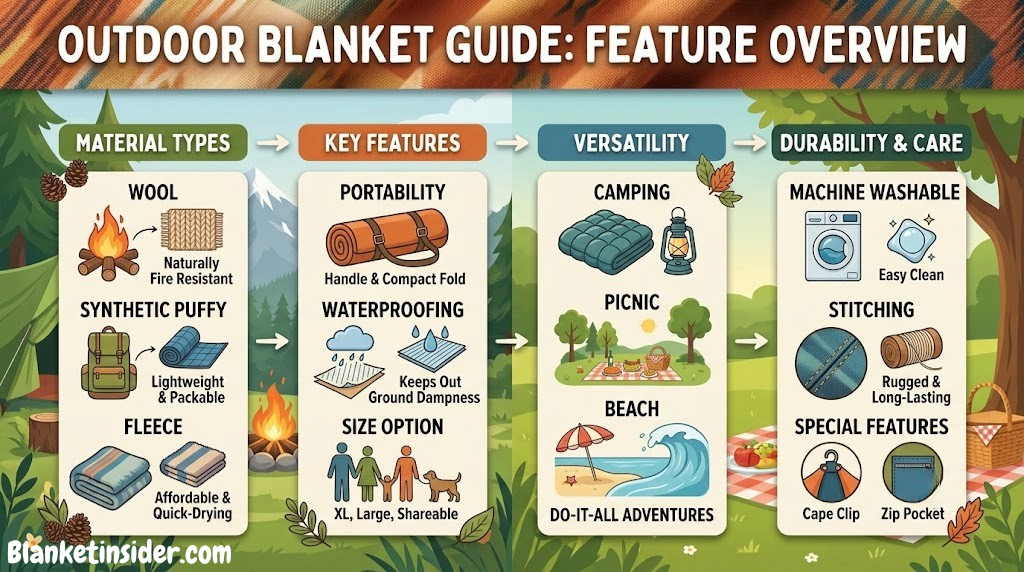
Bound edges: Look for blankets with bound or taped edges rather than simply hemmed edges. A bound edge uses a separate binding tape sewn over the raw fabric edge — it’s significantly more durable than a folded hem, which can unravel with repeated washing and outdoor use. Quality blankets typically specify “bound edges” or “binding tape” in the product description.
Corner anchoring: Some outdoor blankets include ground stake holes (metal grommets at corners) or webbing loops that accept tent stakes. On a breezy beach or open hillside, a blanket that can be staked down is dramatically more practical than one that blows up, carrying sand, food, and gear with it.
Carry strap integration: The best outdoor blankets fold into their own carry bag, which can also clip to a pack or bag. A blanket that folds neatly but has no integrated carry method becomes a loose bundle that eventually gets lost or left behind.
For a comprehensive checklist of what to look for when buying blankets for tough outdoor and emergency conditions, our thermal blanket buying guide covers durability criteria in detail.
Care, Washing & Storage
An outdoor blanket that’s difficult to clean stops getting used. Ease of care is a legitimate buying criterion.
Outdoor blankets accumulate dirt, grass stains, sand, and food residue faster than any indoor blanket. The ease with which a blanket can be cleaned — and how durable its waterproofing remains after washing — directly determines how often you’ll actually use it across a season.
Figure 8.1 — Recommended care flow for outdoor blankets with waterproof backing. The re-proofing step is essential for DWR-coated blankets after every few washes.
Washing Outdoor Blankets With Waterproof Backings
The waterproof backing is the most care-sensitive component of any outdoor blanket. PEVA backings are more vulnerable to heat than TPU — a cycle on hot in the dryer can cause a PEVA backing to bubble, crack, or delaminate entirely. Always use cold water washing and low heat or air drying regardless of what the general care label says, if you want the waterproof backing to retain full function.
Avoid fabric softener entirely on any blanket with a DWR coating. Fabric softener coats fabric fibers with hydrophilic (water-attracting) compounds that directly counteract the hydrophobic DWR treatment, degrading its effectiveness in a single wash. For detailed washing guidance applicable to most outdoor-rated blankets, our blanket washing guide covers fabric-specific protocols.
Re-Proofing DWR Coatings
If your outdoor blanket relies on a DWR (Durable Water Repellent) surface coating rather than a laminate backing, that coating will degrade over time and with washing. The signal that re-proofing is needed: water no longer beads on the surface but instead soaks in. A wash-in or spray-on DWR re-proofing product (Nikwax Tent and Gear SolarProof, Granger’s Performance Repel) restores the coating in a single treatment. Plan to re-proof every 3–5 washes for active outdoor use.
Storage Between Seasons
Store outdoor blankets loosely — compression storage bags are convenient but sustained compression permanently flattens insulation fill and can crack PEVA backings at fold lines. A breathable cotton bag or a large blanket storage bag preserves loft and backing integrity better than vacuum compression for seasonal storage.
Full Feature Comparison: Outdoor Blanket Types Side by Side
Use this table to compare the full picture across outdoor blanket types in the features that matter for buying decisions.
| Blanket Type | Waterproof | Insulation | Packability | Weight | Best Climate | Best Activity | Avg. Durability |
|---|---|---|---|---|---|---|---|
| Non-insulated Ripstop (PEVA backing) | ✓ Yes | ✗ None | Excellent | Light | Warm / humid | Beach, picnic | 3–5 years |
| Fleece (DWR coating) | ◑ Resistant only | ◑ Moderate | OK | Medium | Cold & dry | Stadium, tailgate | 2–4 years |
| Synthetic Insulated (TPU shell) | ✓ Yes | ✓ High | Good | Medium | Cold & wet | Camping, hiking | 4–7 years |
| Down Insulated (ripstop shell) | ◑ Shell only | ✓ Best/oz | Excellent | Lightest | Cold & dry | Backpacking, alpine | 5–10 years |
| Wool / Merino (no backing) | ✗ None | ✓ High (wet) | Poor | Heavy | Cold & wet | Car camping, stadium | 10+ years |
| Canvas Cotton (TPU backing) | ✓ Yes | ✗ None | Fair | Medium–heavy | Warm / dry | Family picnic, park | 5–8 years |
For a deeper dive into how specific outdoor-rated blanket options compare across waterproofing, fleece, heated, and wool categories, see our outdoor sports blanket comparison. If an emergency or thermal blanket is part of your camping kit, our thermal blanket guide covers that segment specifically.
Best Pick by Activity — Quick Reference
If you’ve completed all eight steps and know your activity and climate, here’s the direct recommendation for each scenario.
Best Overall Outdoor Blanket Qualities
- TPU or PEVA waterproof backing present
- Ripstop face fabric for durability
- Bound edges, not raw hem
- Packs into its own carry bag
- Machine washable — no dry clean only
- Corner anchoring or stake loops
Red Flags — Avoid If Present
- “Water-resistant” only, no mm rating given
- No backing material specified
- Care label says “spot clean only”
- Fixed pixel size spec — no carry bag
- Fabric softener recommended (destroys DWR)
- Down fill for wet-climate outdoor use
| Activity | Recommended Type | Key Features to Confirm | Size Target |
|---|---|---|---|
| 🏕️ Camping (car) | Synthetic insulated + TPU shell | 500g+ fill, bound edges, carry bag | 60×80 in |
| 🎒 Backpacking | Down puffy blanket | 600+ fill power, <1 lb, stuff sack | 50×70 in |
| 🧺 Picnic / Park | Ripstop cotton + PEVA backing | Ground-contact waterproof, folds flat | 70×80 in |
| 🏖️ Beach | Ripstop + PEVA, sand-resistant | Easy shake-off, stake loops | 70×80 in |
| 🏟️ Stadium / Tailgate | Heavy fleece or wool | Max warmth, wind-blocking face | 60×80 in+ |
| 🚗 Road Trip | Synthetic insulated or fleece | Versatile, machine washable | 50×60 in throw |
For beach-specific blanket picks with hands-on reviews of sand-resistance and ground waterproofing, see our best beach blanket guide. For outdoor storage options that keep blankets organized between outings, our blanket basket guide and blanket chest reviews cover storage solutions by size.

Top Outdoor Blanket Picks
Find the Right Outdoor Blanket for Your Activity
Browse Outdoor Blankets on AmazonFrequently Asked Questions About Outdoor Blankets
-
1What makes a blanket suitable for outdoor use?
At minimum: a water-resistant or waterproof backing to protect against damp ground. Beyond that, a packable design that compresses into a carry bag, adequate weight-to-warmth ratio for expected temperatures, and a surface that resists snagging on rough terrain. Blankets designed purely for indoor use typically lack the waterproof backing and durable weave needed for regular ground contact.
-
2What is the best material for an outdoor blanket?
It depends on the activity. For camping and hiking: down or synthetic insulation in a ripstop shell (best warmth-to-weight). For beach and picnic: woven cotton or canvas with a PEVA or TPU waterproof backing (most practical). For stadium and cold-weather sports: heavy fleece or wool (maximum warmth, weight not a constraint). No single material is best for all outdoor activities.
-
3How do I know if an outdoor blanket is truly waterproof?
Look for a stated waterproof rating in millimeters — 1,500mm or higher indicates genuine waterproofing, not just water resistance. Also confirm whether the waterproofing is a laminate backing (PEVA or TPU) or a DWR surface coating only. PEVA and TPU backings provide reliable ground moisture protection; DWR coatings degrade over time and don’t work the same way.
-
4What size outdoor blanket do I need?
For one person: 50×60 inches minimum. For two people sitting side by side outdoors: at least 60×80 inches. For a family of four on a picnic blanket: 70×80 inches or larger. Always buy slightly larger than you calculate — cramped outdoor blanket coverage is the most common buyer regret. The outdoor rule is: size up one tier from what you think you need.
-
5Are outdoor blankets machine washable?
Most are machine washable. The waterproof backing requires specific care: gentle cycle, cold water, mild detergent, and low heat or air drying. Avoid fabric softeners (they degrade waterproof coatings) and high dryer heat (it delaminates PEVA and TPU backings). For detailed instructions, see our blanket washing guide.
-
6Can I use a regular fleece blanket outdoors?
A standard indoor fleece can work outdoors on dry days. Without a waterproof backing it absorbs ground moisture quickly, becoming cold and heavy. Fleece also doesn’t pack particularly small. For occasional outdoor use on dry surfaces, it’s fine. For regular outdoor use — especially on grass or near water — a purpose-built blanket with a waterproof backing performs meaningfully better.
-
7What is a ripstop blanket and why does it matter outdoors?
Ripstop is a weave with reinforcing threads crossing every 5–8mm, forming a grid that prevents small tears from propagating into larger ones. On blankets used on rocky ground, near campfires, or in rough terrain, ripstop construction significantly extends the product’s lifespan. It’s especially common in quality camping and hiking blankets.
-
8How do I choose between a down and synthetic insulated outdoor blanket?
Down is lighter, packs smaller, and delivers better warmth per ounce — ideal for backpacking and dry, cold conditions. However, down loses insulating ability when wet and takes a long time to dry. Synthetic retains warmth even when damp, dries faster, and costs less. For activities near water or in variable weather, synthetic insulation is the safer choice. Our outdoor blanket comparison guide covers this trade-off in detail.
-
9What outdoor blanket features matter most in cold weather?
In cold conditions below 50°F (10°C), prioritize insulation fill weight over packability. Look for down at 600+ fill power, or thick synthetic insulation rated to the expected temperature range. A draft collar or draw-cord perimeter helps retain warmth in wind. A windproof outer shell adds meaningful protection in open, exposed conditions like ridgelines or stadium bleachers.
-
10How important is packed size for an outdoor blanket?
Critically important for backpacking (it must fit in your pack), moderately important for car camping and beach trips (compression to football-size is fine), and irrelevant for tailgating or stadium use where you carry it from car to seat. Match packability expectations to your actual mode of transport, not to an idealized scenario.
-
11Is wool a good choice for outdoor blankets?
Wool is one of the best natural insulators for outdoor use — it retains warmth when damp (unlike down), resists odors, and thermoregulates effectively. The trade-offs are weight (wool is heavy per square inch) and price. Merino wool is softer and lighter than standard wool but costs more. For car camping, picnics, and stadium use where weight is no constraint, quality wool is an excellent long-term investment. See our merino wool guide for more detail.
-
12Can an outdoor blanket double as a sleeping bag liner?
Some compact insulated outdoor blankets — particularly those with snap or zip closure edges — can function as improvised sleeping bag liners or emergency wraps. Most picnic and stadium blankets are not shaped or insulated for this. If sleeping-bag-liner functionality matters, look for blankets marketed as puffy or camping blankets with zip edges, not open-style picnic throws.
Pick the Right Outdoor Blanket — Quick Recap
Eight decisions. Activity first. Then waterproofing tier, insulation type, pack size, coverage size, climate-matched material, construction quality, and care simplicity. Work through them in order and you’ll never be disappointed by an outdoor blanket again.
The most common mistake is buying for an idealized scenario — a blanket for a camping trip you imagine — rather than the actual outdoor activities you do most often. Buy for the beach trips you take six times a summer, not the alpine hike you’re planning once.
For more guidance on specific outdoor blanket picks, check our full outdoor blanket guide, or browse the activity-specific picks below.