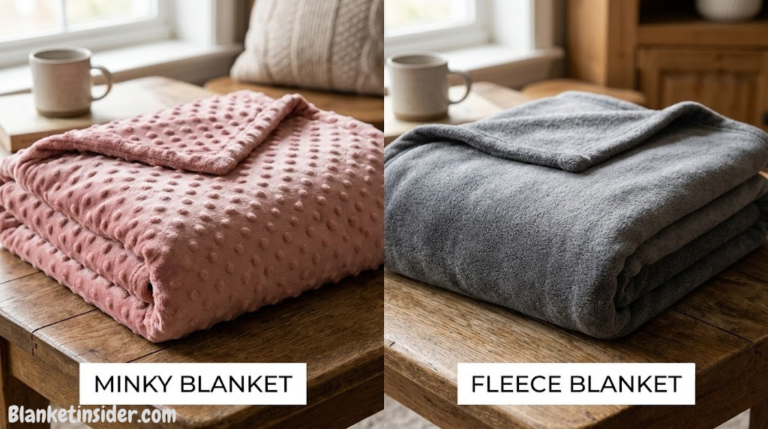
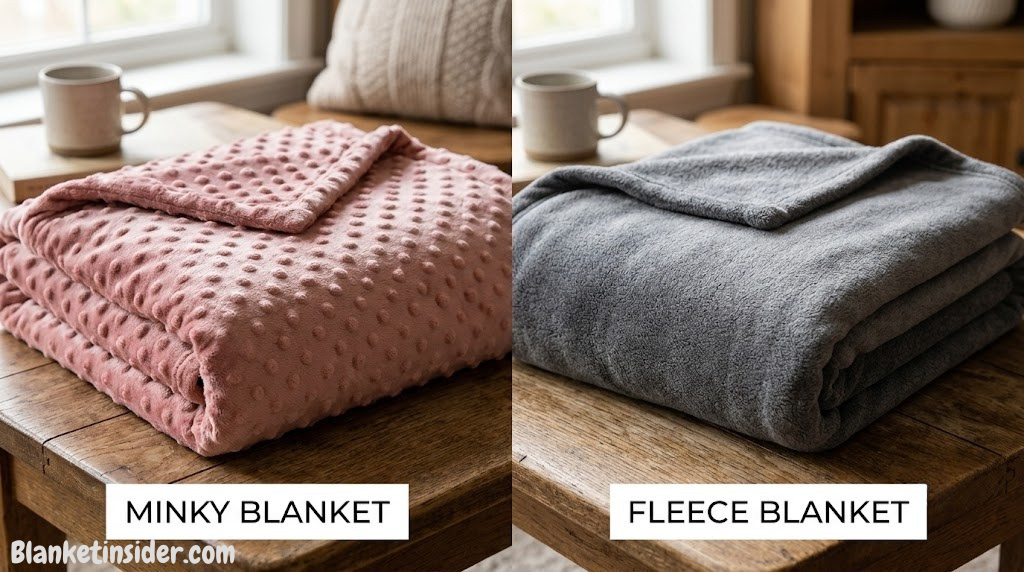
Minky
The ultra-plush, velvet-pile polyester prized for its uniform softness and sensory comfort.
Fleece
The lightweight, breathable workhorse of the blanket world — warm, durable, and endlessly practical.
Minky vs Fleece: The Core Difference in One Paragraph
Both minky and fleece are polyester-based synthetic fabrics designed for softness and warmth, but they achieve those qualities through fundamentally different fiber structures. Minky is a woven fabric with a dense, cut-pile surface — think of it like a very short, very dense velvet. Its uniformity is its defining trait: every square inch feels identical, which makes it the sensory-comfort champion. Fleece is a knitted fabric with a napped (raised and brushed) surface on one or both sides — it’s lighter, loftier, and more breathable than minky but noticeably less silky.
The choice between them almost always comes down to intended use. Understanding that minky and fleece serve different masters — minky excels at tactile luxury, fleece at thermal versatility — makes the decision much clearer.
Dense, Plush, Velvet-Like
Woven polyester with a cut pile surface. Ultra-uniform texture. Heavier and more stable than fleece. The fabric of choice for baby blankets, sensory comfort items, and luxury throws. Does not stretch significantly.
Lightweight, Napped, Versatile
Knitted polyester with a brushed surface. Lighter and loftier than minky. Slightly stretchy. Excellent warmth-to-weight ratio. The fabric of choice for outdoor blankets, budget throws, and all-purpose use. Multiple grades available.
What Is Minky Fabric, Exactly?
Minky (also spelled “minkee”) is a brand name that became a generic term — much like how “Velcro” describes hook-and-loop fasteners. The name comes from its resemblance to mink fur: the dense, impossibly even pile that covers the fabric surface mimics the uniform softness of a pelt. It’s 100% polyester, woven on specialized looms that anchor individual cut fibers into a tight base layer, creating a surface that neither pills easily nor loses its pile under normal use.
Minky comes in several surface variations. Standard minky has a smooth, flat-cut pile in the 3–5mm range. Dimple dot minky has raised dots across the surface — popular for baby items because the texture provides gentle tactile stimulation. Cuddle minky is a trade name for the plusher, higher-pile variants. All share the defining characteristics: weight (typically 300–600 GSM), stability, and a surface feel that’s noticeably more uniform than fleece.
Standard minky, dimple dot minky, and “cuddle fabric” are all the same base construction with surface variations. When shopping for blankets, “minky” on a product listing reliably indicates the dense plush polyester pile regardless of the specific variant name used by the manufacturer.
Minky’s density is what makes it special — and also what creates its limitations. That same dense construction holds heat efficiently (great for warmth, not great for summer), dries slightly slower than fleece after washing, and is heavier per square foot. For a deep dive into the fiber science behind minky’s uniquely satisfying feel, our guide to what minky fabric is made of and why it’s so soft covers the full picture.
✓ Minky Strengths
- Unmatched surface uniformity — zero variation in feel
- Doesn’t pill under normal wash conditions
- Maintains pile height through repeated washing
- Excellent for sensory-sensitive users
- Resists snagging better than fleece
- Dense pile hides minor stains well
- Available in huge variety of prints and colors
✗ Minky Limitations
- Heavier than equivalent fleece blanket
- Traps more heat — not ideal for warm climates
- Takes longer to dry after washing
- Higher price point than most fleece
- Sheds microfibers (microplastics concern)
- Not suited for outdoor/rough-use contexts
What Is Fleece Fabric, and How Many Types Are There?
Fleece is a knitted polyester fabric whose surface has been brushed or napped — mechanically raising fibers into a soft, lofty texture that traps air and provides insulation. Unlike woven minky, fleece is constructed from interlocking knit loops that are then agitated to produce the characteristic fuzzy surface. The result is a fabric that’s lighter, more breathable, and slightly stretchier than minky — practical in ways that minky isn’t designed to be.
Fleece has a meaningful internal taxonomy that matters when you’re choosing a blanket:
Polar Fleece
The original and most common variant. Double-sided nap, moderate weight (200–300 GSM), very good warmth-to-weight ratio. The fabric most people picture when they think “fleece blanket.”
Microfleece
Thinner and lighter (under 200 GSM). Extremely soft for its weight. Dries faster than polar fleece. Slightly less warm but more versatile — good for layering or warmer climates.
Sherpa Fleece
One-sided high-pile that mimics the look of shearling wool. The plushest fleece variant — significantly softer than standard polar fleece and approaches minky in feel. Often used as the backing on throw blankets. We compare sherpa vs. fleece in detail.
Recycled Fleece
Made from reclaimed plastic bottles. Same performance profile as virgin polar fleece. Increasingly common as the mainstream option across major blanket brands — lower environmental impact than minky or standard fleece.
Anti-Pill Fleece
Treated to resist the balling and pilling that standard fleece develops after repeated washing. Worth paying for if the blanket will be laundered frequently. Check listings for “anti-pill” designation.
Blizzard / Plush Fleece
Denser than standard polar fleece with a higher pile on one side. Bridges the gap between traditional fleece and sherpa. Sometimes marketed alongside minky as a softness-first option.
The comparison between fleece and sherpa blankets specifically is one of the most common questions in this space — sherpa sits in an interesting middle ground between conventional fleece and minky in terms of feel and price.
✓ Fleece Strengths
- Excellent warmth-to-weight ratio
- Lighter and more portable than minky
- Dries much faster after washing
- More breathable — better for active use
- Generally lower price than minky
- Recycled options reduce environmental footprint
- Resists moisture better than natural fibers
✗ Fleece Limitations
- Pills with repeated washing (unless anti-pill treated)
- Less uniform surface feel than minky
- Can snag on rough surfaces or velcro
- Slightly stretchy — can distort shape over time
- Also sheds microfibers during washing
- Higher grades (sherpa/plush) approach minky pricing
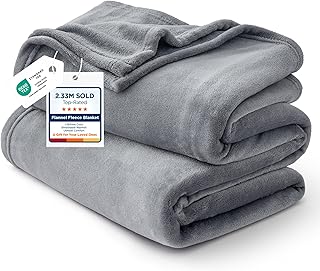
Softness & Texture: Which Fabric Actually Feels Better?
This is the question most people come here to settle, and the honest answer requires a little nuance. In controlled tactile tests and user surveys, minky consistently rates higher for softness — but not by the margin many assume. The real distinction is about the type of softness, not just the degree.
Minky’s softness is defined by uniformity. Run your hand across a minky blanket and every millimeter feels identical — the same resistance, the same fiber density, the same smooth velvet drag. This is the quality that makes it feel luxurious and is also why it’s the fabric of choice for sensory comfort items. There are no rough patches, no direction to the pile, no variation whatsoever.
Fleece’s softness is defined by loft. It feels soft because its fibers are raised and airy, and your hand sinks slightly into it. At equal quality tiers, this lofty softness is genuinely pleasant — but it lacks minky’s uniformity. Standard polar fleece has a slight directionality to its nap (it feels different stroked with vs. against the grain), and higher-quality sherpa fleece is soft but with a slightly more variable texture. Anti-pill treatments also slightly change the hand-feel of fleece, making it marginally firmer than untreated fabric.
Warmth & Insulation: Which Blanket Keeps You Warmer?
This round is more nuanced than you’d expect. Minky is heavier and denser — on a per-blanket basis, a minky throw often feels warmer simply because of its mass. But fleece has a materially better warmth-to-weight ratio, meaning it delivers more insulation for less fabric weight. This distinction matters enormously depending on your use case.
Both fabrics are non-breathable in the traditional sense — unlike cotton or wool, neither allows significant moisture vapor transmission, which means both can feel hot during active use or for warm sleepers. Fleece’s lofted structure traps air more efficiently than minky’s dense pile, which is why outdoor performance fleece is used in cold-weather gear. For blanket applications, a 300 GSM polar fleece will keep most adults warm without the weight of a 500 GSM minky blanket.
For winter blankets where maximum warmth is the goal, a heavy-weight minky or a sherpa fleece are roughly equivalent in thermal output — the difference is how that warmth is delivered. Minky feels warmer because of its dense mass against the skin; sherpa fleece feels warmer because of its superior air-trapping loft.
If warmth is your primary criterion and you’re comparing materials across the full blanket landscape, our guide to the best blanket materials goes beyond just polyester and compares wool, down, cotton, and synthetics side by side. The wool vs. fleece blanket comparison is also worth reading if natural insulation is something you’re considering.
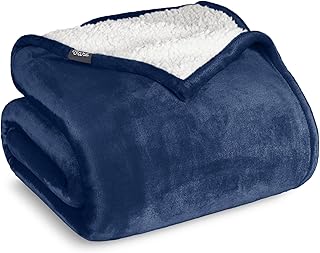
Durability & Longevity: Which Fabric Lasts Longer?
This is the round where fleece’s practical advantages become clearest — but where minky’s construction quality surprises many buyers.
Standard minky is inherently resistant to pilling because of how its pile is constructed. The fibers are cut and anchored into a woven base, which is structurally different from fleece’s napped surface. Fleece pills because the brush-raised surface fibers, once abraded through washing or use, tangle into small balls. Minky’s pile fibers are anchored at the base and don’t tangle in the same way. The result: a well-made minky blanket maintains its appearance longer than equivalent-quality standard fleece.
However, anti-pill fleece closes much of this gap. Modern anti-pill treatments chemically bond the surface fibers, preventing the pilling process effectively for the useful life of the blanket. If you’re comparing premium anti-pill fleece to standard minky, the durability gap narrows considerably.
Washing & Care: Which Is Easier to Maintain?
Both fabrics are machine washable and relatively low-maintenance compared to natural fibers like wool or down. But there are important differences in how they respond to heat, how quickly they dry, and what can go wrong with careless laundering.
The critical shared rule for both fabrics: no high heat. Polyester melts at temperatures above approximately 160°C / 320°F, and domestic dryers on “high” can exceed this at the drum surface. Heat causes both fabrics to flatten irreversibly — minky’s pile fuses and loses its stand, fleece’s nap compresses and becomes hard and scratchy. Low heat or air drying is non-negotiable for either.
Fabric softener is another shared enemy. Both minky and fleece are 100% synthetic, and fabric softener coats synthetic fibers with a waxy residue that actually reduces softness over time while impairing the moisture-wicking properties of the fabric. Skip it for both — neither needs it.
Where they differ: minky requires a gentler cycle and takes noticeably longer to dry than fleece. Its denser construction holds water more stubbornly, which matters if you’re washing frequently (as you would with a baby blanket) or if you don’t have a dryer. Fleece’s lofted structure releases moisture much faster — a fleece throw can air-dry in a few hours while an equivalent minky blanket may need six or more.

Minky vs Fleece: Best Use Cases by Category
The clearest way to settle this comparison is to think about what you’re actually using the blanket for. Each fabric has a domain where it is genuinely the better choice, and crossing those domains leads to disappointment.
Uniform softness matters most for newborn skin. Minky’s pile provides consistent tactile input that is calming for infants. The heavier weight also stays positioned better than lightweight fleece.
Lighter, dries faster if damp, and more resistant to snagging on rough surfaces. Fleece also compresses better for packing. Minky’s dense pile holds moisture and adds unnecessary weight outdoors.
Minky’s uniform, velvet-like pile is the most consistently soothing texture for tactile hypersensitivity. Its smoothness gives zero variation in sensory input — exactly what anxiety and sensory processing conditions respond to best.
Claws snag fleece slightly more than minky, but fleece’s faster drying and easier washing make it far more practical for pet use. Anti-pill fleece holds up well to pet nails and repeated laundering. See our pet blanket roundup for tested options.
Both work well. Choose minky for a luxury, hotel-quality feel; choose fleece for a lighter, more casual drape that’s easier to wash and store. For ideas on styling and options, see our best cozy blankets for the living room.
Weight and packability favor fleece decisively. Microfleece travel blankets compress to the size of a large fist. Minky blankets are too heavy and bulky for most travel contexts. Our travel blanket guide covers the best options.
The “wow factor” of a minky blanket when unwrapped is noticeably higher than fleece. If perceived quality matters for the gift context, minky looks and feels premium from first touch. Our gift blanket guide has more ideas.
Easy laundering, lower cost, and versatility for studying, lounging, and sleeping win the dorm context. For more dorm comfort picks, see our dorm room essentials list.
Minky vs Fleece for Babies and Children: A Closer Look
The baby blanket category is where minky most consistently outperforms fleece, and it’s worth understanding why — because the reasons go deeper than just “it feels nicer.”
Skin Sensitivity
Newborn and infant skin is significantly thinner and more permeable than adult skin. The friction coefficient of the material that contacts it matters for both comfort and potential irritation. Minky’s smooth, uniform pile creates substantially less friction against delicate skin than fleece’s slightly rougher, more directional nap. For babies with eczema or contact sensitivity, this difference can be meaningful. Our resource on blankets for eczema addresses this intersection specifically.
Safety Considerations
Both minky and fleece carry the same fundamental safety caveat for infants: loose bedding in a sleep environment is a suffocation risk for babies under 12 months. Neither fabric is safe for unsupervised infant sleep — not because of anything specific to the materials, but because of the blanket form factor itself. For safe infant sleep alternatives, our guide to baby blanket safety and the baby sleep blanket safety timeline are essential references.
Washability for Baby Items
Baby blankets get washed — a lot. Spit-up, diaper leaks, and spills mean a baby blanket may see two or three wash cycles per week. Fleece’s faster drying time is a genuine practical advantage in this context. If you have multiple minky blankets in rotation, the slower dry time is manageable; with a single blanket, fleece may be more practical despite its sensory disadvantage.
For a comprehensive look at baby-specific blanket options that covers materials, construction, and safety standards across all fabric types, our best swaddle blankets roundup is the most thorough resource.
For skin contact, gift-giving, and sensory comfort: minky. For practical daily use with frequent washing: consider having at least one fleece or muslin option in rotation alongside any minky blankets.

Cost Comparison: What You’re Actually Paying For
Price is one of the most consistent differentiators between minky and fleece, and the reasons are structural — not just marketing. Minky’s woven construction, denser fiber count, and specialized manufacturing process make it inherently more expensive to produce than fleece.
| Blanket Category | Minky Range | Fleece Range | Notes |
|---|---|---|---|
| Baby / Receiving Blanket (30″×40″) | $18–$45 | $8–$22 | Minky 2–3× more than basic fleece at same size |
| Throw / Lap Blanket (50″×60″) | $30–$70 | $12–$35 | Anti-pill fleece brings quality fleece up toward budget minky |
| Full / Queen Blanket | $55–$120 | $20–$60 | Sherpa fleece (premium) approaches entry-level minky pricing |
| Custom / Handmade | $60–$200+ | $25–$100+ | Fabric cost + labor; minky fabric itself runs ~$8–15/yd vs $3–7/yd fleece |
The premium for minky is most justified when the specific properties that minky provides — tactile uniformity, sensory comfort, pile longevity — are actually the use case. Paying minky prices for a blanket that will live in the car, go camping, or be used by pets is poor value. Paying minky prices for a baby’s first blanket, a comfort item for someone with sensory needs, or a meaningful gift makes more sense.
Environmental & Health Considerations
Neither fabric will win an eco-award — both are petroleum-derived polyester. But the environmental story is more nuanced than that, and awareness of the differences helps make more informed choices.
Microfiber Shedding
Both minky and fleece shed microfibers (microplastics) during washing. Studies have found polyester fleece to be among the highest shedding fabrics per wash cycle, releasing tens of thousands of microfibers that pass through most wastewater treatment systems into waterways. Minky, being a woven fabric with anchored pile, may shed fewer fibers than standard fleece — but the evidence for this is not yet definitive.
Practical mitigation: use a washing bag specifically designed to trap microfibers (such as a Guppyfriend bag) for either fabric. Cold water and shorter cycles also reduce shedding significantly.
Recycled Fleece
Recycled polyester fleece (rPET) — made from reclaimed plastic bottles — is now mainstream at most price points. While it doesn’t solve the microfiber shedding issue, it reduces demand for virgin petroleum and diverts plastic from landfill. Recycled fleece options are readily available and perform identically to virgin polyester fleece. Minky in recycled polyester is less common but does exist at premium price points.
Chemical Safety and Skin Sensitivity
For people with chemical sensitivities, OEKO-TEX Standard 100 certification is the most reliable indicator that both the fabric and its dyes have been tested for harmful substances. Both minky and fleece are available in OEKO-TEX certified variants — it’s worth filtering for this when shopping for baby items or for anyone with contact dermatitis.
If natural fibers are a priority for environmental or health reasons, the comparison shifts entirely toward materials like organic cotton, bamboo viscose, or merino wool. Our comparison of cotton vs. polyester blankets covers that trade-off directly.
The Final Verdict: Minky or Fleece?
After examining softness, warmth, durability, washability, use cases, price, and environmental profile, the verdict is deliberately honest: these two fabrics aren’t competing for the same crown. They’ve evolved to serve different contexts. Calling one objectively better would be like calling a sports car better than a pickup truck — it entirely depends on what you’re doing.
The scoreboard lands exactly even — which is the most honest answer the data supports. Here’s the practical decision guide:
Tactile Quality Is the Priority
You want the softest possible feel. The blanket is for a baby, a sensory-sensitive person, or as a gift. The blanket will be kept and cherished rather than used hard. You’re making a weighted, comfort, or anxiety blanket. The budget allows for the premium.
Practicality Is the Priority
The blanket will be washed frequently or used heavily. You need something lightweight for travel, camping, or outdoor use. The budget is limited but you don’t want to sacrifice warmth. The blanket is for a pet, a dorm room, or daily throw use. You want the faster drying option.
Worth noting: if you love the feel of minky but need the practicality of fleece, sherpa fleece is the genuine middle ground. Its pile side approaches minky in softness, while its fleece backing retains the light weight and faster drying of conventional fleece. Our sherpa vs. fleece comparison explores this specifically, and our roundup of the best blanket materials covers how both fit within the broader landscape of blanket fabrics.

Frequently Asked Questions
Ready to Choose Your Fabric?
Whether you’re drawn to the velvety uniform luxury of minky or the lightweight practical warmth of fleece, you now have everything you need to make the right call. Both fabrics have earned their place — it just depends on what you need them to do.