
Can Static Electricity From a Blanket Cause a Fire? The Science, the Risks, and What You Can Do
Under normal household conditions, static electricity from a blanket cannot start a fire. The sparks are real but tiny — far too brief and low-energy to ignite most materials. However, in specific dangerous scenarios — near medical oxygen equipment, leaking gas appliances, or flammable vapors — even a small static spark can trigger ignition. Knowing when static crosses the line from nuisance to hazard is what this article is about.
You’ve probably experienced it dozens of times — you pull a blanket off the bed on a dry winter night and see a shower of tiny blue-white sparks in the dark. Maybe your hair stands on end, or you get a sharp jolt when you touch a metal doorknob afterward. The crackling energy of a charged blanket is one of those peculiarly satisfying sensory experiences that makes you wonder: what exactly is happening here, and could it possibly go wrong?
The short answer is that your average bedroom blanket static is harmless. But the longer answer — the one that actually matters for safety — involves understanding the physics, the specific conditions that change the equation, and a handful of genuinely dangerous real-world scenarios that have caused documented fires and accidents. Let’s dig in.
How Static Electricity Actually Works in Blankets
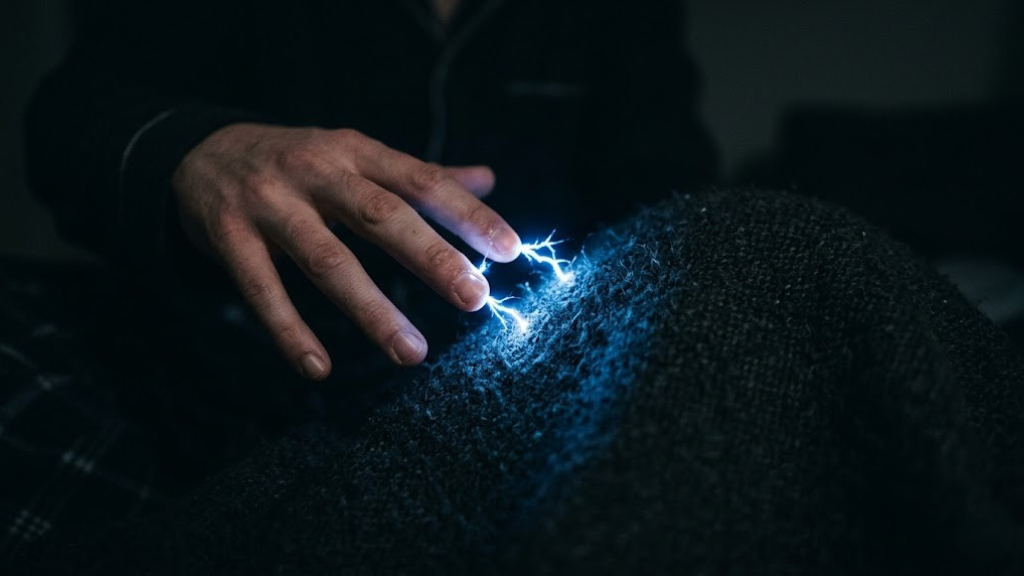
Static sparks from blankets are most visible in the dark — a sign of genuine charge buildup.
Static electricity in blankets is produced through a process called triboelectric charging. “Tribein” is the Greek word for rubbing, and that’s precisely what’s happening when you toss and turn in bed, fold a blanket, or pull it across your body. Two materials in contact exchange electrons. When they separate, one surface is left with an excess of electrons (negatively charged) and the other with a deficit (positively charged).
The key determinant of how much charge builds up is the materials’ positions on what physicists call the triboelectric series — a ranking of materials by their tendency to gain or lose electrons. The greater the difference in position between two materials, the more charge transfers when they rub together.
The Triboelectric Series: Why Fabric Matters So Much
At one extreme of the triboelectric series you have materials that readily give up electrons (becoming positively charged) — things like human hair, wool, nylon, and silk. At the other extreme are materials that aggressively grab electrons (becoming negatively charged) — polyester, acrylic, and other synthetic fibers sit here. When a polyester fleece blanket rubs against cotton sheets, the charge differential is significant. When it rubs against another synthetic material, it can be enormous.
The typical static discharge from pulling a fleece blanket off a bed in dry winter air can reach 5,000 to 20,000 volts. This sounds terrifying, but voltage alone doesn’t determine danger — current and energy duration do. The current in clothing static is measured in microamps, making the energy equivalent to roughly a millionth of a joule. That’s why you feel a shock but don’t get electrocuted.
Why It Sparks (and Crackles)
Once charge builds up between two surfaces, it needs to equalize. When the accumulated voltage is high enough, the air itself becomes temporarily conductive — electrons jump across the gap in a miniature lightning bolt. That’s the spark you see and the crack you hear. In a blanket, this happens thousands of times in rapid succession as fabric separates, producing the light show visible in a darkened room.
The conditions that amplify this effect dramatically are low humidity, synthetic fabric content, friction intensity, and the size of the charged surfaces. Understanding each of these variables is key to both understanding the risk and eliminating it.
Can a Static Spark From a Blanket Actually Ignite a Fire?
Let’s address the core question directly, because a lot of anxiety around this topic comes from not knowing where the line actually falls.
A static spark is a real transfer of electrical energy. For a spark to start a fire, it must deliver enough energy to raise a flammable material to its ignition temperature — essentially, to break chemical bonds fast enough that a self-sustaining combustion reaction begins. The critical measure is called Minimum Ignition Energy (MIE), and every material has one.
The Energy Math
A typical static discharge from a blanket or clothing delivers somewhere between 0.05 and 1 millijoule of energy. Now consider what it takes to ignite common materials:
| Material | Min. Ignition Energy (mJ) | Ignitable by Blanket Static? |
|---|---|---|
| Hydrogen gas | 0.017 mJ | ⚠️ Yes — at high charge levels |
| Propane/air mixture | 0.25 mJ | ⚠️ Possibly, at high discharge |
| Natural gas/air mixture | 0.28 mJ | ⚡ At upper end of static range |
| Gasoline vapor | 0.24 mJ | ⚠️ Possibly, at high discharge |
| Cotton fiber/dust | ~25–45 mJ | ✔ No — too high |
| Polyester blanket fabric | >100 mJ | ✔ No — far too high |
| Loose paper | ~20–50 mJ | ✔ No — too high |
| Dry leaves/tinder | ~100–500 mJ | ✔ No — far too high |
The table tells the story clearly. Under normal circumstances, the blanket itself cannot ignite — and neither can most materials around it. The scenario changes dramatically, however, when flammable gases or vapors are present. This is where blanket static moves from “annoying” to potentially life-threatening.
The Genuinely Dangerous Scenarios You Need to Know
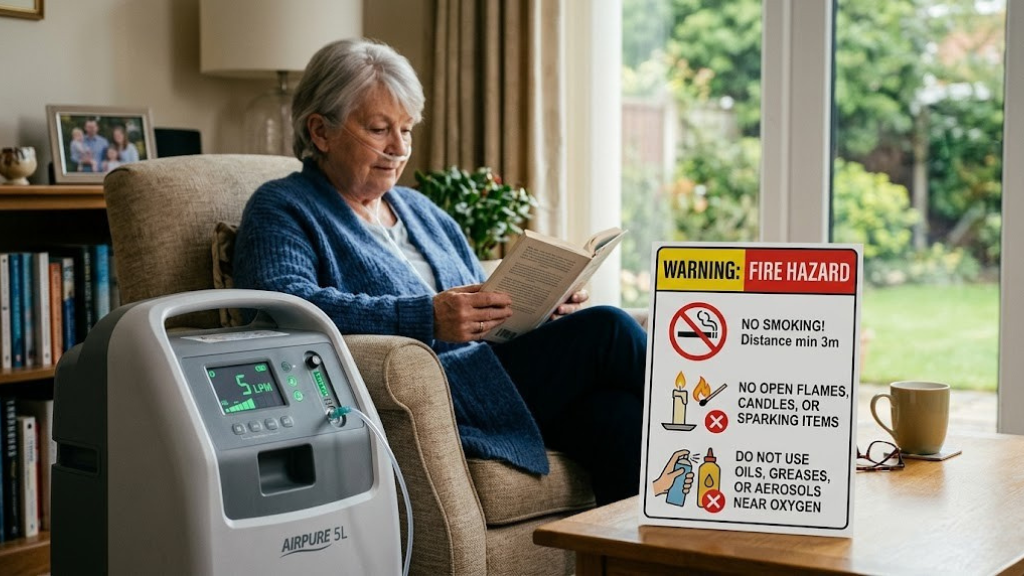
Oxygen concentrators create enriched-oxygen environments where static sparks from synthetic blankets pose genuine fire risk.
Scenario 1: Medical Oxygen Equipment
This is the most widely documented and most serious real-world risk associated with blanket static electricity. Oxygen concentrators, liquid oxygen systems, and portable oxygen tanks used by patients with COPD, sleep apnea, or other respiratory conditions create an oxygen-enriched atmosphere in the immediate area of use.
In normal air (21% oxygen), materials require significantly more energy to ignite. In oxygen-enriched air (above 30% oxygen), the minimum ignition energies of almost everything drop precipitously — and materials that wouldn’t otherwise burn easily become highly flammable. The National Fire Protection Association (NFPA) and the FDA both document cases of fires caused by static sparks from synthetic clothing and blankets near oxygen equipment.
If anyone in your home uses supplemental oxygen equipment, synthetic blankets — especially fleece — must not be used in the same room during oxygen use. This applies to visitors’ clothing too. The NFPA recommends a minimum 5-foot clearance of all flammable materials, including synthetic fabrics, from oxygen equipment during use.
Scenario 2: Gas Leaks
Natural gas and propane are both colorless and nearly odorless in their raw form (the “gas smell” comes from an added chemical called mercaptan). If gas has been leaking in a confined space — a bedroom, a laundry room — it can accumulate to explosive concentrations without being immediately detected. In this situation, pulling a synthetic blanket off a bed could produce the ignition spark for what amounts to a confined explosion.
The critical safety protocol here: if you suspect a gas leak, do not pull any blankets, do not flip any light switches, do not touch anything that could create a spark. Leave immediately and call your gas company from outside.
Scenario 3: Flammable Liquid Vapors
Gasoline, acetone, some cleaning solvents, and certain aerosol propellants all produce vapors with very low minimum ignition energies. If someone has been using these products in a confined space and the vapors have accumulated, a static discharge from a blanket could theoretically provide ignition. This is less likely in everyday bedroom use but becomes relevant in workshops, garages, or when blankets are used in areas where flammable products are stored.
Scenario 4: Industrial and Agricultural Settings
Grain dust, fine metallic powders, and certain organic dusts are highly flammable and can be ignited by static discharges even weaker than those from a blanket. While these are not household concerns, they’re important context for understanding why static electricity is taken extremely seriously in industrial settings — and why the principle extends to anything that generates significant charge, including blankets, clothing, and footwear.
Danger Scenarios at a Glance — Tap to Explore

Neutralizes static charge on blankets, bedding, and clothing instantly — safe on all fabrics.
Which Blanket Fabrics Produce the Most Static?
Not all blankets are created equal when it comes to static generation. The fabric type is the single most important variable determining how much electrostatic charge builds up during normal use. Understanding the triboelectric ranking of common blanket materials gives you an immediate, practical tool for reducing your risk.
High-Static Fabrics (Synthetics)
Polyester fleece is the champion static generator among blanket materials. Its molecular structure holds electrons tightly and transfers charge aggressively when rubbed against almost any other material. The fluffy, high-surface-area texture of fleece maximizes the contact area during friction, making charge buildup even more intense. This is why a fleece blanket in dry winter air produces the most spectacular light show when pulled off a bed in the dark.
If you’re interested in comparing how fleece stacks up against other materials beyond just static, our deep dive on sherpa vs fleece blankets covers the full spectrum of performance differences including warmth, weight, durability, and yes — static behavior.
Moderate-Static Fabrics
Wool is an interesting middle case. It sits higher on the triboelectric series than cotton (meaning it gives up electrons more readily), but natural lanolin in wool fibers provides a degree of antistatic behavior. Wool is also somewhat hygroscopic — it absorbs a small amount of moisture from the air, which improves conductivity and allows charge to dissipate more easily. The result is moderate static that’s notably less intense than synthetics, especially in average-humidity environments.
Low-Static Fabrics (Naturals)
Natural cellulose fibers — cotton, bamboo, linen, and hemp — generate very little static electricity in typical conditions. Their molecular structure allows charge to distribute and dissipate more readily, and they retain a tiny amount of ambient moisture that acts as a natural conductor. If static electricity is a concern for you — whether for comfort, for medical device safety, or for fire risk near sensitive equipment — switching to a natural fiber blanket is the single most effective material change you can make.
Bamboo blankets in particular have become a popular choice precisely because of their low static profile combined with exceptional softness. Check out our comprehensive guide to the best bamboo blankets for a full breakdown of what makes bamboo fabric an outstanding choice for anti-static bedding.
Static Risk by Fabric — Interactive Visual
Static Generation Level by Blanket Material
Synthetic vs Natural Blankets: Head-to-Head Static Profile
The Humidity Factor: Why Winter Is Static Season
If you’ve noticed that blanket static is dramatically worse in winter than in summer, you’re observing one of the most important variables in static electricity: relative humidity. Moisture in the air is an excellent conductor of electricity. When humidity is high, water molecules coat every surface — including fabric fibers — creating a thin, conductive layer that continuously bleeds off any charge that builds up.
In summer, typical indoor relative humidity sits between 50–70%. In winter, when heating systems are running continuously, indoor humidity can drop to 20% or even lower — and that’s when static becomes genuinely problematic.
The Humidifier Solution
Maintaining indoor relative humidity between 40–50% is the single most cost-effective intervention for reducing blanket static. A whole-house humidifier attached to your HVAC system handles this automatically. For individual rooms, a quality console humidifier can bring humidity up to comfortable levels within hours. Not only does this reduce static, but it also improves sleep quality, reduces respiratory irritation, and protects wooden furniture and flooring.
Other Environmental Factors
Beyond humidity, several other environmental variables affect static buildup in blankets:
- Temperature: Colder air holds less moisture, which is part of why cold, dry winter conditions are the worst for static
- Airflow: Moving air can accelerate charge buildup by facilitating fabric-to-fabric contact
- Insulating surfaces: Rubber-soled shoes and insulating mattresses prevent charge from grounding through the body
- Repeated friction: Active sleepers who toss and turn generate more static than those who sleep still

Maintains ideal 40–50% humidity to eliminate blanket static naturally — covers up to 505 sq ft.
Electric Blankets: A Different Kind of Fire Risk
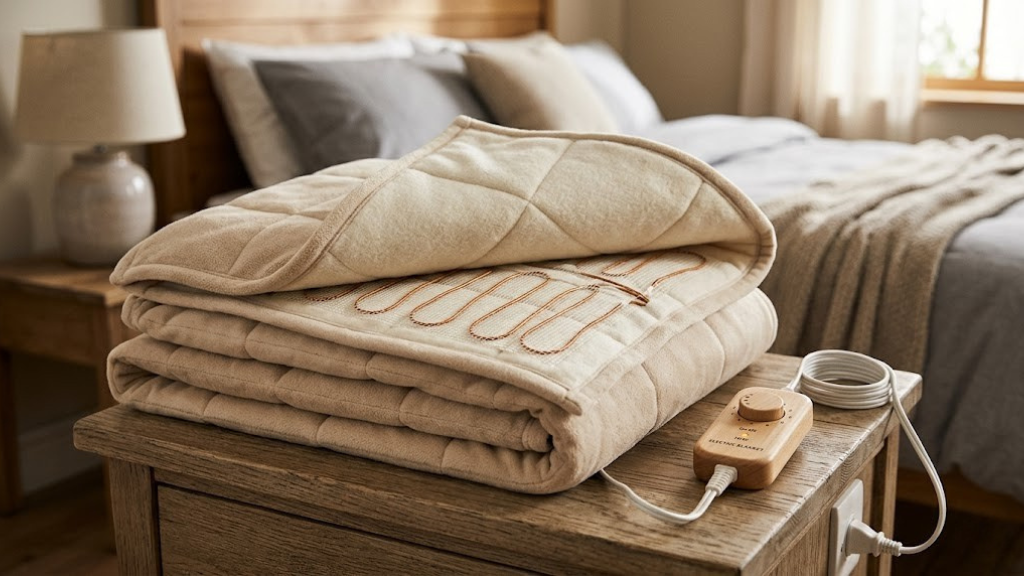
Electric blanket fire risks come from damaged wiring and overheating — not static electricity from the fabric itself.
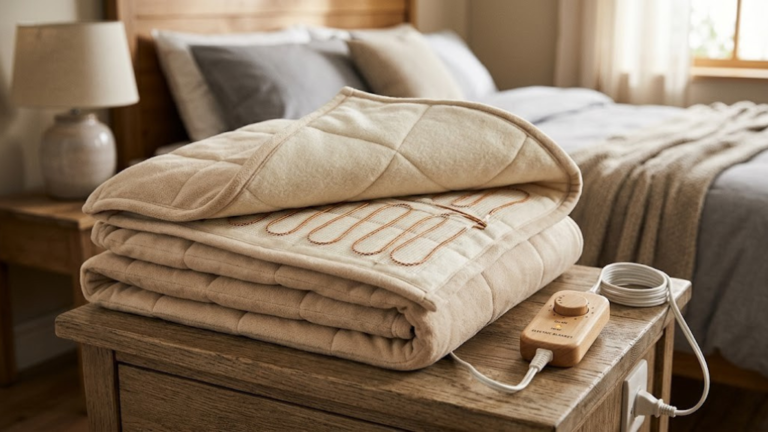
When people search “can a blanket cause a fire,” electric blankets are often the actual source of concern — and here the conversation shifts substantially. Electric blankets don’t cause fires through static electricity. Their fire risk comes from a completely different set of mechanisms.
How Electric Blanket Fires Actually Start
- Damaged or frayed wiring: The heating elements inside electric blankets are insulated wires. Over time — or through bending, folding while hot, or pet damage — the insulation can wear through and create a direct short circuit
- Overheating: Running an electric blanket at high settings for extended periods, especially with additional bedding on top that traps heat, can cause thermal runaway in older or lower-quality units
- Folding while on: Electric blankets should never be folded or bunched while in use — the concentrated heat of overlapping wires can exceed safe temperature thresholds rapidly
- Age and wear: Electric blankets older than 10 years should be retired — internal insulation degrades even when the exterior looks fine
Our comprehensive guide on 2026 electric blanket reviews covering safety, heat control, and comfort goes into significant detail on exactly which products have built-in overheat protection, auto-shutoff features, and fire-safe wiring designs. If you’re using an electric blanket, that’s essential reading.
Static Electricity and Electric Blankets
The electrical systems within electric blankets are insulated and grounded, which actually means they’re somewhat better at preventing static buildup than a simple synthetic blanket. However, the fabric coverings of many electric blankets are polyester — which means the surface layer can still generate static charge even though the internal wiring is safe. This is worth noting for anyone using an electric blanket near medical oxygen equipment.
Fire Risk Score by Blanket Type
Scores represent relative fire risk on a 1–10 scale. 10 = extreme risk.
Static Electricity From Blankets and Medical Devices
Beyond the direct fire risk, static electricity from blankets raises a second, less-discussed safety concern: electrostatic discharge (ESD) damage to sensitive medical devices. This affects a meaningful portion of the population and is worth understanding even if fire risk in your specific situation is low.
Devices at Risk
- Hearing aids: ESD is one of the leading causes of hearing aid malfunction. The sensitive microelectronics inside can be damaged by discharges as low as 100 volts — well within the range of fabric static
- Cochlear implants: External processors are vulnerable to ESD from synthetic clothing and bedding
- Insulin pumps: Some older models have been reported to malfunction or deliver incorrect doses after significant static discharge
- Pacemakers and ICDs: Modern devices are designed with ESD protection, but extremely high static discharges can still pose risks — particularly during device programming or when near the generator
If you or a family member uses any implanted or wearable medical electronic device, consult your physician or device manufacturer about ESD precautions. Switching to cotton or bamboo bedding is a simple, low-cost mitigation that device manufacturers often recommend.
Static and Infants
Infants don’t have medical devices to worry about, but static in baby blankets creates a different concern: the discomfort of repeated small shocks can disturb sleep, and in very dry environments, synthetic baby blankets can cause distress. Natural fiber blankets — cotton muslin, bamboo, organic cotton fleece — are recommended for infant bedding for multiple reasons, static reduction among them. Our 2026 baby blanket reviews covering organic muslin, plush, and safety provides a thorough evaluation of the safest and lowest-static options for newborns and infants.
How to Prevent Static Electricity in Blankets: Practical Solutions
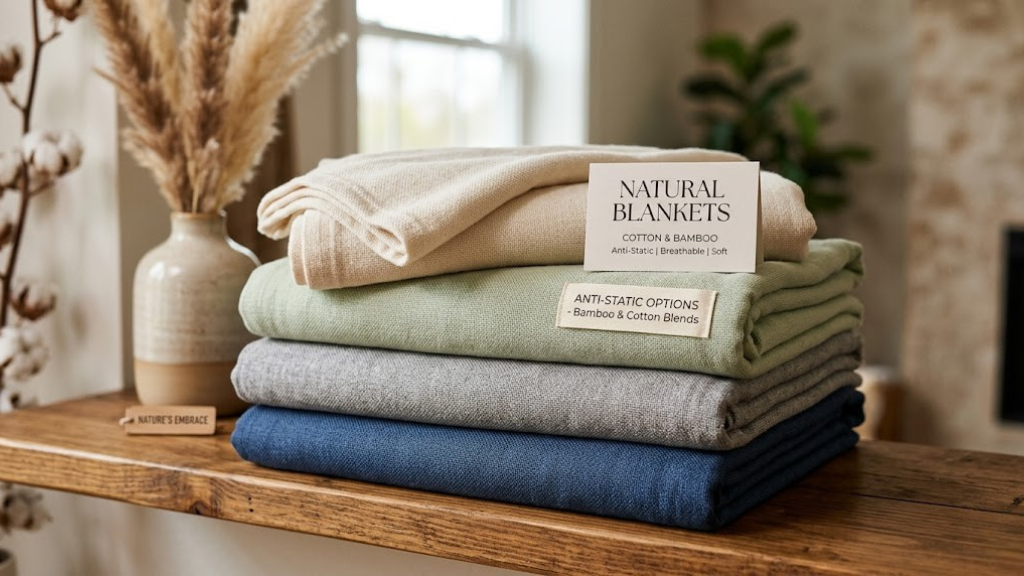
Switching to natural fiber blankets like cotton or bamboo is the most effective long-term solution for static reduction.
Static electricity in blankets is almost entirely preventable. The interventions range from zero-cost behavioral changes to product switches that pay dividends in comfort, safety, and blanket longevity.
Prevention Methods by Effectiveness and Cost
| Method | Cost | Effectiveness | How It Works |
|---|---|---|---|
| Switch to Natural Fiber Blanket | $30–$200 | ⭐⭐⭐⭐⭐ Excellent | Eliminates the source — natural fibers generate minimal charge |
| Whole-House Humidifier | $100–$400 | ⭐⭐⭐⭐⭐ Excellent | Raises ambient humidity, enabling continuous charge dissipation |
| Room Humidifier | $25–$80 | ⭐⭐⭐⭐ Very Good | Same principle as whole-house but for one room — ideal for bedrooms |
| Anti-Static Fabric Spray | $8–$15 | ⭐⭐⭐ Good | Coats fibers with a conductive compound that dissipates charge |
| Dryer Sheets / Fabric Softener | $5–$12 | ⭐⭐⭐ Good | Lubricates fibers and leaves a light anti-static coating after washing |
| Mist Blanket With Water | Free | ⭐⭐ Moderate | Temporarily increases surface conductivity — effect lasts 1–2 hours |
| Touch Grounded Metal First | Free | ⭐⭐ Moderate | Dissipates built-up charge on your body before touching blanket |
| Anti-Static Laundry Balls | $10–$20 | ⭐⭐ Moderate | Mechanical separation during drying reduces fiber-to-fiber friction |
| Hang Dry Instead of Machine Dry | Free | ⭐⭐⭐ Good | Tumble drying is a major source of static buildup — air drying eliminates it |
The Washing and Drying Factor
One underappreciated source of static buildup in blankets is the dryer itself. Tumble drying — especially at high heat — is essentially a controlled environment for triboelectric charging. Synthetic blankets churning against each other in a hot dryer for 60 minutes accumulate tremendous amounts of static charge. This charge is partially retained even after removal.
For synthetic blankets that you’re not ready to replace, air drying is the single best practice change you can make. For those that must go in the dryer, a dryer sheet or wool dryer balls (which increase air circulation and reduce friction) are effective mitigation. Our guide on washing weighted blankets without causing damage covers related care principles that apply broadly to most large blankets.
Special Precautions Near Oxygen Equipment
If someone in your household uses supplemental oxygen, a more comprehensive protocol is needed:
- Replace all synthetic blankets and throws in the oxygen-use area with 100% cotton alternatives
- Ensure clothing worn during oxygen use is also cotton or wool (no polyester)
- Post “No Synthetic Fabrics” reminders near oxygen equipment for visitors and home health aides
- Consult your oxygen equipment supplier for their specific fabric safety recommendations
- Never use aerosol products (including anti-static sprays containing flammable propellants) near oxygen equipment
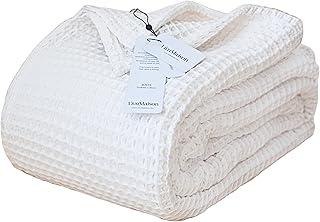
OEKO-TEX certified pure cotton — the simplest, most effective anti-static blanket swap for all settings including near oxygen equipment.
Beyond Blankets: The Broader Picture of Fabric Fire Safety
Static from blankets exists within a wider landscape of fabric-related fire safety that’s worth briefly understanding — particularly if you’re building safe practices around flammable environments or managing care for vulnerable individuals.
Other Fabric Fire Risks
Static electricity isn’t the only way blankets and textiles intersect with fire risk. The inherent flammability of the fabric itself matters enormously when a flame source is actually present. Polyester — despite being a poor choice for static reduction — is actually more flame-resistant than untreated cotton in direct contact with flame. Cotton ignites more readily but burns less intensely. Wool is naturally flame-resistant (it chars rather than melts) and is used in fire-safe bedding in some medical facilities.
Understanding fabric flammability is important if your home includes open-flame heaters, candles, or fireplaces in rooms where blankets are used. Our guide to cozy fireplace accessories includes essential safety guidance on which textiles and blanket types to keep clear of open flames and heating elements.
The Special Case of Heated Blankets vs Space Heaters
Many people choose between an electric heated blanket and a space heater for warmth — and the fire risk calculus is genuinely different between these options. Space heaters are responsible for far more residential fires than electric blankets, but the specific failure modes are different. Understanding which option carries what kind of risk is essential for informed decision-making, and our comparison of heated blankets vs space heaters breaks it down with data on failure types, statistics, and which scenario favors each choice.
Care and Maintenance: The Static-Fire Connection
Proper care of synthetic blankets reduces both static buildup and the degradation of fire-safety treatments that may have been applied during manufacturing. Many commercial blankets — especially children’s bedding — are treated with flame retardants during production. Improper washing (high heat, harsh detergents, repeated machine drying) can degrade these treatments over time. Following care instructions preserves both the anti-static and fire-resistance properties of your blankets for as long as possible.
Static Electricity Myths About Blankets — Busted
The internet is full of half-truths and outright myths about static electricity and blankets. Let’s clear up the most pervasive ones.
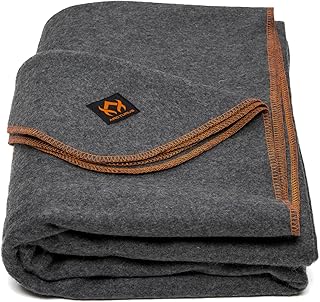
Natural wool construction dramatically reduces static compared to fleece — a classic choice that combines warmth with low static profile.
Frequently Asked Questions
The Bottom Line: Context Is Everything
Static electricity from a blanket is not something the average person needs to fear catching fire from. The physics simply don’t support it under normal household conditions — the spark energy is too low by a significant margin. But that same “probably harmless” truth carries a critical asterisk: in specific environments, particularly near medical oxygen equipment, suspected gas leaks, or flammable chemical vapors, blanket static absolutely can provide the ignition energy for a serious fire or explosion.
The practical takeaway is clear. If you’re in a standard bedroom with no special environmental hazards: relax, consider switching to a cotton or bamboo blanket for comfort, and maybe get a humidifier for winter. If you or someone in your home uses supplemental oxygen, uses a gas appliance with any concerns, or works around flammable materials: take the risk seriously, switch to natural fiber bedding immediately, and consult your equipment provider about static safety protocols.
→ Browse Our Safest Natural Fiber Blankets