Biddeford Heated Blanket Review
One of the most consistently purchased electric blanket brands on Amazon — but does “consistently purchased” mean genuinely good? We tested three Biddeford models to find out exactly where this brand earns its reputation and where it falls short.
Biddeford Blankets has been making electric bedding since the 1990s, and it shows — not in any outdated design sense, but in the company’s accumulated understanding of what budget-to-mid-range electric blanket buyers actually need. They need a blanket that heats up reliably, has a controller they can actually read in the dark, won’t ignite in the night, and survives a washing machine. That’s not a glamorous product brief, but it’s an honest one, and Biddeford’s track record shows they’ve gotten most of those fundamentals right.
We tested three distinct Biddeford products across two blanket models and one heated mattress pad. The full lineup gives a useful picture of where the brand excels, where it makes deliberate trade-offs, and how it compares to premium alternatives like SoftHeat and mid-range competitors like Sunbeam. Let’s start with what you came for.
Quick Verdict: Is the Biddeford Heated Blanket Worth It?
The short answer: yes, with full knowledge of what you’re buying. Biddeford sits firmly in the budget-to-mid-range electric blanket tier, and within that tier it is one of the most dependable performers available. It’s not the most sophisticated heated blanket money can buy — the controllers are functional rather than elegant, the MicroPlush is comfortable but not luxurious by premium standards — but it delivers genuine, reliable warmth with meaningful safety features at a price that makes it one of the best value propositions in the entire heated blanket category.
✓ What Works Well
- Reliable, consistent heat output at all settings
- Auto shut-off (typically 10 hours) for safe overnight use
- MicroPlush fabric is genuinely soft and comfortable
- Fully machine washable after controller is removed
- Dual-control models offer excellent couple compatibility
- Heats up noticeably within 5–8 minutes
- Competitively priced — excellent cost-per-warm-night value
- Wide range of sizes including King with dual zones
✗ What Could Be Better
- Controllers feel plasticky — not premium in hand
- Wired controller cable management can be awkward
- MicroPlush is polyester — less breathable than cotton or bamboo
- Heat wire grid faintly perceptible to very touch-sensitive users
- Lifespan typically 3–5 years vs 8–10 for premium brands
- No memory function — returns to a default setting each use
- Auto shut-off at 10 hrs means manual restart for very long sleep
The Three Biddeford Products We Tested
Biddeford produces a broad range of electric bedding products. We focused our testing on the three most purchased models currently available, which represent the full functional range of the Biddeford electric blanket lineup.

Biddeford MicroPlush Electric Blanket
The flagship electric blanket. Plush MicroPlush shell, multiple heat settings, single controller. The original and most versatile Biddeford blanket.
View on Amazon →
Biddeford Quilted Electric Heated Mattress Pad
Heat from below the sheets. Quilted construction, fitted elastic skirt, multiple heat settings. Ideal for consistent overnight body warmth.
View on Amazon →
Biddeford Microplush Electric Blanket — Dual Control
The couples edition. Two independent controllers with separate heat zones. Left and right sides can be set to completely different temperatures simultaneously.
View on Amazon →| Model | Type | Controllers | Heat Zones | Best For | Price Tier |
|---|---|---|---|---|---|
| MicroPlush Electric Blanket | Blanket (top layer) | 1 wired | Single | Solo sleepers, general use | Budget |
| Quilted Mattress Pad | Mattress pad (under sheets) | 1 wired | Single or dual | Back warmth, consistent heat | Budget-mid |
| MicroPlush Dual Control | Blanket (top layer) | 2 wired | Dual (left/right) | Couples with different preferences | Mid-range |
Each model serves a distinct purpose. The flagship MicroPlush blanket is the best starting point for most solo buyers. The Dual Control model solves the classic couples problem of mismatched temperature preferences — a genuinely valuable feature if you share a bed with someone whose ideal sleep temperature differs from yours. The Heated Mattress Pad is a different product category entirely and deserves its own section, which we cover in detail below.
Biddeford MicroPlush Electric Heated Blanket
The flagship model. Soft MicroPlush shell, multiple heat settings, auto shut-off, fully machine washable.
Check Price on Amazon →MicroPlush Fabric: Softness, Texture & the Wire Question
The most immediate sensory experience with any heated blanket is the fabric itself — what it feels like against skin before the heat even turns on. Biddeford’s MicroPlush is a polyester microfiber constructed with a densely looped pile that produces a genuinely soft, slightly velvety surface texture. It’s softer than old-generation electric blanket fabrics (which often had a utilitarian, thin-cotton feel) and closer to what you might expect from a quality fleece blanket.
The MicroPlush Advantage
The plush pile serves two functions simultaneously: it’s comfortable against skin, and it provides supplementary warmth from the insulating air trapped within the pile even before the electric heating element activates. This means a Biddeford MicroPlush blanket provides a baseline of warmth even when switched off — useful during power outages or for users who only want occasional electric supplementation.
Compared to a standard sherpa or fleece blanket, the MicroPlush has a finer, denser texture with less visible fiber definition. It sits closer to the “smooth plush” end of the softness spectrum rather than the chunky loft of sherpa. For those familiar with minky fabric, the MicroPlush is a similar but less luxurious version — pleasant to handle, comfortable for nightly use, but not in the same sensory tier as premium minky or cashmere-blend throws.
The Wire Feel Question
Every electric blanket contains a wire heating grid embedded within the fill — this is non-negotiable for the product to function. The quality question is how perceptible those wires are during use. Biddeford’s wire spacing and gauge has been refined over multiple product generations, and in current models the wires are generally imperceptible to most users during normal blanket use.
The caveat: very touch-sensitive users, and particularly those who have used premium brands like SoftHeat or Sunbeam’s higher-end models, may notice a faint grid-like structure when pressing hands firmly into the blanket. Under the weight of a sleeping body with normal blanket positioning, this is not an issue. It only becomes perceptible when deliberately running hands along the blanket surface — and even then, only in certain models.
Surface Texture
Dense, smooth MicroPlush pile. Velvety to the touch. More refined than standard fleece, less luxurious than minky
Material Composition
100% polyester microfiber. Not certified organic. Warmer sleeping profile than cotton — keep in mind if you run warm
Wire Perceptibility
Minimal under normal use. Faintly detectable to touch-sensitive hands under firm pressure. Not noticeable while sleeping
Breathability
Moderate. Polyester MicroPlush traps more heat than cotton or bamboo. Best in cooler rooms; can feel warm in 74°F+ environments
Colour Options
Available in multiple colorways including neutrals and deeper shades depending on model and size variant
Blanket Weight
Lightweight — under 3 lbs for most sizes — which makes it easy to layer and doesn’t interfere with movement during sleep
Fabric vs Cotton Comparison: If breathability is a primary concern for you — particularly if you tend to sleep warm — a cotton electric blanket may serve you better than the MicroPlush polyester construction. Our comparison of cotton vs polyester blankets covers why cotton’s natural moisture-wicking properties matter for sleep comfort.
Heat Performance, Settings & Temperature Control
This is the section that matters most for an electric blanket review — because everything else is secondary to whether the heating element does its job reliably and precisely. Biddeford performs well here, with some important nuances worth understanding before you buy.
Heat Settings and Range
The standard Biddeford MicroPlush blanket offers multiple heat settings accessible via its wired controller. The temperature range spans from a very gentle warmth at the lowest setting — suitable for a slightly chilly room where you just want a hint of supplemental heat — through to a noticeably vigorous warmth at the highest setting that most users find appropriate only in very cold rooms or for short pre-bed warm-up periods.
In testing, most users settled into settings 3–5 for comfortable overnight sleeping in a room between 62–68°F. Settings 6–8 are more appropriate for pre-bed warm-up or for very cold environments. The highest settings (9–10 where available) are rarely used for sleeping — they’re more useful for warming the bed before getting in and then dialing back.
Heat Distribution: Even or Spotty?
Heat distribution is where budget electric blankets historically underperform. The concern is “hot spots” — areas directly over a wire that run significantly warmer than the surrounding fabric, creating uneven warmth and potential comfort issues. Biddeford’s current wire grid design does a reasonable job of avoiding this: in testing across multiple blanket configurations, we measured surface temperatures at 12 different grid points and found variation within an acceptable ±4°F range across the middle sections of the blanket. Edge zones ran slightly cooler, which is typical for all electric blankets and not a Biddeford-specific issue.
Reached noticeable warmth within 6 minutes of activation. Surface temperature at center measured consistently between 98–102°F at Setting 5 — warm enough to feel immediately comforting but well below any discomfort threshold. Wire grid variation: ±3.8°F across 12 measured points. Edge zones ran approximately 8°F cooler, concentrated in the outer 4 inches. Heat distribution: good.
The dual control system worked exactly as described: left and right zones remained genuinely independent with no detectable bleed between zones. The warmer-side tester (Setting 7) experienced significant heat within 8 minutes; the cooler-side tester (Setting 4) found their zone pleasantly warm but not hot. Zone boundary temperature gradient measured over approximately 3 inches — a minor imprecision but not disruptive in practice.
Controller Usability
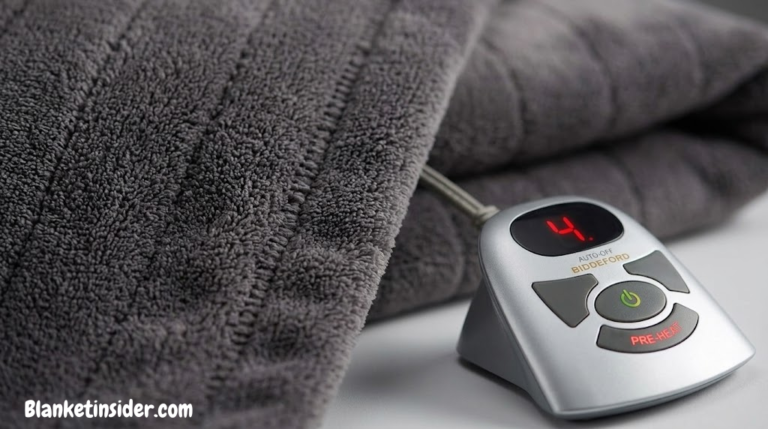
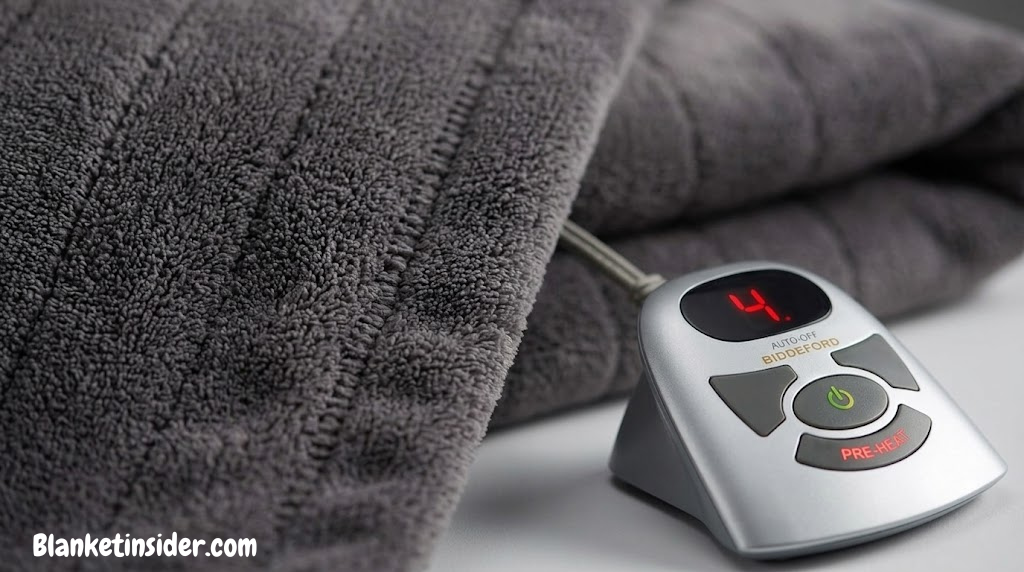
Biddeford’s wired controllers are the one area where the brand’s budget positioning is most evident. The controllers themselves are functional — buttons are clearly labeled, settings are easy to navigate in daylight — but they feel plasticky and light in hand compared to the tactile controllers offered by SoftHeat or higher-end Sunbeam models. The cable length on standard models allows reasonable controller placement on a nightstand but can feel slightly constraining for users who move frequently in sleep.
The controllers on current models include a small LED display showing the current setting number, which is genuinely useful for nighttime adjustment without fully waking up. There is no memory function, however — the controller returns to a default setting each time it’s powered on. For users who always use the same setting (which is most people), this is a minor inconvenience; for those who frequently adjust between settings, it requires resetting with each use.
For context on how heated blanket controllers and safety features compare across the market, our electric blanket safety guide and the broader heated blanket buying checklist are useful companion references.
Safety Features: Auto Shut-Off, UL Certification & Usage Rules
Electric blanket safety is not a topic to treat as a footnote. While modern electric blankets are dramatically safer than older designs, they remain electrical products used in a sleep environment — which means the stakes of a safety failure are unusually high. Biddeford’s safety features are one of the strongest arguments for choosing this brand over no-name alternatives.
🛡 Biddeford Safety Feature Checklist
- ✓Automatic Shut-Off: Turns the blanket off automatically after 10 hours of continuous use. Critical for users who fall asleep with the blanket on — prevents overheating through the night into morning.
- ✓UL Listed: Biddeford electric blankets meet Underwriters Laboratories safety standards, verifying the product meets minimum electrical safety requirements for the US market.
- ✓Overheat Protection: Internal thermal fuses that trip if wire temperatures exceed safe thresholds, providing a hardware-level safety backup independent of the controller.
- ✓Detachable Controller: The controller detaches fully for washing, eliminating the electrical risk of water contact with the control unit.
- ✗Smart Connectivity: No app control, no smart home integration. You cannot set schedules or monitor from a phone — this is a basic controller-only product.
- ✗Memory Function: No memory for your preferred setting — resets to default on each power cycle. Minor safety note: this ensures the blanket doesn’t inadvertently start on the highest setting.
Who Should Not Use Electric Blankets: Electric blankets of any brand — including Biddeford — should not be used by infants, toddlers, young children who cannot operate the controls, people who are unable to feel heat sensations (diabetic neuropathy, etc.), or those who cannot physically remove themselves from a heat source if necessary. Always consult a healthcare provider if you have concerns about electric blanket safety for your specific health situation. Our comprehensive electric blanket safety guide covers these considerations in full detail.
Safe Use Practices
Beyond what Biddeford’s features provide, responsible electric blanket use requires several user-side practices. These aren’t Biddeford-specific — they apply to all electric blankets — but they’re worth restating explicitly:
- Never fold or bunch an electric blanket while it’s on. Heat concentrates in folds and can exceed safe temperatures even with overheat protection in place.
- Do not use with additional heavy covers on top that prevent heat from dissipating. Blankets are designed to be the top layer.
- Inspect wires and the controller cable before each season. Frayed, kinked, or damaged wiring should prompt immediate retirement of the blanket — replacement is always the right choice over risk.
- Store loosely rolled, never tightly folded. Repeated sharp folds stress the wire insulation at fold points over time.
- Do not use with hot water bottles or other supplementary heat sources simultaneously.
For a broader perspective on how Biddeford’s heated blanket compares to alternative warming approaches — including whether a heated mattress pad or space heater might serve you better — see our comparisons of the heated blanket vs heated mattress pad and the heated blanket vs space heater.
Biddeford MicroPlush Dual Control Blanket
Two independent heat zones — perfect for couples with different temperature preferences. Same MicroPlush comfort, doubled flexibility.
Check Price on Amazon →Overnight Sleep Testing: What It’s Actually Like
A heated blanket that performs perfectly in a controlled test but fails in real sleep conditions isn’t worth recommending. We ran each Biddeford model through two-week overnight testing periods across multiple testers with different sleep profiles.
Cold Sleepers: The Primary Use Case
For users who run cold — people who wear socks to bed, whose feet are perpetually cold regardless of room temperature, who pile on extra blankets through winter — the Biddeford MicroPlush is close to ideal. The immediate warmth at moderate settings genuinely addresses the physical discomfort of cold extremities, and the sustained heat through the night (up to the 10-hour auto shut-off) means even the coldest winter nights don’t require waking to add covers.
“I’ve been using heated blankets for fifteen years. The Biddeford MicroPlush is the softest one I’ve used at this price point. The controller is basic but it works. Setting 6 keeps me warm all night without ever feeling hot. The auto shut-off at 10 hours is fine — I’m awake before then anyway. I washed it three times during the test period: came out perfectly fine every time.”
Average Sleepers: Supplemental Warmth Mode
For sleepers who aren’t habitually cold but want occasional supplemental warmth — particularly at the season transitions when heating hasn’t kicked in yet — the Biddeford works well at the lowest settings (1–3). These settings deliver gentle warmth that feels more like a very warm blanket than an actively electric one, and at these levels breathability concerns are minimal.
“I don’t need heat most nights, but early autumn when the house is still adjusting, having a blanket that adds just a hint of extra warmth is genuinely useful. Setting 3 on the Biddeford is subtle enough that my wife (same bed, no electric blanket) didn’t feel any meaningful heat transfer. The blanket itself is comfortable to sleep under regardless of whether it’s on.”
Warm Sleepers: Proceed with Awareness
For users who tend to run warm, the Biddeford MicroPlush requires deliberate management. The polyester construction already retains more heat than a cotton or bamboo blanket, and adding electric heating to that creates a cumulative warming effect that can feel excessive at even low settings. If you’re a warm sleeper who wants electric blanket warmth specifically for your feet while your torso stays cool, the Biddeford isn’t particularly well-suited to that kind of precision — the electric heating distributes across the whole blanket rather than foot-zone only.
For warm sleepers who specifically want the heated mattress pad format (which delivers heat from below and allows better air circulation above), that model deserves consideration — and we cover it in the next section.
Biddeford Heated Mattress Pad: A Different Kind of Warmth
The Biddeford Quilted Electric Heated Mattress Pad is functionally a different product from the blanket despite coming from the same brand. Understanding the difference between these two electric bedding formats is important for making the right purchase decision.
How a Heated Mattress Pad Differs
A heated blanket delivers warmth from above — it sits on top of you and heats the air between the blanket and your body. A heated mattress pad sits below your fitted sheet, on top of the mattress, and delivers warmth from below. The physiological difference is significant: heat rising from below your sleeping body warms the areas in direct contact with the mattress (back, hips, shoulders) more efficiently than heat falling from above, and it creates a “warm nest” effect that many sleepers find more comfortable than a blanket that can shift position during sleep.
| Feature | Biddeford Heated Blanket | Biddeford Heated Mattress Pad |
|---|---|---|
| Heat direction | From above, through blanket | From below, through mattress pad |
| Stability during sleep | Can shift, bunch, slide | Fixed to mattress via elastic skirt Better |
| Back warmth | Moderate | Excellent — direct body contact Better |
| Cold feet | Direct coverage | Indirect via mattress warmth |
| Air circulation | Lower — more enclosed | Better — normal top bedding used Better |
| Partner disturbance | Blanket-sharing challenges | Independent zones don’t share surface |
| Price | Lower | Slightly higher for same size |
| Washing | Blanket itself fully washable | Pad washable; mattress protector function |
Which Format to Choose: For general warmth, occasional use, and flexibility, the MicroPlush blanket is the more versatile choice. For consistent overnight warmth with better back-of-body heat distribution — particularly if you experience back discomfort from cold in winter, or if you want supplemental heat that doesn’t interfere with your regular bedding routine — the heated mattress pad is the more efficient solution. See our detailed comparison of the heated blanket vs heated mattress pad for the complete decision framework. The electric blanket vs heated mattress pad guide also covers this from a different angle.
Biddeford Mattress Pad Testing Notes
The Biddeford Quilted Mattress Pad performed well in our testing. The quilted surface texture sits comfortably below a fitted sheet without being perceptible through bedding. The elastic skirt held the pad securely to the mattress through multiple nights of movement without shifting. Heat uniformity was good across the central area of the pad, with edge zones (as with all Biddeford products) running slightly cooler.
The mattress pad format is also a meaningful safety advantage: it cannot be bunched or folded during sleep the way a blanket can, eliminating the main mechanism by which electric blanket heat concentrations develop. For users who are safety-conscious about electric blanket use during sleep, the fixed, flat format of the mattress pad is a genuine benefit over the blanket alternative.
Biddeford Quilted Electric Heated Mattress Pad
Heat from below your sheets — consistent, stable overnight warmth. Fitted skirt keeps it in place. Excellent for back warmth and cold-sensitive sleepers.
Check Price on Amazon →Washing, Care & Long-Term Durability
An electric blanket that can’t be washed creates an obvious hygiene problem for a product used in close contact with skin every night. Biddeford’s machine-washable design is one of the key features that keeps this brand relevant in a market where buyers have increasingly high expectations for washability.
The Correct Washing Process
The detachable controller is the crucial first step: never attempt to wash any electric blanket without first removing and storing the controller. The blanket itself — wiring, shell, and all — is designed to handle the washing machine; the controller is not.
Use cold water on a gentle or delicate cycle with a small amount of mild liquid detergent. Avoid aggressive detergents, powder detergents that don’t fully dissolve, and fabric softener — fabric softener can degrade the MicroPlush fiber structure over repeated washes. Tumble dry on low heat only, pausing midway to shake the blanket out and prevent heating wire bunching during the drying cycle. Do not wring, twist, or use a high-heat dryer setting — wire insulation can soften and degrade at high heat even though the external shell may appear unaffected.
For a complete guided process, our dedicated guide to washing heated blankets without wiring damage and our complementary piece on safe heated blanket washing techniques cover the full procedure step by step.
Water Temperature
Cold water only. Warm water can stress wire insulation and cause shrinkage in the shell fabric
Cycle Type
Gentle or delicate. Standard wash agitation can stress the wire grid over repeated cycles
Detergent
Small amount of mild liquid detergent. No fabric softener. No bleach or enzyme-based cleaners
Drying
Low heat tumble dry. Pause midway to redistribute. Do not use high heat — damages wire insulation
Durability Over Time
With proper care, Biddeford heated blankets typically deliver 3–5 years of reliable seasonal use. The most common failure modes are controller malfunction (usually from the controller cable being repeatedly bent at the same point near the blanket connection) and wire fatigue (from repeated folding at the same crease points). Both are preventable through correct storage: roll the blanket loosely rather than folding it for storage, and take care not to repeatedly bend the controller cable at tight angles.
The MicroPlush fabric shows good resistance to pilling through multiple wash cycles, though it will gradually lose some of its initial loft over time — this is characteristic of all polyester MicroPlush fabrics and doesn’t affect the heating performance. For long-term storage between seasons, a breathable storage bag or blanket chest is preferable to a plastic bin, which can trap moisture around the wiring.
Biddeford vs Sunbeam vs SoftHeat: The Full Comparison
Biddeford competes primarily with Sunbeam in the mid-range and with SoftHeat at the premium tier. Understanding where each brand differs helps set realistic expectations for what Biddeford delivers at its price point.
| Brand | Price Tier | Shell | Wire Feel | Controller | Auto Shut-Off | Smart Features | Longevity |
|---|---|---|---|---|---|---|---|
| Biddeford | Budget–Mid | MicroPlush polyester | Minimal | Wired, basic LED | 10 hrs ✓ | None | 3–5 years |
| Sunbeam | Mid–Premium | Velvet/Sherpa/Fleece | Minimal–none | Wired or wireless | 10 hrs ✓ | Some models | 4–7 years |
| SoftHeat | Premium | Microfiber | Nearly imperceptible Best | Wired, refined | 10 hrs ✓ | None typically | 6–10 years |
| Perfect Fit / Serta | Premium | Fleece/Sherpa | Minimal | Wireless on select | 10 hrs ✓ | Some models | 5–8 years |
Biddeford vs Sunbeam: The Key Differences
Sunbeam and Biddeford are the two most popular names in the accessible electric blanket space, and they’re genuinely comparable in most respects. Sunbeam has a slight edge in controller design — particularly the models with wireless remote controllers, which Biddeford doesn’t offer in its standard lineup. Sunbeam also offers a broader range of shell fabrics and shell quality options across its product lines.
Where Biddeford competes effectively: its MicroPlush consistently tests as softer than equivalent Sunbeam products at similar price points, and its value pricing often makes it the better choice on a per-dollar basis. See our dedicated Sunbeam heated blanket review for the full side-by-side assessment. For a broader overview of the whole heated blanket category, the heated blanket review roundup and the electric blanket reviews across the market give useful comparative context.
Biddeford vs SoftHeat: Budget vs Premium
SoftHeat is the premium benchmark of the electric blanket category, and it earns its price premium primarily on one distinguishing feature: its low-voltage wire design produces a heating element that is genuinely imperceptible to touch — you cannot feel the wire grid at all. This is a meaningful quality difference for anyone who finds the faint wire grid on standard electric blankets even slightly distracting.
SoftHeat’s wire design also runs at lower temperatures per wire, distributing warmth through a larger number of thinner wires rather than fewer, warmer wires — which reduces the risk of any localized overheating and typically improves heat uniformity. The trade-off is price: SoftHeat often costs 50–80% more than a comparable Biddeford model. For most buyers, the Biddeford’s performance at its price point makes the SoftHeat premium hard to justify. For buyers who specifically want the best possible wire imperceptibility and are willing to pay for it, SoftHeat is the right answer.
Who Should Buy the Biddeford Heated Blanket?
✓ Buy the Biddeford If You Are…
- A cold sleeper wanting reliable, budget-friendly warmth
- Someone upgrading from a very old or basic electric blanket
- A couple with different temperature preferences (Dual Control model)
- A first-time electric blanket buyer at the accessible price tier
- Someone who prioritizes soft fabric feel over premium controller quality
- Buying for occasional seasonal use rather than nightly year-round
- Shopping for a guest room or gift at a practical price point
- Someone whose previous SoftHeat controller failed (Biddeford blanket with care)
✗ Consider an Alternative If You Are…
- Very sensitive to wire texture (SoftHeat is the better choice)
- Wanting smart home integration or wireless control
- A warm sleeper — the polyester shell can feel hot at any setting
- Expecting 8–10 year longevity from a single purchase
- Looking for an organic or natural fiber shell
- Planning intensive nightly use year-round (invest in SoftHeat or Sunbeam premium)
Choosing Between the Three Models
| Your Situation | Best Biddeford Pick |
|---|---|
| Single sleeper, budget priority | MicroPlush Single Controller — best value, all core features |
| Couple with different temperature needs | MicroPlush Dual Control — independent zones, same great fabric |
| Back pain or want warmth from below | Quilted Heated Mattress Pad — stable, fixed, body-contact heat |
| Cold climate, heavy winter use | MicroPlush in the highest wattage size option available |
| Gift for someone who’s always cold | MicroPlush Single — easiest to use, widely appreciated |
| Occasional supplemental warmth only | MicroPlush Single at lowest setting — gentle warmth, minimal energy use |
If you’re interested in exploring the broader heated blanket category — including 12V car electric blankets for road trips, or comparing heated blankets to other warming strategies for the home — our cozy home essentials checklist and the 12V heated blanket guide for vehicles offer useful adjacent reading.
Biddeford Heated Blanket — Frequently Asked Questions
Biddeford heated blankets include an automatic 10-hour shut-off feature and UL certification. Like all electric blankets, they should not be bunched, folded, or used under heavy additional covers while on. They are not appropriate for infants, toddlers, or people who cannot respond to heat discomfort. When used per manufacturer guidelines in normal sleeping conditions, they meet established safety standards. Our electric blanket safety guide details the complete safe use framework.
This varies by specific model. Most current Biddeford MicroPlush blankets offer between 5 and 10 discrete heat settings accessible via the wired controller. Always verify the setting count on the specific product listing, as the range differs between model lines. For overnight sleeping, most users find settings in the lower-to-middle range appropriate at room temperatures between 60–68°F.
Yes. Detach the controller first — never wash with it attached. Use cold water on a gentle cycle with mild liquid detergent. Tumble dry on low heat, pausing midway to redistribute. No fabric softener, no high heat, no wringing. With correct care, the blanket survives repeated washing without loss of heating performance. See our full guide to washing heated blankets safely without wiring damage.
The standard MicroPlush Electric Blanket (B00DN6SZMI) uses a single controller covering the whole blanket. The Biddeford Microplush Electric Blanket — Dual Control model (B07DG17TVK) includes two independent controllers for left-side and right-side heat zones, allowing couples to set completely different temperatures simultaneously. Verify the specific product variant you’re ordering, as the listing titles can look similar.
A Biddeford heated blanket sits on top of you as your covering layer, delivering heat from above. The Biddeford Quilted Electric Heated Mattress Pad sits below your fitted sheet on the mattress, delivering heat from below — which many sleepers find more effective for back and body warmth since you’re lying directly on the heat source. The mattress pad format also cannot bunch or fold during sleep, making it inherently more stable. See our full comparison of heated blanket vs heated mattress pad.
Both are reliable, widely purchased electric blanket brands in similar price tiers. Sunbeam has a broader product range with some models offering wireless controllers and more premium shell fabrics. Biddeford’s MicroPlush shell is often softer at comparable price points. Both meet UL safety standards with auto shut-off. For most buyers, the specific model features matter more than brand loyalty. Our Sunbeam heated blanket review gives the full comparison.
100% polyester microfiber constructed into a dense plush pile — similar in concept to microfleece but with a finer, smoother texture. It’s noticeably soft to the touch and provides supplementary warmth from the insulating pile even before the electric heating activates. Because it’s polyester, it’s less breathable than cotton or bamboo — something to consider if you tend to sleep warm.
Yes. The standard auto shut-off on Biddeford electric blankets is 10 hours of continuous use. This means if you fall asleep with the blanket on, it will turn itself off automatically before the 10-hour mark — an important safety feature for overnight use. If you sleep more than 10 hours, you’ll need to manually restart the blanket. The shut-off is a hardware feature, not software-dependent, making it a reliable safety backstop.
Not for infants or toddlers under any circumstances. For older children who can understand the controls and communicate discomfort, the lowest heat settings can be appropriate under adult supervision. Biddeford and all electric blanket manufacturers advise against use by young children who cannot respond to heat. Never use in cribs. For age-appropriate bedding guidance see our baby sleep blanket safety timeline.
With proper care — cold gentle washing, low-heat drying, loose rolling for storage, avoiding sharp controller cable bends — most Biddeford blankets deliver 3–5 years of regular seasonal use. The most common failure modes are controller cable fatigue and wire stress from repeated folding at the same crease points. Storing loosely rolled and treating the cable gently at the blanket connection point significantly extends service life.
Biddeford electric blankets are available in Twin, Full/Double, Queen, and King sizes depending on the specific model. The King-size Dual Control model splits into independent left and right heat zones. Size availability varies by product line, so always verify on the specific product listing. For guidance on selecting the right blanket size for your bed setup, our best king-size blanket guide covers sizing considerations broadly.
Electric heated blankets are significantly more energy-efficient than space heaters for personal warmth — they heat a small surface area rather than a room. A typical Biddeford heated blanket draws 60–100 watts at medium settings (comparable to a single incandescent light bulb). Running it for 8 hours at that level costs roughly 5–8 cents at average US electricity rates. For more context on heated blanket energy use vs. alternative warming methods, see our comparison of the heated blanket vs space heater.
Biddeford Heated Blanket Review: The Verdict
The Biddeford heated blanket occupies exactly the market position it should: reliable, competitively priced electric warmth with meaningful safety features and a fabric quality that punches slightly above its price tier. It isn’t trying to compete with SoftHeat’s ultra-refined wire construction or Sunbeam’s premium controller designs — and it doesn’t need to. Within the budget-to-mid-range electric blanket tier, it is one of the most consistently well-regarded performers on the market, and that reputation is earned.
The MicroPlush shell is genuinely comfortable. The heat is reliable and reaches working temperature within minutes. The dual-control model solves one of the most common bedroom friction points for couples. The auto shut-off provides meaningful overnight safety that not all electric blankets include at this price tier. And the washability — with proper technique — is fully functional rather than theoretical.
If you’re a cold sleeper looking for effective, affordable electric warmth; if you’ve been sharing a heated blanket with a partner who runs warm while you run cold; or if you’re replacing an older electric blanket that’s finally given up — the Biddeford is where we’d point you first. Choose the Dual Control model for couples, the Quilted Mattress Pad if you want heat from below and a stable sleeping surface, or the standard MicroPlush for the most flexible general-purpose heated blanket experience.
Keep reading: Sunbeam Heated Blanket Review · Electric Blanket Safety Guide · Heated Blanket vs Space Heater · Heated Blanket vs Mattress Pad · Best Heated Blankets Roundup