Muslin vs Cotton Blanket:
Which Is Better for Babies?
Two natural fibers, one nervous parent, and a lot of conflicting advice online. This guide gives you the real science — weave structure, breathability, safety, care, and what pediatric guidelines actually say about each.
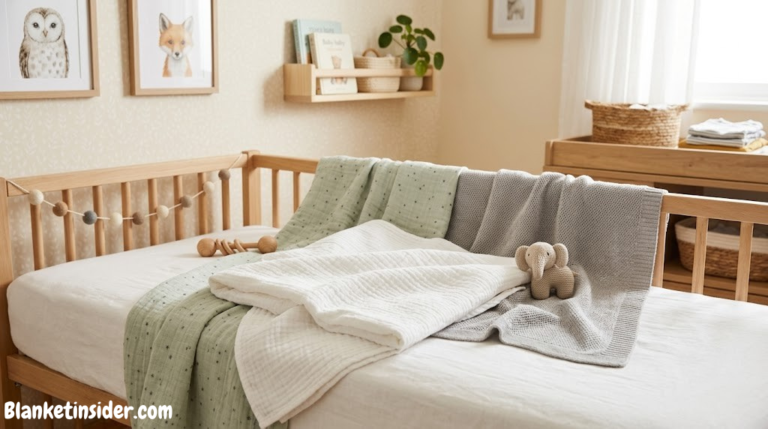
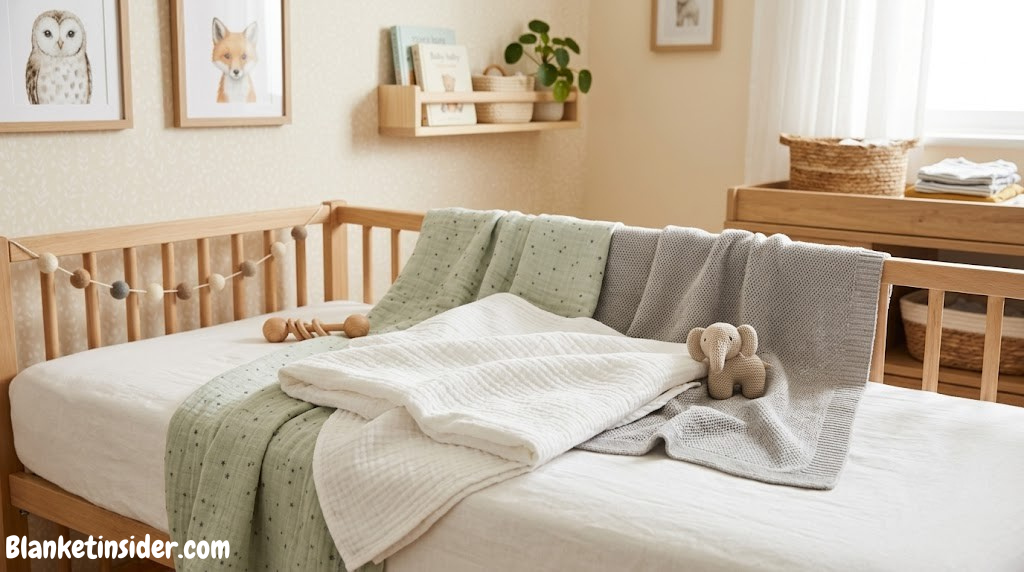
Left: muslin swaddle — visibly open weave with a slightly gauzy drape. Right: standard cotton blanket — denser, more opaque surface with tighter thread structure.
Picking a blanket for your newborn shouldn’t feel like studying for an exam — but here you are, tabs open, reading about thread counts and weave structures at an hour when sensible people are asleep. The good news: the muslin vs cotton question has a clear answer, and it depends almost entirely on how old your baby is and what you’re using the blanket for.
Both muslin and cotton are natural, plant-based fibers. Both are safe against infant skin. But their weave structures create very different fabrics with different breathability profiles, different softness timelines, and genuinely different suitability for swaddling newborns versus blanketing a rolling six-month-old. This guide covers all of it — including what the AAP’s safe sleep guidelines actually say about when and how blankets of any kind belong in a baby’s sleep environment.
What Is Muslin — and What Makes It Different from Cotton?
This is where most people get confused: muslin is cotton. Muslin is not a separate fiber — it’s a specific way of weaving cotton fiber into fabric. Cotton is both the raw material and a broad category of fabrics made from it. Think of it this way: “muslin” is to cotton what “sourdough” is to bread. One is a specific style; the other is the broader category that contains it.
Muslin: A Weave, Not a Fiber
Muslin is a loosely woven, plain-weave cotton fabric characterized by its deliberately open, gauze-like structure. The weave is simple: threads cross over and under each other in a basic one-over-one-under pattern, but they’re spaced further apart than in standard woven cotton, creating gaps between the threads that give muslin its characteristic semi-transparent, breathable quality.
The word “muslin” originates from Mosul, a city in present-day Iraq where fine loosely-woven cotton textiles were historically produced. Today the term covers a spectrum from rough industrial muslin used in pattern-making to the ultra-fine, multi-layer muslin used in premium baby products like the ADEN + ANAIS swaddles that popularized muslin for baby use in the Western market.
Modern baby muslin is almost always 100% cotton, and it’s typically sold in multiple layers (double, triple, or quadruple gauze) to add body and warmth while retaining the open-weave breathability of the individual layers. Each additional layer increases warmth and durability while only modestly reducing airflow — which is why a four-layer muslin blanket can be genuinely warm without sacrificing the breathability that makes muslin desirable for infant use. Our full resource on receiving blankets vs swaddles vs muslin explains the terminology in even more detail for those still sorting out the vocabulary.
Standard Cotton: Tighter, Denser, More Durable
When parents and product listings say “cotton blanket” in contrast to muslin, they typically mean a more tightly woven cotton fabric — jersey cotton (knitted, stretchy), flannel cotton (brushed for softness), or plain-weave cotton at a higher thread count than muslin. These fabrics use the same cotton fiber but in a much denser construction that creates a solid, opaque, less porous surface.
The tighter weave of standard cotton makes it more durable (threads have less room to shift and abrade), warmer (fewer air gaps = better heat retention), and more resistant to snags. It also makes it less breathable per layer than muslin — though “less breathable than muslin” doesn’t mean “not breathable”; cotton in any weave construction is more breathable than synthetic fabrics like polyester fleece.
🧵 The Bottom Line on “What They Are”
Muslin is a loosely woven cotton fabric with wide air gaps between threads — breathable, lightweight, and semi-transparent. Standard “cotton blanket” fabric is the same cotton fiber woven much more tightly — more durable, more opaque, warmer per layer, and less breathable. The fiber is the same; the weave is everything.

aden + anais Classic Muslin Swaddle Blankets — 4-Pack, GOTS Organic
The blanket that put muslin on the baby registry map. Four-layer organic muslin that softens with every wash — the gold standard for newborn swaddling.
Shop on AmazonBreathability & Overheating: The Most Important Factor for Newborns
If there’s one property that matters more than any other when choosing a blanket for a newborn, it’s breathability. Infant thermoregulation is genuinely immature in the first months of life — newborns can’t shiver effectively to generate heat, and more critically, they cannot remove a blanket if they become too warm. Overheating in infants is associated with increased risk, making breathability a safety issue, not just a comfort one.
Why Muslin Breathes Better
The open weave of muslin creates continuous air channels through the fabric. Heat and moisture vapor from a baby’s skin can escape through these gaps rather than building up against the skin surface. In warm nurseries or humid climates, this difference is immediately practical: a muslin-wrapped baby in a warm room is less likely to develop that hot, flushed look that signals overheating than one wrapped in a denser cotton blanket.
Multi-layer muslin (double gauze, triple gauze) retains more warmth than single-layer muslin while maintaining this breathability advantage. The air channels between layers can still carry heat away from the body, and the lightweight cotton yarn doesn’t retain heat the way heavier woven cotton does. This makes double-gauze muslin the preferred recommendation in warmer climates and for babies who run warm — a quality we explore in detail in our guide to best swaddle blankets for newborns.
Standard Cotton Breathability — Good, But Not Equal
Standard cotton is more breathable than any synthetic fabric — that much is true and important. But compared to muslin, standard cotton’s tighter weave traps more heat against the skin surface. For a sleeping baby in a cool, well-ventilated room, this may not matter. For a baby in a warmer environment, or one who’s been bundled in several layers, the extra heat retention can push a well-wrapped baby toward overheating faster than muslin would.
Flannel cotton (which is regular cotton that’s been brushed to raise its fibers) is the warmest cotton construction — lovely for very cold nurseries but inappropriate in warm environments. Jersey cotton (knitted cotton, like a soft T-shirt) falls between standard woven cotton and muslin for breathability, and its stretch makes it popular for sleep sacks and swaddle wraps where a close but not rigid fit is helpful.
The American Academy of Pediatrics identifies overheating as a risk factor associated with SIDS. Regardless of the fabric you choose, the practical guide is simple: a baby’s sleep environment should feel comfortable to a lightly dressed adult. Check the back of your baby’s neck rather than hands or feet — warm, sweaty neck = too hot. Both muslin and cotton can cause overheating if too many layers are used. No fabric substitutes for appropriate room temperature and layering management.
Softness, Texture & What Each Feels Like Against Newborn Skin
Newborn skin is about 30% thinner than adult skin, more permeable to topical substances, and significantly more reactive to friction, dye residues, and rough textures. When evaluating any blanket for infant use, softness isn’t a luxury feature — it’s a skin health consideration.
Muslin Softness: Better With Every Wash
New muslin can feel slightly stiff and almost papery when you first take it out of packaging. This puts some parents off — but it’s completely normal and actually a positive sign. Muslin’s open weave structure allows the cotton fibers to relax, loosen, and soften progressively with every wash cycle. A muslin blanket that’s been washed 20 times is noticeably softer than one that’s been washed twice.
This softening trajectory is why muslin tends to become a parent’s most-reached-for blanket over time. The blanket that felt slightly rough at the hospital in week one becomes a trusted, buttery soft companion by month three. Premium organic muslin made from long-staple cotton (Egyptian or Pima cotton) starts softer and reaches that butter-soft peak faster than standard cotton muslin. Our guide to muslin vs stretchy swaddle blankets covers how different constructions compare at every stage of washing-in.
Cotton Softness: Immediate and Consistent
Standard cotton blankets — particularly jersey cotton and flannel cotton — are typically soft right out of the package without requiring any washing-in period. Jersey cotton in particular has a T-shirt-like softness that many parents prefer for the immediate newborn period when time for multiple wash cycles before hospital departure is limited.
Cotton softness tends to be consistent: it doesn’t dramatically improve with washing the way muslin does, but it also doesn’t degrade significantly either. Flannel cotton maintains its brushed texture through many wash cycles, though it can pill slightly if washed with rougher fabrics. Plain woven cotton (like a receiving blanket in tight weave) starts reasonably soft and holds that level reliably.
🌿 Skin Sensitivity Tip
For babies with confirmed or suspected eczema, contact dermatitis, or very reactive skin, the best practice is to wash any new fabric — muslin or cotton — at least twice in fragrance-free detergent before use. This removes sizing, manufacturing residues, and any transport chemicals that could be present even on “natural” fabrics. Our resource on blankets for eczema covers fabric preparation and ongoing care for reactive skin in more detail.
Dye Safety and Certified Fabrics
Both muslin and cotton can be dyed with either reactive fiber dyes (which bond chemically to cotton) or surface dyes (which sit on the fiber and can migrate more easily). For infant use, look for blankets certified under OEKO-TEX Standard 100 or GOTS (Global Organic Textile Standard) — these certifications require testing for harmful chemical residues including heavy metals, formaldehyde, and certain azo dyes. Neither certification guarantees a specific weave type; they both apply equally to muslin and cotton blankets. The presence of these certifications is a meaningful signal for infant skin safety regardless of fabric type.

Little Unicorn Cotton Muslin Quilt — GOTS Organic, 47″×47″
Premium organic cotton multi-layer blanket that works as a swaddle, tummy time mat, and toddler nap companion. Certified for infant skin safety.
Shop on AmazonSafe Sleep Guidelines: What Actually Matters More Than Fabric Choice
Here is the most important thing in this entire article: for infants under 12 months sleeping unattended, the type of fabric is secondary to whether a loose blanket should be present at all. The safe sleep guidance from the American Academy of Pediatrics is clear and consistent: no loose bedding of any kind — including both muslin and cotton blankets — in a baby’s sleep environment for the first year.
This doesn’t mean blankets have no place in a baby’s first year. It means the context matters enormously. Our detailed baby sleep blanket safety timeline covers exactly when and how to introduce blankets at each developmental stage. The short version:
Regardless of fabric: baby sleeps on a firm, flat surface · alone in the sleep space · on their back · in a temperature-controlled environment (68–72°F / 20–22°C is the general guidance) · without loose objects including blankets, pillows, bumpers, or toys until 12 months. These rules apply equally to muslin and cotton blankets — neither material makes a loose blanket safe for unsupervised infant sleep.
For the supervised and awake-time use that makes up most of a newborn’s blanket interactions — tummy time support, feeding wraps, stroller covers, nursing covers — both muslin and cotton are appropriate. In this context, muslin’s breathability advantage becomes relevant: a muslin layer over a stroller or during feeding is less likely to contribute to overheating than a denser cotton layer.
Washing & Care: Which Holds Up to Newborn Laundry Reality?
Anyone who has cared for a newborn knows that baby laundry is not a once-a-week activity. Between spit-up, diaper blowouts, and the general biological enthusiasm of newborns, baby blankets often need washing multiple times a week. Care durability is a practical requirement, not an afterthought.
Muslin Care: Simple, But Shrinkage is Real
Muslin is machine washable on a gentle or normal cycle in warm water, and most muslin blankets can go in the tumble dryer on low or medium heat. The open weave construction means muslin dries remarkably quickly — faster than standard cotton — which is a genuine practical advantage for frequent washing.
The important caveat with muslin is first-wash shrinkage. Muslin typically shrinks 5–10% in its first wash due to the relaxation of the loose weave threads. This is expected and normal — premium muslin brands like aden + anais account for it by cutting blankets slightly larger than the stated finished size. Always wash muslin before use, both for this reason and to remove manufacturing residues. Subsequent washes produce minimal additional shrinkage.
Standard Cotton Care: Predictable and Durable
Standard cotton baby blankets — whether jersey, flannel, or tight-woven — are generally machine washable and dryer safe on medium heat. They’re slightly more durable to high-frequency washing than muslin because the tighter weave is more resistant to mechanical abrasion during the wash cycle. Cotton flannel in particular is robust through hundreds of wash cycles with minimal quality degradation.
Cotton shrinks too — typically 3–5% in the first wash — but the tighter weave structure means subsequent washes produce less dimensional change than muslin. For both muslin and cotton, washing in warm rather than hot water minimizes shrinkage in subsequent washes.
🧺 Detergent Matters for Both
Regardless of muslin or cotton, fragrance-free, dye-free baby detergent is the right choice for all infant textiles. Standard adult detergents contain optical brighteners, synthetic fragrances, and enzyme formulations that can irritate infant skin or cause contact dermatitis. This applies whether you’re washing muslin swaddles or cotton receiving blankets — the fabric type doesn’t change the sensitivity of the skin that will be pressed against it for hours at a time.
Age-by-Age Fabric Guide: Matching Blanket to Developmental Stage
The best blanket for a newborn is different from the best blanket for a six-month-old, which is different again from the best choice for a toddler. As babies grow, their thermoregulation matures, their range of motion increases, and their relationship with blankets changes. Here’s how muslin and cotton fit each stage.
| Age Stage | Muslin | Cotton | Recommended Use |
|---|---|---|---|
| Newborn (0–3 months) | Excellent for swaddling; highly breathable | Good for supervised tummy time; jersey for snuggling | Muslin for swaddles; cotton for tummy time mats |
| Young Infant (3–6 months) | Tummy time, stroller cover, nursing layer | Play mat cover, supervised cuddle blanket | Both work; muslin better in warm environments |
| Older Infant (6–12 months) | Lightweight floor cover, car seat drape | Thicker cotton good for cooler floor play | Both appropriate for awake use; sleep sack for sleep |
| Toddler (12–36 months) | Lightweight nap blanket, lovey | Main sleep blanket, especially in cooler rooms | Cotton flannel or jersey for sleep; muslin for naps |
| Preschool+ | Travel blanket, summer nap | All-season sleep blanket | Cotton for primary use; muslin for warm months |
The transition from swaddle to blanket is one of the most anxiety-producing milestones for new parents. Our resource comparing receiving blankets vs swaddles and our guide on when to make the swaddle-to-sleep-sack switch answer the most common questions about this transition in plain terms.

Gerber Flannel Receiving Blankets — 4-Pack, Soft Cotton Flannel
The workhorse of baby blankets — American classic, 100% cotton flannel, pre-washed, available in every print. Durable enough to use for the full first year.
Shop on AmazonSwaddling Suitability: Which Fabric Actually Works for Newborn Wrapping?
Swaddling — wrapping a newborn snugly in a blanket to mimic the containment of the womb — is one of the most effective strategies for settling young babies. The fabric you swaddle with directly affects how comfortable the swaddle is, how long it holds, and how safely it breathes.
Why Muslin Became the Swaddling Standard
Muslin has essentially become synonymous with swaddling for good reason. Its combination of properties is nearly ideal for wrapping newborns: it’s breathable enough to prevent overheating during close body contact, it has just enough give to allow the snug-but-not-rigid wrap technique, it drapes and folds easily without bulk, and its light weight means even a good swaddle doesn’t add excessive warmth in a warm room.
Large-format muslin blankets (typically 47″×47″ or larger) are specifically designed for swaddling — they give enough fabric to wrap fully around a newborn with room to tuck securely. The slightly loose weave of muslin means it can be pulled snugly without creating pressure points, and its natural give in the weave allows the swaddle to breathe as the baby moves. Our full review of the best swaddle blankets for newborns explains why muslin dominates the category at every price point.
Cotton for Swaddling: Works, But With Caveats
Standard cotton can be used for swaddling, and historically before muslin became widely available, cotton receiving blankets were the standard tool. The limitation is that tight-woven cotton has less breathability than muslin and slightly more stiffness, which can make achieving a snug-but-not-too-tight swaddle more challenging. Cotton flannel is warmer and can become uncomfortably hot during the body contact of a good swaddle, particularly in warm climates or during summer.
Jersey cotton is actually a good swaddling option for parents who struggle with the “floppy” quality of muslin — its gentle stretch helps keep the wrap secure and its T-shirt-like texture is immediately soft against skin. Stretchy swaddle wraps made from cotton-spandex blends have become popular as an alternative to the traditional flat-blanket swaddle, offering a more foolproof technique for new parents.
Organic, GOTS & OEKO-TEX: Decoding Baby Blanket Certifications
The organic baby product market has created a dense thicket of certifications, labels, and claims that vary enormously in what they actually mean and how rigorously they’re enforced. For parents trying to make informed choices, understanding which certifications actually matter is more useful than trying to evaluate every label on its own terms.
GOTS — Global Organic Textile Standard
GOTS is considered the gold standard for organic textile certification because it covers the entire production chain: from raw fiber growing (no prohibited pesticides or synthetic fertilizers) through processing (restricted chemical use in dyeing and finishing) to final product (social responsibility standards for workers). A GOTS-certified muslin or cotton blanket represents the most comprehensively verified organic claim available. Look for the GOTS logo with a certification body number on both muslin and cotton baby products.
OEKO-TEX Standard 100
OEKO-TEX 100 tests the finished product for over 100 harmful substances including heavy metals, formaldehyde, pesticide residues, and certain azo dyes. Importantly, it tests at the finished-product level — a blanket can earn OEKO-TEX certification even if the cotton was conventionally grown, as long as the finished fabric tests clear of the harmful substance list. For infant skin safety, OEKO-TEX 100 is a meaningful and practical standard. The “Class I” designation specifically applies to products for infants and has the strictest limits.
What These Certifications Mean for Muslin vs Cotton
Both muslin and cotton blankets can carry either or both certifications — the certification type doesn’t correlate with weave construction. What matters is that you look for these certifications specifically on baby products rather than relying on “natural” or “organic” claims on packaging, which are unregulated marketing terms in many markets. Our guide on what to check before buying any baby-adjacent blanket covers certification verification in detail.
📋 Certification Summary for Baby Blanket Shopping
GOTS certified = organic fiber + safe processing + ethical production (highest standard). OEKO-TEX Standard 100 Class I = finished product tested free of harmful substances (strong safety guarantee, doesn’t require organic fiber). “Natural cotton” / “100% cotton” without certification = unverified claim — may still be safe but no third-party testing guarantee. For anything going near newborn skin, look for at least one of the first two.
Cost, Durability & What Actually Makes Sense to Buy
Baby products attract premium pricing in ways that aren’t always justified by the underlying material quality. Knowing the realistic price ranges for both muslin and cotton blankets — and what that money actually buys — helps cut through the premium baby market fog.
Muslin Blanket Pricing
Entry-level muslin blankets from unbranded or budget brands typically run $8–20 for a single large swaddle and $15–35 for multi-packs. These perform adequately for supervised use but may not hold up to intense frequent washing as well as premium options, and the muslin quality may be thinner or less evenly woven.
Mid-range muslin from quality brands (including ADEN + ANAIS, Little Unicorn, and similar) typically runs $15–25 per blanket or $40–80 for four-packs. These represent the best value for regular use — better weave quality, certified organic options available, and construction that survives the first year of infant laundry without deteriorating.
Premium organic muslin (GOTS certified, long-staple cotton, brand-name) can run $25–40 per blanket. For baby shower gifts or items intended to become keep-sake heirlooms, these are worth the premium. For day-to-day use where the blanket will regularly encounter bodily fluids, mid-range is often the smarter buy.
Cotton Blanket Pricing
Standard cotton receiving blankets are among the most affordable baby textiles available — good quality flannel receiving blankets from Gerber or similar brands run $4–8 per blanket or $15–25 for four-packs. At this price, having ten or twelve on hand (a genuine requirement for newborn life) is financially feasible in a way that ten premium muslin blankets wouldn’t be.
Premium cotton baby blankets — organic GOTS cotton, higher thread counts, specialty finishes — run $20–50 per blanket, overlapping significantly with premium muslin pricing. At this price tier, the choice between muslin and cotton becomes a preference question rather than a value question.
💡 The Practical Registry Advice
The most experienced parents tend to recommend: put 4–6 quality muslin swaddles on your registry (aden + anais four-packs are the classic recommendation), and stock up separately on 8–12 affordable cotton receiving/flannel blankets for the inevitable bodily fluid realities of newborn life. Having both types — muslin for breathing and swaddling, cotton for sheer quantity — covers most situations without requiring premium spending across the board.
Best Uses for Each Fabric: The Practical Guide
Newborn Swaddling
Muslin’s breathability, size, and drape make it the ideal swaddling material from day one through the transition away from swaddling.
Muslin WinsBurp Cloth / Catchall
Budget cotton receiving blankets are the workhorse catchall. Affordable enough to use 12+ at once and wash daily without guilt.
Cotton WinsHot Climate / Summer
Muslin’s open weave keeps baby cooler in warm environments. Single-layer muslin is ideal for summer use anywhere the temperature climbs.
Muslin WinsWinter / Cold Climate
Cotton flannel and heavier cotton blankets provide better warmth for cold nurseries. Multiple layers of cotton outperform muslin in genuinely cold conditions.
Cotton WinsStroller & Car Cover
A muslin drape over a stroller in sun or breeze stays breathable rather than creating a heat trap. Critical for preventing overheating on outings. Pair with a stay-put stroller blanket for colder outings.
Muslin WinsHigh-Volume Daily Use
For blankets that need washing multiple times a week and may be ruined eventually — cotton’s lower cost makes it the sensible choice for high-volume use.
Cotton WinsBaby Shower Gift
Quality muslin swaddles make the most-appreciated baby shower gifts — they’re used constantly, get better with time, and feel genuinely special.
Muslin WinsToddler Sleep Blanket
By toddlerhood, a heavier cotton blanket provides better warmth for independent sleep. Cotton flannel or jersey is ideal for the 12-month+ sleeping context.
Cotton WinsMany experienced parents end up treating muslin and cotton as complementary rather than competing — muslin for the breathability-critical newborn period and summer months, cotton as the durable everyday workhorse that handles everything from tummy time to toddler nap time. Both fabric types earn a place in a well-stocked nursery.
For parents still making sense of the broader baby blanket landscape, our reviews of baby blankets by material type and our guide comparing muslin vs stretchy swaddle wraps cover the rest of the category in similar depth.

Hudson Baby Muslin Cotton Swaddle Blankets — 4-Pack, Printed Designs
A well-priced four-pack of 100% cotton muslin blankets that covers swaddling, stroller use, and tummy time. OEKO-TEX certified — safe for newborn skin.
Shop on AmazonComplete Head-to-Head Comparison
| Category | Muslin | Cotton (Standard) | Winner |
|---|---|---|---|
| Weave Type | Open, loosely woven | Tight, densely woven | Different — both cotton |
| Breathability | Excellent — open air gaps | Good — better than synthetics | Muslin |
| Summer / Warm Climate | Excellent — stays cool | Adequate — can trap heat | Muslin |
| Winter Warmth | Limited (layer required) | Good — flannel especially warm | Cotton |
| Newborn Swaddling | Excellent — the gold standard | Good (jersey) to average (flannel) | Muslin |
| Initial Softness | Slightly stiff — improves quickly | Soft immediately — consistent | Cotton (initially) |
| Long-Term Softness | Gets dramatically softer | Stays consistent | Muslin (improves) |
| Durability | Good — tight washes may fray at edges | Excellent — tight weave very durable | Cotton |
| First-Wash Shrinkage | 5–10% (normal, expected) | 3–5% | Cotton (less shrinkage) |
| Care Ease | Easy — quick drying | Very easy — robust washing | Cotton (slightly more robust) |
| Eco / Organic Options | GOTS muslin widely available | GOTS cotton widely available | Tie — both available |
| Sticker Price | $8–40/blanket | $4–15/blanket (receiving) | Cotton (more affordable) |
| Best For Newborns | Swaddling, breathable layering | Volume use, winter warmth | Muslin (breathability priority) |
| Best For Toddlers | Light naps, summer sleep | Year-round sleep blanket | Cotton |
🌊 Choose Muslin When…
- You’re buying for a newborn and swaddling is a priority
- You live in a warm or humid climate
- Breathability and overheating prevention are top concerns
- You want a gift that will become more treasured over time
- Summer use or year-round warm indoor environments
- You need a versatile stroller drape, nursing cover, or tummy time mat
- You want one blanket that grows with your baby through the first year of supervised use
🌿 Choose Cotton When…
- You need volume — 8+ blankets for high-frequency washing
- You live in a cold climate and need a blanket with more warmth
- It’s for a toddler or older baby sleeping independently
- Budget is a primary consideration
- You want something with immediate softness (jersey cotton)
- Winter use or cold nursery environments
- You need a durable all-purpose blanket that handles rough use without special care
For most parents, the ideal answer is both: a small number of quality muslin swaddles for the early months and warm weather, and a generous supply of affordable cotton blankets for the volume demands of everyday baby life. If you can only choose one for a tight budget, muslin’s versatility in the critical newborn period gives it a slight overall edge for 0–6 month use; cotton’s durability and affordability give it the advantage across the full first year and into toddlerhood.

HALO SleepSack + Muslin Swaddle Bundle — Newborn Starter Kit
The best of both worlds: a HALO sleep sack for safe independent sleep plus muslin swaddles for those important early weeks. The complete safe-sleep setup for any new nursery.
Shop on AmazonFrequently Asked Questions
Muslin is a type of cotton — it’s cotton fiber woven in a specific loose, open-weave construction. All muslin is cotton, but not all cotton is muslin. When parents compare “muslin vs cotton blankets,” they’re comparing muslin’s loose, gauzy weave with standard cotton’s tighter, denser weave. The fiber is the same plant-derived cellulose; the weave structure creates dramatically different fabrics in terms of breathability, weight, and feel. Think of the relationship like this: all champagne is wine, but not all wine is champagne — same base material, very different product.
Any blanket can contribute to overheating if too many layers are used or if the room temperature is too high — muslin is not immune. However, muslin is significantly less likely to cause overheating than denser cotton weaves because of its open, breathable structure that allows heat and moisture to escape rather than building up against the skin. The key safety practices are universal: keep room temperature between 68–72°F (20–22°C), dress the baby appropriately for room temperature, use only one layer of muslin rather than multiple, and check the back of the baby’s neck periodically — warm and sweaty means too hot, regardless of what blanket you’re using.
Double-gauze (or double-layer) muslin is made by layering two loose muslin weaves and stitching them together at points to create a single fabric that’s warmer and more structured than single-layer muslin while retaining the characteristic breathability of the open weave. Triple and quadruple-gauze muslin add additional layers progressively. Each layer adds warmth, body, and absorbency while only modestly reducing airflow. Double-gauze muslin is the most commonly sold format for baby swaddles and blankets, offering a practical balance between breathability and useful warmth. Premium baby brands like aden + anais typically use a proprietary multi-layer muslin construction in their flagship products.
The American Academy of Pediatrics recommends keeping loose bedding — including blankets of any material — out of a baby’s sleep environment for the first 12 months due to suffocation risk. For the first 4 months, swaddling with a muslin or cotton swaddle blanket and placing baby on their back is the safest approach. From 4 months (or when rolling begins), transition to a sleep sack, which provides warmth without loose fabric. From 12 months onward, a single thin blanket can generally be introduced safely for independent sleep. Our detailed baby sleep blanket safety timeline walks through each developmental stage with specific guidance.
Yes — muslin typically shrinks 5–10% in its first wash, which is normal and expected. Reputable muslin baby blanket manufacturers cut their products slightly larger than the stated finished dimension to account for this. The best practice is to wash and dry muslin before using it with your baby — this completes most of the shrinkage, removes manufacturing residues, and begins the softening process. Subsequent washes produce minimal additional shrinkage. Washing in warm (rather than hot) water and drying on medium heat keeps post-first-wash shrinkage to a minimum.
Certified organic muslin (GOTS or OEKO-TEX Standard 100 Class I certified) offers meaningful advantages for baby use: it’s grown and processed without the pesticide residues, formaldehyde treatments, or certain synthetic dyes that may be present in conventionally produced cotton. Newborn skin is thinner and more permeable than adult skin, making it more susceptible to topical chemical exposure. For items in constant contact with a newborn’s skin — swaddles, sleep sacks, bedding — certified organic is worth the modest price premium. However, “organic” claims without certification are unverified marketing language. Look specifically for GOTS or OEKO-TEX logos with verification numbers, not just “organic cotton” text on packaging.
Muslin is generally considered the superior swaddling fabric for most situations. Its open weave provides better breathability during the close body contact of swaddling, its light weight adds minimal warmth to an already-warm body-contact situation, and its generous sizing (typically 47″×47″ or larger) gives enough fabric for a secure wrap. Jersey cotton (knitted, stretchy cotton) is a good alternative, particularly for parents who find muslin too floppy to wrap securely — the stretch helps maintain a snug wrap without pulling it too tight. Standard tight-woven cotton receiving blankets are usable for swaddling but offer less breathability and less material flexibility than muslin or jersey.
Wash it multiple times before introducing it to your baby — this is the most reliable approach. Muslin softens through the mechanical loosening of the cotton fibers during wash and dry cycles. For faster initial softening: use warm water (not cold), include a brief tumble in the dryer on medium heat at the end of each cycle (even if primarily air drying), and use a gentle cycle that allows proper agitation. Avoid fabric softener — it coats the natural cotton fibers and actually reduces the long-term softening potential of muslin while potentially leaving residues inappropriate for infant skin. By wash four or five, most quality muslin has reached a noticeably soft and drape-y state.
Cotton flannel is safe for newborns in appropriate contexts, but requires thoughtful use because of its warmth. Flannel is regular cotton that’s been brushed to raise the fiber surface into a soft, fuzzy nap that traps heat effectively. For cold nurseries (below 68°F / 20°C), a single flannel receiving blanket for supervised tummy time or feeding wrap is completely appropriate. However, flannel should be avoided for swaddling in warm environments or warm climates because its heat retention can contribute to overheating during the body contact of a good swaddle. The general rule: the warmer the room, the lighter the fabric should be.
For effective swaddling, most experienced parents recommend at least 44″×44″ (112×112 cm) and ideally 47″×47″ (120×120 cm) or larger. Smaller blankets (under 40″) make it difficult to complete a proper swaddle wrap with enough fabric to tuck securely, and newborns grow quickly — a blanket that barely covers at birth won’t work at all by two months. Many premium muslin brands produce their newborn swaddles at 47″×47″ pre-wash, knowing they’ll reduce to approximately 43″–44″ after the first wash and dry cycle. Extra-large muslin blankets (60″×60″ and above) work as swaddles for larger babies and then transition naturally into toddler throw blankets.
The Final Word
Muslin and cotton are both excellent natural choices for baby blankets — and the good news is that you don’t have to choose just one. They serve different purposes so well that most experienced parents end up using both without viewing it as a compromise.
For the newborn weeks and warm weather use, muslin’s breathability and swaddling versatility make it irreplaceable. The investment in a small stack of quality organic muslin swaddles — four is the typical recommendation — covers most of the first six months of daily use and grows into a loved toddler blanket as it softens with washing. For everything else — the volume demands of infant laundry, cold-weather layering, tummy time mats, and eventually a proper toddler sleep blanket — standard cotton in affordable flannel or jersey form is the sensible choice.
Most importantly: remember that safe sleep practices matter more than any fabric choice. No blanket, however breathable or soft, substitutes for the right sleep environment. Our safe sleep timeline is the most important guide we’ve written for new parents navigating blanket decisions. Bookmark it alongside this one.
BlanketInsider.com is reader-supported. When you purchase through our Amazon affiliate links, we may earn a small commission at no extra cost to you. All baby safety information in this article is sourced from AAP guidelines and should not substitute professional pediatric advice.
Baby Blanket Reviews · Safe Sleep Timeline · Best Swaddle Blankets · Receiving vs Swaddle vs Muslin · All Blanket Materials