Is Your Electric Blanket Safe? The Complete Guide to Heated Blanket Safety
Electric blankets cause thousands of house fires every year — yet most dangers are completely preventable. Here’s everything you need to know to use yours safely, spot the warning signs, and protect everyone in your household.
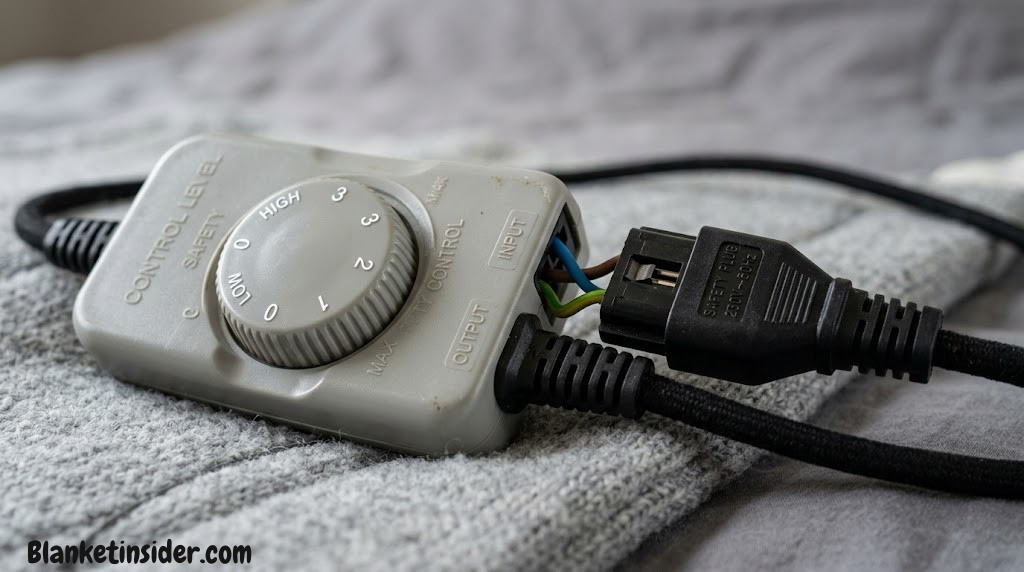
The controller and wiring connector are the two highest-risk components in any electric blanket. Learn to inspect them regularly.
Why Electric Blanket Safety Is a Topic You Cannot Afford to Skip
Electric blankets are one of the most convenient winter comforts ever invented. They’re also one of the most misunderstood electrical appliances in the home — used casually, stored carelessly, and replaced far less often than they should be.
According to consumer product safety data, electric blankets and electric heating pads are responsible for a significant portion of all appliance-related residential fires. The critical insight that most safety guides miss: the majority of these fires involve blankets that are more than ten years old, or blankets that are being used in ways that seem harmless but create dangerous internal heat buildup.
The good news is that electric blanket fires are almost entirely preventable. Unlike some home hazards that require expensive retrofits or professional interventions, electric blanket safety comes down to understanding a handful of clear rules, knowing what warning signs to look for, and making one non-negotiable purchase decision: buying a certified blanket from a reputable manufacturer and replacing it on schedule.
This guide covers the full picture — from the physics of how electric blankets generate heat, to the specific groups of people who should never use them, to what “UL certified” actually means and why it matters for your family. If you already own an electric blanket, you’ll finish this guide knowing exactly whether yours is safe to continue using. If you’re shopping for one, you’ll know exactly what to look for.
Electric blankets aren’t the only heated bedding option worth understanding. If you’re weighing your options, our complete comparison of heated blankets vs heated mattress pads covers the safety profiles of both in detail — and our electric blanket reviews with safety ratings can help you identify which models perform best on all dimensions.
Most fire safety organizations, including the UK’s Fire Kills campaign and the US Consumer Product Safety Commission, recommend replacing electric blankets after 10 years — regardless of outward appearance. Internal wiring degradation is invisible until it fails. If you don’t know how old your electric blanket is, treat it as due for replacement.
How Electric Blankets Work — and Why the Design Creates Risk
Understanding the basic mechanics of an electric blanket explains why certain behaviors that seem harmless — folding it, laying heavy objects on it, using it with worn insulation — are actually dangerous.
The Heating Element Network
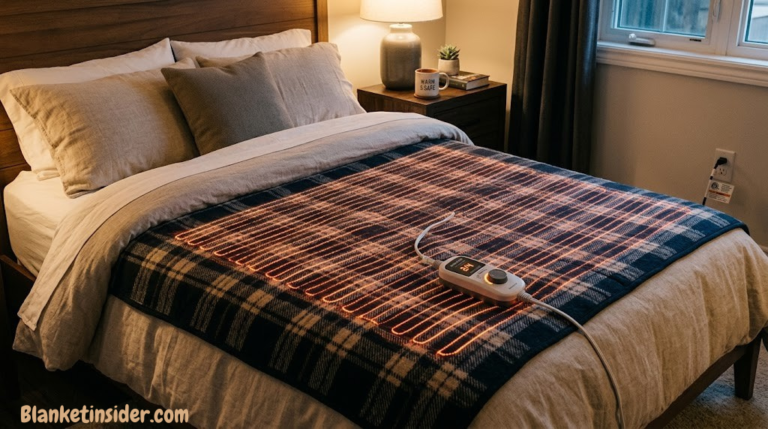
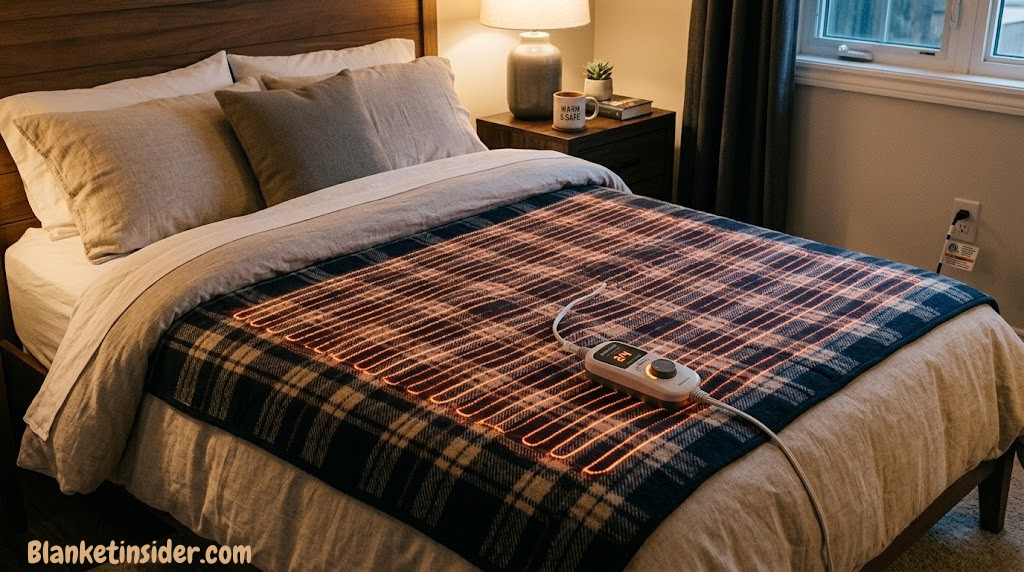
An electric blanket contains a network of thin insulated electrical wires (heating elements) woven throughout the fabric in a precise serpentine pattern. When electricity flows through these wires, they resist the current, converting electrical energy to heat — the same process that makes a toaster or electric stovetop hot, just at much lower power.
In a typical electric blanket, these wires are rated to operate at a specific temperature range — usually between 90°F and 120°F (32°C to 49°C) at maximum settings. The controller regulates current flow to maintain temperature within this range. Modern controllers are electronic rather than purely mechanical, allowing more precise temperature regulation and enabling auto-shutoff features.
Why the Design Is Inherently Vulnerable
The heating wires in an electric blanket are thin, flexible, and run throughout a fabric that bends, folds, and compresses with every use. This creates several structural vulnerabilities over the blanket’s lifetime:
- Insulation fatigue: The plastic insulation surrounding the heating wires flexes millions of times over the blanket’s life. Over years, this insulation becomes brittle, develops micro-cracks, and eventually fails — allowing wires to contact each other, which creates short circuits and localized heat spikes.
- Connection failure: The point where the controller connects to the blanket’s internal wiring is a high-stress junction. This connector undergoes repeated insertion, removal, and mechanical stress with every use cycle. It’s one of the most common failure points in aging blankets.
- Kink and pinch points: When a blanket is folded, rolled, or compressed, wires at the fold points experience concentrated mechanical stress. Over time, these stress points develop wire breaks or insulation failures that are invisible from the outside.
- Heat concentration: When a blanket is folded while powered, the heat from multiple layers combines in enclosed pockets that have no airflow. Even at a moderate heat setting, this can create temperatures far above the wire’s design specification.
The Controller: Your Primary Safety Interface
The controller is more than a heat dial — it’s the primary safety component of the entire system. Quality controllers include overheat protection circuits that detect abnormal temperature spikes and cut power automatically. Auto-shutoff timers (typically 8–10 hours) prevent the blanket from being left on indefinitely. Some modern controllers include display alerts and automatic fault detection.
A controller that runs very hot during normal use, produces a burning smell, or has any visible damage is a serious warning sign that should be acted on immediately. The controller should be checked before every use — particularly for any cracking of the housing or fraying where the cord meets the unit.
For a comprehensive look at how different heated blanket models handle controller safety, our heated blanket buying checklist for wire safety, auto-off, and washability gives you a thorough evaluation framework.
Modern electric blankets use a safety circuit called a Positive Temperature Coefficient (PTC) thermistor or a thermal fuse. When wire temperature exceeds a safe threshold, these devices interrupt the circuit — cutting heat before a dangerous condition develops. Blankets without this feature are significantly more dangerous. Always verify your blanket includes overheat protection before purchasing.

Shop Safety-Certified Electric Blankets on Amazon
UL-listed, auto-shutoff equipped, and machine washable — find the top-rated safe options from verified brands.
🛒 Shop Safe Electric Blankets on AmazonElectric Blanket Fire Risks: What Actually Causes Fires
Electric blanket fires don’t happen randomly. They follow predictable patterns — specific behaviors and conditions that dramatically increase risk. Understanding these patterns is the most practical fire prevention education you can get.
The Top Causes of Electric Blanket Fires
Blankets over 10 years old have degraded wire insulation that creates short circuits. This is the leading cause of electric blanket fires — the blanket looks fine but the internal wiring has failed invisibly.
Folding traps heat between layers, creates extremely high temperatures at fold points, and puts mechanical stress on already-fatigued wiring. Even one fold at a moderate setting is dangerous.
Sitting or placing heavy items on an electric blanket blocks the heat from dissipating, creating dangerous heat buildup in compressed areas — especially dangerous at the center of the blanket where wire density is highest.
Plugging in a wet or damp electric blanket can cause immediate arcing, short circuits, and fire. This includes blankets that haven’t fully dried after washing or that have been exposed to beverage spills.
A frayed power cord or damaged controller connector is a direct electrical hazard. Damaged insulation allows wires to arc — which can ignite the fabric directly or start a fire in adjacent bedding.
Blankets left on for extended periods — particularly overnight without auto-shutoff — accumulate thermal stress that increases the probability of failure. This is especially dangerous with older blankets.
The Hidden Risk: Storing Incorrectly and Then Using
One of the most overlooked electric blanket fire causes is damage that occurs during off-season storage. Rolling an electric blanket tightly, folding it with the wiring creased under heavy objects, or storing it compressed in a bag creates internal wire damage that isn’t apparent when you get the blanket out the following fall. The damage is already done — and the first time you plug it in, you’re using a compromised blanket.
We cover the correct storage method in detail in Section 8 below, but the key principle is that electric blankets should always be stored loosely rolled or laid flat — never tightly folded or compressed.
The highest-risk scenario for an electric blanket fire is: an older blanket (5+ years) with a damaged or fraying controller connection, used on a high heat setting, left folded on a bed overnight. This scenario concentrates multiple risk factors. If any part of this description matches your situation, discontinue use immediately.
For context on how electric blanket heat risk compares to other heating approaches — and when each makes more safety sense — our heated blanket vs space heater safety comparison is worth reading alongside this guide.
Also worth noting: blanket-related static electricity is a separate, much lower-level concern — but if you’ve ever wondered whether static from a blanket can cause fire, we have a detailed explainer on whether static electricity from blankets can cause fires.
Warning Signs That Your Electric Blanket Is Dangerous
Your electric blanket will often signal its own failure before it becomes a fire hazard — if you know what to look for. These warning signs should be treated as disqualifying: if you observe any of them, the blanket must be discarded, not repaired.
Any of the following are fire or electrocution risks. None of them can be safely repaired at home.
- Visible wire damage: Any exposed metal wiring, broken insulation, or visible internal structure showing through the fabric indicates direct fire and electrocution risk. Discard immediately.
- Scorch marks or discoloration: Yellow, brown, or black areas on the blanket fabric or near the connector indicate previous overheating events. The wiring at those points has been structurally compromised.
- Burning smell during use: A burning plastic, metallic, or acrid smell during operation indicates wire insulation burning. Remove from the bed, unplug, and do not use again.
- Controller overheating: The controller should be warm during use, not hot. If it’s too hot to touch comfortably, or if it emits any smell, there is a fault in the circuit.
- Uneven heating: Areas that heat significantly more or less than surrounding fabric indicate wire damage or connection failure within the blanket. Hot spots are especially dangerous — they indicate concentrated current flow.
- Sparking at connection: Any visible spark when connecting or disconnecting the controller is an electrical arcing hazard. Do not use the blanket again.
- Crackling or popping sounds: Audible electrical sounds during use indicate arcing within the wiring — one of the most dangerous conditions possible.
- Fraying cord: Fraying at any point on the power cord, especially near the plug or controller, indicates insulation wear. This is a near-term failure risk even if the blanket still functions.
- Physical kinking or lumps in the fabric: Internal lumps or hardened areas in the blanket fabric indicate that internal wires have been bent, kinked, or broken. These areas will eventually fail.
- Age over 10 years: No visible damage required — age alone is sufficient cause to replace. Internal degradation may not be detectable externally.
The critical mindset shift: an electric blanket is not worth repairing. Unlike a lamp or a vacuum cleaner, the internal heating wires of an electric blanket cannot be safely accessed, inspected, or repaired by a consumer. Once any of these warning signs appear, the blanket must be discarded.
When discarding an electric blanket, cut the power cord before putting it in the trash to prevent someone else from retrieving and using it. Some areas have e-waste recycling programs that accept small appliances with heating elements — check your local recycling program.

Time to Replace? Top Safety-Rated Electric Blankets
If your blanket is showing warning signs — or has simply aged out — these are the certified replacements our team recommends.
🛒 Browse Replacement Electric BlanketsThe Complete Rules for Safe Electric Blanket Use
Safe use of an electric blanket comes down to a set of clear, non-negotiable behaviors. These aren’t suggestions — they’re the difference between a safe appliance and a fire hazard. Most electric blanket accidents involve at least one of the “Don’ts” below.
- ✓ Pre-heat the bed, then switch the blanket off before sleeping
- ✓ Use the blanket flat and unfolded at all times
- ✓ Read the manufacturer’s instructions completely before first use
- ✓ Store loosely rolled or laid flat — never tightly folded
- ✓ Inspect the cord, connector, and fabric before every use
- ✓ Use a certified blanket from a reputable manufacturer
- ✓ Unplug the blanket completely when not in use
- ✓ Replace every 5–10 years depending on usage frequency
- ✓ Keep the controller away from the edge of the bed where it can fall
- ✓ Use on auto-shutoff mode if sleeping with the blanket on
- ✗ Never fold or bunch the blanket while it is switched on
- ✗ Never sit or place heavy objects on top of the blanket
- ✗ Never use a wet or damp blanket
- ✗ Never pin the blanket to the bed with safety pins (can puncture wires)
- ✗ Never use the blanket under a person (underblankets excepted)
- ✗ Never use on a waterbed, adjustable bed (unless rated for it), or recliner
- ✗ Never use with an infant, toddler, or anyone who cannot operate the controller
- ✗ Never attempt to repair any damage to the blanket yourself
- ✗ Never leave unattended for extended periods without auto-shutoff
- ✗ Never cover the blanket with a duvet while it is switched on
The Preheat Method: Safest Approach for Sleep
The safest way to use an electric blanket for nighttime comfort is the preheat method: switch the blanket on 15–30 minutes before you get into bed to warm the sheets and mattress, then switch it off completely — ideally by unplugging — before you fall asleep. Your warmed bedding will retain heat for an hour or more, providing comfort through the initial sleep phase without leaving the blanket powered overnight.
If you genuinely need heat throughout the night (common in people with arthritis, poor circulation, or in very cold climates), use a blanket with a certified auto-shutoff feature and keep it on the lowest effective heat setting. Never use the highest setting for overnight use.
Layering Rules
A frequently misunderstood rule is how electric blankets interact with other bedding layers. The standard electric blanket (an overblanket) should always be the topmost layer — placed on top of your regular bedding, not underneath it. Placing a duvet or comforter on top of a powered electric blanket traps heat and creates conditions very similar to the dangerous folded-blanket scenario.
If you use a heated mattress pad (underblanket) — a different product designed to be placed under your sheets — you can use your regular bedding on top because underblankets are specifically engineered with lower maximum temperatures and heat distribution designed for that use pattern. Do not substitute a regular electric overblanket for an underblanket.
Layering a duvet over a switched-on electric overblanket is one of the most common and underappreciated dangers. The combined insulation of the duvet and blanket creates extremely high temperatures in the trapped air space — enough to cause fire in degraded wiring or even accelerate aging of newer wiring. Always switch the blanket off before covering it.
Who Should Avoid Electric Blankets — A Medical Safety Guide
Electric blankets are not appropriate for everyone. Several groups face specific and serious risks that make alternatives a better choice — not because electric blankets are categorically dangerous, but because the risk calculus changes significantly for people with certain conditions or vulnerabilities.
Children under 5 cannot regulate body temperature effectively, cannot communicate overheating, and may be unable to move away from an overheating blanket. Risk of hyperthermia is severe. Use breathable baby-specific blankets only.
Peripheral neuropathy reduces or eliminates the ability to feel heat against the skin. This means the person cannot feel the blanket overheating — and burns can occur without any sensation of pain.
Paralysis can prevent both sensation of heat and the ability to move away from overheating areas. Even with partial paralysis, the risk of contact burns is significantly elevated.
Sustained elevated core temperature during early pregnancy has been associated with neural tube defects in some studies. Use is not prohibited but consult your obstetrician — especially in the first trimester.
Older adults may have reduced heat sensation, thinner skin more prone to burns, and conditions that make thermoregulation less effective. Limit to lowest settings and use the preheat method.
Conditions like Raynaud’s disease, peripheral arterial disease, or heart conditions that affect circulation can make heat management unpredictable. Consult a physician before regular use.
Anyone who cannot independently reach and operate the controller — including some disability conditions, dementia, or heavy sedation from medication — should not use an electric blanket unsupervised.
Healthy adults using a certified blanket correctly, on appropriate settings, with the preheat method have a low risk profile. Regular inspection and timely replacement are the key ongoing requirements.
A Note on Pet Safety with Electric Blankets
Many pet owners use electric blankets with or near their animals. This creates specific risks: pets can puncture heating wires with claws or teeth, creating an electrocution hazard, and they cannot communicate when they are becoming overheated from a blanket set too high.
The safest approach is to use purpose-built pet heating pads with built-in thermostats and chew-resistant cords, rather than adapting a human electric blanket for pet use. Our reviews of the best pet blankets for dogs and cats include warm-climate options that are pet-appropriate without electrical risk.
For parents concerned about blanket safety more broadly, the conversation extends beyond electric blankets to infant sleep safety in general. Our detailed baby sleep blanket safety timeline covers exactly when different blanket types become appropriate as infants grow.

Safe Pet Warming Pads — Better Than an Electric Blanket for Animals
Purpose-built pet heating pads with pet-safe thermostats, auto-shutoff, and chew-resistant cords — the safe alternative to using a human electric blanket with your pets.
🛒 Shop Pet Heating Pads on AmazonHow to Wash an Electric Blanket Without Creating a Hazard
Washing an electric blanket is possible and necessary for hygiene — but it must be done correctly. Improper washing is responsible for a significant portion of electric blanket failures, because rough mechanical action and heat damage the internal wiring structure even if the outer fabric emerges looking fine.
Before You Wash: The Essential Checks
Before washing any electric blanket, confirm that your specific model is manufacturer-rated as machine washable. Some older blankets are hand-wash or dry-clean only, and putting a non-machine-washable blanket through a washing cycle can cause immediate and severe wiring damage. If you no longer have the original instructions, search the model number online before proceeding.
Critically: remove the controller completely before washing. This is the step most people rush or forget. The controller is an electronic device that will be permanently and irreparably damaged by water. On most blankets, the controller connector is a simple plug-in fitting — disconnect it fully, check that the connection socket on the blanket is sealed (most modern blankets have a waterproofed connection socket), and confirm the blanket is controller-free before loading it.
Machine Washing: Step by Step
Pre-soak (optional but recommended)
Soaking the blanket in cold water for a few minutes before washing reduces the mechanical stress of the initial wash cycle absorbing water, which can cause sudden jolts to internal wiring.
Use a gentle / delicate cycle only
Never use a normal, heavy, or intensive wash cycle. The agitation in a normal cycle is enough to damage internal wiring over time. Gentle cycle limits mechanical stress significantly.
Cold or lukewarm water — never hot
Hot water causes the wire insulation to expand and soften, weakening its structural integrity. Cold or lukewarm water (up to 30°C/86°F) is safe for the internal components.
Mild detergent only — no bleach, no fabric softener
Bleach degrades wire insulation over time. Fabric softener can coat the wire connections and insulation, reducing their performance and lifespan. Use a small amount of mild liquid detergent.
Short wash cycle — under 10 minutes
The longer the blanket agitates in the machine, the more mechanical stress the internal wiring sustains. A short cycle (5–10 minutes) is sufficient for cleaning without unnecessary stress.
Gentle spin only — or no spin
The spin cycle creates significant centrifugal stress on internal wiring. Use the lowest spin speed or, ideally, remove the blanket before the spin cycle and gently press out excess water by hand — never wring or twist.
Air dry completely before reconnecting
Lay flat to air dry, or use a tumble dryer on the lowest heat setting for a partial cycle, then air dry to completion. The blanket must be completely dry — including the connection socket — before the controller is reconnected. Plugging in a damp blanket is a serious electrical hazard.
For a complete, detailed walkthrough of the washing process for different electric blanket types, our guide on how to wash a heated blanket without wiring damage covers every scenario — including blankets with fixed connectors and blankets with waterproof controllers. Our dedicated guide on washing heated blankets safely is also a valuable reference.
Never put the controller in the wash. Never wring or twist the blanket — this kinks internal wires. Never use a high spin speed. Never put the blanket in a dryer on high heat. Never use the blanket before it is completely, thoroughly dry throughout.
Storing Your Electric Blanket: The Off-Season Safety Protocol
Electric blanket storage is where many people unknowingly create the damage that leads to next season’s safety problems. The blanket comes out of storage looking perfect — but the wiring inside has been compromised by months of improper compression.
The Correct Storage Method
The single most important rule is: never tightly fold an electric blanket for storage. Tightly folded blankets create repeated, concentrated stress points at every fold line where the wiring is forced to bend sharply. Over months of storage under even moderate compression, this causes micro-fractures in the wire insulation at those fold points.
The correct approach is to roll the blanket loosely around a cylinder — a tube from a roll of wrapping paper works well, as does a pool noodle or even loosely around itself. The blanket should be rolled gently, not compressed. Store it in a breathable storage bag or a linen bag — not a sealed plastic bag, which can trap moisture.
Before storing for the off-season: clean the blanket according to manufacturer instructions, allow to dry completely, disconnect and store the controller separately in a cushioned bag, inspect all components one final time, then roll loosely and store in a breathable bag away from damp areas, direct sunlight, and heavy objects. For storage bag options, our best blanket storage bags guide includes breathable options sized for bulky blankets.
Inspecting After Storage
Before using the blanket for the first time after off-season storage, conduct a complete physical inspection: check the full length of the cord for any cracking or fraying, check the connector and controller housing for any damage, unfold or unroll the blanket completely and look for any lumps, hard spots, or scorch marks, and run your hands over the blanket surface to feel for any areas where the internal wiring structure has changed.
This inspection takes about three minutes and should become an annual ritual at the start of blanket season. If anything raises concern, replace the blanket rather than using it and watching for problems.
If you’re looking for ways to organize your seasonal blanket collection more broadly — electric or otherwise — our guide to best blanket chests and storage trunks is a useful companion. Proper physical storage matters for all blanket types.

Blanket Storage Bags — Keep Your Electric Blanket Safe Between Seasons
Breathable, correctly-sized storage bags prevent the compression damage that ruins electric blanket wiring during off-season storage.
🛒 Shop Blanket Storage Bags on AmazonSafety Certifications Explained: What the Labels on Electric Blankets Actually Mean
Safety certification markings on electric blankets are not marketing language — they are the result of independent laboratory testing to established safety standards. Understanding what each certification means (and importantly, what it doesn’t mean) will help you make genuinely safer purchase decisions.
| Certification | Region | What It Tests | Trust Level |
|---|---|---|---|
| UL (Underwriters Laboratories) | USA / North America | Electrical safety, fire resistance, overheat protection, wiring durability under repeated use and wash cycles | Very High ✅ |
| ETL Listed | USA / North America | Equivalent testing to UL, performed by Intertek. ETL and UL are equally valid safety certifications. | Very High ✅ |
| CSA (Canadian Standards Association) | Canada / North America | Similar scope to UL/ETL. Required for sale in Canada. CSA and UL certifications are often both present on North American market blankets. | Very High ✅ |
| CE Marking | European Union | Manufacturer self-declaration of conformity to EU safety directives. CE marking alone is not as rigorous as UL/ETL independent testing — look for additional notified body marks (e.g., TÜV, BSI) for higher assurance. | Medium ⚠️ |
| TÜV / GS Mark | Germany / Europe | Independent German safety testing with physical and electrical safety standards. GS mark indicates independent testing has occurred, not just self-certification. | High ✅ |
| BSI Kitemark | United Kingdom | British Standards Institution independent product certification. Equivalent trust level to UL for UK market products. | High ✅ |
| No Certification Mark | Any | No independent safety testing. The manufacturer has self-certified or made no safety claims at all. These blankets frequently fail independent safety evaluations. | Avoid 🚫 |
The Uncertified Blanket Problem
A significant and growing safety concern is the proliferation of uncertified electric blankets sold through online marketplaces — particularly from sellers who appear to ship directly from overseas. These blankets frequently lack any safety certification and, when tested, often fail basic overheat protection requirements, have insufficient wire insulation thickness, and have controllers with no fault protection circuitry.
The low price point of these blankets makes them attractive — but the lack of safety testing means you have no reliable indication of whether the internal components meet even minimum safety standards. A certified blanket from a reputable manufacturer (Sunbeam, Biddeford, Serta, Beautyrest) costs more upfront but represents a categorically different risk profile.
Our Sunbeam heated blanket review gives a sense of what a properly certified blanket’s safety features actually look like in practice, and our broader heated blanket review covers the safety performance across multiple brands.
Don’t rely on certification logos in product photos — these can be copied or faked. Look for the actual embossed or printed certification mark on the physical product and controller. UL marks can be verified at productiq.ul.com. If a seller cannot provide a verifiable certification listing, treat the product as uncertified.
Electric Blankets and EMF: Separating Evidence from Concern
Electromagnetic field (EMF) exposure from electric blankets is a topic that generates significant concern and significant confusion in equal measure. Here’s an honest summary of what the science actually shows.
What EMF Exposure From Electric Blankets Looks Like
Electric blankets generate extremely low frequency (ELF) electromagnetic fields during operation. The field strength is strongest directly at the blanket’s surface and decreases rapidly with distance — at a few inches from the blanket, field strength drops to background levels similar to the general indoor environment.
Because an electric blanket is in direct body contact during use, the EMF exposure it creates is higher than most other household electrical appliances encountered at normal distances. Older electric blankets — particularly those that use a continuous AC current rather than low-voltage or pulsed DC — generally have higher EMF emissions than modern designs.
What the Research Actually Shows
The research on ELF-EMF exposure and health effects is genuinely mixed, and it would be intellectually dishonest to present it as definitively either safe or definitively harmful. The weight of current evidence from major health organizations — including the World Health Organization and the US National Cancer Institute — is that ELF-EMF from household appliances, including electric blankets, does not pose a clearly established cancer risk at normal exposure levels.
However, several epidemiological studies have suggested associations between long-term, high-level ELF-EMF exposure and certain childhood health outcomes, and the evidence base continues to evolve. Pregnant women are most commonly cited as having the most reason for precaution, given the sensitivity of fetal development.
Practical Recommendations
For the general adult population, the evidence does not support treating electric blanket EMF as a significant health concern. For pregnant women, particularly in the first trimester, a precautionary approach is reasonable — either avoiding electric blankets or using the preheat-and-off method described in Section 5, which eliminates active EMF exposure during sleep.
If EMF is a specific concern for you, modern low-voltage electric blankets (which operate on 12V or 24V DC rather than 120V AC) have significantly lower EMF emissions while maintaining similar heating performance. These are worth seeking out if this aspect of safety matters to you.
For those exploring other bedding technologies with different EMF profiles, our reviews of grounding sheets and earthing products and the Lifepro infrared sauna blanket’s safety and EMF profile cover related topics in depth.
Safer Alternatives to Electric Blankets for Different Situations
For the groups who should avoid electric blankets, or for situations where the risks outweigh the benefits, several alternatives provide warmth and comfort without the electrical hazard profile of electric blankets.
For Elderly Users and People with Reduced Sensation
A quality thermal blanket — particularly a high-loft wool or high-GSM fleece blanket — can provide substantial warmth without any electrical components. Wool is particularly effective because of its natural thermoregulation properties: it holds body heat without creating the risk of overheating. Our best thermal blankets for cold weather covers the warmest non-electric options available.
For bed warming specifically, a microwaveable heat pad or a hot water bottle (properly covered to prevent contact burns) can warm the bed before sleep without the ongoing electrical risk. These are especially appropriate for people who need warmth but cannot safely manage a powered electric blanket.
For Cold Climates and Whole-Room Warming
Improving the room’s ambient temperature through better insulation, draft exclusion, or a safely-positioned radiator is often more effective than a personal electric blanket and carries no personal fire or burn risk. In terms of targeted heat appliances, our comparison of electric blanket vs space heater covers the safety and efficiency profiles of both options in cold-room scenarios.
For Travel Warmth
Travel scenarios call for different solutions entirely. A high-loft down travel blanket, a quality fleece throw, or a wearable blanket provides warmth on long journeys without electrical dependency. For in-car use, our 12V heated blanket guide for EVs and road trips covers vehicle-specific heated blanket options that are designed for mobile use — a safer alternative to adapting a household electric blanket for car use. Our cozy car road trip guide has broader comfort recommendations for extended journeys.
For Baby and Infant Warmth
The alternatives to electric blankets for infants are well-established and non-negotiable: breathable cotton swaddle blankets, muslin wraps, or appropriate sleep sacks. Our best swaddle blankets guide covers the safest options for newborn warmth. The swaddle vs sleep sack guide helps parents navigate the right choice as their infant develops. For a fuller picture of infant sleep safety, the baby sleep blanket safety timeline is essential reading.
| Situation | Electric Blanket Risk | Recommended Alternative |
|---|---|---|
| Infant / baby | Severe — avoid | Cotton swaddle, muslin blanket, sleep sack |
| Person with neuropathy | High — avoid | Heavyweight wool throw, room heating |
| Pregnancy (early) | Caution — consult physician | Preheat method, thermal blanket, room temperature increase |
| Elderly user | Moderate with precautions | Low-voltage model, preheat method, thermal throw |
| Pets | Moderate — not recommended | Purpose-built pet heating pad with pet thermostat |
| Car / travel use | Non-standard use — risk | 12V vehicle-rated heated blanket or fleece throw |
| Healthy adult, general use | Low with correct usage | Certified electric blanket with preheat method |

Warm Without the Wires: Top Thermal Blankets for Safe Winter Comfort
For anyone who can’t safely use an electric blanket, these high-loft thermal options provide serious warmth with zero electrical risk.
🛒 Shop Thermal Blankets on AmazonHow to Buy a Safe Electric Blanket: The Complete Checklist
If you’re in the market for a new electric blanket — whether replacing an aging one or purchasing your first — these are the criteria that determine a genuinely safe product from a fire-risk waiting to happen.
| Safety Feature | Why It Matters | Must Have? |
|---|---|---|
| UL / ETL / CSA Certification | Independent testing to established fire and electrical safety standards | Essential ✅ |
| Auto-Shutoff Timer | Prevents indefinite operation — most critical safety feature for overnight use | Essential ✅ |
| Overheat Protection Circuit | Cuts power if wire temperature exceeds safe threshold — prevents the most common fire initiation | Essential ✅ |
| Machine Washable Rating | Indicates wiring and connectors are designed to tolerate washing — important for long-term hygiene and safety | Strongly Recommended |
| Reputable Brand | Established manufacturers have service networks, replacement part availability, and track records of safety compliance | Strongly Recommended |
| Multiple Heat Settings | Allows use at lowest effective temperature — reduces thermal stress on wiring over the blanket’s lifespan | Recommended |
| Preheat Mode | Dedicated preheat setting makes it easy to use the safest operating pattern without using the full controller | Very Useful |
| Low-Voltage Design | 12V or 24V DC designs have lower EMF and are generally considered safer for people with EMF concerns | Useful for at-risk groups |
| Dual-Zone Controls | Allows two people to set independent temperatures — prevents overheating for one person while accommodating the other’s preferences | Optional comfort feature |
Brands With Strong Safety Track Records
In the North American market, Sunbeam, Biddeford, Serta, Beautyrest, and Bedsure are established manufacturers with UL or ETL certification across their product lines and track records in consumer safety compliance. In the UK market, Dreamland and Silentnight have consistently strong safety ratings and BSI certification on their heated blanket ranges.
This doesn’t mean every product from these companies is equal — individual models vary — but starting your search with established brands significantly reduces the probability of purchasing an uncertified or undertested product. Our comprehensive electric blanket reviews evaluate specific models on safety, heat control, and comfort so you can compare within brands as well as between them.
Red Flags When Shopping Online
- No visible certification mark or a certification mark that cannot be verified on the certification body’s website
- Price dramatically lower than comparable certified products (often 50%+ cheaper)
- No brand name — just a generic product name and seller name
- Product description that mentions safety features in vague marketing language without specific standards
- No warranty — certified products from reputable manufacturers typically carry a 1–5 year warranty
- Fulfilled by a marketplace third-party seller with no brand website
For a structured approach to evaluating any specific electric blanket before you buy, our heated blanket buying checklist walks through every key criterion in a format designed for in-the-moment shopping decisions.

Best-Selling Certified Electric Blankets — All the Safety Features, Properly Tested
Auto-shutoff, overheat protection, UL-listed, machine washable — the complete safety package. Compare the top-sellers on Amazon.
🛒 Compare Certified Electric Blankets on AmazonElectric Blanket Safety: Frequently Asked Questions
-
Most modern electric blankets with auto-shutoff timers are considered reasonably safe for sleeping. However, the safest practice recommended by fire safety organizations is to preheat your bed with the blanket, then switch it off before you fall asleep. If you must sleep with it on, use only a newer model with an automatic shutoff feature, never fold it while in use, and ensure the wiring is undamaged.
-
Yes. Electric blankets are responsible for thousands of residential fires each year globally. The most common causes are damaged wiring, using a folded blanket that traps heat, leaving the blanket on unattended for extended periods, placing heavy objects on the blanket, and using a blanket that is too old — generally over 10 years. Modern blankets with proper certifications have significantly reduced but not eliminated this risk.
-
It is generally not recommended. Pets can puncture the internal heating wires with their claws or teeth, creating an electrocution or fire risk. They also cannot communicate overheating discomfort. If you want warmth for your pet, use a purpose-built pet heating pad with overheat protection rather than a human electric blanket.
-
Most modern electric blankets can be machine washed, but you must remove the controller completely and follow the manufacturer’s instructions precisely. Use a gentle cycle with cold or lukewarm water, and never wring or twist the blanket — this can damage the internal heating wires. Always air dry or tumble dry on the lowest heat setting, and ensure the blanket is completely dry before plugging it back in.
-
The following groups should avoid electric blankets or use only with medical supervision: infants and young children under 5, people with diabetes or neuropathy (reduced sensation), paralyzed individuals, people who cannot operate the controls independently, pregnant women (heat exposure risk to the fetus), and people with certain circulatory conditions. Always consult a physician if you have any condition affecting heat perception or circulation.
-
Most electric blanket manufacturers and fire safety organizations recommend replacing electric blankets every 10 years at maximum, and ideally every 5–7 years for regularly used blankets. Over time, internal wiring can develop insulation fatigue, micro-fractures, and connection failures that are invisible on the outside but create significant fire and electrocution hazards.
-
No. Folding or bunching an electric blanket while it is switched on is one of the most common causes of electric blanket fires. Folding concentrates heat in overlapping layers, which can cause the internal wiring to overheat and ignite the surrounding fabric. Always use electric blankets flat and unfolded.
-
Look for UL (Underwriters Laboratories) certification in the US, CE marking in Europe, ETL listing, or CSA certification in Canada. These indicate the blanket has been independently tested to established safety standards. Avoid blankets with no certification markings, particularly cheap imported blankets from unverified sellers — these frequently fail safety testing.
-
No. Placing any blanket or covering over or under an electric blanket while it is in use traps heat and creates a fire hazard. Electric blankets should always be the topmost layer on the bed — not placed under sheets, mattress toppers, or duvets. The exception is underblankets (electric mattress pads), which are specifically designed to be placed under bedding.
-
Immediately stop using an electric blanket if you notice: visible damage to the cord or fabric, scorch marks or discoloration anywhere on the blanket, a burning smell during use, the controller feeling excessively hot, the blanket heating unevenly, sparking or cracking sounds, or any part of the wiring becoming exposed. These are all signs of internal wiring failure and the blanket should be discarded immediately.
-
The evidence on electric blanket use during pregnancy is mixed, but most medical organizations advise caution or avoidance. Sustained elevated core body temperature during early pregnancy has been associated with neural tube defects. Additionally, some older electric blankets emit EMF, though evidence on EMF harm is not conclusive. Consult your obstetrician before using an electric blanket during pregnancy, particularly in the first trimester.
-
It is best practice to unplug your electric blanket completely when it is not in use, rather than leaving it plugged in in standby mode. Even in the off position, a plugged-in appliance with damaged wiring can present a risk. Unplugging also prevents accidental activation and reduces standby power consumption.
Electric Blanket Safety: The Bottom Line
Electric blankets are not inherently dangerous appliances — but they are appliances that require more informed, attentive use than most people give them. The overwhelming majority of electric blanket-related fires and injuries are the result of preventable behaviors: using damaged or aged blankets, folding them while powered, placing them under covers, or using them with people who have reduced heat sensation.
The three most impactful safety decisions you can make right now:
- Replace your blanket if it’s over 10 years old — regardless of how it looks, internal wiring degrades invisibly and fire risk increases significantly with age.
- Adopt the preheat-and-off method — warm your bed before sleep, then switch the blanket off. It’s the single most effective risk-reduction behavior available to every user.
- Only buy certified blankets — UL, ETL, or CSA certification with auto-shutoff and overheat protection isn’t optional. It’s the minimum safety floor for a product that runs electrical current through your bedding while you sleep.
Electric blanket safety also extends to how you care for your blanket between uses. Washing it correctly, storing it without compression, and inspecting it before each season are the ongoing maintenance habits that keep a safe blanket safe for its full lifespan.
For more from Blanket Insider on electric and heated blanket topics: our full electric blanket reviews, the electric blanket vs heated mattress pad comparison, and our guide to washing heated blankets without wiring damage are all worth bookmarking alongside this safety guide.
🛒 Shop Safety-Certified Electric Blankets on Amazon