
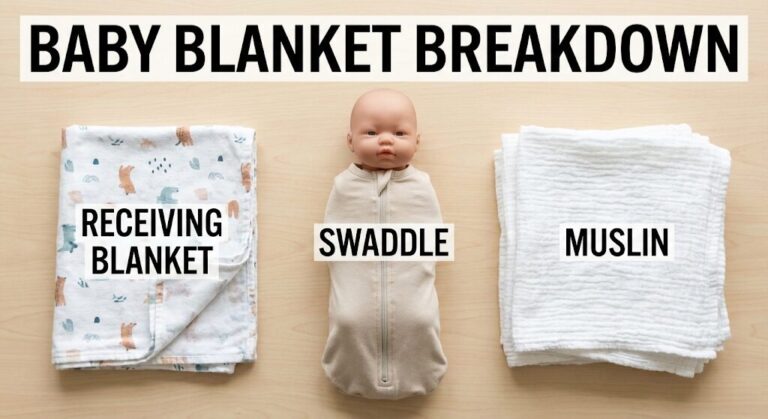
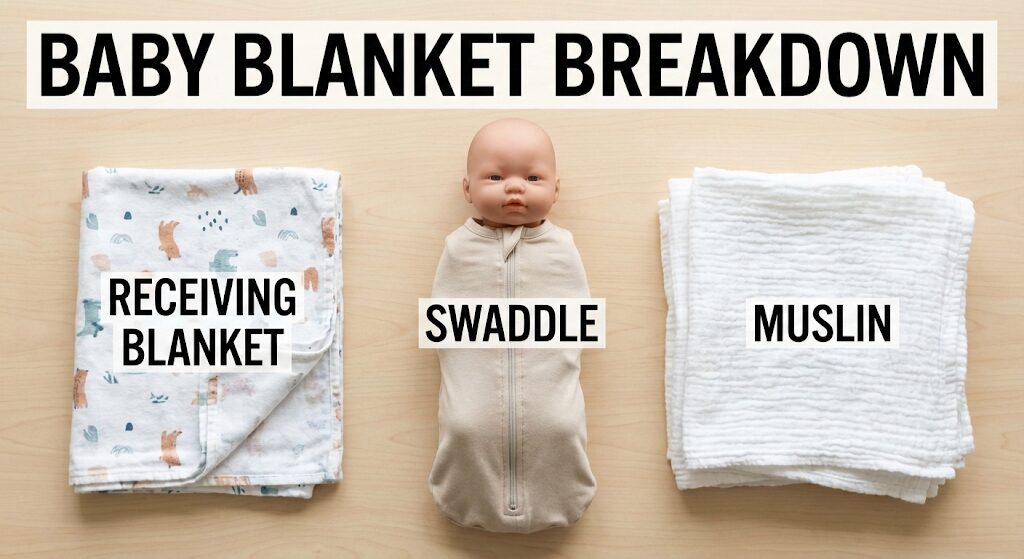
Demystifying Baby Blankets: What’s the Real Difference Between Receiving, Swaddle, and Muslin?
Walking into a baby store or opening up a registry checklist can feel like learning an entirely new language. As an expectant or new parent, you are bombarded with terms that seem interchangeable but actually serve very different purposes. You’re told you need receiving blankets, swaddle blankets, and muslin cloths. But what do these terms actually mean? Are they just clever marketing tactics, or do you genuinely need all three to survive the newborn phase?
It is completely normal to feel overwhelmed by the sheer volume of baby gear. We’ve all stood in the middle of a nursery aisle wondering how a simple piece of fabric can have so many different names. The reality is that while there is some overlap, understanding the specific design, fabric, and primary use case of each type of blanket will save you money, reduce registry clutter, and most importantly, keep your baby safe and comfortable.
In this comprehensive guide, we will break down the exact differences between receiving blankets, swaddles, and muslin. We’ll cover the pros, cons, dimensions, and ideal uses of each, so you can confidently curate your baby’s linen closet without second-guessing yourself.
1. The Classic Receiving Blanket: The Ultimate Multitasker
Let’s start with the grandfather of all baby linens: the receiving blanket. If you have given birth in a hospital, chances are your baby was wrapped in a receiving blanket right after delivery. Those iconic white blankets with pink and blue stripes? Those are receiving blankets.
The term originates from the historical practice of a baby literally being “received” into this specific blanket immediately after birth before being handed to the mother.
What Makes a Blanket a “Receiving” Blanket?
A standard receiving blanket is usually square or rectangular, measuring roughly 30 x 30 inches (though some can be slightly larger). They are almost exclusively made of thin, soft cotton flannel or simple cotton blends. Because of their modest size and basic fabric, they are incredibly versatile but have some limitations.
Best Uses for a Receiving Blanket
- Burp Cloth Alternative: Because they are highly absorbent and inexpensive, they make fantastic, oversized burp cloths for spit-up-prone babies.
- Makeshift Changing Mat: Need to change a diaper on a friend’s couch or the backseat of a car? Throw down a receiving blanket.
- Stroller Cover: Great for draping over a stroller to block the sun (though ensure proper ventilation) or tucking around a toddler’s legs on a breezy evening.
- Tummy Time Mat: Perfect for laying on the carpet for a clean, soft surface during tummy time.
What they are not ideal for is swaddling a growing baby. Because they are only about 30 inches wide, most babies outgrow them as a swaddle within the first few weeks. They simply lack the stretch and the surface area to secure a squirming newborn tightly.
Pros
- Highly affordable and easily accessible.
- Incredibly versatile for everyday messes.
- Durable; can be washed hundreds of times.
- Takes up very little space in a diaper bag.
Cons
- Too small to swaddle babies past 3-4 weeks old.
- Cotton flannel lacks the “stretch” needed for a secure wrap.
- Not as breathable as looser weaves.

Upgrade Your Basics
Stock up on ultra-soft, highly absorbent organic cotton receiving blankets. Perfect for every mess and moment.
Shop Receiving Blankets on Amazon2. The Purpose-Built Swaddle: Engineering Better Sleep
If a receiving blanket is a jack-of-all-trades, a swaddle is a specialized master. Swaddling is the ancient practice of wrapping an infant snugly to restrict their motor movements. This mimics the tight, secure environment of the womb and prevents the Moro reflex (the startle reflex) from waking the baby up mid-sleep.
When we talk about “swaddles” today, we are generally referring to one of two things: large, stretchy swaddling blankets, or pre-made swaddle sacks (sleep sacks with wings).
The Traditional Swaddle Blanket
Unlike receiving blankets, dedicated swaddle blankets are much larger—typically 40 x 40 inches or even 47 x 47 inches. This extra square footage is crucial. It gives you the fabric necessary to create a tight, secure wrap that won’t come undone when your baby kicks. They are also made from materials that have a bit of give or stretch, such as bamboo blends, jersey knit, or loosely woven cotton.
The Modern Swaddle Sack
Let’s be honest: learning the origami required to perfectly swaddle a crying baby at 3:00 AM in the dark is a skill not every parent wants to master. Enter the swaddle sack. These feature velcro patches, zippers, or snaps. You put the baby inside a pouch and simply wrap and secure the “wings” across their chest.
Important Note: You must stop swaddling your baby as soon as they show signs of attempting to roll over. To understand the exact timing and transition process, we highly recommend reading our guide on swaddle vs sleep sack: when to switch.
Pros
- Large enough to properly secure a growing infant.
- Pre-made options (velcro/zippers) are foolproof for sleep-deprived parents.
- Effectively reduces the startle reflex for longer sleep stretches.
- Stretchy fabrics allow for natural hip movement.
Cons
- Pre-made swaddles have a very short lifespan (must stop when baby rolls).
- Can be more expensive than basic receiving blankets.
- Velcro can stick to other items in the washing machine if not secured.

Secure Sleep Made Easy
Stop wrestling with complicated blanket folding. Try an easy-wrap Velcro swaddle sack designed for safe, secure sleep.
Shop Swaddle Sacks on Amazon3. The Magic of Muslin: A Fabric, Not a Shape
Here is where the most confusion lies. People often compare a “muslin” to a “swaddle” or a “receiving blanket.” However, muslin is a type of fabric weave, whereas a swaddle or receiving blanket refers to the item’s purpose and dimensions.
That being said, because muslin is so highly prized in the baby world, “muslins” has become a shorthand term for large, muslin-fabric swaddle blankets.
What is Muslin?
Muslin is a finely-woven, breathable cotton fabric that dates back centuries. The open weave allows for incredible airflow, significantly reducing the risk of a baby overheating while wrapped. Despite feeling light and delicate, the weave makes it surprisingly durable, and it has the wonderful property of getting softer with every single trip through the washing machine.
Why Parents Obsess Over Muslin
When you buy a “muslin swaddle,” you are usually buying a large 47 x 47-inch square of muslin fabric. Because of its massive size and breathable nature, it bridges the gap between the receiving blanket and the swaddle.
- Temperature Regulation: It is the undisputed champion for summer babies or warmer climates.
- The “Stretch”: The open weave gives the fabric a natural, mechanical stretch on the bias (diagonal), making it fantastic for achieving a tight, hip-healthy swaddle wrap.
- Longevity: Long after your baby stops being swaddled, a large muslin blanket serves as a nursing cover, a lightweight toddler summer blanket, a car seat canopy, or even a chic scarf for mom.
If you are looking for specific brands and material comparisons, take a look at our roundup of the top baby swaddle blankets of 2026.
Pros
- Unmatched breathability prevents overheating.
- Gets softer with every single wash.
- Incredibly generous sizing (often 47″ x 47″).
- Beautiful, aesthetic prints and colors.
Cons
- Not warm enough on its own for harsh winter climates.
- Prone to snagging on velcro or sharp zippers in the wash.
- Higher initial price point compared to standard flannel.

Breathable Comfort
Discover the ultra-soft, breathable magic of 100% cotton muslin swaddle blankets. Perfect for sensitive newborn skin.
Shop Muslin Blankets on Amazon4. Head-to-Head Comparison: Which One Wins?
To make your decision as easy as possible, let’s look at a direct side-by-side comparison of these three nursery staples.
| Feature | Receiving Blanket | Swaddle Blanket/Sack | Muslin Blanket |
|---|---|---|---|
| Primary Material | Cotton flannel or polyester blend | Jersey, Bamboo, or Velcro/Spandex blends | Open-weave 100% Cotton or Bamboo Muslin |
| Typical Size | 30″ x 30″ (Small) | 40″ x 40″ or Pre-sized Sacks | 47″ x 47″ (Extra Large) |
| Best Used For | Burp cloths, wiping spills, quick changing mats | Strictly for sleeping and calming the startle reflex | Swaddling, nursing cover, summer blanket, sun shade |
| Breathability | Moderate (can get warm) | Varies heavily by material | Extremely High (Best for airflow) |
| Lifespan of Use | Birth to 3 months (as a blanket), forever as a rag | Birth until baby rolls (approx. 2-4 months) | Birth through toddlerhood |
5. How to Choose What You Actually Need
Do you need to buy all three? The short answer is no, but having a strategic mix will make your life significantly easier. How you build your registry depends on your parenting style, budget, and climate.
The Minimalist Approach
If you want to keep baby gear to an absolute minimum, skip the receiving blankets entirely. Buy a 4-pack of high-quality, large muslin blankets. They are large enough to swaddle effectively, soft enough to use as burp cloths in a pinch, and breathable enough for any climate. Add in one or two velcro swaddle sacks for those desperate middle-of-the-night changes where you don’t have the patience to wrap a blanket.
The “Prepared for Everything” Approach
If you prefer to have the right tool for every job:
- Get a cheap 5-pack of receiving blankets to keep in the car, stroller, and living room for spit-ups and quick messes.
- Invest in 3-4 swaddle sacks (like a Halo SleepSack or Ollie Swaddle) purely for nighttime sleep.
- Buy 2 beautiful muslin blankets for daytime naps, nursing covers, and aesthetic newborn photos.
Climate Considerations
If you live in a colder climate or are having a winter baby, muslin might feel too thin for daytime lounging (though it remains safe for swaddling if the ambient room temperature is controlled). In this case, you might find yourself exploring thicker fabrics. If you are debating warmer materials, be sure to read our breakdown of minky vs fleece baby blankets to ensure you are choosing a fabric that is warm but still safe for infants.
6. Safe Sleep Guidelines: Blankets and Newborns
No discussion about baby blankets is complete without a strict review of safe sleep practices. The American Academy of Pediatrics (AAP) has very clear guidelines regarding blankets in the crib.
Rule #1: No Loose Blankets. A baby under the age of 12 months should never sleep with a loose blanket in their crib, bassinet, or play yard. This includes receiving blankets and muslin blankets that are simply draped over the baby. Loose fabrics pose a severe suffocation and Sudden Infant Death Syndrome (SIDS) risk.
Rule #2: Swaddles Must Be Secure. If you use a blanket to swaddle your baby, it must be wrapped tightly enough around the torso that it cannot come loose and cover the baby’s face, but loose enough around the hips to allow the legs to bend up and out to prevent hip dysplasia.
Rule #3: Stop Swaddling When Rolling Begins. The moment your baby shows signs of trying to roll over (which can happen as early as 2 months), you must stop swaddling their arms. At this point, you should transition to a wearable blanket or sleep sack. For a complete timeline of what is safe at what age, bookmark our baby sleep blanket safety timeline.
7. Frequently Asked Questions (FAQs)
Can I use a receiving blanket to swaddle a newborn?
Yes, you can use a receiving blanket to swaddle a newborn for the first few weeks. However, because they are typically small (30×30 inches) and lack stretch, babies outgrow them quickly and can easily kick out of them, posing a loose-blanket safety risk. A dedicated swaddle or large muslin blanket is much better.
What is the point of a receiving blanket if it’s too small to swaddle?
Receiving blankets are excellent multi-purpose utility cloths. They are perfect for draping over a shoulder for burping, laying down on the floor for a quick diaper change, wiping up spills, or providing a clean surface for tummy time.
Are muslin blankets safe for newborns?
Yes, muslin blankets are highly recommended for newborns when used as a secure swaddle. Their open, breathable weave significantly reduces the risk of overheating. However, like any blanket, a muslin blanket should never be left loose in a crib with an infant under 12 months.
How many swaddles do I actually need?
A good rule of thumb is to have 3 to 4 swaddles. This allows you to have one on the baby, one in the wash, and a clean backup ready for middle-of-the-night blowouts or spit-ups.
What is the difference between a swaddle and a sleep sack?
A swaddle restricts a baby’s arms to prevent the startle reflex and mimics the womb. A sleep sack is a wearable blanket (like a sleeping bag with armholes) that leaves the arms free. You must transition from a swaddle to a sleep sack once the baby shows signs of rolling over.
Do babies sleep better in muslin or stretchy swaddles?
It depends on the baby. Some babies fight the swaddle and prefer the secure, unyielding hold of a velcro swaddle sack. Others prefer the slight, natural give and superior temperature regulation of a muslin blanket. It often requires trial and error.
Can you wash muslin blankets with regular laundry?
Yes, but use caution. Muslin is a delicate, open weave. It can easily catch on zippers, velcro, or bra hooks in the wash. It is best to wash muslin blankets with other soft items, or place them in a mesh laundry bag, using cold water and a gentle cycle.
Why are receiving blankets called receiving blankets?
The term stems from a historical hospital custom where newborns were immediately ‘received’ into a standardized, soft, square blanket right after birth before being handed to the mother.
8. Final Thoughts: Wrapping It All Up
Navigating the early days of parenthood is challenging enough without stressing over blanket terminology. To summarize: Receiving blankets are your everyday, inexpensive utility cloths for messes and quick changes. Swaddles (specifically pre-made sacks) are your sleep-training secret weapon to suppress the startle reflex and buy you a few extra hours of sleep. Muslin blankets are premium, oversized, ultra-breathable squares of fabric that act as superior swaddles, nursing covers, and lifelong comfort items.
Every baby is wonderfully unique. Some will demand the tight squeeze of a velcro swaddle, while others will happily snooze wrapped in a lightweight muslin. Don’t be afraid to register for a few different styles to see what your little one prefers. Once you find the magic formula, the whole family will sleep a little easier.
Ready to Build the Perfect Nursery?
Now that you know exactly what types of blankets you need, it’s time to choose the best ones for your baby. Explore top-rated, parent-approved options and check out user reviews to make the smartest purchase.
Shop the Best Baby Blankets on Amazon